Custodial Deaths in India: Key Concerns, Laws & Way Forward
Custodial deaths in India, highlighted by the Jayaraj and Bennix custodial death case, expose serious concerns around accountability, human rights, and constitutional safeguards.

Gajendra Singh Godara
Last updated
8
mins read
Key highlights:
Constitutional Violation : Custodial deaths violate Article 21 (Right to Life)
Landmark Case : The Jayaraj and Bennix custodial death case brought national attention to police brutality
Root Cause : Linked to colonial era laws and weak accountability
Legal Framework : Governed by Bharatiya Nyaya Sanhita and Bharatiya Nagarik Suraksha Sanhita
International Status : India has signed but not ratified United Nations Convention Against Torture
Sathankulam case judgement: In a landmark verdict on 6th April 2026, nine police personnel were sentenced to death penalty by the Additional District and Sessions Court in Madurai for the custodial torture and killing of father-son duo: P. Jayaraj and J. Benicks in 2020.
Join our WhatsApp Community
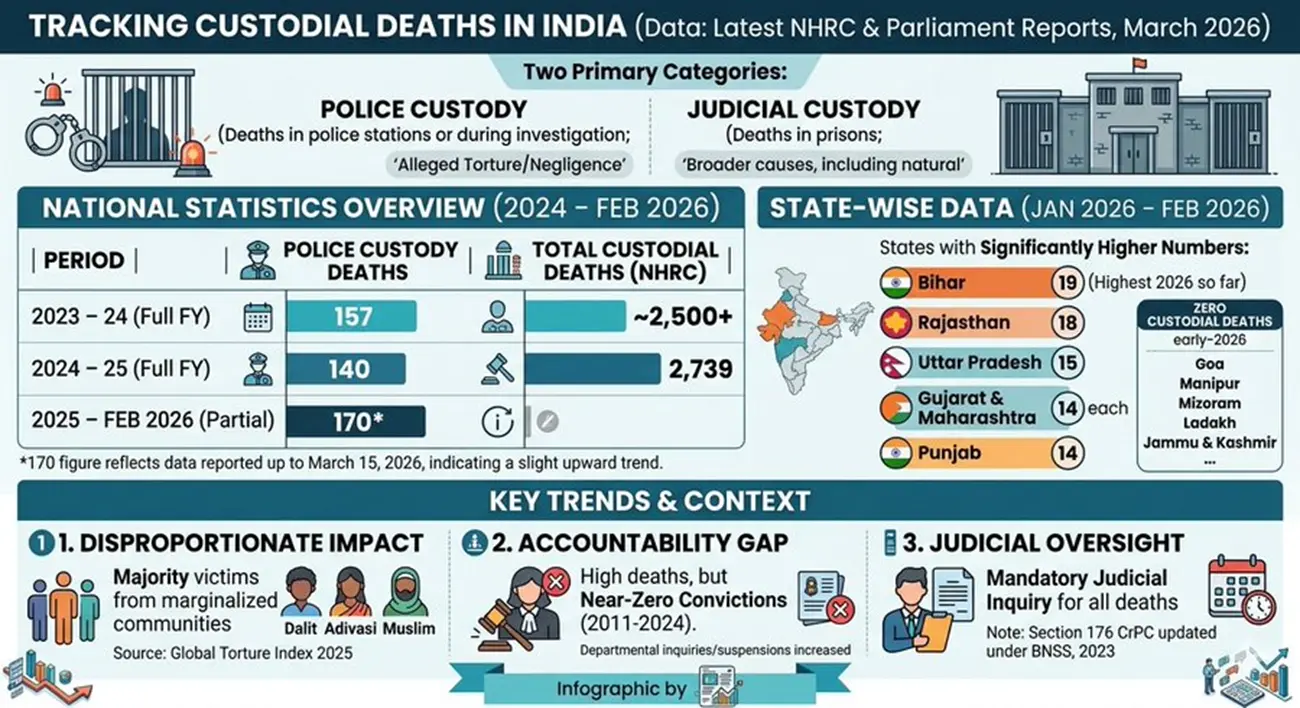
Custodial deaths refer to the death of a person in police or judicial custody. There are broadly two kinds of custodial deaths:
Police Custody Death: Happens during arrest, interrogation, transfer, torture, illegal detention or due to medical negligence.
Judicial Custody Death: Happens inside prisons due to disease, suicide, violence, overcrowding, lack of medical care, psychological stress, etc.
In 2024-25, the total number of cases of custodial deaths was 140, while earlier years recorded 157 cases in 2023-24, 163 in 2022-23, and 176 in 2021-22.
Financial Year | Recorded Custodial Deaths |
2021–22 | 176 |
2022–23 | 163 |
2023–24 | 157 |
2024–25 | 140 |
2025–26 (so far) | 170 |
As of 15th March 2026, 170 custodial death cases have already been reported in 2026 as per data provided by National Human Rights Commission (NHRC) to the Parliament. Additionally it was noted that from 2021-2026, only one case of disciplinary action has been recorded. This marks a sharp rise in such cases and demands a closer look at what causes custodial deaths in the first place.
Add as a preferred Source on Google
Custodial deaths continue to be a significant human rights issue in India and internationally often caused by a mix of systemic failures, outdated laws and abuse of power.
Structural Causes
Structural causes refer to deep-rooted societal and organizational frameworks that allow custodial deaths to happen.
Colonial Era Legacy: The Indian police system is governed by the colonial era law- Police Act of 1861 which enables “policing by fear.”
Vulnerable Groups at risk: As per statistics, a disproportionate number of custodial deaths involve marginalised groups. Societal prejudices lead to harsh treatment and less legal oversight for these groups.
Pressure of efficiency : Immense political pressure and expectation of efficiency by the public at large forces policemen to ‘solve’ cases quickly even if that requires torture, forced confessions or other ‘third-degree’ methods.
Legal Causes
There exist several legal loopholes and procedural delays that impact the administration of justice in such scenarios.
Lack of implementation of Section 176(1A) CrPC: This law mandates a Judicial Magistrate inquiry for every death that occurs in custody. In many cases, these inquiries are either delayed, performed by Executive Magistrates instead or lack forensic accuracy.
Burden of Proof: In cases of torture, the burden of proof lies on the victim and their family. Since the evidence, if there is any, is held in the police station (in control of the accused party), proving their involvement is very difficult.
Lack of Ratification of UNCAT: India signed the United Nations Convention Against Torture (UNCAT) in 1997 but has not ratified it yet.
Protection under Section 197 CrPC: This provision protects public servants- prior government sections are required to prosecute public servants for actions taken in the line of duty. This prevents timely legal action against officers.
Institutional Causes
These are internal operational failures within the police and prison systems that lead to incidents of custodial deaths:
Poor infrastructure: Many lock-ups lack basic amenities, proper ventilation, and 24/7 CCTV surveillance. Overcrowded prisons lead to increased tension and medical neglect.
Lack of Specialized Training: Most police personnel are not trained in ethical and legal techniques of interrogation and negotiation. Without modern skills, physical coercion is the easiest way out.
Intense Workload: Police forces are chronically understaffed leading to extreme stress, long hours and poor living conditions. This impacts their working style and overall mental health, causing irritability and tendency to resort to violence.
Inadequate Medical Oversight: Standard operating procedures require a medical examination of every detainee. In reality, the doctors may be pressured by police to overlook signs of physical abuse in their reports.
The following table enlists the constitutional safeguards that are entrenched in the Indian constitution to prevent custodial violence and legal safeguards that ensure these constitutional rights are not violated in practice:
Feature | Constitutional Safeguards (Supreme Law) | Legal/Statutory Safeguards (CrPC/Evidence Act) |
Core Philosophy | Protection of Fundamental Rights and Human Dignity. | Procedural checks and balances for law enforcement. |
Key Provisions | Article 21: Right to life and dignity; prohibits torture. | Section 176(1A) CrPC: Mandatory Judicial Magistrate inquiry for death in custody. |
Arrest Protocols | Article 22(1): Right to be informed of grounds for arrest and right to a lawyer. | Section 41B CrPC: Mandatory preparation of an 'Arrest Memo' with a witness signature. |
Detention Limits | Article 22(2): Production before a Magistrate within 24 hours is a fundamental right. | Section 57 CrPC: Statutory limit prohibiting detention beyond 24 hours without a warrant. |
Interrogation | Article 20(3): Immunity against self-incrimination (cannot be forced to confess). | Sections 25 & 26 Evidence Act: Confessions to police are inadmissible as evidence in court. |
Health & Safety | Implicit under Article 21 as a facet of "Right to Health." | Section 54 CrPC: Mandatory medical examination of the arrestee by a medical officer. |
Legal Recourse | Article 32 & 226: Right to move Supreme Court or High Courts for "Habeas Corpus." | Section 41D CrPC: Right of the prisoner to consult an advocate during interrogation. |
The Supreme Court has played a fundamental role in shifting focus from police immunity to strong state accountability.
Case Law | Court / Authority | Legal Landmark & Impact |
Nilabati Behera (1993) | Supreme Court | Established Strict Liability; the State must pay compensation for custodial deaths (Article 21). |
D.K. Basu (1997) | Supreme Court | Laid down 11 mandatory guidelines for arrest and detention to prevent "naked" rights violations. |
Prakash Singh (2006) | Supreme Court | Directed the creation of a Police Complaints Authority (PCA) to investigate police misconduct. |
Paramvir Singh (2020) | Supreme Court | Mandated 24/7 CCTV surveillance with night vision/audio in all police stations. |
Sathankulam (2026) | Madurai Sessions Court | Awarded the Death Penalty to police for custodial murder (using the SC's "Rarest of Rare" doctrine). |
Note: While the Sathankulam (2026) verdict is a Sessions Court ruling, it is relevant because it applied the Supreme Court's "Rarest of Rare" doctrine to award the death penalty for custodial murder, signaling a "zero-tolerance" shift towards police accountability.
The transition from colonial-era laws (IPC, CrPC) to the new criminal codes (Bharatiya Nyaya Sanhita - BNS and Bharatiya Nagarik Suraksha Sanhita - BNSS) is framed as a shift from "punishment" to "justice."
Positive impact of the new laws
This transition has brought some positive impact to prevent the long-standing issue of custodial violence:
Feature | Change in BNSS / BNS | Impact on Custodial Safety |
Digitization | Mandatory videography of search/seizure and forensic evidence collection. | Increases transparency; makes it harder for police to fabricate "recoveries" or hide custodial abuse. |
Forensic Mandate | Compulsory forensic investigation for crimes punishable by 7+ years. | Reduces the reliance on "confession-based" (torture-heavy) investigations in favor of science. |
Information Rights | Mandatory provision of progress reports to victims within 90 days. | Enhances accountability; keeps the process under the "public eye" rather than behind closed station doors. |
Zero FIR | Legal recognition of Zero FIRs (reporting crime at any station). | Curbs the colonial practice of police "refusing" to register cases to protect their own or manipulate jurisdictions. |
Critical Oversights
Despite many changes, there is scope for improvement in the laws as given in this table:
Provision / Law | Core Issue & Risk | Required Amendment |
Section 187, BNSS | Allows the 15-day police custody to be spread across the first 40 or 60 days of arrest. This increases the window for prolonged psychological and physical torture. | Revert to a continuous initial 15-day limit or mandate daily judicial oversight for split remands. |
Section 43, BNSS | Legalizes handcuffs for "habitual offenders" and "serious crimes," contradicting Supreme Court rulings that label handcuffing as "inhuman." | Strictly limit handcuffing only to "demonstrable risk of escape" with recorded judicial permission. |
State Immunity | Retains the requirement for prior government sanction to prosecute police officers (formerly Sec 197 CrPC). | Remove the sanction requirement specifically for cases involving custodial death and torture. |
Standalone Law | India still lacks a dedicated Anti-Torture Act despite signing the UN Convention (UNCAT) in 1997. | Enact a specific law that defines torture, criminalizes it, and shifts the burden of proof to the state. |
Medical Oversight | Current laws allow any police officer to request a medical exam, and reports are often perfunctory. | Mandate that exams be conducted by an independent medical board and videographed for all arrests. |
The table below provides international frameworks governing custodial violence and India’s status of adoption/ implementation of these frameworks:
Instrument | Year | Core Focus | India’s Stand |
UN Charter (United Nations Charter) | 1945 | Foundation of the UN; promotion of universal human rights. | Ratified. India is a founding member; Article 51 of the Constitution encourages respect for international law. |
UDHR (Universal Declaration of Human Rights) | 1948 | Prohibits torture (Art. 5) and guarantees presumption of innocence. | Adopted. India was a signatory; its principles are deeply reflected in Part III (Fundamental Rights) of the Constitution. |
ECHR (European Convention on Human Rights) | 1950 | Regional treaty protecting dignity and access to justice. | This is a regional convention for European states; however, Indian courts often cite its jurisprudence. |
ICCPR (International Covenant on Civil and Political Rights) | 1966 | Legally binding protection of life (Art. 6) and dignity in custody. | Ratified (1979). India is legally bound by its provisions, though it has made specific "declarations" regarding certain articles. |
UNCAT (UN Convention Against Torture) | 1984 | Specialized treaty to prevent and punish torture globally. | Signatory (1997) / Not Ratified. India has signed but not yet ratified it due to the lack of a standalone domestic anti-torture law. |
Mandela Rules (UN Standard Minimum Rules for the Treatment of Prisoners) | 2015 | Global "Gold Standard" for humane treatment in prisons/detention. | Supported. While not a treaty, India has integrated several of these rules into the Model Prison Manual (2016). |
Frequently asked question (FAQs)
What is a custodial death?
Which constitutional provisions safeguard against custodial deaths?
What laws deal with custodial violence in India?
What is India’s status on the United Nations Convention Against Torture?
Why are custodial deaths important for UPSC?
Custodial deaths highlight a serious gap between constitutional guarantees under Article 21 and their on-ground enforcement, making them a core concern for GS Paper 2 (Polity & Governance) and Ethics (human dignity, accountability). Despite the transition from Indian Penal Code to Bharatiya Nyaya Sanhita–Bharatiya Nagarik Suraksha Sanhita, the shift from policing “by force" to policing “by law" remains incomplete.






Research methodology
PadhAI's research methodology ensures every article is accurate, UPSC-ready, and beginner-friendly. We curate current affairs analysis based on UPSC exam relevance by cross-referencing The Hindu, Indian Express, and PIB. General Studies (GS) topics are drafted from NCERTs and standard books such as M. Laxmikanth, Spectrum, and GC Leong, then reviewed by subject matter experts to eliminate factual errors. Additionally, we update aspirants with verified government exam notifications alongside expert blogs suggesting the best resources, syllabus, and comprehensive Prelims and Mains strategies.


No comments yet. Be the first to join the discussion!