US Russia Sanctions Bill 2026: Impact on India for UPSC
The US Russia Sanctions Bill, formally the Lindsey O. Graham Sanctioning Russia and Iran Act of 2026, became law on 18 September 2026. It lets Washington impose tariffs of up to 100% on the biggest buyers of Russian oil and gas, and India is one of them. Here is the full UPSC breakdown.

Gajendra Singh Godara
Last updated
5
mins read
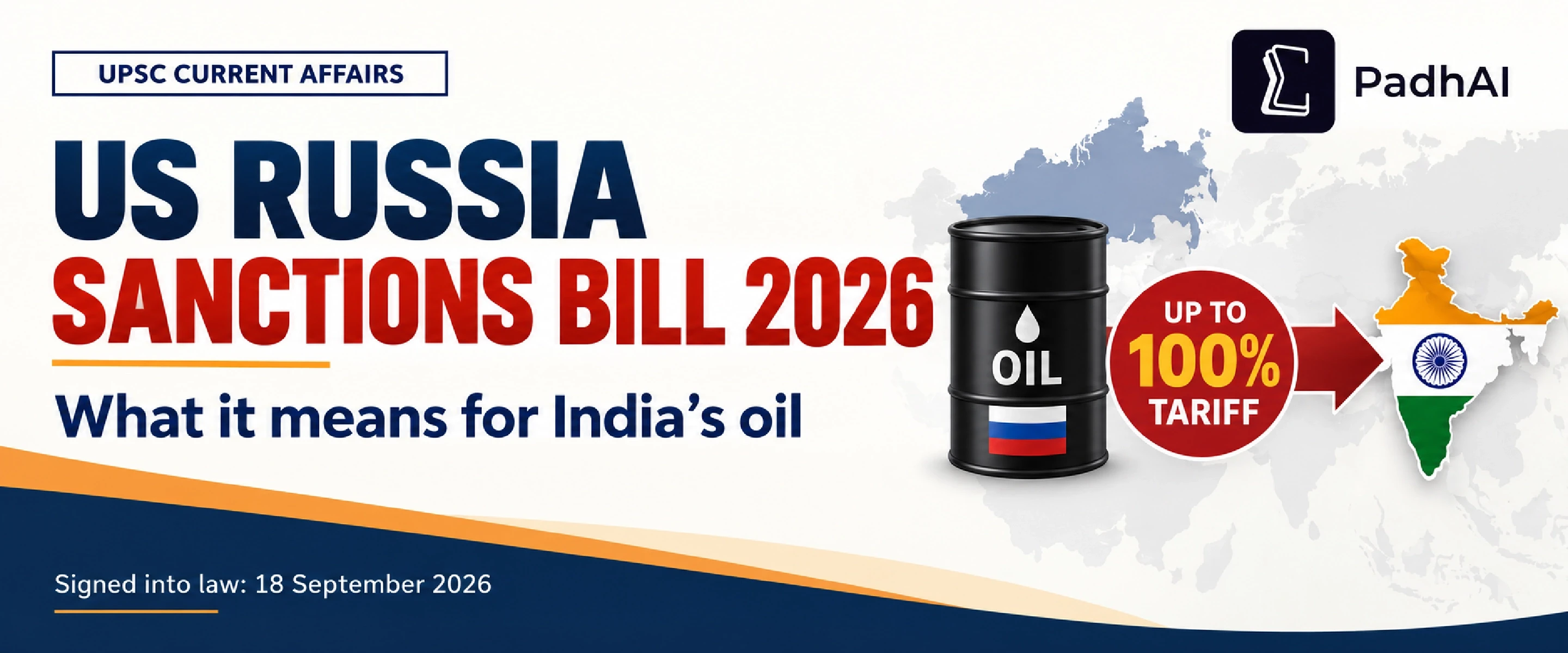
Donald Trump approved the US Russia Sanctions Bill on 18 September 2026. The official title reads the Lindsey O. Graham Sanctioning Russia and Iran Act of 2026 (H.R. 5334).
Goods from top purchasers of Russian gas and oil face tariffs reaching 100%. India gets nearly half of its crude from Moscow. This puts New Delhi directly in the crosshairs.
Top five purchasers of Russian natural gas or crude face tariffs reaching 100%.
Five nations aiding Moscow in bypassing energy restrictions also get targeted.
The legislation penalizes Russian banks, energy companies, officials and the "shadow fleet" of tankers.
Lawmakers extended the Iran Sanctions Act for another five years.
A national interest certification to Congress lets the president grant waivers.
Drafters initially wanted a 500% tariff before dropping it to 100%.
Join our WhatsApp Community
Moscow sold very little crude to New Delhi prior to 2022. Western nations stopped buying Russian oil following the February 2022 Ukraine invasion. Moscow then started offering steep discounts.
Refiners in India accepted those lower prices. Moscow quickly jumped from a marginal player to the number one crude source. It easily beat Saudi Arabia and Iraq.
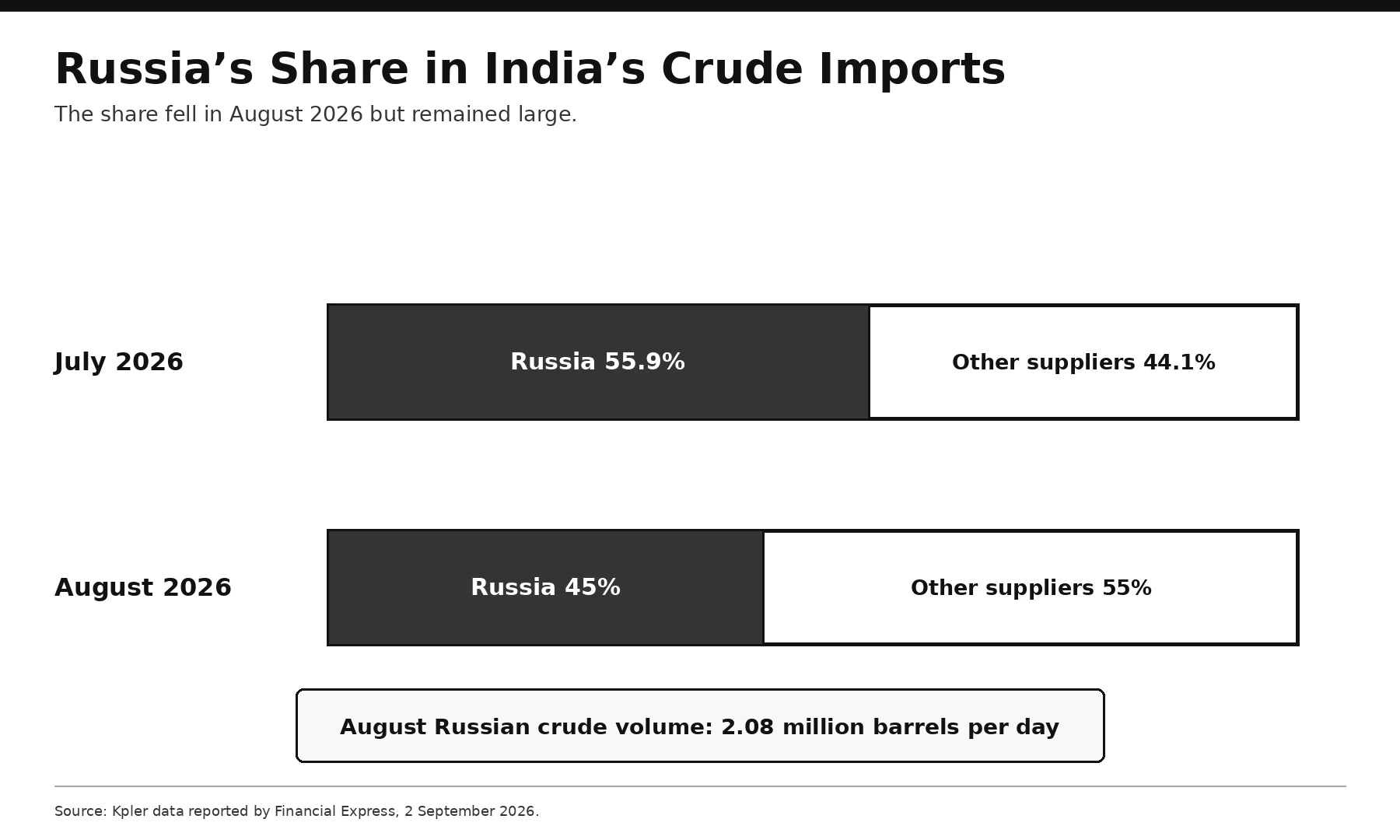
Local reports cite trade tracking data showing 2.08 million barrels per day arrived from Moscow during August 2026. That volume made up roughly 45% of total Indian oil imports. The previous two months actually saw that share cross 50%.
New Delhi buys over 88% of its required crude from abroad. Any nation with that level of dependence needs a steady, cheap supply. It becomes a strategic asset rather than a simple bargain.
Rule | Explanation |
Tariff trigger | Nations ranking in the top five for Russian gas or crude imports over the last 12 months face penalties if they knowingly buy more. |
Tariff ceiling | Goods entering the US can face duties reaching 100%. |
Timeline | The president must take action within 30 days after the law passes. |
Evasion clause | Five nations helping Moscow bypass energy restrictions also fall under the rules. |
Direct sanctions | The law targets shadow fleet vessels, state-linked entities, financial institutions and Russian officials. |
Iran | Lawmakers added five more years to the Iran Sanctions Act. |
Waiver | The president can bypass the rules by sending a written national-interest report to Congress. |
That phrase "up to" carries a lot of weight. The legislation grants authority, yet the actual pain depends entirely on executive choices. Nobody has faced these specific tariffs yet.
Add as a preferred Source on Google
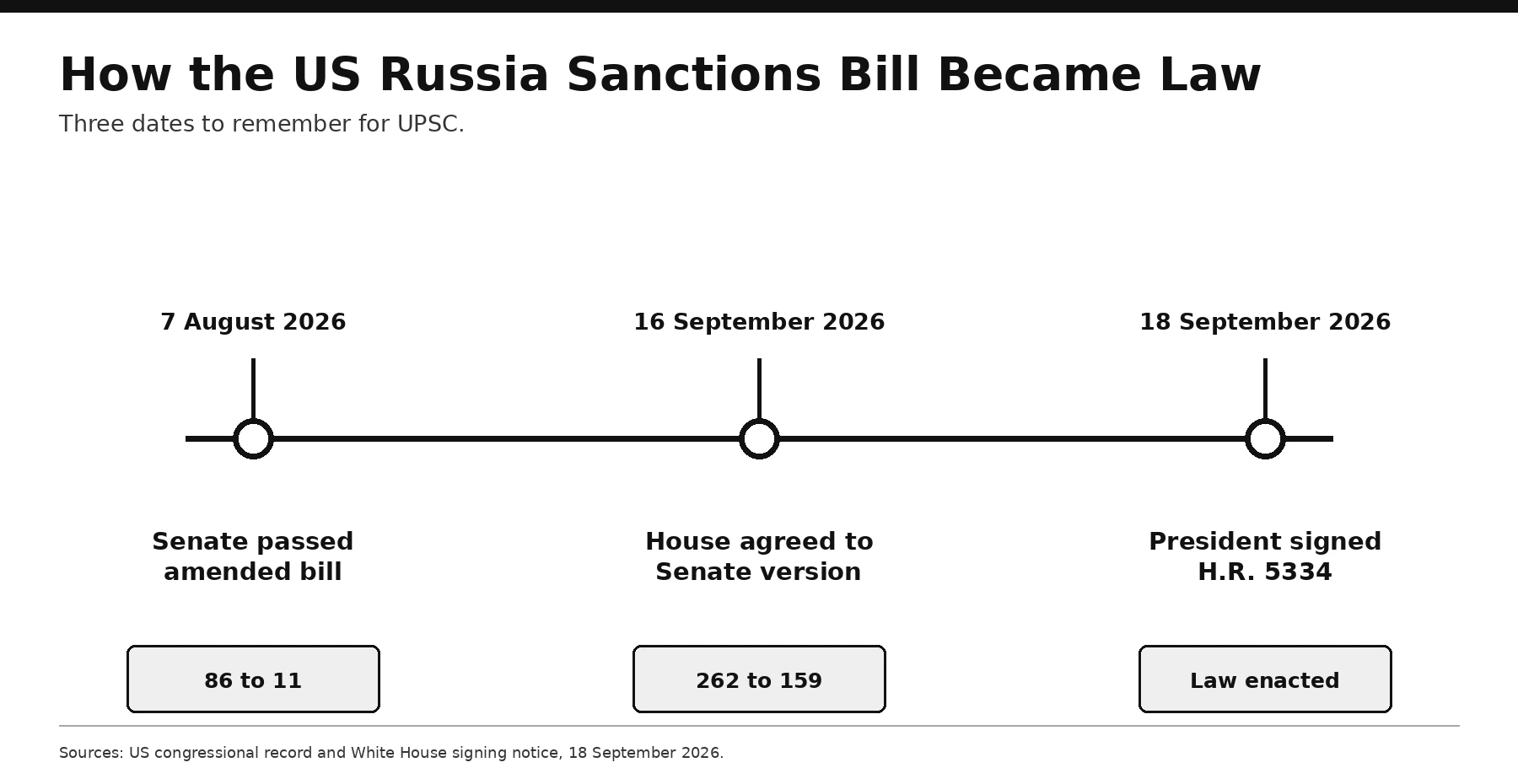
Legislative step | Calendar date | Voting result |
Senate approval with amendments | 7 August 2026 | 86 to 11 |
House acceptance of Senate text | 16 September 2026 | 262 to 159 |
Presidential signature | 18 September 2026 | Enacted |
Senator Richard Blumenthal helped Senator Lindsey Graham draft the original text. Graham died in July 2026, so the final legislation carries his name.
Finding alternatives for two million daily barrels is a huge problem to find alternatives for. West Asian supply lines remain disrupted right now, which complicates energy security.
Higher crude costs inevitably drive up food, manufacturing, fertilizer and transport prices.
This creates direct inflation.Washington gains new leverage for ongoing bilateral trade negotiations. That had triggered an additional 25% tariff on Indian goods from the US in August 2025, on those Russian energy purchases. New Delhi has a strict policy of buying energy only on a national interest basis.
It has refused to apply foreign sanctions lists, so as to preserve its strategic autonomy. Officials of the Ministry of External Affairs assured to get energy from diversified sources. They also communicated their concerns directly to Washington on the new legislation.
UPSC exams frequently test the differences between various types of penalties.
Category | Issuing authority | Does it bind India? |
UN sanctions | UN Security Council acting under Chapter VII, Article 41 of the UN Charter | Yes |
Unilateral sanctions | One individual nation like the US | No, though trading with the US brings penalties |
Secondary sanctions | A nation penalizing third parties dealing with a target | The current legislation fits this definition |
New Delhi dealt with the US CAATSA of 2017 previously. That law threatened penalties because India bought the S-400 system from Moscow.
Students should also link this topic to the Strategic Petroleum Reserves located at Padur, Mangaluru and Visakhapatnam. Indian Strategic Petroleum Reserves Limited manages these facilities, which hold 5.33 million tonnes combined.
American supporters believe oil revenue funds the war in Ukraine. They think cutting off that money forces Moscow to seek peace quickly.
Removing millions of barrels from an already tight market might spike global prices. That outcome would hurt American consumers too.
Certain American analysts note that the Treasury rarely enforces existing penalties. This new authority might just sit idle as well.
Critics argue the rules unfairly target nations like China and India. Meanwhile, other countries continue buying Russian energy through alternative methods.
New Delhi should slowly broaden its suppliers across the Americas, Africa and West Asia.
Diplomats must negotiate a waiver just like they did for previous Iranian penalties.
The government needs to build larger strategic reserves to absorb sudden price spikes.
Officials should separate bilateral trade negotiations from diplomatic energy decisions.
Investing in electric mobility, green hydrogen and biofuels will reduce long-term import reliance.
UPSC Relevance
Exam stage | Relevant topics |
GS Paper 2 | Bilateral ties with the US and Russia, plus how developed nations affect Indian policies |
GS Paper 3 | External trade, inflation and energy security |
Prelims | Article 41 of the UN Charter, SPR locations, CAATSA, the 100% tariff limit and the Act name |
Mains | Economic pressure clashing with strategic autonomy |
Frequently asked question (FAQs)
What is the US Russia Sanctions Bill 2026?
Has any tariff been imposed on India yet?
Why does the Russia Sanctions Bill matter for India?
Can the US President waive these tariffs?
Are US sanctions legally binding on India?
The US Russia Sanctions Bill is now active, yet the actual economic damage remains unclear. New Delhi must now juggle its strategic autonomy, a major trade partner and the need for cheap energy. Keep checking our daily current affairs page for new developments.
Sources: The White House signing notice from 18 September 2026, the US Congress record for H.R. 5334 and reported Ministry of External Affairs statements.
Mains Questions



Research methodology
PadhAI's research methodology ensures every article is accurate, UPSC-ready, and beginner-friendly. We curate current affairs analysis based on UPSC exam relevance by cross-referencing The Hindu, Indian Express, and PIB. General Studies (GS) topics are drafted from NCERTs and standard books such as M. Laxmikanth, Spectrum, and GC Leong, then reviewed by subject matter experts to eliminate factual errors. Additionally, we update aspirants with verified government exam notifications alongside expert blogs suggesting the best resources, syllabus, and comprehensive Prelims and Mains strategies.


No comments yet. Be the first to join the discussion!