World Circular Economy Forum 2026: Theme, India Host

Gajendra Singh Godara
Last updated
8
mins read
Gandhinagar becomes the venue for the World Circular Economy gathering between 15 and 18 September 2026.
This is the first time ever that South Asia is hosting this global event. The official theme of the World Circular Economy is “Circular Economy: Transition for People and Prosperity”. Here is a complete study guide for UPSC with past papers and mock prompts.
The Ministry of Environment, Forest and Climate Change made an announcement on 13 September 2026. Gandhinagar in Gujarat will hold the World Circular Economy Forum (WCEF) 2026 between 15 and 18 September 2026.
South Asia has never seen this event before. Union Minister for Environment, Forest and Climate Change Bhupender Yadav and Gujarat Chief Minister Bhupendrabhai Patel will open the proceedings on 15 September.
Aspirants should pay attention to this specific update. Environment, economy, governance and international cooperation all intersect here. UPSC examiners love to frame questions around such multi-dimensional topics.
Key facts about World Circular Economy 2026
Dates: 15 to 18 September 2026
Venue: Gandhinagar, Gujarat, India
Theme: Circular Economy: Transition for People and Prosperity
First for South Asia: the forum has never been held in this region before
Edition: the tenth edition since the forum began in 2017
Participation: more than 2,000 stakeholders from over 65 countries
Expo: more than 125 national and international exhibitors
Organisers: Central Pollution Control Board, Finnish Innovation Fund Sitra, Government of Finland, Ministry of Environment, Forest and Climate Change, Government of Gujarat and Gujarat Pollution Control Board
Sidelines: the 10 Year Framework of Programmes (10YFP) Board meets in person at Gandhinagar on 15 September
Join our WhatsApp Community
Current economic systems mostly follow a straight path. Humans extract raw materials, manufacture goods, consume them and discard the remnants. Experts label this approach the linear model, also known as "take, make, dispose".
Bending that straight path into a closed loop defines a circular system. Products reaching the end of their useful life get repaired, refurbished, remanufactured or broken down. Those recovered materials then re-enter the manufacturing cycle.
The goal involves keeping resources active for maximum duration while minimizing fresh extraction from the earth.
Environmental protection is not the only advantage here. Recovering one tonne of metal means you skip mining or importing that exact amount. India imports a massive portion of its critical minerals.
This turns resource recovery into a strategic necessity, not just an ecological preference.
Linear Economy vs Circular Economy
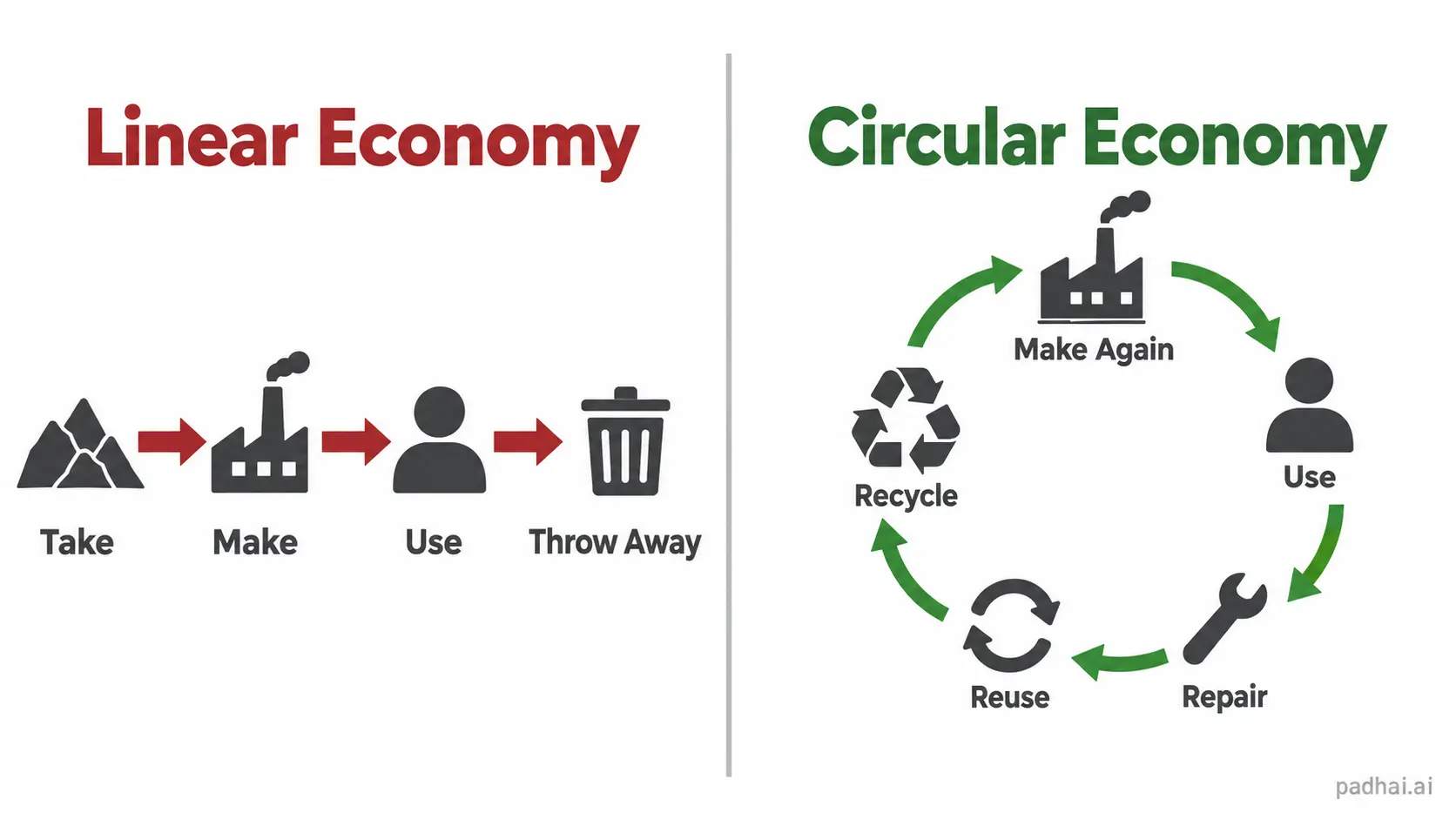
Basis | Linear Economy | Circular Economy |
Core idea | Take, make, dispose | Reduce, reuse, repair, recycle, regenerate |
Material flow | Moves in one direction before hitting a landfill | Returns directly to the manufacturing cycle |
Raw material use | Stays high and constant | Drops because recovered items replace virgin inputs |
Waste | Viewed as an expense to discard | Viewed as an asset holding economic value |
Product design | Built for quick replacement | Built to last and allow easy fixes |
Emissions | Rises due to heavy extraction and processing | Falls because extraction and processing requirements drop |
Employment | Stays mostly within manufacturing plants | Creates new jobs in fixing, refurbishing and recycling |
Memorize these differences carefully. A 2025 Prelims paper already tested candidates on how circularity affects raw material consumption and greenhouse gas output.
That exact question appears further down in this guide.
This annual global gathering focuses entirely on resource loops. Finland and the Finnish Innovation Fund, called Sitra, launched the event in 2017. Since then, organizers have moved the location to a new region nearly every year.
Delegates do not draft binding treaties or negotiate legal rules here. The event functions purely as a collaborative platform.
Representatives from governments, corporations, research institutes, startups and civil groups share successful models and form new alliances.
Real value emerges from the resulting partnerships and pilot projects instead of signed legal documents.
Mains aspirants should compare this event to the World Economic Forum at Davos or the Raisina Dialogue.
Real influence stems from the ability to bring key players together rather than any power to enforce compliance.
World Circular Economy Forum Editions Since 2017
Year | Host City and Country | Notable Point |
2017 | Helsinki, Finland | First edition, about 1,600 participants from nearly 100 countries |
2018 | Yokohama, Japan | Over 1,100 experts, focus on a circular economy by 2050 |
2019 | Helsinki, Finland | Over 2,200 participants, focus on scaling up |
2020 | Online | Held virtually during the pandemic, over 4,200 participants |
2021 | Toronto, Canada | Paired with a separate WCEF+Climate event |
2022 | Kigali, Rwanda | First time in the Global South and in Africa |
2023 | Helsinki, Finland | Over 2,600 people from 155 countries |
2024 | Brussels, Belgium | Attendees from 168 countries |
2025 | São Paulo, Brazil | First time in Latin America, 102 accelerator sessions |
2026 | Gandhinagar, India | First time in South Asia, tenth edition |
This list shows a clear geographic shift. Organizers began in Nordic countries, then expanded into Africa, Latin America, and finally South Asia.
You can use this same trend to reinforce a Mains argument on the Global South demanding more power in environmental governance.
Add as a preferred Source on Google
Analyzing the World Circular Economy theme
"Circular Economy: Transition for People and Prosperity" is the chosen World Circular Economy theme for 2026.
Pay close attention to those specific words. Past events focused mostly on corporate competition and climate targets.
This current phrasing prioritizes human beings. The wording points toward employment, basic incomes and fairness.
Such a focus carries huge weight in a nation where millions survive by gathering and separating trash entirely outside formal labor structures.
This framing provides an excellent opening line for any GS3 or essay response. Domestic debates on resource loops no longer center purely on emission cuts.
The conversation now includes the distribution of wealth generated from reclaimed materials.
How the schedule is organized
Dates | What Happens |
15 to 16 September | Four plenary sessions and 16 parallel thematic sessions |
15 September | Inaugural session, plus the 10YFP Board in-person meeting |
15 to 18 September | Expo with more than 125 national and international exhibitors |
17 to 18 September | Around 80 accelerator sessions organised by global collaborators, online, hybrid and in person |
Those 16 thematic tracks explore artificial intelligence applications, job creation, power generation, financial mechanisms, policy administration, green products, factory solutions, new ventures and young leaders.
Organizers restrict physical entry to invited guests only. Anyone can join the digital broadcasts without paying a fee.
That detail helps if you prefer watching the live feed instead of reading a news recap.
A joint committee handles the 2026 arrangements. Members include the Central Pollution Control Board, the Finnish Innovation Fund Sitra, the Government of Finland, the Ministry of Environment, Forest and Climate Change, the Government of Gujarat and the Gujarat Pollution Control Board.
The opening ceremony will feature more than just the two chief guests. Gujarat's Forest, Environment and Climate Change Minister Arjunbhai Modhwadia, Finland's Ambassador to India Mikko Kivikoski, and Marieke Spijkerboer from the Netherlands' Ministry of Economic Affairs and Climate are also expected to attend.
Delegates from the Board of the 10 Year Framework of Programmes on Sustainable Consumption and Production Patterns will meet physically in Gandhinagar on 15 September.
Examiners love testing minor sidebar details like this one. Participants adopted the 10YFP at the Rio+20 conference to guide global consumption habits.
This framework connects directly to Sustainable Development Goal 12 regarding responsible production.
India recently assumed the Co-Chair position for this specific board. Expect a Prelims question asking which international group India currently co-chairs.
Diplomatic weight. Adding India to a roster featuring Finland, Japan, Canada, Rwanda, Belgium and Brazil sends a clear message.
This move backs the national effort to represent the Global South during climate and resource negotiations.
Market reality. Domestic consumption of steel, cement, plastics and electronics grows faster than almost anywhere else.
Global resource targets fail mathematically if they ignore such a massive buyer. Bringing foreign investors and tech firms to a local city works much better than sending delegations abroad.
Mineral security. The energy transition requires lithium, cobalt, nickel and rare earths. India buys most of these elements from foreign sellers.
Extracting these metals from old batteries and discarded gadgets offers a rapid method to cut that foreign reliance.
NITI Aayog estimates domestic lithium-ion battery demand will jump from roughly 16 GWh in 2023 to nearly 248 GWh by 2035. Those numbers guarantee a massive incoming wave of electronic trash.
Local industry. Gujarat operates heavy chemical plants, textile mills and engineering hubs alongside the Alang ship recycling yard.
Placing the event in this specific state allows officials to showcase active factory floors instead of just presenting theoretical slides.
Most of India's initiatives for promoting circular economy rest on a single legal concept named Extended Producer Responsibility.
People usually abbreviate this term as EPR. Grasping this one concept clears up half the syllabus.
Extended Producer Responsibility Explained
Under EPR, corporate accountability extends far past the cash register. Any business releasing plastic packaging, laptops or batteries into the market must legally guarantee that a specific volume of those items gets collected and processed after consumers discard them.
A certificate market enforces this rule domestically. Approved recycling firms earn EPR certificates by processing trash.
Manufacturers then purchase those certificates to hit their mandatory quotas. The Central Pollution Control Board manages the digital portals handling all registration and trading activity.
Lawmakers issued these regulations under the Environment (Protection) Act, 1986.
That specific statute grants the central government authority to draft environmental rules. Article 48A provides constitutional support by directing the State to safeguard nature.
Article 51A(g) turns environmental protection into a fundamental duty for all citizens. Judges have also interpreted Article 21 to include the right to live in a clean space.
Important Laws and Frameworks
Instrument | Year | What It Does |
Environment (Protection) Act | 1986 | Parent law under which all waste rules are notified |
Plastic Waste Management Rules | 2016 | Basic framework for plastic waste, later strengthened |
Plastic Waste Management Amendment Rules | 2021 and 2022 | Ban on identified single-use plastic items from 1 July 2022, and EPR guidelines for plastic packaging |
Solid Waste Management Rules | 2016 | Segregation at source, processing duties for urban local bodies |
E-Waste (Management) Rules | 2022 | Shifted EPR from collection-based to recycling-based, covering more than 100 categories of electrical and electronic equipment |
Battery Waste Management Rules | 2022 | EPR for all battery types including lithium-ion, with recycled content obligations |
Vehicle scrapping rules under the Motor Vehicles framework | 2021 | Registered Vehicle Scrapping Facilities for end-of-life vehicles |
Steel Scrap Recycling Policy | 2019 | Framework for organised metal scrapping centres |
Mission LiFE (Lifestyle for Environment) | 2022 | Behaviour-side push on mindful consumption |
Draft National Resource Efficiency Policy | 2019 | Proposed a national resource efficiency framework, still at draft stage |
Pay attention to that final row, as most study materials ignore it. People often list the National Resource Efficiency Policy as an active regulation.
Officials only circulated a draft version back in 2019. The government never notified it as a finalized rule. Mentioning the word "draft" in your Mains paper proves you actually check primary sources.
How NITI Aayog Helps
The body established 11 separate committees targeting end-of-life goods and complicated trash categories.
Officials finished 10 sectoral action plans by early 2022 and delivered them to relevant ministries.
A specific Circular Economy Cell started operating in September 2022.
Five specialized working groups formed in mid-2024 to handle old vehicles, discarded tyres, electronic trash, scrap metal and lithium-ion batteries.
Three new reports covering old vehicles, waste tyres and electronic trash arrived in January 2026.
The Environment Ministry announced a unified EPR portal to combine multiple trash categories, though developers are still building it.
You can find related environmental topics in the PadhAI environment section. The PIB summary page also collects these policy updates in a single spot.
Circular Economy in the Global Framework
Framework | Link to Circularity |
SDG 12 | Responsible consumption and production, the closest goal to circularity |
10YFP | Global framework on sustainable consumption and production, India is a Co-Chair of its Board |
Paris Agreement | Lower material extraction means lower emissions, which supports Nationally Determined Contributions |
Basel Convention | Governs transboundary movement of hazardous waste, including plastic waste amendments |
EU Circular Economy Action Plan | The most developed regional circularity policy, a common benchmark in answers |
Global plastics treaty talks | Negotiations under the UN Environment Assembly process are still ongoing without a final agreed text |
Current Domestic Roadblocks
Challenge | What It Means on the Ground |
Informal sector | A very large share of collection and sorting is done by waste pickers with no contracts, safety gear or social security |
Weak segregation | Mixed household waste lowers the value of everything recovered from it |
Thin markets for recycled material | Buyers still prefer virgin material, so recyclers face unstable demand |
Quality and standards | Limited standards for secondary raw materials make industrial buyers cautious |
Enforcement gaps | Rules exist on paper, but state pollution control boards are short on staff and testing capacity |
Financing | Recycling plants need heavy upfront capital, and small firms struggle to raise it |
Consumer behaviour | Refurbished goods still carry a stigma of being second best |
Arguments Against the Trend
Examiners give extra marks when you include valid counter-arguments.
Talking shops. This event generates declarations rather than binding legal commitments. Skeptics point out that ten years of similar meetings have failed to slow down global resource extraction.
Harming the poor. Shifting recycling work into massive corporate plants threatens independent trash collectors.
Those workers lose their income unless companies actively hire them. The 2026 focus on human prosperity directly answers this complaint, though actual results depend entirely on execution.
Paper compliance. Trading certificates do not equal actual recycling. The EPR market only functions when those certificates represent physically processed goods.
Poor oversight allows companies to buy their way to compliance while trash still rots in open dumps.
Hierarchy placement. Recycling is not the absolute best choice. Cutting consumption and making products last longer sit much higher on the waste hierarchy.
Policies celebrating high recycling volumes might accidentally encourage people to buy more stuff.
Border issues. Nations restrict scrap imports and apply conflicting quality standards. These trade barriers make international supply chains much harder to operate than textbook models suggest.
Steps to Fix the Gaps
Integrate independent collectors through official registration, ID cards, protective gear and fixed buy-back rates. This method guarantees formalization boosts their earnings instead of destroying them.
Build actual market demand by mandating minimum recycled content for government purchases and specific commercial goods.
Audit the EPR certificate market using strict traceability rules and surprise physical inspections.
Release clear quality standards for secondary materials so factories can confidently purchase recovered plastic, paper and metal.
Back the repair industry by cutting taxes on fix-it services, passing right to repair laws and guaranteeing spare part availability.
Treat mineral recovery from old electronics as a vital national security objective instead of a simple garbage problem.
Increase funding, hire more staff and build better laboratories for state pollution control boards, since they handle almost all enforcement duties.
UPSC Relevance: Where This Topic Fits
Exam Stage | How It Can Be Asked |
Prelims | Theme of WCEF 2026, host city, organisers, Sitra, 10YFP, SDG 12, which rules carry EPR |
GS Paper 2 | India's role in international groupings and its positioning on the Global South |
GS Paper 3 | Environmental pollution and degradation, conservation, resource efficiency, growth and development |
Essay | Sustainable development, growth versus environment, technology and responsible consumption |
Interview | Why India is hosting, what Gujarat brings to it, how waste pickers fit into formal recycling |
Memorize these specific Prelims details. The event started in 2017 as a Finnish project managed by Sitra. Gandhinagar hosts the 2026 edition using the "Circular Economy: Transition for People and Prosperity" theme.
This marks the first South Asian appearance and lines up with a 10YFP Board meeting where India holds a Co-Chair seat.
You can find model questions on resource use in the GS Paper 3 answer writing section. That page also features a prompt about India's climate commitments under the Paris Agreement.
Frequently asked question (FAQs)
Where is the World Circular Economy Forum 2026 being held?
What is the World Circular Economy theme for 2026?
Who organises the World Circular Economy Forum?
What are India's initiatives for promoting a circular economy?
How can I use this topic in a UPSC answer?
Prelims Questions
Mains Questions


Research methodology
PadhAI's research methodology ensures every article is accurate, UPSC-ready, and beginner-friendly. We curate current affairs analysis based on UPSC exam relevance by cross-referencing The Hindu, Indian Express, and PIB. General Studies (GS) topics are drafted from NCERTs and standard books such as M. Laxmikanth, Spectrum, and GC Leong, then reviewed by subject matter experts to eliminate factual errors. Additionally, we update aspirants with verified government exam notifications alongside expert blogs suggesting the best resources, syllabus, and comprehensive Prelims and Mains strategies.


No comments yet. Be the first to join the discussion!