India-Uzbekistan Ties and Uranium Deal for UPSC
India and Uzbekistan have upgraded their partnership and set a USD 5 billion trade goal for 2030. For UPSC, the news links Central Asia, nuclear energy, connectivity, the SCO and India's multi-alignment.
Last updated
6
mins read
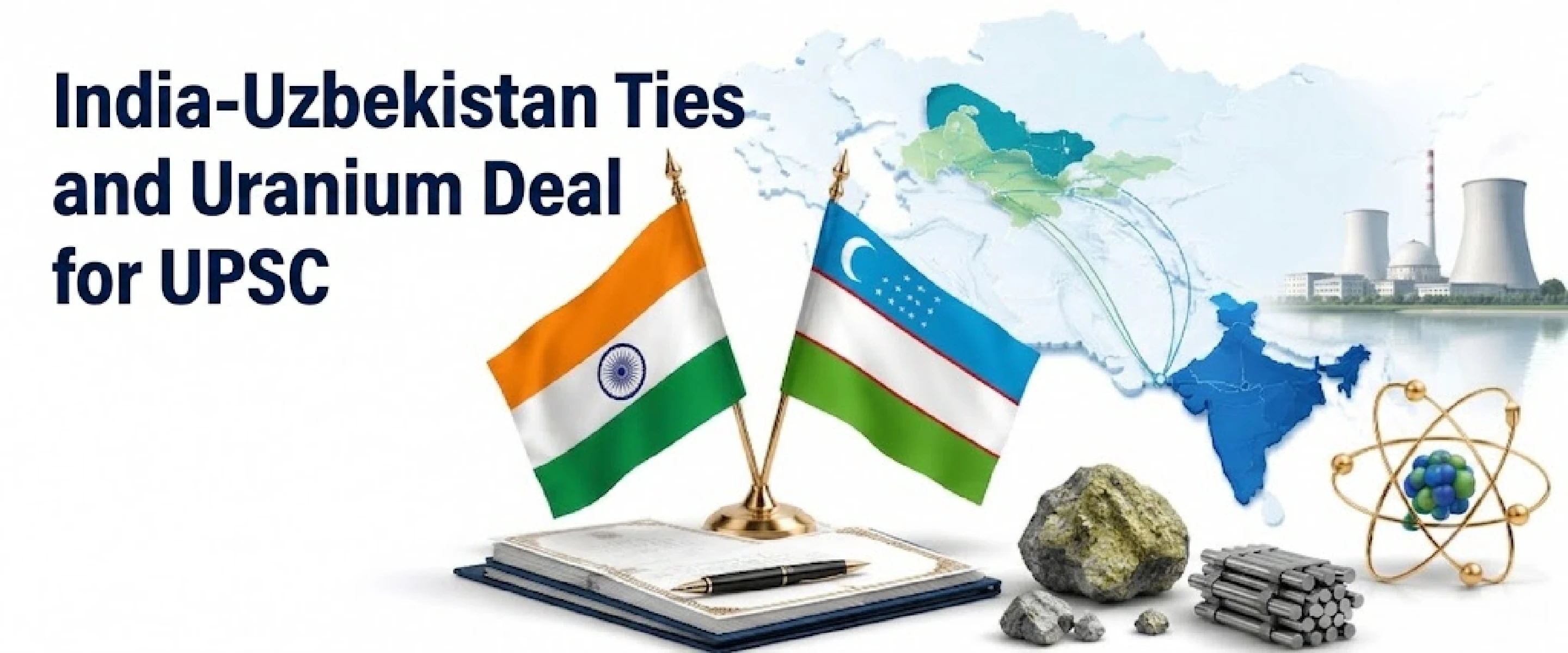
Tashkent, 30 August 2026: India and Uzbekistan elevated their Strategic Partnership to a Comprehensive Strategic Partnership during Prime Minister Narendra Modi's State Visit to Uzbekistan on 29-30 August 2026.
The two sides agreed to aim for USD 5 billion in bilateral trade by 2030.
India also noted progress on a long-term arrangement for uranium supply from Uzbekistan.
The official statements do not disclose the quantity, price, duration or delivery schedule of this arrangement. That detail is pending in the public domain.
Key Highlights
India-Uzbekistan relations now have the status of a Comprehensive Strategic Partnership.
The official trade target is USD 5 billion by 2030.
Uranium cooperation matters for India's energy security, but its commercial terms are not public.
The news is best studied through Central Asia, connectivity, the SCO, critical minerals and counter-terrorism.
India established diplomatic relations with Uzbekistan on 18 March 1992 and declared a Strategic Partnership in 2011. Uzbekistan connects India's economic, security and cultural interests in Central Asia.
For Prelims, locate Uzbekistan in Central Asia. It is a landlocked country and shares borders with Kazakhstan, Kyrgyzstan, Tajikistan, Afghanistan and Turkmenistan. Its capital is Tashkent. Tashkent also hosts the Regional Anti-Terrorist Structure of the Shanghai Cooperation Organisation.
For a quick map revision, add an internal link here: UPSC world maps
Join our WhatsApp Community
The headline matters, but the wider agenda matters more for UPSC. The joint statement covered trade, transport, digital technology, critical minerals, peaceful nuclear energy, defence, counter-terrorism, health, education and culture.
Area | Official outcome | UPSC connection |
Political ties | Partnership elevated to Comprehensive Strategic Partnership | India's bilateral diplomacy in Central Asia |
Trade | USD 5 billion target by 2030 | Trade diversification and market access |
Uranium | Progress on a long-term supply arrangement | Energy security and peaceful nuclear energy |
Minerals | Cooperation in geology, mining, processing and value chains | Critical minerals and supply-chain resilience |
Security | Continued counter-terror and defence cooperation | GS 2 and internal security linkages |
Connectivity | Multimodal routes and logistics corridors | Landlocked Central Asia and transit constraints |
Digital cooperation | IT, AI, space and cybersecurity cooperation | Digital public infrastructure and technology diplomacy |
The leaders also decided to create a Foreign Ministers-led mechanism to follow up bilateral agreements and priority projects.
The Inter-Governmental Commission on trade and economic cooperation is to be raised to ministerial level.
Uranium is a key material in the nuclear fuel cycle. India needs a reliable supply of nuclear fuel for its civilian nuclear power programme.
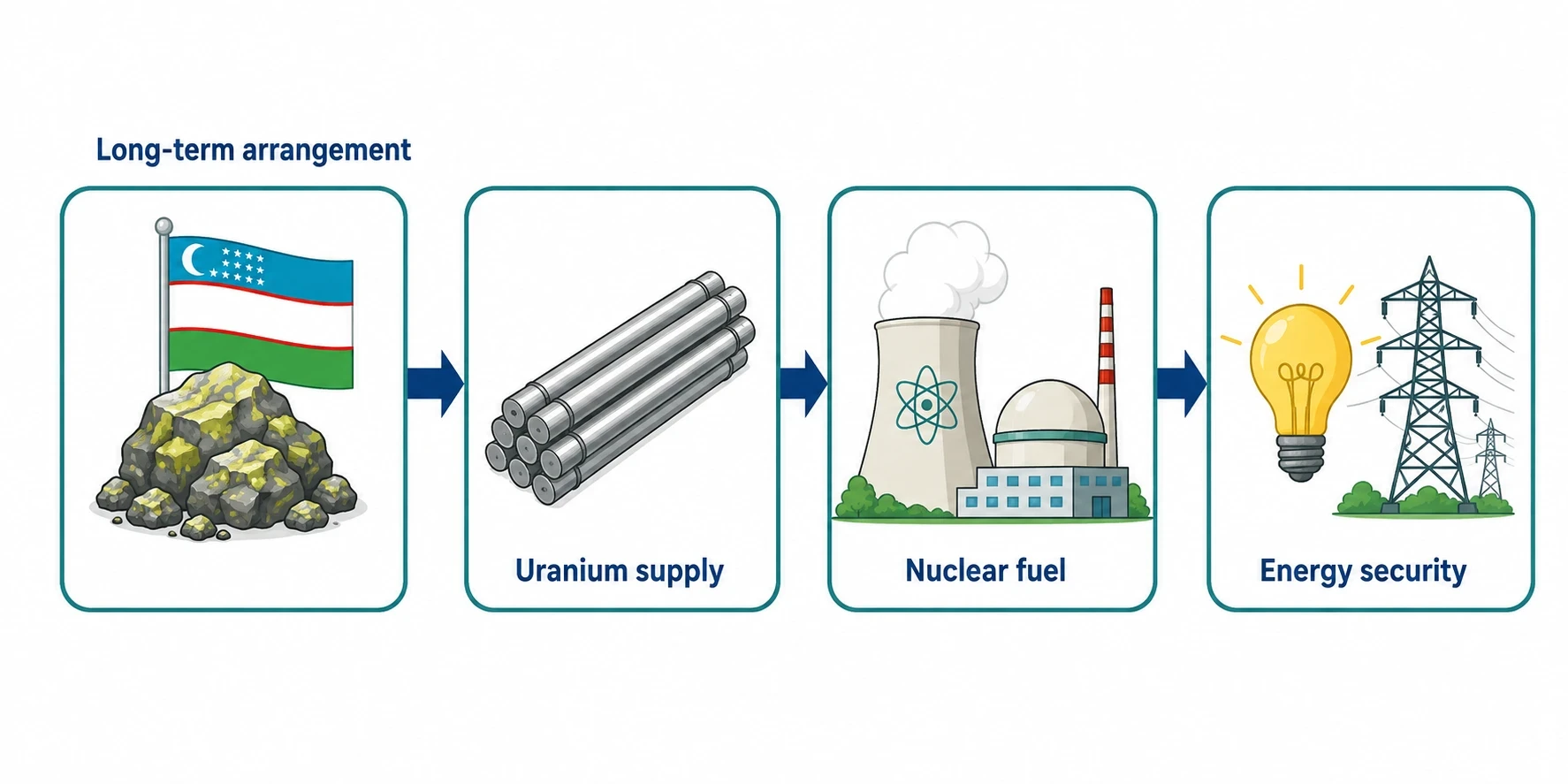
A long-term supply arrangement can reduce uncertainty in fuel procurement, but it does not by itself create a nuclear power plant or transfer reactor technology.
The joint statement separately records interest in wider cooperation on peaceful uses of nuclear energy. It does not publish contractual details. Do not write an unverified value, volume or time period in an answer.
At the June 2026 India-Uzbekistan Inter-Governmental Commission meeting, both sides identified critical minerals as an important area for energy cooperation.
UPSC nuance: Uranium is a strategic mineral for civilian nuclear energy. It should not be confused with a nuclear weapons agreement. India remains committed to the peaceful use of nuclear energy in this bilateral framework.
Add as a preferred Source on Google
India-Uzbekistan relations are part of India's Central Asia policy. The region matters for four practical reasons.
Security and Afghanistan
Central Asia is close to Afghanistan and faces concerns related to terrorism, extremism, drug trafficking and organised crime. India and Uzbekistan reaffirmed counter-terror, intelligence and law-enforcement cooperation.
Connectivity
India has no direct land border with Central Asia. This makes transport routes costly. Agreements need viable transport, banking and payment channels to become trade.
Energy and minerals
The region offers scope for cooperation on uranium, renewable energy and critical minerals. India gains by diversifying sources.
Trade and people-to-people ties
Uzbekistan reported bilateral trade with India at USD 1.3 billion in 2025. The USD 5 billion target will depend on dealing with non-tariff barriers, market access, logistics and payments.
The Shanghai Cooperation Organisation is a Eurasian regional grouping. Uzbekistan is a founding member, while India became a full member in 2017.
It gives India a forum to engage Central Asian states, Russia and China on security, connectivity and terrorism.
One high-value fact: the SCO's Regional Anti-Terrorist Structure, or RATS, is located in Tashkent.
Its formal mandate is to assist member states in coordinating action against terrorism, separatism and extremism.
This makes Uzbekistan especially relevant in questions on regional security architecture.
Exam area | What to prepare |
GS Paper 2 | India and its neighbourhood, bilateral relations, regional groupings and agreements affecting India's interests |
GS Paper 3 | Energy security, critical minerals, supply chains, terrorism and technology |
Prelims | Uzbekistan's location and capital, SCO, RATS headquarters, Central Asian countries, uranium as reactor fuel |
Mains | Assess India's Central Asia policy through security, connectivity, trade and energy diversification |
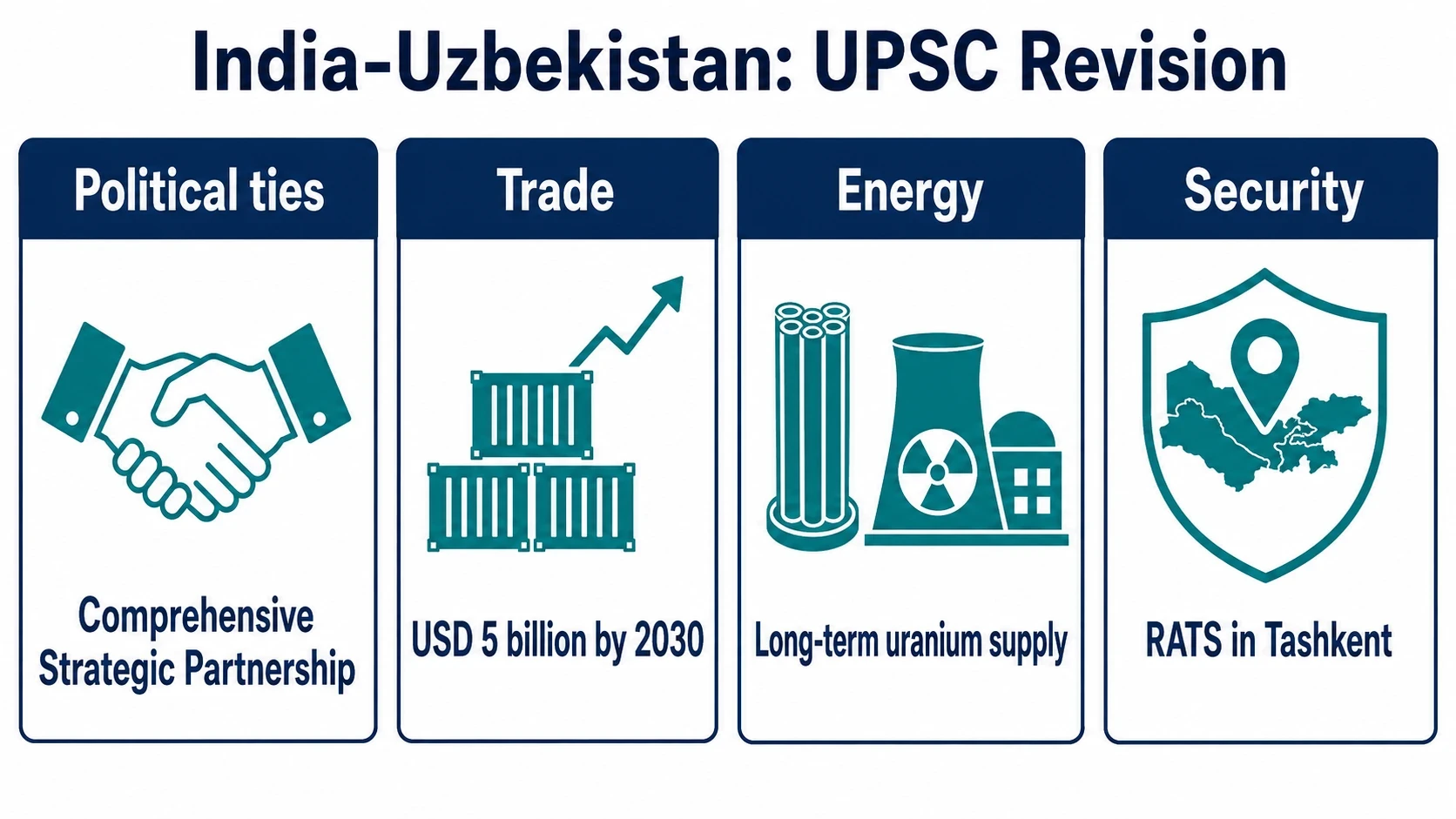
Prelims revision: Central Asian republics are Kazakhstan, Kyrgyzstan, Tajikistan, Turkmenistan and Uzbekistan. Revise the SCO separately: its Regional Anti-Terrorist Structure is in Tashkent and deals with cooperation against terrorism, separatism and extremism.
The announcements are useful, but a good UPSC answer should not treat targets as achievements.
Central Asia is landlocked and India lacks a direct overland route. The trade target is much higher than the present trade base, so payments, market access and logistics need practical solutions. China and Russia already have large strategic and economic roles in the region.
India should build reliable niche partnerships rather than promise more than it can deliver.
The uranium arrangement also needs careful public communication. Since the official sources have not disclosed commercial terms, the correct approach is to recognise its strategic value while avoiding claims about its scale.
India should focus on workable transport links, pharmaceuticals and digital services, technology partnerships and counter-terror cooperation.
The Foreign Ministers-led mechanism should review a short list of projects with clear timelines.
India should use the India-Central Asia format and the SCO for wider engagement, while bilateral projects move through identified agencies, financing and viable routes.
Frequently asked question (FAQs)
What changed in India-Uzbekistan relations in August 2026?
Did India and Uzbekistan sign a uranium deal?
What is the India-Uzbekistan trade target?
Why is Uzbekistan important for the SCO?
Which GS papers can include this topic?
Prelims Questions
Mains Questions



Research methodology
PadhAI's research methodology ensures every article is accurate, UPSC-ready, and beginner-friendly. We curate current affairs analysis based on UPSC exam relevance by cross-referencing The Hindu, Indian Express, and PIB. General Studies (GS) topics are drafted from NCERTs and standard books such as M. Laxmikanth, Spectrum, and GC Leong, then reviewed by subject matter experts to eliminate factual errors. Additionally, we update aspirants with verified government exam notifications alongside expert blogs suggesting the best resources, syllabus, and comprehensive Prelims and Mains strategies.


No comments yet. Be the first to join the discussion!