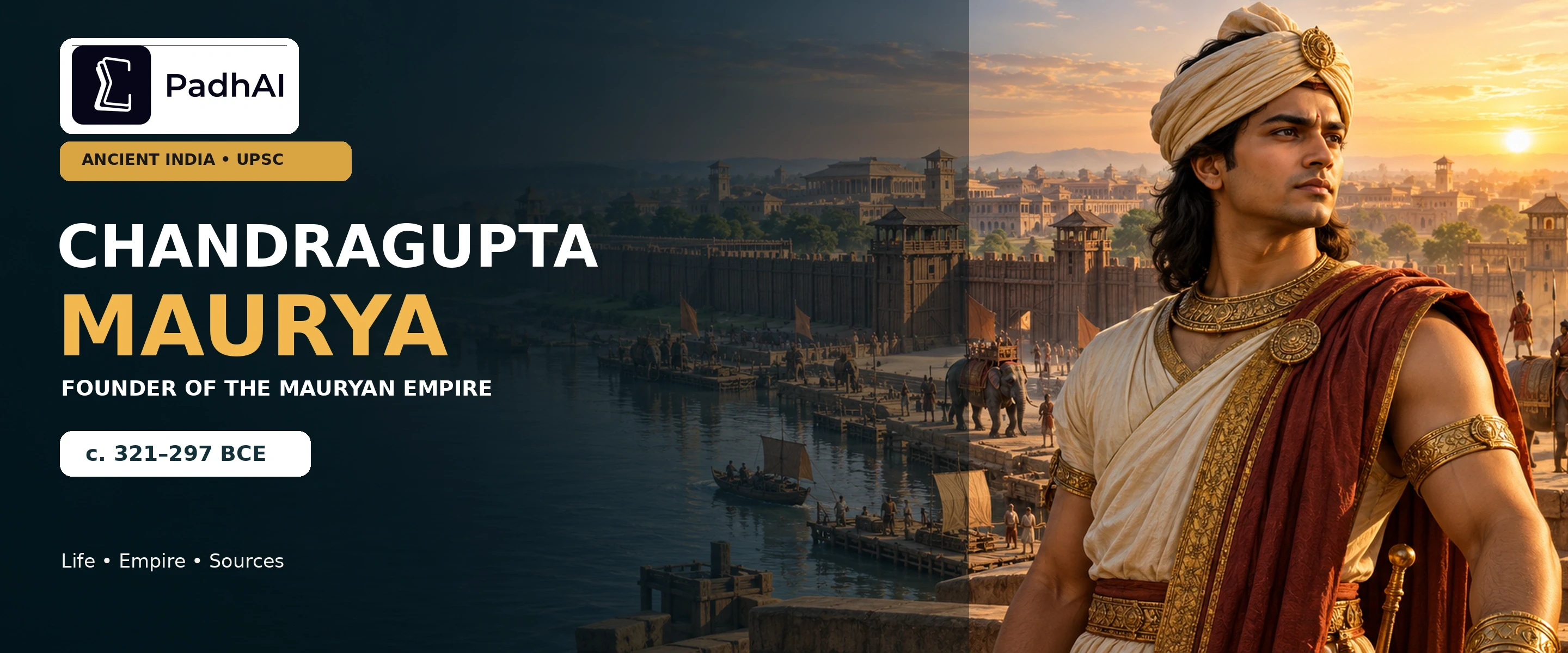
Chandragupta Maurya: Founder of the Mauryan Empire
Chandragupta Maurya founded India's first empire around 321 BCE, checked the territorial ambitions of Alexander the Great's successor, and ended his life devoted to ritual fasting as a Jain ascetic. Much of what circulates today about his paternal lineage and his wives comes from 12th-century medieval accounts or recent television dramas. This guide separates evidence supported by documentary sources from later fabrications.

Gajendra Singh Godara
Last updated
12
mins read
Reign: c. 321 to 297 BC; established the Maurya dynasty.
Guide and strategist: Chanakya, also called Kautilya or Vishnugupta.
Imperial capital: Pataliputra, consolidated after overthrowing Dhana Nanda in Magadha.
He contained Seleucus I Nicator around 305-303 BC, incorporating four western satrapies into his orbit.
Heir: his son Bindusara, who assumed the dynastic succession.
Death: occurred around 297 BC in Shravanabelagola, according to the Jain precept of the sallekhana.
Join our WhatsApp Community
Chandragupta Maurya established the Mauryan Empire, the first political entity to unify most of the Indian subcontinent under a single system of government.
He ruled from approximately 321 to 297 BCE from his capital at Pataliputra, present-day Patna.
He established the first continental Indian empire. Before his rise to power, the northern Indian peninsula consisted of a patchwork of rival states (mahajanapadas) among which the kingdom of Magadha stood out.
Following his campaigns, a unified administration was established, stretching from the mountains of Afghanistan to the lowlands of Bengal, a territorial structure the dynasty maintained for 136 years.
It halted the Hellenistic advance. Around 305 BC, Seleucus Nicator, the eastern successor of Alexander the Great, marched toward the Indus River basin with the intention of recovering the lost provinces.
The conflict concluded with a peaceful agreement favorable to the Indian monarch, which permanently established India's northwestern border for a century.
He is the most complex Mauryan figure to trace. Unlike his grandson Ashoka, who bequeathed to the world dozens of inscriptions containing his own reflections on governance, Chandragupta left no edicts in his own voice.
What we know of him comes from fragments of Greek chroniclers, religious traditions written several centuries later, and Puranic genealogies.
Accurately distinguishing historical fact from legendary embellishment represents the true challenge of this period, an area where most popular textbooks fail.

Appearance | Historical detail |
Government period | c. 321 to 297 BC. C. |
Birth | c. 340 BC; geographical location debated |
Dynasty founded | Maurya |
Intellectual mentor | Chanakya (Kautilya, Vishnugupta) |
Deposed Monarch | Dhana Nanda, of the Nanda Dynasty |
Capital of the kingdom | Pataliputra |
Hellenic interlocutor | Seleuchus I Nicator |
Greek ambassador to his court | Megasthenes, author of the Indica |
Son and successor to the throne | Bindusara |
Final religious affiliation | Jainism |
Death | c. 297 BC, Shravanabelagola (Karnataka) |
Add as a preferred Source on Google
This question is among the most frequently asked about his biography, although the documented historical answer is far from conclusive.
No reliable contemporary testimony preserves the name of Chandragupta's father. Traditions differ substantially from one another, and the names circulating on the internet come, for the most part, from fictional television adaptations.
Documentary tradition | Version about his origin and ancestry |
Buddhist (Mahavamsa, Mahavamsa-tika) | He associates it with the Kshatriya clan of the Moriya, based in Pipphalivana |
Jainist (Parishishtaparvan) | Describes him as the son of a sovereign deposed by a usurper, raised by a rural foster family |
Brahmanic (Puranas, Mudrarakshasa) | It attributes to him a modest birth, linking him to lineages of shudra status |
Greek (Justin, Plutarch) | Refers to a humble social background, without providing the names of parents |
The story about "Mura" is a folk etymology without critical foundation. It is often claimed that his mother was named Mura and that the patronymic "Maurya" derives from her name.
Historical linguistics and philology dismiss this explanation; the most plausible origin points to the Moriya clan, widely attested in Buddhist texts in Pali.
Television scripts are not historical sources. Certain fictional series have given their progenitors names like Chandravardhan, Suryagupta, or Moora.
These are narrative liberties devised for dramatic entertainment that lack any basis in ancient manuscripts and should never be included in academic work.
The rigorous formulation: Chandragupta's origins are a subject of open disagreement among Buddhist, Jain, Brahmanic, and Hellenic traditions.
The two main currents contrast his membership in the Kshatriya clan of the Moriya with a modest Shudra origin. Clearly presenting this contrast reflects a genuine understanding of the historiographical debate.
Chandragupta Maurya's teacher and advisor was Chanakya, also remembered as Kautilya and Vishnugupta, a Brahmin teacher and thinker linked to the intellectual center of Taxila.
Historical accounts relate that Chanakya suffered a public affront at the Nanda court, swore revenge against the ruling dynasty, recognized the talents of the young Chandragupta, and devised the plan to overthrow the monarchs of Magadha.
Chandragupta provided the tactical military expertise on the ground; Chanakya conceived the overall strategy and subsequently assumed the position of imperial prime minister.
A necessary critical caveat: there is no contemporary documentary evidence about Chanakya.
All biographical information about his life comes from legendary Buddhist, Jain, and Brahmanic texts established centuries later, as well as from Vishakhadatta's theatrical drama Mudrarakshasa, which historical criticism recognizes as having aesthetic rather than documentary value.
This circumstance does not deny its historical existence, but it requires treating the stories surrounding it as a living tradition of thought, not as notarial records of the time.
The Arthashastra treatise is attributed to him by canonical inheritance. However, the text that has come down to us contains successive additions and corrections, leading most scholars to define it as a work composed over several generations.
A rigorous examination should characterize it as a normative manual on the exercise of power, and not as a descriptive chronicle of Chandragupta's daily rule.
The historical moment favored the success of the insurrection. Alexander the Great retreated westward in 325 BC and died in 323 BC, leaving the Greek garrisons of the northwest defenseless and in conflict.
At the same time, Dhana Nanda ruled in Magadha, whom ancient accounts unanimously portray as an immensely wealthy monarch but reviled by his own subjects.
In his first attempt, Chandragupta launched a frontal offensive against the heart of Magadha and suffered a severe military defeat.
Popular tradition preserves the famous anecdote of the leader overhearing a mother scolding her son for eating a hot cake by biting into the burning center instead of starting with the warm edges; from this, he supposedly deduced the wisdom of subduing the border provinces first before striking the kingdom's nerve center.
Regardless of its anecdotal veracity, the fable faithfully illustrates the geopolitical maneuver he carried out.
Around 321 BCE, his forces captured Pataliputra, ending Nanda hegemony. This event marks the birth of the Mauryan Empire and the beginning of a unified imperial experience in India.

The borders secured by Chandragupta reached immense dimensions long before Ashoka's later annexations:
Cardinal point | Limit reached |
North | The foothills of the Himalayas |
Northwest | Beyond the Hindu Kush, encompassing eastern Afghanistan and Balochistan |
East | The plains of Bengal |
West | The regions of Saurashtra and Gujarat |
South | He ventured into the Karnataka plateau |
Outside its orbit | The kingdom of Kalinga and the Tamil domains of the far south |
The documentation relating to the western frontier is remarkably strong. The Junagadh rock inscription of the Saka ruler Rudradaman I, carved around 150 CE, commemorates the construction of the Sudarshana Lake reservoir in Saurashtra during the reign of Chandragupta under the direction of his regional governor, Pushyagupta, and its later remodeling during the time of Ashoka.
An inscription carved by a foreign dynasty detailing Mauryan public works carried out four centuries earlier constitutes a classic chain of evidence in UPSC history.
Between 305 and 303 BC approximately, Seleucus I Nicator advanced eastward to restore Alexander's Asian possessions, finding the pass blocked by Chandragupta's forces.
It is advisable to avoid using the verb "defeated." No contemporary source describes a crushing victory. The records attest to a negotiated agreement with clauses largely favorable to Chandragupta, suggesting that Seleucus deemed his military position untenable and preferred to negotiate.
Describing the event by stating that the Indian monarch "contained Seleucus" or "reached an advantageous agreement with him" is more accurate and rigorous.
The agreed conditions:
Concessions obtained by Chandragupta | Considerations received by Seleucus |
Aracosia (around Kandahar) | 500 war elephants |
Gedrosia (Baluchistan) | A marriage alliance (epigamy) |
Paropamisada (Kabul region) | No other territorial compensation |
Aria (Herat area) | No other territorial compensation |
The weight of those pachyderms was considerable: Seleucus used them decisively in the decisive Battle of Ipsus in 301 BC, a contest that determined the division of the Hellenistic world.
The pact also prompted Megasthenes' journey to Pataliputra as the official Seleucid ambassador. His treatise, the Indica, is known only through fragments scattered throughout later Greek and Roman works; nevertheless, it provides the most revealing foreign testimony about urban life, the government of the six civic committees, the standing army, and his flawed description of the seven social classes, an interpretive misunderstanding of indigenous social reality on the part of the foreign diplomat.
Chandragupta's Family: Wife and Children
This chapter is rife with errors in its explanation, therefore requiring careful critical examination:
The documented heir
Bindusara, who succeeded his father around 297 BCE and reigned until around 273 BCE, is fully documented in Buddhist, Jain, and Greek sources.
Classical authors refer to him as Amitrocates, a phonetic adaptation of the Sanskrit Amitraghata ("destroyer of enemies"). The figure of Chandragupta's son is the only piece of information about the family circle that is free from documentary controversy.
The Wife's Identity and the Fragility of the Traditional Narrative
The name that is repeated almost universally in popular publications is Durdhara. It is important to keep in mind three historiographical points:
1. It appears in only one very late source. It is found exclusively in the Parishishtaparvan of Hemachandra, a Jain text from the 12th century CE, written approximately 1,600 years after the death of Chandragupta. The figure of Durdhara lacks documentary corroboration outside of this medieval testimony, and Burmese and Sri Lankan Buddhist chronicles completely ignore it.
2. The Jain narrative itself omits her name at the time of the betrothal. The narrative records the monarch's marriage to the daughter of a Nanda king without baptizing her, and only in later passages does it attribute to her the name Durdhara as the mother of Bindusara.
3. Extended versions originate from television. Several dramatic series have presented Durdhara either as the daughter or the sister of Dhana Nanda, inventing a Greek princess named Helen, supposedly a descendant of Seleucus. Helen is a fictional television character. Greek texts briefly record a marriage alliance (epigamy), without identifying the bride.
Furthermore, the chronology contradicts the account: Bindusara was born around the time of the treaty with Seleucus, which completely rules out the possibility that a Seleucid noblewoman could be her biological mother.
How to present this in an exam: Late Jain tradition identifies their queen as Durdhara and attributes to her the motherhood of Bindusara; Greek sources record a marriage pact with Seleucus without mentioning proper names. Any further assertion belongs to the realm of literary dramatization.
The Legend of Bindusara's Birth
Buddhist and Jain chronicles share the same etymological explanation for the successor's name: Chanakya administered microscopic doses of poison to the sovereign to immunize him against assassination attempts.
Unbeknownst to him, Chandragupta one day shared his meal with the pregnant queen, who collapsed from the poison.
To save the heir's life, Chanakya surgically operated on the mother's womb, at which point a drop of poison (bindu) touched the unborn child's forehead, marking him forever.
The episode has an indisputable legendary value and should be presented as such, reflecting the symbolic reason why collective memory fixed the prince's name.
Administrative Organization in the Time of Chandragupta
The overall organic structure is discussed in detail on the Mauryan Empire page, but its essential defining features include:
A ministerial governing council (Mantriparishad), complemented by senior civil administration officials (Amatyas) and directors of technical areas (Adhyakshas).
Organization of the domains into large provinces entrusted to imperial princes (Kumara), with regional capitals fixed in Taxila, Ujjain and Suvarnagiri.
An organized internal intelligence and espionage service (gupta-purushas), structured through fixed agents and itinerant inspectors.
Crown monopoly over forests, mining deposits, saltworks and basic manufacturing workshops.
Regular collection of the agricultural levy (bhaga), ordinarily estimated at one-sixth of the harvested crop.
A municipal council in Pataliputra described by Megasthenes as a body of six committees made up of five members each.
It is important to emphasize critical caution: much of this description comes from the Arthashastra, a normative work, and from the scattered fragments of Megasthenes' account.
Adherence to Jainism, renunciation of the throne and death
The emperor's life story is as extraordinary as his meteoric rise to the throne.
Jain tradition relates that Chandragupta embraced the doctrines of Jainism under the tutelage of the venerable master Bhadrabahu.

Credit: Photo: Rohit14400 / Wikimedia Commons, CC BY-SA 4.0. Resized and converted to WebP.
Faced with the threat of a prolonged famine that ravaged the north of the country, Bhadrabahu led a march of followers south; in this situation, the monarch abdicated the crown in favor of Bindusara around 297 BCE and joined the ascetic exodus.
Having arrived in Shravanabelagola, in the Karnataka region, he ended his earthly existence by practicing sallekhana, the solemn Jain vow of gradual abstinence from food until voluntary death.

Credit: Photo: Rohit14400 / Wikimedia Commons, CC BY-SA 4.0. Resized and converted to WebP.
The hill where he completed his retreat has since been called Chandragiri, and it contains a cave and early epigraphic evidence that devotion associates with his memory.

Historical Solidity of this Episode: Although it rests on Jain doctrinal testimonies and not on chancery records of the period, the narrative cannot be equated with the fictions about Durdhara or Helen.
It is supported by a unanimous textual tradition and the presence of a real geographical site with ancient epigraphy linked to her figure.
It should therefore be presented as a coherent historical tradition, well-founded in the archaeology of the site.
Which dynasty ruled after the Mauryans?
The Shunga Dynasty.
The Mauryan imperial sovereignty lasted until around 185 BC, when the last emperor, Brihadratha, was assassinated during a military parade by his own commander-in-chief, Pushyamitra Shunga, who seized the crown and established the Shunga dynasty.
The genealogical order that should be retained for the evidence on the hegemony of Magadha comprises: Haryanka → Shishunaga → Nanda → Maurya → Shunga → Kanva → Satavahana.
Chandragupta Maurya's Study on the UPSC Exam
This period is assessed within the Ancient History section in the General Studies Paper I block.
The preliminary evidence (Prelims) examines specific empirical aspects: the year of the overthrow of the Nanda, the four satrapies ceded in the Seleucid treaty, the contingent of five hundred war elephants, the figure of Megasthenes and his testimony about the city, the chain of archaeological citations of the Junagadh inscription and the order of dynastic succession after the Mauryan fall.
The development phase (Mains) prioritizes conceptual analysis: the characteristics of the Mauryan State model and the critical examination of primary sources, where knowing how to discern archaeological data from literary elaboration makes a notable difference in qualification.
For preparing written answers, you can consult the guide on answer writing practice for UPSC Mains. The thematic repository of previous year questions helps you recognize assessment trends.
Frequently asked question (FAQs)
What was the name of Chandragupta's father?
Who was Chandragupta Maurya's teacher?
Who was Chandragupta Maurya's wife?
Who was Chandragupta Maurya's son?
Which dynasty ruled after the end of the Mauryan Empire?
Chandragupta Maurya built India's first unified empire in a span of twenty-four years and, having completed his political work, abdicated the throne to spend his final days in the ascetic retreat of a hill in Karnataka. That life trajectory alone would suffice to grant him a singular stature in the annals of ancient power.
The real challenge posed by his figure lies in the absence of first-person accounts. Any information about his biography reaches us filtered through scattered notes from Greek envoys, medieval Jain chronicles, courtly plays, and Puranic compilations, each guided by its own particular interests of the time.
To successfully address academic assessment tests, three issues demand preferential attention: the soundness of the dates and territorial clauses of the Seleucid treaty; the methodological distinction between a documented heir and a consort attested only by later sources; and the rigor of prefacing the formula "according to Jain tradition" instead of validating devotional accounts as incontestable certainties.
Chronologies and attributions are based on established academic research, notably Romila Thapar's studies on the Mauryas, R.S. Sharma's India's Ancient Past, the NCERT ancient history texts, and critical editions of Greek, Buddhist, Jain, and Puranic texts. When information is based on a late or isolated source, the text explicitly indicates this. Regnal dates for this period are approximate.*



Gajendra Singh Godara
Ex-UPSC Aspirant | Exam Preparation Expert
Gajendra Singh Godara is an IIT Bombay graduate and a UPSC aspirant with 4 attempts, including multiple Prelims and Mains appearances. He specializes in Polity, Modern History, International Relations, and Economy. At PadhAI, Gajendra leverages his firsthand exam experience to simplify complex concepts, creating high-efficiency study materials that help aspirants save time and stay focused.

No comments yet. Be the first to join the discussion!