Dancing Girl of Mohenjo Daro: History, Facts and UPSC Notes
The Dancing Girl of Mohenjo Daro is a small bronze figurine from the Harappan Civilisation, made around 2500 BCE using the lost-wax method. Found at Mohenjo-daro in 1926, this 10.5 cm statue is now kept at the National Museum, New Delhi, and is a high-yield UPSC art and culture topic.

Gajendra Singh Godara
Last updated
8
mins read
Dancing Girl of Mohenjo Daro Key Points
The Dancing Girl is a bronze statue from the Indus Valley (Harappan) Civilisation, dated to about 2500 BCE.
It stands roughly 10.5 cm (about 4 inches) tall and was made using the lost-wax casting method (cire perdue).
The figurine was found during the 1926 excavations at Mohenjo-daro, in present-day Sindh, Pakistan.
The name "Dancing Girl" was given by John Marshall, then Director-General of the Archaeological Survey of India. Many historians now question it.
The Dancing Girl Controversy of 2026 began when NCERT printed a modified, "clothed" image of the statue in a Class 9 textbook, then restored the original after criticism.
The original sculpture is housed at the National Museum, New Delhi.
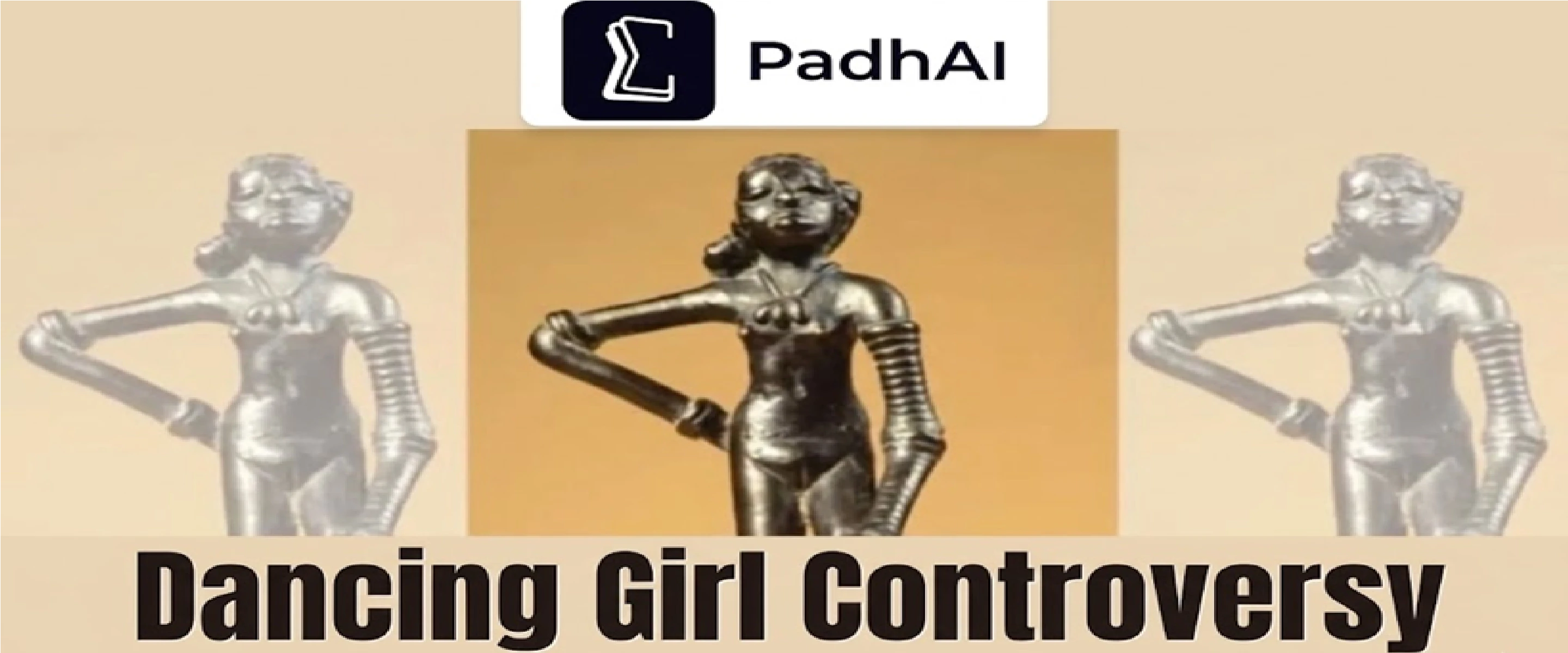
The Dancing Girl is a bronze statuette from the Indus Valley Civilisation, sculpted around 2500 BCE.
It shows a slim young woman standing with one hand resting on her hip and her head tilted slightly back.
At just about 10.5 cm tall, this small figure is one of the most recognised objects from the Harappan world.
This statue matters for two reasons.
First, it proves that Harappan craftsmen knew advanced metal casting nearly 4,500 years ago.
Second, the figurine has become the centre of a modern debate about how India should present its ancient art in school textbooks.
For a UPSC aspirant, this figurine sits at the meeting point of ancient history, art and culture, and live current affairs.
This article is written for civil services aspirants who want one clear place to study the statue, its history, and the recent NCERT row.
You will find the static facts, the controversy, and the exam angle in plain language.
Join our WhatsApp Community
The table below collects the static data points you should memorise about the Mohenjo Daro Dancing Girl statue. These are the facts that appear most often in objective papers.
Feature | Detail |
Civilisation | Harappan / Indus Valley Civilisation (Bronze Age) |
Approximate date | Around 2500 BCE (mature Harappan phase, c. 2600–1900 BCE) |
Year found | 1926 |
Site | Mohenjo-daro, Sindh (present-day Pakistan) |
Named by | John Marshall, then Director-General, ASI |
Material | Bronze (copper-tin alloy) |
Height | About 10.5 cm (roughly 4 inches) |
Casting method | Lost-wax technique (cire perdue) |
Ornaments | About 24–25 bangles on the left arm, 4 on the right, a cowrie-shell necklace |
Posture | Right hand on hip, left arm hanging, head tilted back |
Present location | National Museum, New Delhi |
Source: National Museum (New Delhi) records and standard NCERT art and culture material, 2026.
The figurine came to light during the 1926 digs at Mohenjo-daro, one of the largest cities of the Indus Valley Civilisation.
The site name itself means "mound of the dead" in Sindhi. The bronze figure was a surprise, because most human figures from Harappan sites are made of terracotta or stone, not metal.
Why Is It Called the 'Dancing Girl'?
The label came from John Marshall, who led the Archaeological Survey of India at the time. He looked at her relaxed posture, with one hand on the hip, and decided she resembled a "nautch girl", the professional female performers of his own colonial era.
He wrote that she seemed to keep time to music with her feet.
That reading is now widely doubted. No inscription or other evidence confirms she was a performer.
Historian Upinder Singh has noted that the figure may not have been performing at all, and even if she was, she need not have been a professional. Scholar Gregory Possehl also expressed doubt about the identification.
Historian Ashish Kumar of Panjab University argues that British officials were simply familiar with court performers, so they read that meaning into an object they did not understand.
The takeaway is simple. The name tells you more about the people who named her than about the woman the statue shows. Labels attached to ancient objects carry the bias of the time they were coined.
Add as a preferred Source on Google
The bronze figure was produced by the lost-wax casting method, known in art history as cire perdue. The steps were clever for their time:
The artist first shaped the figure in wax.
The wax model was covered in wet clay and left to dry.
The clay was then heated, the wax melted and drained out, leaving a hollow clay mould.
Molten bronze was poured into the mould and allowed to set.
The clay shell was broken away to reveal the metal figure.
This process needed control over high temperatures and a working knowledge of metal alloys. The use of a copper-tin mix shows the Harappans understood how to make a stronger, more durable metal.
The same casting method survives in parts of India today, for example in the brass and bronze idol work of Bastar and parts of West Bengal.
For UPSC, the lost-wax point is a favourite, because it links the statue directly to the theme of ancient Indian metallurgy.
The statue rewards close study, and examiners like the small details. The figure stands in a natural, slightly off-balance pose, with her weight resting more on one leg.
Art historians call this kind of relaxed stance contrapposto.
Her ornaments are uneven, and this asymmetry is a common exam point:
The left arm is almost fully covered with bangles, counted at about 24 to 25.
The right arm carries only about 4 bangles, often described with a bracelet near the wrist.
A simple cowrie-shell necklace sits at her neck.
Her hair is tied in a coiled bun at the back of her head.
Her right hand rests on her hip, while the longer left arm hangs down.
The bare-torso form of the figure is original to the Harappan period. That single fact sits at the heart of the controversy that follows.
The Dancing Girl Controversy is the current-affairs hook that brought this 4,500-year-old object back into the news in 2026.
Aspirants should know both what happened and why it triggered a debate about history teaching.
What Did NCERT Change?
In its new Class 9 Arts Education textbook, titled Madhurima, NCERT printed a digitally altered image of the figurine.
The torso was shaded to make the statue look clothed. The picture appeared in the opening chapter, "History of Arts".
The NCERT dancing girl image, in other words, did not match the actual bronze object kept at the National Museum.
After scholars and historians objected, NCERT decided to bring back the original image.
NCERT Director Dinesh Saklani confirmed that the council would replace the modified picture with the true one in the digital version and in future print runs.
Notably, the image of the figure in the Class 6 Social Science textbook had stayed closer to the original.
Why the Change Drew Criticism
Critics argued that editing a historical object is not the same as protecting children. It changes the evidence itself.
Michel Danino, who headed the committee for the Class 6 Social Science textbooks, said the reason offered to him was that the image was "not age-appropriate".
He compared covering the figure to adding a fig leaf to Michelangelo's statue of David, calling it a distortion of history.
The core question for a Mains answer is this: should a textbook show an artefact as it truly is, reflecting the society that made it, or should it edit the object to fit present-day comfort?
Most historians say the first approach is the honest one, because a doctored image teaches students a false version of the past.
The Colonial 'Vulgarity' Debate
The idea that the figure is somehow improper is older than the NCERT row. It goes back to colonial attitudes.
British officials treated nudity in Indian art as immoral, while praising Greek and Roman sculpture for its "accurate" anatomy. Indian forms with many limbs, many heads, or bare bodies were dismissed as irrational.
There is a clear double standard in this. The many nude terracotta female figurines found at Harappan sites were politely filed under the "Mother Goddess" category.
Only this one bronze figure was singled out and linked to a performer. The reaction to the statue, then and now, says a lot about the values of each age that looked at her.
Because the Harappans left no readable written records, every reading of the figure stays a theory. Scholars have offered several:
A ritual or Mother Goddess figure. Some link her to the goddess cult seen across many Harappan sites.
A Shakti or Parvati link. A newer view connects Harappan religion to early Shiva imagery, such as the Pashupati seal, and argues that a male deity implies a female counterpart. This reading is not widely accepted.
A warrior or armed figure. The left arm has an empty socket, which suggests she once held an object, perhaps a spear. Some read the heavier ornaments on the left arm as a sign that the right was kept free for action.
For exam purposes, the safe line is that the identity is unsettled, and the "dancer" label is only one colonial-era guess among several.
The figurine also carries a Partition-era story that is useful for both Prelims and Mains. At the time of Partition, about 12,000 objects from Mohenjo-daro were in Delhi.
They had been brought there by Mortimer Wheeler, then head of the ASI, for an exhibition. Pakistan asked for them back, arguing that the sites lay in its territory.
India's reply was that the Harappan past is shared South Asian heritage and not the property of one nation.
The two countries finally agreed to split the artefacts from Mohenjo-daro and Chanhu-daro roughly in half.
Pakistan wanted both the Dancing Girl and the famous Priest-King statue, but India agreed to part with only one. Pakistan chose the Priest-King.
Reports suggest officials there preferred to avoid a row at home over a bare female figure.
The result is the split you must remember: the Dancing Girl stays at the National Museum, New Delhi, while the Priest-King is at the National Museum of Pakistan, Karachi.
Why This Topic Matters for UPSC
This single object connects three parts of the syllabus, which is why it is worth your time.
Prelims (GS Paper 1): Static art and culture questions test material, site, technique, and current location. The bronze metal point and the Delhi-versus-Karachi split are classic objective traps.
Mains (GS Paper 1): The topic fits questions on Indus Valley art, Harappan culture, and the larger theme of how we read and present the past.
Essay and Ethics: The NCERT row gives you a ready example for debates on historical honesty, education policy, and moral censorship.
Here is a model Prelims-style question to test yourself:
Q. With reference to the Dancing Girl of Mohenjo Daro, consider the following statements:
It is made of bronze using the lost-wax casting method.
It was discovered at Harappa in present-day Pakistan.
The original is currently housed in the National Museum, New Delhi. Which of the statements given above are correct? (a) 1 and 2 only (b) 1 and 3 only (c) 2 and 3 only (d) 1, 2 and 3
Answer: (b). Statement 2 is wrong because the figure was found at Mohenjo-daro, not Harappa.
Frequently asked question (FAQs)
What is the Dancing Girl of Mohenjo Daro made of?
Where is the Mohenjo Daro Dancing Girl statue kept today?
Why is there an NCERT Dancing Girl controversy?
Who named the Dancing Girl of Mohenjo Daro?
What is the difference between the Dancing Girl and the Priest-King statue?
The Dancing Girl of Mohenjo Daro is far more than a small bronze figure. She records the skill of Harappan metalworkers, the bias of colonial naming, and a present-day argument about how honestly we teach our own history.
For your exam, lock in the static facts from the table, remember the bronze and lost-wax points, and keep the 2026 NCERT episode ready as a current-affairs and essay example.
Study the object as it is, and you will have one clean answer for several parts of the paper.
Want more high-yield art and culture notes like this? Explore PadhAI's Indian art and culture section and keep your current affairs prep exam-ready.


Gajendra Singh Godara
Ex-UPSC Aspirant | Exam Preparation Expert
Gajendra Singh Godara is an IIT Bombay graduate and a UPSC aspirant with 4 attempts, including multiple Prelims and Mains appearances. He specializes in Polity, Modern History, International Relations, and Economy. At PadhAI, Gajendra leverages his firsthand exam experience to simplify complex concepts, creating high-efficiency study materials that help aspirants save time and stay focused.

No comments yet. Be the first to join the discussion!