World Space Week 2026 is being observed from 4 to 10 October on the theme "Rocket Revolution". The dates mark the launch of Sputnik 1 and the entry into force of the Outer Space Treaty. Here is the full explainer with space law, India's reforms and everything UPSC can ask.

Gajendra Singh Godara
Last updated
4
mins read
Add a comment
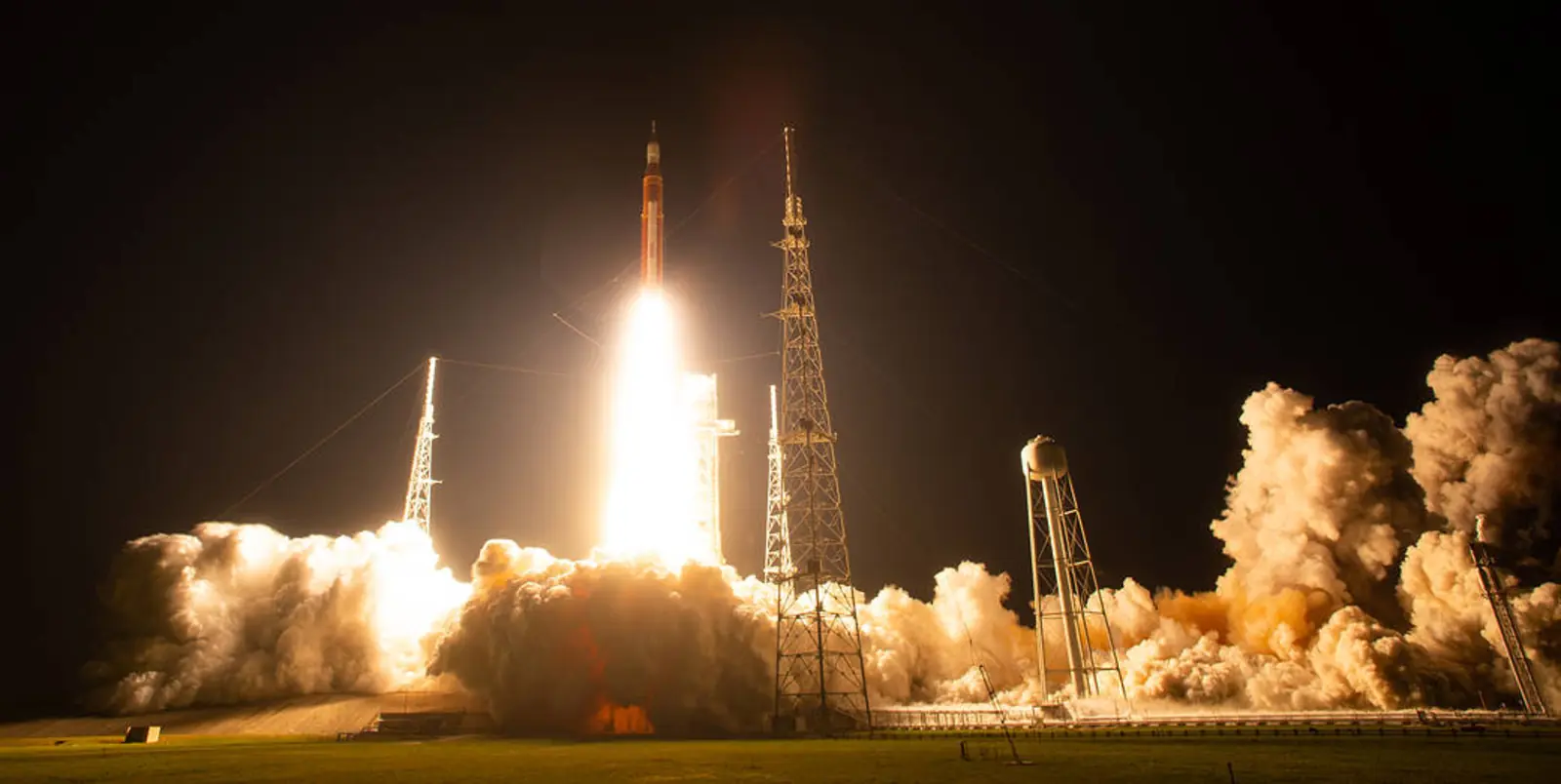
Between 4 to 10 October 2026, the whole world observes World Space Week 2026. The theme this year is "Rocket Revolution".
The United Nations declared it, and the World Space Week Association coordinates it, which makes it the biggest space event on the annual calendar. This year around 100 countries take part.
Key Highlights
Dates: 4 to 10 October, every year
Theme 2026: Rocket Revolution
Declared by: UN General Assembly Resolution 54/68 of 1999
First observed: 2000
Supported by: UN Office for Outer Space Affairs, with the World Space Week Association coordinating
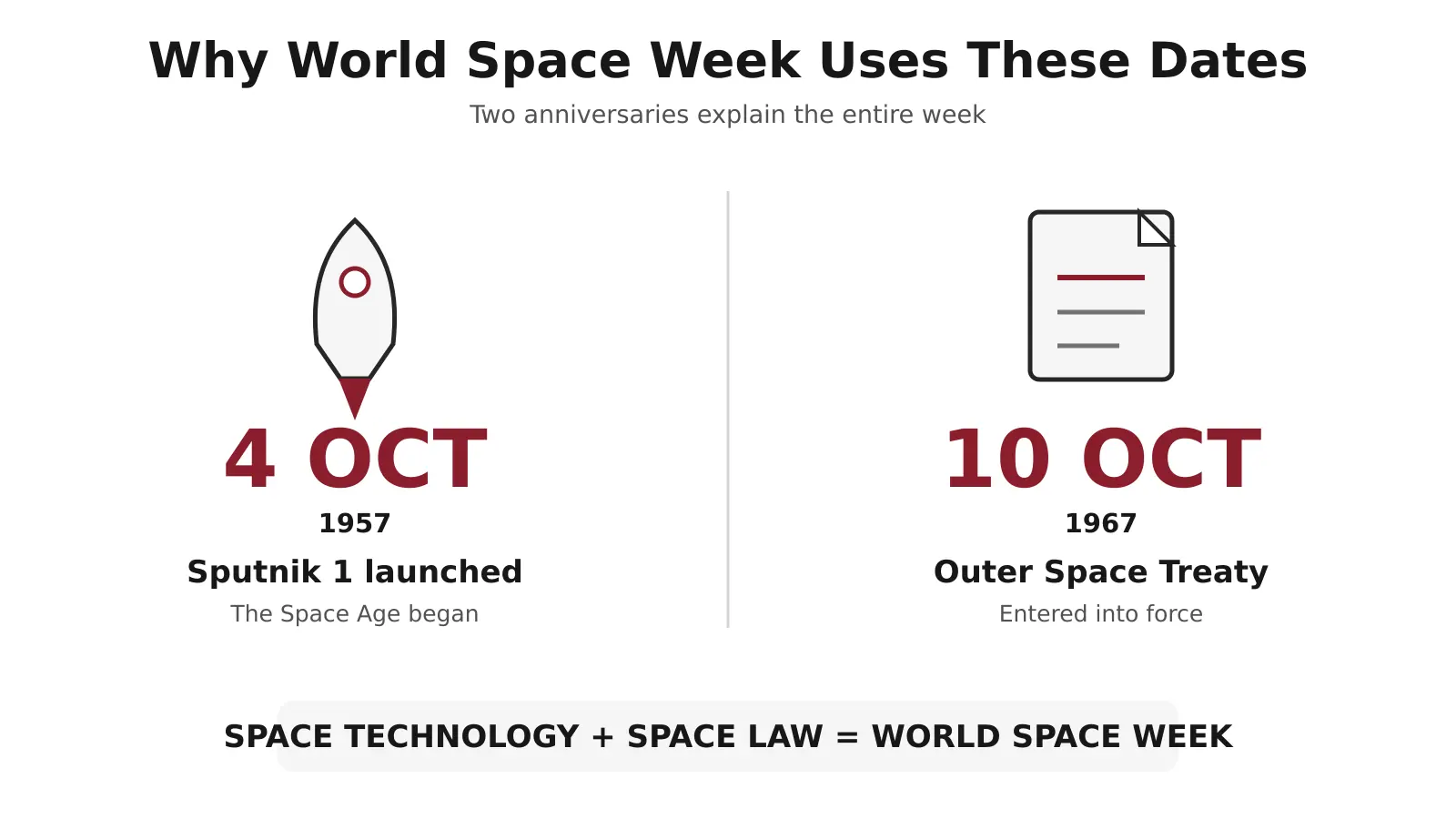
Nothing about these dates is arbitrary. Two anniversaries sit at either end, and between them they produced both the technology of space and its law.
Date | Event | Why It Matters |
4 October 1957 | The Soviet Union launched Sputnik 1, the first artificial satellite | Began the Space Age |
10 October 1967 | The Outer Space Treaty entered into force | Laid down the basic legal principles for using space |
Hold on to that pairing. Prelims tends to test these two anchors far more often than it tests whatever the current theme happens to be.
Join our WhatsApp Community
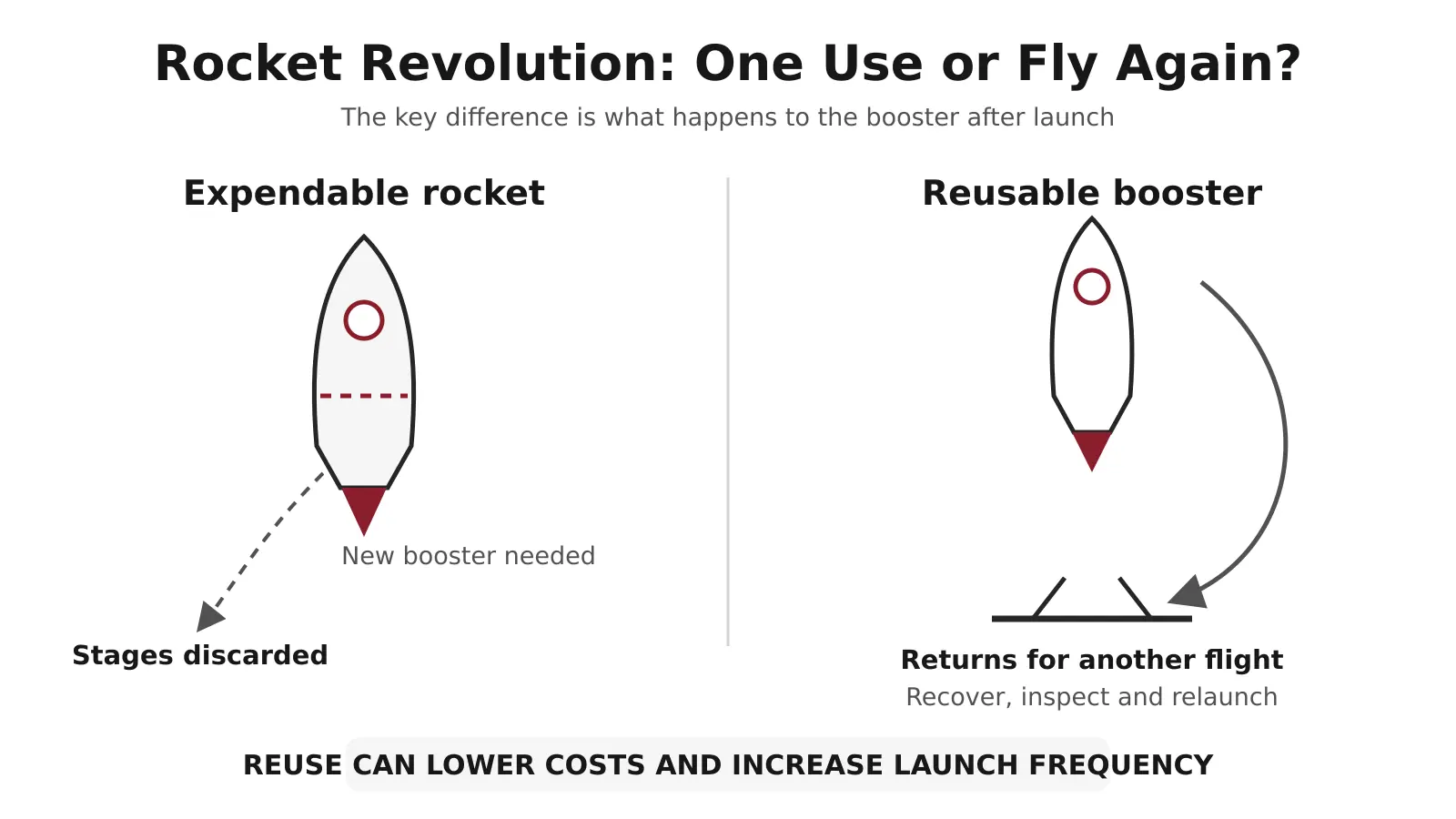
"Rocket Revolution" is the World Space Week 2026 theme. The subject is launch itself, and how much it has changed.
Orbit used to cost a fortune and arrive on a government rocket that burned once and was thrown away. That was true for most of the Space Age.
Reusable boosters changed it, along with private launch companies and small dedicated launchers, and together they dragged costs down while pushing launch frequency up.
Cheaper launch is what opened the door to the many new uses of space people now take for granted, according to Dennis Stone, President of the World Space Week Association. Pulling students towards science and engineering is the other thing the theme is meant to do.
Why it matters in simple terms: once reaching orbit costs less, the impossible turns routine. How affordable satellites get up there decides whether weather tracking, navigation, broadband for remote villages, crop monitoring and disaster warning happen at all.
United Nations work on using outer space peacefully is where World Space Week history begins.
Year | Development |
1958 | UN General Assembly adopted Resolution 1348 (XIII) on the peaceful uses of outer space |
1959 | The Committee on the Peaceful Uses of Outer Space (COPUOS) was made a permanent committee |
1967 | The Outer Space Treaty came into force |
1999 | UNGA Resolution 54/68 declared 4 to 10 October as World Space Week |
2000 | The first World Space Week was observed |
Who runs the week
Support for the observance comes from the UN Office for Outer Space Affairs (UNOOSA), which is based in Vienna.
Events across the world are coordinated by the World Space Week Association (WSWA). Founded in 1982, it is a non-profit, non-governmental body, and it holds permanent observer status at COPUOS.
John Elbon, former interim head of United Launch Alliance, is Honorary Chair for 2026.
Add as a preferred Source on Google
Activity | Detail |
Scale | Around 100 nations participating. Last year saw roughly 50,000 events across 102 countries |
United States | An expo at NASA's Kennedy Space Center Visitor Complex featuring Space Shuttle Atlantis |
Europe | A family exhibition by the European Space Agency with The Pokémon Company International |
Schools | Model rocket launches by student and rocket clubs |
National drives | Large school-level programmes led by Saudi Arabia's education ministry and Pakistan's SUPARCO |
No single venue hosts any of it. Wherever an organiser registers something, an event happens, and that is why this week reaches more people than any conference could.
Here the observance stops being a date to memorise and becomes a UPSC topic.
The Outer Space Treaty of 1967
Its formal name is the Treaty on Principles Governing the Activities of States in the Exploration and Use of Outer Space. The core rules:
Article | Principle |
Article I | Exploration and use of space is free for all countries and must benefit all |
Article II | No national appropriation. No country can claim sovereignty over the Moon or any celestial body |
Article IV | No nuclear weapons or other weapons of mass destruction in orbit; celestial bodies to be used for peaceful purposes |
Article VI | States are internationally responsible for national activities in space, including those by private companies, which need authorisation and continuing supervision |
Article VII | The launching state is liable for damage caused by its space object |
Article VIII | The state of registry keeps jurisdiction and control over its object |
Article IX | Parties must avoid harmful contamination and act with due regard for others |
Underline Article VI. A private rocket company does not sit outside the law, because the government of its country answers for it. Countries need national space legislation at all for exactly that reason.
The Five UN Space Treaties
Treaty | Year | What It Covers |
Outer Space Treaty | 1967 | Basic principles |
Rescue Agreement | 1968 | Assistance and return of astronauts |
Liability Convention | 1972 | Damage caused by space objects |
Registration Convention | 1975 | Registering objects launched into space |
Moon Agreement | 1979 | Moon as the common heritage of mankind. India signed it but has not ratified it, and very few countries have joined |
India is also a signatory to the Artemis Accords, which it joined in 2023.
Talks, exhibitions and model rocket activities are how ISRO centres use the week to open the space programme up to students. The Satish Dhawan Space Centre at Sriharikota is among them.
India sits in the middle of exactly the shift the "Rocket Revolution" theme describes, so the fit is close.
Reforms in India's space sector
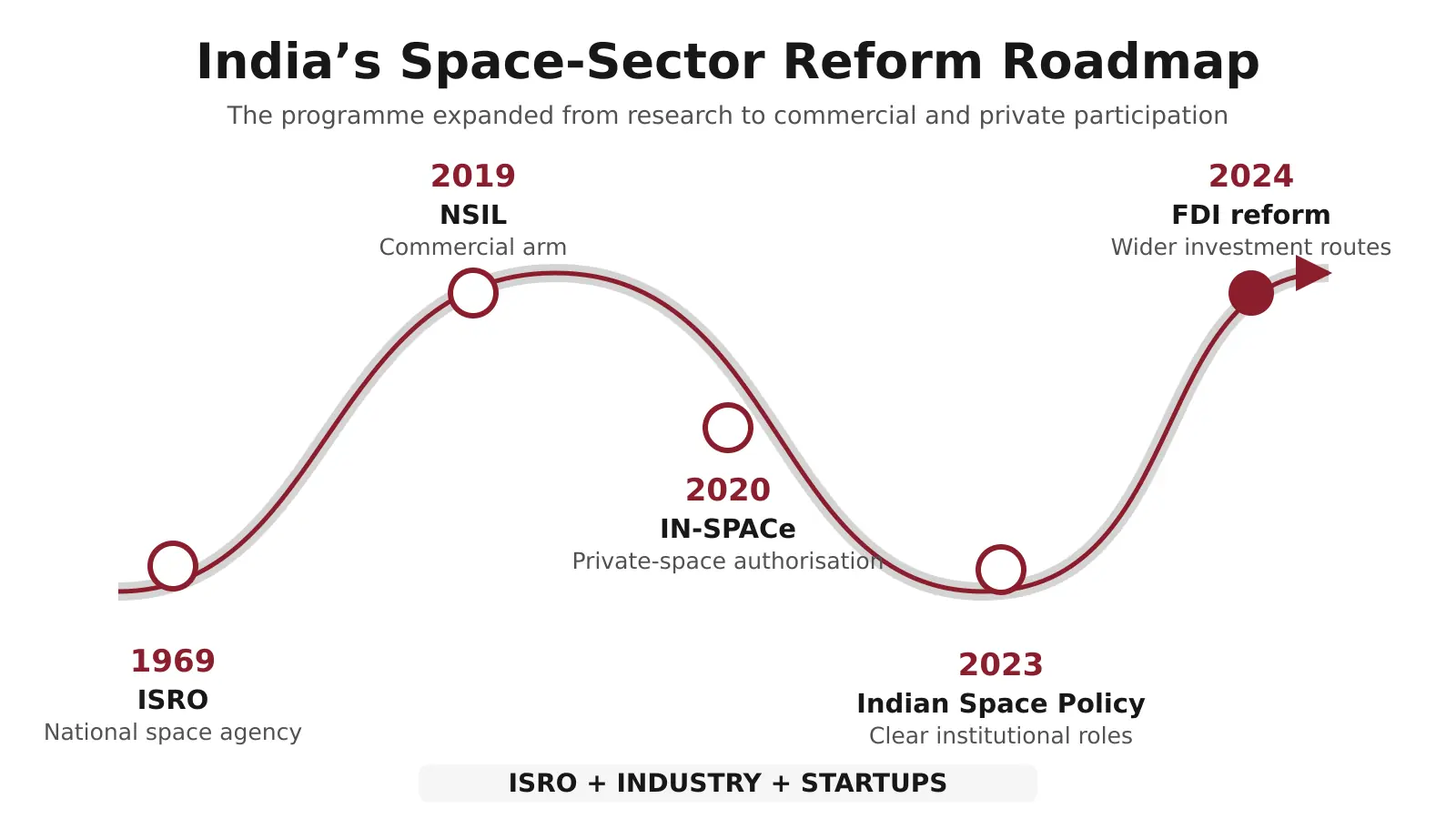
Reform | What It Does |
IN-SPACe, 2020 | Single-window authorisation and regulation of private space activity |
NewSpace India Limited (NSIL), 2019 | Commercial arm of the Department of Space |
Indian Space Policy 2023 | Defines the roles of ISRO, IN-SPACe and NSIL, and opens the end-to-end space value chain to private players |
FDI liberalisation, 2024 | Allows higher foreign investment across satellite manufacturing, components and launch vehicles |
Venture capital fund | A dedicated government-backed fund for space startups |
On the launch side, ISRO has been building this story itself: the small satellite launch vehicle for quick commercial missions, reusable launch vehicle landing experiments, and the Gaganyaan human spaceflight programme. Private Indian firms have flown their own launch vehicles and built satellites already.
An answer also has a set of Indian landmarks that pair naturally with this week: the Chandrayaan-3 soft landing near the lunar south pole, now marked every year as National Space Day, the Aditya-L1 solar mission, and an Indian astronaut flying to the International Space Station as part of a commercial mission. An Indian space station and a crewed lunar landing are the declared long-term goals.
One point is the reason this week exists: space is not a distant subject. Ordinary life runs into it every day.
Communication: television, telephony and internet links travel by satellite, including to places no cable reaches.
Weather and disaster warning: cyclones and heavy rainfall are tracked by meteorological satellites, and the warnings that follow have cut death tolls sharply in coastal India.
Navigation: aviation, shipping and the delivery app on a phone all run on satellite positioning.
Agriculture: crop area estimation, drought monitoring and irrigation planning use remote sensing data.
Earth observation: forest cover assessment, urban planning and flood mapping rely on satellite images.
Carry that list into an answer. Applications come up in questions far more often than missions do.
Stopping at celebration makes for a weak answer.
Space debris. More objects reach orbit because launch has got cheaper. Working satellites already face threats from defunct ones and fragments, and a cascade of collisions in low Earth orbit is a real risk.
Crowded orbits and spectrum. Who gets which slots and which frequencies is a question large satellite constellations raise, along with whether latecomers will find room at all.
Militarisation. Weapons of mass destruction in orbit are barred by the Outer Space Treaty, but conventional anti-satellite weapons get little mention. Several countries have demonstrated that capability now.
A gap in the law. Space was a government activity when these treaties were written in the 1960s and 1970s. Modern questions get no clear answer from them, such as who owns resources mined from an asteroid.
India's own gap. Authorisation and continuing supervision of private actors is what Article VI requires. India handles this through the Indian Space Policy 2023 and IN-SPACe, but a dedicated national space law has still not been enacted. A bill drafted in 2017 did not become law. Pending: check the status of any space legislation before publishing, since this is an active area.
The counter-view. Rules that arrive too early can smother a young industry. Several countries have kept their rules light on purpose so private launch could grow, and they argue policy frameworks can do the job until the industry settles.
Enact a national space law that gives IN-SPACe statutory backing and fixes liability clearly
Treat debris as a design problem, with de-orbiting plans built into every mission
Push for updated international rules on resources, traffic management and anti-satellite tests
Expand tracking capacity, since safe operations depend on knowing what is in orbit
Keep the public link alive, because weeks like this one are how a space programme earns public support
Stage | Angle |
Prelims | Dates and theme, Sputnik 1, Outer Space Treaty, Resolution 54/68, UNOOSA, COPUOS, the five treaties, Moon Agreement status |
GS Paper 2 | International treaties and institutions, India's position in global regimes |
GS Paper 3 | Space technology, indigenisation, private sector participation, space debris |
Essay | Science, exploration and the common heritage of mankind |
Interview | Should India legislate on space activity, and how soon? |
Frequently asked question (FAQs)
When is World Space Week 2026?
What is the World Space Week 2026 theme?
Why is World Space Week held from 4 to 10 October?
Who declared World Space Week?
What is the theme for World Space Week 2027?
Two facts reduce World Space Week 2026 to almost nothing, the dates and the theme. Learn both. Carry the rest as well.
Sputnik and the Outer Space Treaty are why the week exists, and that pairing is a reminder: every leap in space capability has needed a matching set of rules.
Rocket Revolution is the latest leap, and India is inside it through IN-SPACe, private launch companies and a policy that has opened the sector. Rules, both international and Indian, are still catching up.


Gajendra Singh Godara
Ex-UPSC Aspirant | Exam Preparation Expert
Gajendra Singh Godara is an IIT Bombay graduate and a UPSC aspirant with 4 attempts, including multiple Prelims and Mains appearances. He specializes in Polity, Modern History, International Relations, and Economy. At PadhAI, Gajendra leverages his firsthand exam experience to simplify complex concepts, creating high-efficiency study materials that help aspirants save time and stay focused.
No comments yet. Be the first to join the discussion!