Three of the six Nobel Prizes for 2026 are announced: optogenetics in Medicine, high-energy neutrinos in Physics, asymmetric synthesis in Chemistry. Literature, Peace and Economics follow between 8 and 12 October. Here is the running nobel prize 2026 winners list, the contributions explained, and the static facts UPSC asks.

Gajendra Singh Godara
Last updated
7
mins read
Add a comment
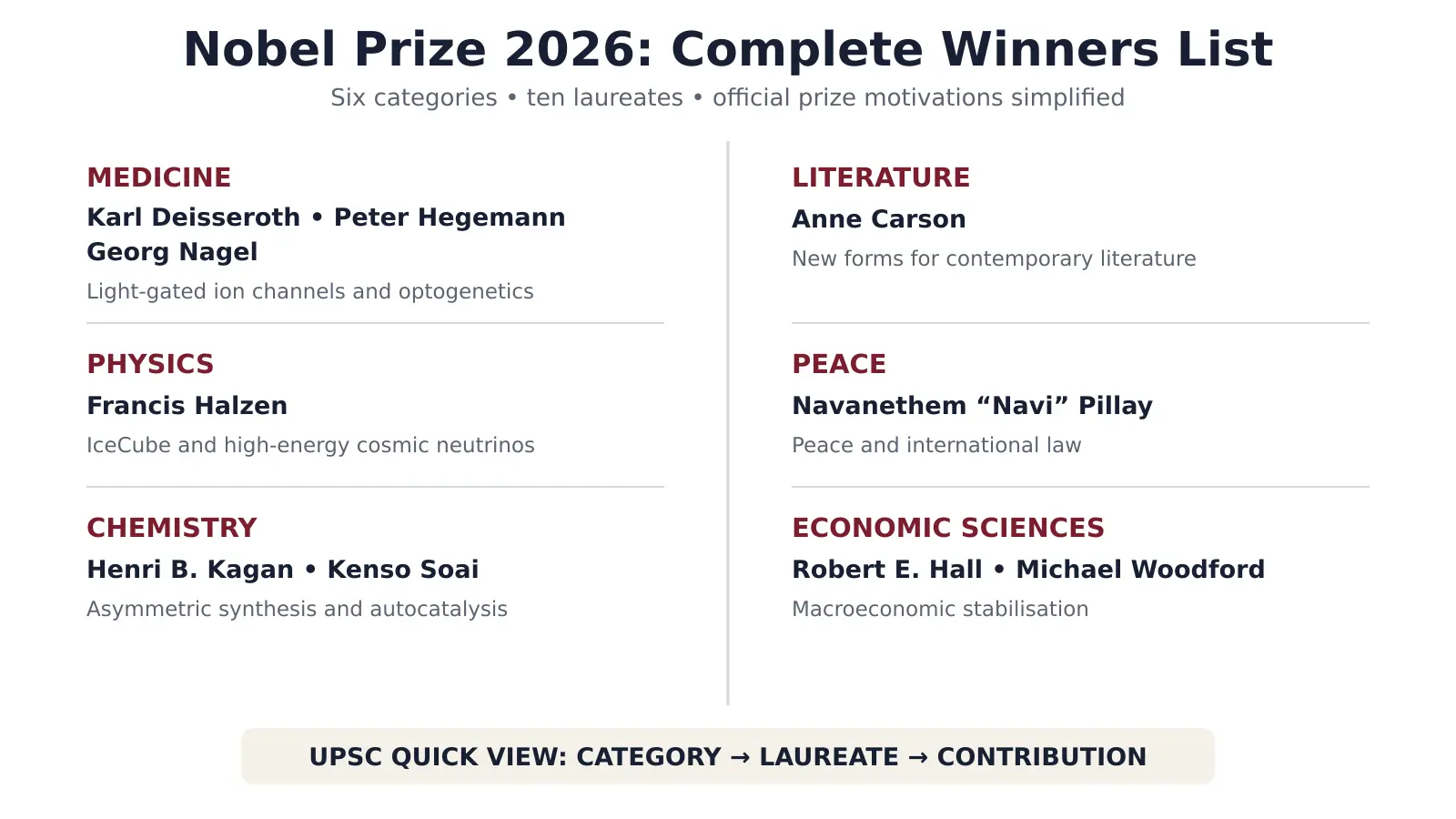
Medicine: Karl Deisseroth, Peter Hegemann and Georg Nagel, for optogenetics
Physics: Francis Halzen, for the IceCube Neutrino Observatory and high-energy neutrinos
Chemistry: Henri B. Kagan and Kenso Soai, for asymmetric organic synthesis
Literature, Peace and Economics are announced on 8, 9 and 12 October 2026
Prize money raised to 12.0 million SEK per full category, up from 11.0 million in 2025
Ceremony: 10 December 2026, Stockholm, with the Peace Prize in Oslo
So far, three categories have names attached. Three more are still pending. This running nobel prize 2026 winners list gets updated at each announcement.
Category | 2026 Winner | Announced | Awarded for |
Physiology or Medicine | Karl Deisseroth, Peter Hegemann, Georg Nagel | 5 Oct 2026 | Light-gated ion channels and optogenetics |
Physics | Francis Halzen | 6 Oct 2026 | IceCube Neutrino Observatory and high-energy astrophysical neutrinos |
Chemistry | Henri B. Kagan, Kenso Soai | 7 Oct 2026 | Non-linear effects and autocatalysis in asymmetric organic synthesis |
Literature | Anne Carson | 8 Oct 2026, 4:30 PM IST | Swedish Academy |
Peace | Navanethem "Navi" Pillay | 9 Oct 2026, 2:30 PM IST | Norwegian Nobel Committee |
Economic Sciences | Robert E. Hall, Michael Woodford | 12 Oct 2026, 3:15 PM IST | Royal Swedish Academy of Sciences |
A word on accuracy. Several sites already carry filled-in names for Literature, Peace and Economics. Those are guesses or placeholders.
Nothing has been announced in those three categories, and nobelprize.org lists them as not yet awarded. Verify any name you see against the official site before you put it in your notes.
Join our WhatsApp Community
Category | Date | CEST | IST | Announcing body |
Medicine | Mon 5 Oct | 11:30 | 3:00 PM | Nobel Assembly, Karolinska Institutet |
Physics | Tue 6 Oct | 11:45 | 3:15 PM | Royal Swedish Academy of Sciences |
Chemistry | Wed 7 Oct | 11:45 | 3:15 PM | Royal Swedish Academy of Sciences |
Literature | Thu 8 Oct | 13:00 | 4:30 PM | Swedish Academy, Börssalen, Stockholm |
Peace | Fri 9 Oct | 11:00 | 2:30 PM | Norwegian Nobel Committee, Oslo |
Economic Sciences | Mon 12 Oct | 11:45 | 3:15 PM | Royal Swedish Academy of Sciences |
Every category except Peace lists a time "at the earliest." Peace is fixed at 11:00 CEST.
Beyond the names, three things about this cycle stand out.
The money went up. For 2026, the Nobel Foundation raised the award to 12.0 million Swedish kronor per full category, from 11.0 million in 2025.
The Foundation adjusts this according to the health of its investment portfolio, and it has risen steadily since the cut to 8 million in 2012.
Two of the three science prizes went to long-running collaborative projects rather than single breakthroughs. IceCube took decades and hundreds of researchers to build, and optogenetics came from three laboratories in two countries working on separate problems.
That pattern is worth noting in a Mains answer about how frontier science gets done now: by large, long-horizon, internationally funded teams rather than lone investigators.
And the Physics prize was unshared. Francis Halzen received the full award alone, which has become uncommon. Of the last decade's physics prizes, most were split two or three ways.
Nobel Prize 2026 Categories
Six categories make up the Nobel Prize 2026 categories, the same six awarded every year since 1969: Physiology or Medicine, Physics, Chemistry, Literature, Peace, and Economic Sciences. Full institutional detail for each one is in the static background section below.
Add as a preferred Source on Google
Neurons communicate using electrical signals. For decades, the problem was that researchers could watch brain activity but could not switch individual cells on and off to prove what each one did.
The answer came from pond algae. Hegemann studied how single-celled green algae swim towards light, and found light-sensitive proteins called channelrhodopsins. Nagel, working with Hegemann, showed these proteins are light-gated ion channels: shine light on them and they open, letting ions flow.
Deisseroth took that biology and made it a tool. Insert the gene for a channelrhodopsin into specific neurons, shine light through a fibre, and those neurons fire on command. Nothing else in the brain is touched.
Why it matters: researchers can now establish cause rather than correlation in the living brain, mapping which circuits produce memory, fear, appetite or movement. It underpins current research into Parkinson's disease, depression and blindness.
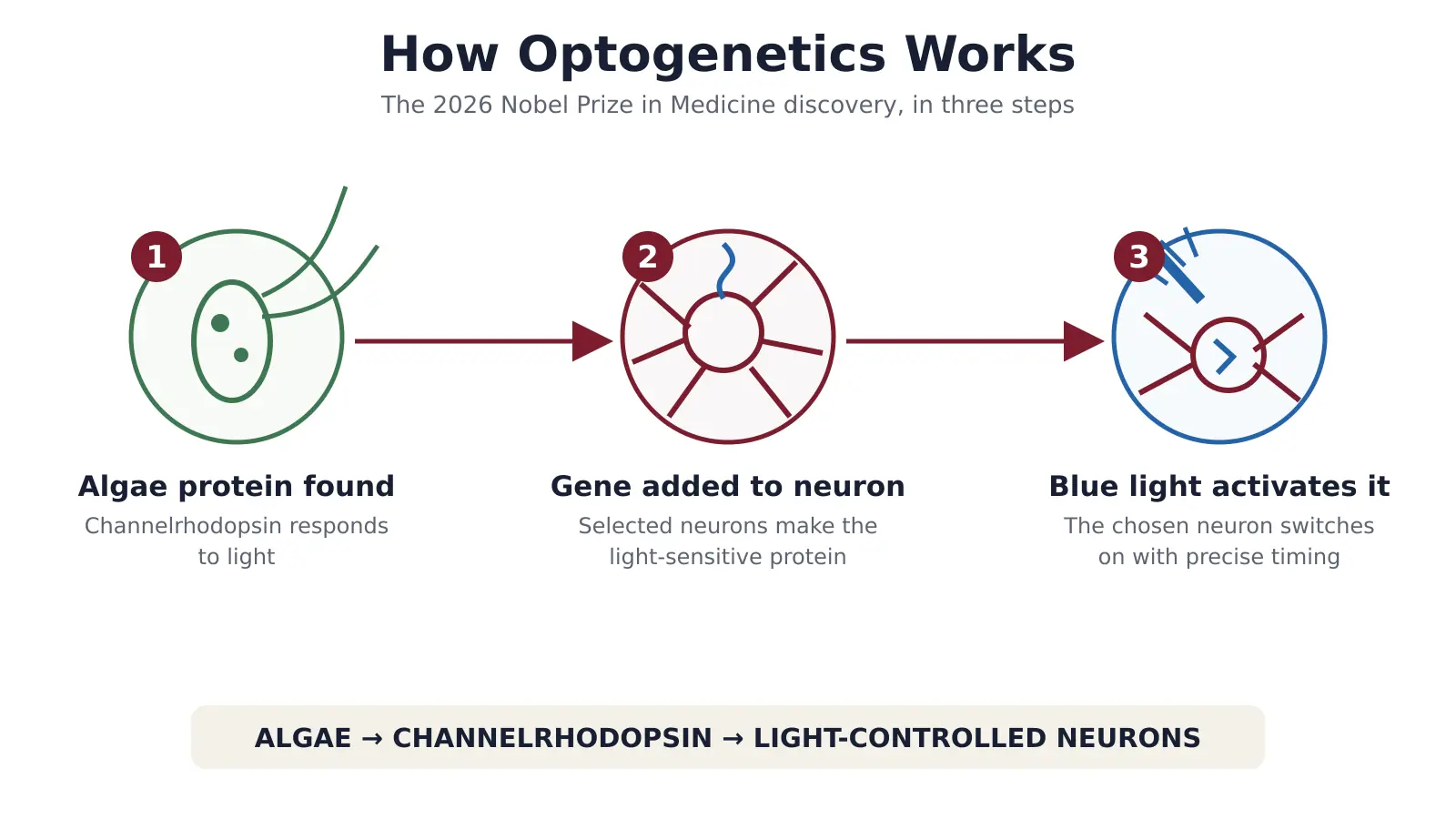
UPSC angle: this sits in GS Paper III, science and technology, under biotechnology. The examinable chain is algae → channelrhodopsin → light-gated ion channel → neural control.
Francis Halzen won the Nobel Prize in Physics 2026, "for decisive contributions to the IceCube Neutrino Observatory and the discovery of high-energy neutrinos of astrophysical origin."
This is an unshared prize. That is relatively uncommon in physics.
Neutrinos and IceCube
Neutrinos are subatomic particles with almost no mass and no electric charge. They barely interact with matter, so they pass straight through planets. Billions cross your body every second.
That property makes them extraordinarily useful and extraordinarily hard to catch. Light from distant cosmic events gets absorbed or deflected on its way to us. Neutrinos do not, so they arrive carrying undistorted information about whatever produced them.
IceCube solves the detection problem with scale. Built at the Amundsen-Scott South Pole Station in Antarctica, it uses a cubic kilometre of Antarctic ice as its detector, with thousands of optical sensors buried up to 2,500 metres deep.
When a neutrino does interact with the ice, it produces a faint flash of blue light that the sensors record.
Halzen, who leads IceCube from the University of Wisconsin-Madison, established the observation of high-energy neutrinos from outside our solar system.
That work opened what is now called multi-messenger astronomy: studying the universe using neutrinos and gravitational waves alongside light.
UPSC angle: GS Paper III. Expect questions pairing the detector with its location and the particle with its properties, chargeless and nearly massless.
Henri B. Kagan (France) and Kenso Soai (Japan) shared the Nobel Prize in Chemistry 2026, "for the discovery of non-linear effects and autocatalysis in asymmetric organic synthesis."
Chirality, in plain terms
Here is the puzzle. Living organisms use only one of the two mirror images. Almost all natural amino acids are left-handed; most natural sugars are right-handed.
Chemistry made in a lab normally produces a 50:50 mixture. So how did life end up one-handed?
Kagan and Soai supplied the mechanism:
Kagan discovered non-linear effects: a catalyst that is only slightly imbalanced towards one mirror image can produce a product that is overwhelmingly one-handed. A small bias gets amplified.
Soai demonstrated asymmetric autocatalysis: a reaction in which the product acts as the catalyst for its own formation, so each cycle reinforces the same handedness. The Soai reaction remains the textbook example.
Why it matters beyond theory. Chirality is a life-and-death issue in pharmaceuticals, because the two mirror images of a drug can behave completely differently in the body. The thalidomide tragedy is the standard example. Asymmetric synthesis is how the industry now makes single-enantiomer drugs reliably.
UPSC angle: GS Paper III. The useful hooks are chirality, enantiomers, the origin-of-life question, and the pharmaceutical application.
A country wise breakdown of the laureates announced so far.
Country | Laureates | Category |
United States | Karl Deisseroth, Francis Halzen | Medicine, Physics |
Germany | Peter Hegemann, Georg Nagel | Medicine |
France | Henri B. Kagan | Chemistry |
Japan | Kenso Soai | Chemistry |
No Indian laureate so far in 2026. Three categories remain, and an Indian name is most plausible in Peace or Economics, though there is no basis for predicting one.
Country attribution is slippery and worth a caution. Laureates are usually counted by the country of the institution where they work, not by birth or citizenship, and many have moved across borders. Treat any country-wise tally as an approximation.
Nobel laureates with an Indian connection
A recurring Prelims area, and the distinction that gets tested is Indian citizenship at the time of the award against Indian origin.
Laureate | Year | Category | Note |
Rabindranath Tagore | 1913 | Literature | Indian citizen |
C. V. Raman | 1930 | Physics | Indian citizen |
Mother Teresa | 1979 | Peace | Indian citizen |
Kailash Satyarthi | 2014 | Peace | Indian citizen |
Har Gobind Khorana | 1968 | Medicine | Indian-born, US citizen |
S. Chandrasekhar | 1983 | Physics | Indian-born, US citizen |
Amartya Sen | 1998 | Economics | Indian citizen |
Venkatraman Ramakrishnan | 2009 | Chemistry | Indian-born, US and UK |
Abhijit Banerjee | 2019 | Economics | Indian-born, US citizen |
This is the part that does not change year to year, and the part Prelims actually tests.
Alfred Nobel (1833-1896) was a Swedish chemist, engineer and inventor, best known for inventing dynamite. In his will of 1895, he directed most of his fortune towards prizes for those who "conferred the greatest benefit to humankind". The first prizes were awarded in 1901.
Nobel Prize categories and who awards them
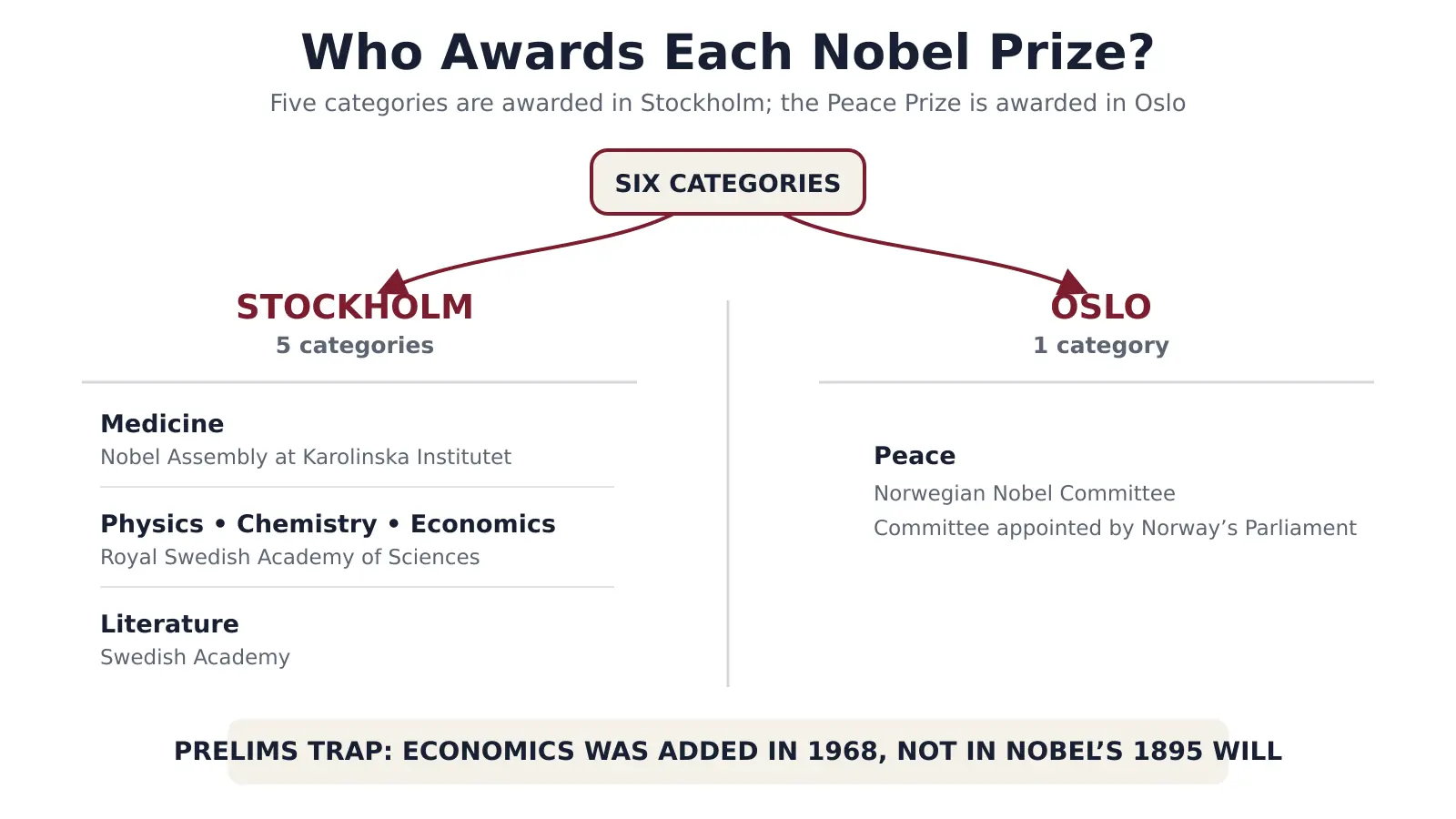
Category | Awarded by | Based in |
Physiology or Medicine | Nobel Assembly at Karolinska Institutet | Stockholm |
Physics | Royal Swedish Academy of Sciences | Stockholm |
Chemistry | Royal Swedish Academy of Sciences | Stockholm |
Literature | Swedish Academy | Stockholm |
Peace | Norwegian Nobel Committee | Oslo |
Economic Sciences | Royal Swedish Academy of Sciences | Stockholm |
Four nuances that get examined:
1. Economics is not an original Nobel. Its formal name is the Sveriges Riksbank Prize in Economic Sciences in Memory of Alfred Nobel, established in 1968 by Sweden's central bank. Nobel's will named only five categories. This is the most common Prelims trap on the topic.
2. The Peace Prize is the odd one out. It is the only prize awarded in Norway, by a committee appointed by the Norwegian Parliament, and the only one that can go to organisations, not just individuals.
3. No posthumous awards, with one exception: if a laureate dies after the announcement but before the ceremony, the award stands.
4. A maximum of three laureates may share a prize in any category.
Prize money and ceremony. For 2026 the Nobel Foundation raised the award to 12.0 million Swedish kronor per full category, up from 11.0 million in 2025. Ceremonies are held on 10 December, the anniversary of Alfred Nobel's death, in Stockholm, with the Peace Prize presented separately in Oslo.
How this appears in the exam, and what is worth memorising.
Prelims facts most likely to be asked:
Which category is not in Alfred Nobel's original will (Economics, added 1968)
Which prize is awarded in Oslo (Peace)
The pairing of laureate to discovery for each 2026 category
Maximum number of shared laureates (three)
Which body awards Medicine (Nobel Assembly at Karolinska Institutet, not the Royal Swedish Academy)
Mains relevance is in the science, not the names. Optogenetics belongs in answers on neuroscience and biotechnology, neutrino astronomy in questions on frontier research and big-science collaborations, and asymmetric synthesis in the pharmaceutical and chiral-drug context.
A note on how to revise awards. Do not memorise every laureate from every year. Learn the current year properly, keep the Indian-connection list permanently, and know the static institutional facts cold.
That is where the questions are. Our guidance on how to prepare current affairs covers the method, and the monthly current affairs compilations carry the consolidated version once Nobel Week closes.
Frequently asked question (FAQs)
Who won the Nobel Prize 2026 so far?
When will the Nobel Peace Prize 2026 be announced?
How many Nobel Prize categories are there?
What is the Nobel Prize money in 2026?
Has any Indian won the Nobel Prize in 2026?
Three prizes down, three to go. For revision purposes the 2026 science prizes share a useful theme: all three are about control at a very small scale, whether that is switching single neurons with light, catching a particle that almost never interacts, or forcing molecules to pick a side.
Keep this page open through 12 October. For the exam, learn the laureate-to-discovery pairings, keep the static institutional facts separate in your notes because they never change, and remember the one trap that gets asked more than any other: Economics is not an original Nobel Prize.
Laureate names, citations and announcement times in this article are taken from nobelprize.org, the official site of the Nobel Prize, and from the Nobel Foundation's 2026 announcement schedule. Categories still listed as awaiting announcement are confirmed as not yet awarded on the official site at the time of writing. This page is updated within an hour of each remaining announcement.
Prelims Questions

Gajendra Singh Godara
Ex-UPSC Aspirant | Exam Preparation Expert
Gajendra Singh Godara is an IIT Bombay graduate and a UPSC aspirant with 4 attempts, including multiple Prelims and Mains appearances. He specializes in Polity, Modern History, International Relations, and Economy. At PadhAI, Gajendra leverages his firsthand exam experience to simplify complex concepts, creating high-efficiency study materials that help aspirants save time and stay focused.
No comments yet. Be the first to join the discussion!