UPSC Full Form, History, Functions, Exam Pattern 2026
UPSC stands for Union Public Service Commission, India’s central body for recruiting civil servants like IAS, IPS, and IFS.

Last updated
Key Highlights:
Full Form: Union Public Service Commission
Type: Constitutional body
Role: Civil services recruitment
Major Exam: CSE
Top Services: IAS, IPS, IFS
Stages: Prelims, Mains, Interview
Eligibility: Graduate, 21–32 years for General
What is the Full Form of UPSC?
The full form of UPSC is the Union Public Service Commission.
UPSC plays an important role in recruitment of candidates to the All India Services like IAS, IPS & IFS through an examination process. People consider the UPSC CSE, or UPSC Civil Service Examination, one of the toughest exams in India.
Once you clear the exam, your service journey is governed by the New Cadre Allocation Policy, which determines the state and zone where an officer will serve throughout their career.
Role & Constitutional Status
Union Public Service Commission is the prestigious central recruiting agency of India. Its role and constitutional status is determined by the Constitution.
Role of UPSC
The key responsibilities of UPSC are:
It is responsible for conducting the Civil Service Examination in order to select candidates for Indian Administrative Service, Indian Police Service, Indian Foreign Service and other Group A and Group B central services.
Other UPSC functions include developing recruiting schemes.
It also provides consultation to the government on recruitment, appointments, pensions, promotions, transfers, and disciplinary cases.
Constitutional Status of UPSC
The Constitution of India defines the status and functions of Union Public Service Commission categorically:
Under Articles 315 to 323 (Part XIV, Chapter II of the Constitution of India), UPSC is a constitutional body.
It is expected to perform the duties, functions, and obligations listed in Article 320.
The most important function of UPSC is to conduct various examinations in accordance with the rules provided by the government of India.
It must act in a just, fair, and impartial way by selecting and recommending civil service candidates based on merit.
History of UPSC
Before the formal establishment of UPSC, the civil services exams were held in a different manner. The history of UPSC is interlinked with the origin of the Civil Services Exam.
Background of Civil Service Exam
The concept of Civil Service Examination (CSE) was introduced by the British East India Company in 1854. The first Indian who succeeded in this examination was Shri Satyendranath Tagore (brother of legendary Shri Rabindranth Tagore) in 1864.
In the beginning, the exams for Indian Civil Service were held only in London. After the Montagu Chelmsford Reforms, the Indian civil service exam started being conducted in India.
Establishment of UPSC
Union Public Service Commission was established in three phases:
In 1923, the Royal Lee Commission on superior civil services was set up in India. Based on the recommendation by this commission, the Public Service Commission was established in India on October 1st, 1926 under Government of India Act, 1919. Sir Ross Baker was the first chairman of the Public Service Commission.
This was followed by establishment of the Federal Public Service Commission under Government of India Act, 1935.
After gaining constitutional status under the Constitution of India implemented on 26 January 1950, it came to be known as the Union Public Service Commission.
Exams Conducted by UPSC
The Union Public Service Commission conducts the following examinations:
Indian Statistical Service Examination (ISS)
Indian Forest Service Examination (IFS)
Civil Services Examination (CSE) for recruitment to IAS, IPS, IRS, etc officers
Combined Medical Services Examination
Combined Defence Services Examination (CDS)
Various Recruitment Tests for UPSC EPFO, and other exams
Indian Engineering Services Examination
Combined Geo-Scientist and Geologist Examination
National Defence Academy and Naval Academy Examination (NDA)
Indian Economic Service Examination (IES)
Central Armed Police Forces (ACs) Examination
Join our WhatsApp Community
In order to be recruited in the Civil services, aspirants are required to appear in the UPSC Civil Service Examination (UPSC CSE). There are three stages in this selection process:
Preliminary Examination
Mains Examination
Personality Interview Test
Why is UPSC Considered India’s Toughest Exam?
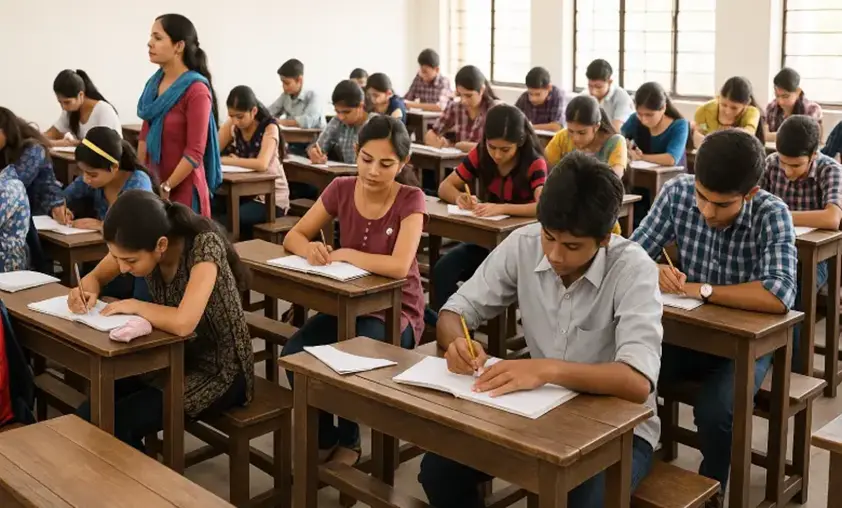
UPSC CSE is considered one of the toughest exams in India due to various factors:
A vast syllabus with unpredictable question patterns.
With an extremely low success rate, only 900-1000 candidates are selected out of 10-12 lakh applicants.
It is a three-phase selection where candidates are required to clear the prelims, the Mains exam and the rigorous Interview.
The entire recruitment cycle lasts a year. This long duration and intensity of the process required consistency, dedication and high mental capacity.
Instead of rote learning, questions are designed to test critical and analytical thinking skills.
The negative marking raises the difficulty.
There are some UPSC eligibility criteria for the exam that candidates need to fulfil. They are provided in the table below:
Criteria | Requirement |
Age Limit | 21 to 32 years (as on 1st August of the exam year) |
Age Relaxation | Applicable for reserved categories as per Government of India rules |
Educational Qualification | Bachelor’s degree from a recognized university (final-year students may also apply) |
Nationality | Indian citizen (for IAS and IPS); other conditions apply for certain services |
Age Limit for UPSC
For certain categories, UPSC provides age relaxation rules that can be found in the table below:
Category | Minimum Age | Maximum Age | Age Relaxation |
General (UR) | 21 years | 32 years | No relaxation |
OBC | 21 years | 35 years | +3 years |
SC / ST | 21 years | 37 years | +5 years |
EWS | 21 years | 32 years | No relaxation (same as General) |
PwBD (General) | 21 years | 42 years | +10 years |
PwBD (OBC) | 21 years | 45 years | +13 years |
PwBD (SC/ST) | 21 years | 47 years | +15 years |
Ex-Servicemen (incl. ECOs/SSCOs) | 21 years | 37 years* | Typically +5 years (conditions apply) |
Use the UPSC Age calculator to check your eligibility for the UPSC Exam as per the age limits.
Educational Qualification
The following educational qualifications are required to be eligible for the UPSC Exam:
In terms of academic qualification, a candidate must hold a bachelor’s degree from a University or equivalent qualification recognised by the Government.
Candidates who are in the final year of their degree are also eligible to appear for Prelims given that they provide proof of passing the required examinations before Mains examination.
Number of UPSC Attempts
The number of attempts a candidate has varies based on the category they belong to. Number of UPSC attempts for each category is provided below:
Category | Maximum Attempts Allowed |
General (UR) | 6 attempts |
EWS | 6 attempts (same as General) |
OBC | 9 attempts |
SC / ST | Unlimited attempts (till upper age limit) |
PwBD (General / EWS / OBC) | 9 attempts |
PwBD (SC/ST) | Unlimited attempts (till upper age limit) |
Nationality Criteria
For different services, the nationality criteria varies slightly:
For Indian Administrative Service (IAS) , Indian Police Service (IPS) and Indian Foreign Service (IFS) - the candidate must be a citizen of India.
For other civil services, those who are citizens of Nepal/Bhutan, Tibetan refugees (pre-1962) , persons of Indian origin (PIO) who have migrated from specific countries like Pakistan, Sri Lanka, Kenya, etc to settle in India are also eligible.
Add as a preferred Source on Google
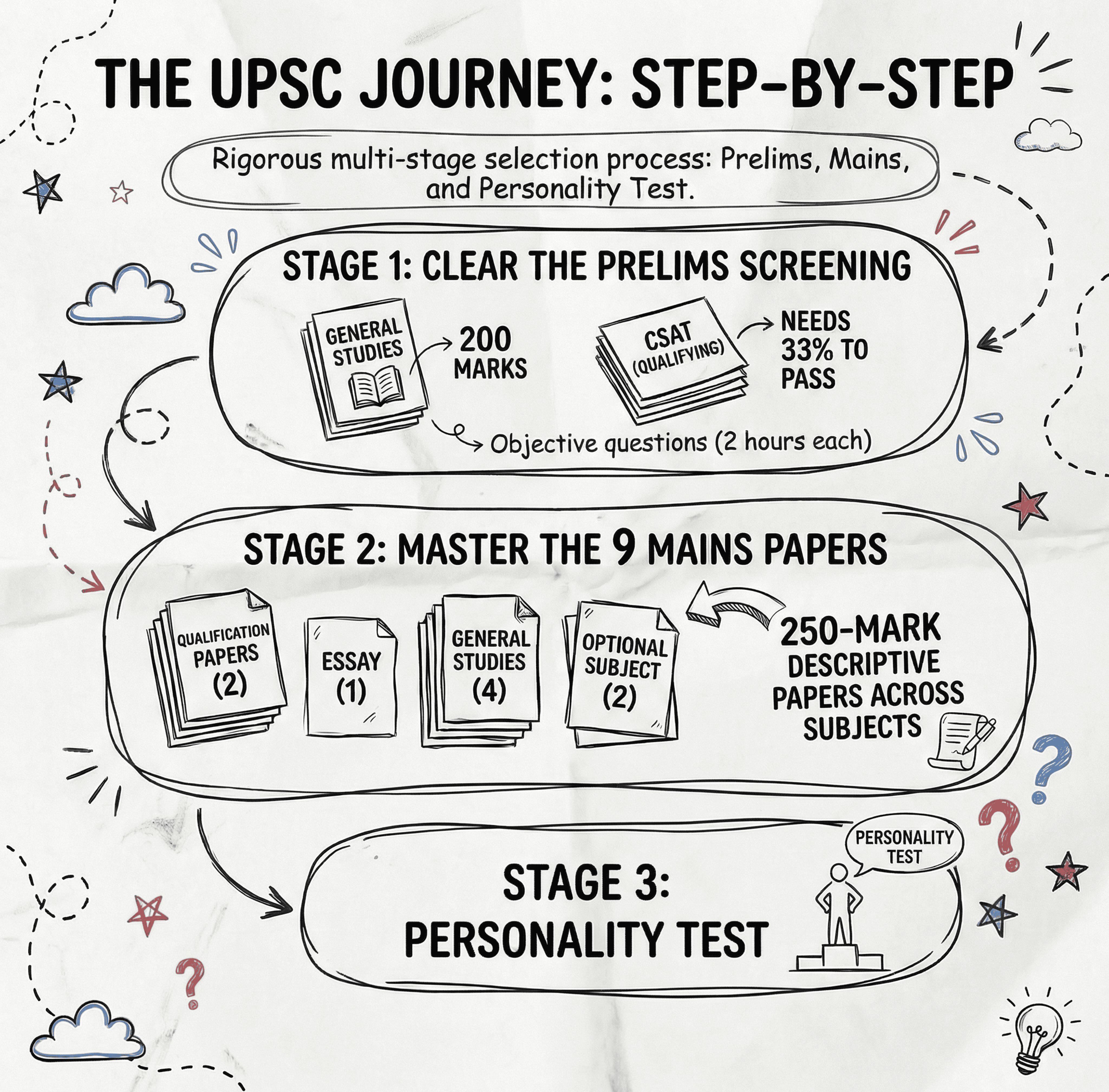
The UPSC Examination is divided into 3 phases:
Prelims Exam
Mains Exam
Personality Interview Test
After clearing each stage, the candidates are qualified for the successive stage and the Personality Interview test is the final phase of selection.
Prelims Exam
The Preliminary Examination consists of two papers of 200 marks each:
General Studies I
General Studies II.
Note: GS Paper II is a qualifying paper with minimum qualifying marks being 33%.
These papers are objective in nature. They contain MCQs (Multiple Choice Questions). Marks secured at this stage determine whether a candidate will sit for Mains examination. These marks are not considered in final selection or rank determination.
The Preliminary stage is an objective-type exam. To practice effectively, aspirants should download the official UPSC OMR Sheet Pdf to simulate exam conditions and cross-verify their mock scores using official Answer Keys from previous years.
Mains Examination
The Mains Examinations consists of nine papers in total out of which only seven are considered in the final merit list.
The remaining two papers are of qualifying nature and candidates have to obtain the minimum qualifying marks determined by UPSC each year in order to move to the next stage.
All papers in the Mains exam are of subjective type.
Interview (Personality Test)
The final stage of selection consists of a board of members assessing the personality of the candidates through an interview.
In the personality test, the board asks questions in order to determine whether the candidate has the social skills and critical thinking required to hold a position in civil service.
Successful candidates eventually find their names on the IAS Civil List, a comprehensive directory of all serving IAS officers in India maintained by the Department of Personnel and Training (DoPT).
Note for current cycle candidates: There have been recent updates regarding the UPSC CSE Mains Interview Personality Test 2026. Check the revised schedule to ensure you don't miss your slot
UPSC Syllabus (Prelims & Mains)
Here is the overview of the UPSC Prelims syllabus and UPSC Mains syllabus:
Stage | Paper | Subjects / Areas Covered | Nature of Paper |
Prelims | General Studies Paper I | History, Geography, Polity, Economy, Environment, Science & Technology, Current Affairs | Objective (MCQs), Merit-counting |
Prelims | CSAT (Paper II) | Comprehension, Logical Reasoning, Analytical Ability, Basic Numeracy, Decision Making | Objective (MCQs), Qualifying (33%) |
Mains | Paper A | Indian Language (from Eighth Schedule) | Descriptive, Qualifying |
Mains | Paper B | English | Descriptive, Qualifying |
Mains | Essay (Paper I) | Essay writing on multiple topics | Descriptive, Merit-counting |
Mains | General Studies I | Indian Heritage & Culture, History, Geography, Society | Descriptive |
Mains | General Studies II | Polity, Governance, Constitution, Social Justice, International Relations | Descriptive |
Mains | General Studies III | Economy, Agriculture, Science & Tech, Environment, Security, Disaster Management | Descriptive |
Mains | General Studies IV | Ethics, Integrity, Aptitude, Case Studies | Descriptive |
Mains | Optional Subject Paper I | Chosen subject (e.g., History, Sociology, Public Administration, etc.) | Descriptive |
Mains | Optional Subject Paper II | Same optional subject (advanced level) | Descriptive |
Note: UPSC optional subjects are chosen by the candidates based on their expertise and interest.
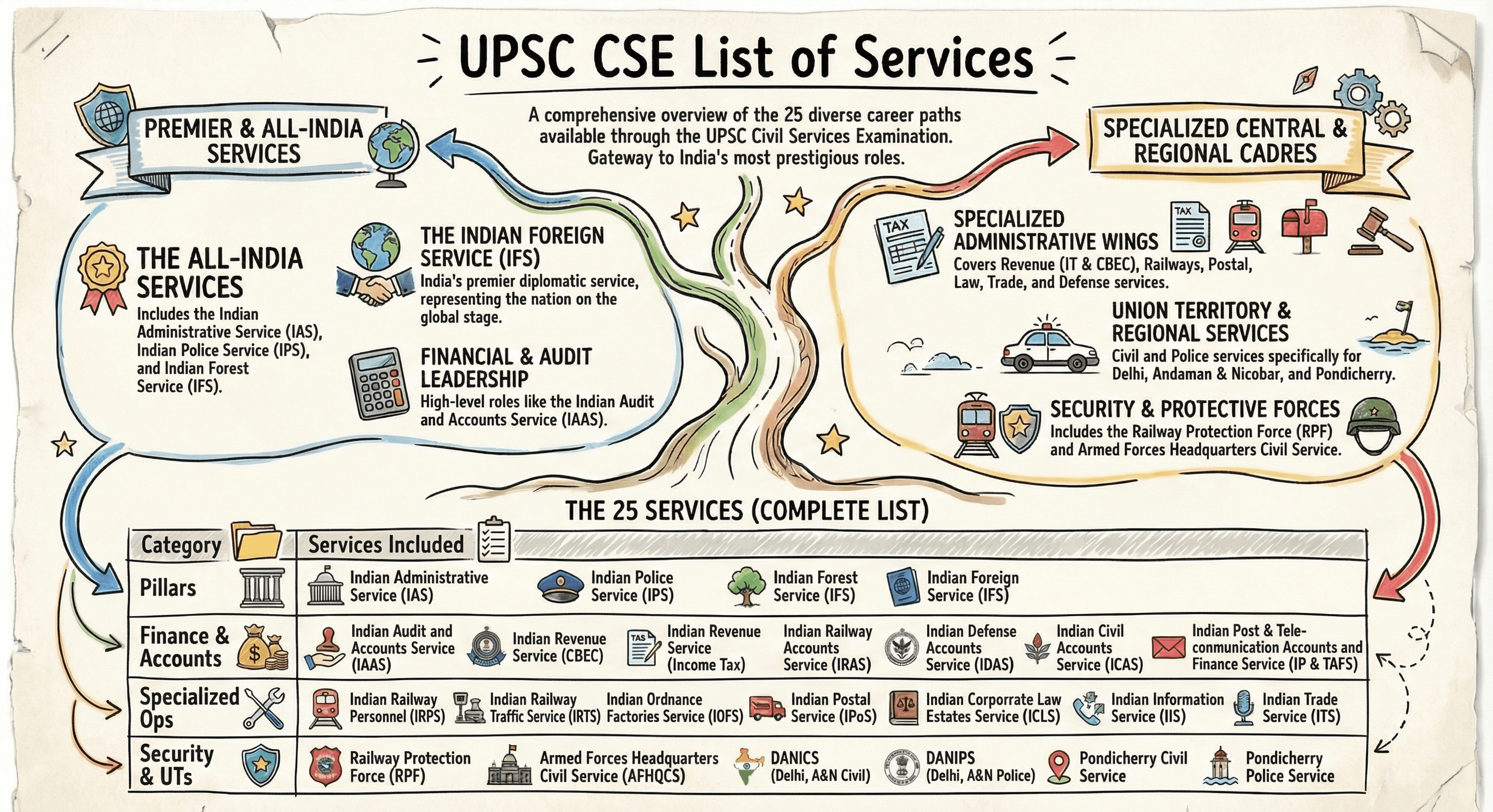
The services offered through UPSC CSE are:
Service | Full Form | Category | Type | Primary Role |
IAS | Indian Administrative Service | All India Service | Group A | District & state administration, policy implementation |
IPS | Indian Police Service | All India Service | Group A | Law & order, policing, internal security |
IFoS* | Indian Forest Service | All India Service | Group A | Forest & environmental management |
IFS (Foreign) | Indian Foreign Service | Central Service | Group A | Diplomacy, embassies, foreign policy |
IRS (IT) | Indian Revenue Service - Income Tax | Central Service | Group A | Direct tax administration |
IRS (C&IT) | Indian Revenue Service - Customs & Indirect Taxes | Central Service | Group A | GST, customs, indirect taxes |
IAAS | Indian Audit & Accounts Service | Central Service | Group A | Government auditing (CAG) |
ICAS | Indian Civil Accounts Service | Central Service | Group A | Government financial management |
IIS | Indian Information Service | Central Service | Group A | Media & communication for government |
IPoS | Indian Postal Service | Central Service | Group A | Postal system administration |
IRAS | Indian Railway Accounts Service | Central Service | Group A | Railway finances |
IRTS | Indian Railway Traffic Service | Central Service | Group A | Railway operations & logistics |
IRPS | Indian Railway Personnel Service | Central Service | Group A | HR management in Railways |
IDAS | Indian Defence Accounts Service | Central Service | Group A | Defence financial administration |
ICLS | Indian Corporate Law Service | Central Service | Group A | Corporate regulation & compliance |
DANICS | Delhi, Andaman & Nicobar Islands Civil Service | UT Service | Group B* | Administration in Union Territories |
DANIPS | Delhi, Andaman & Nicobar Islands Police Service | UT Service | Group B* | Policing in Union Territories |
Pondicherry Civil Service (PCS) | — | UT Service | Group B | Administration in Puducherry |
Pondicherry Police Service (PPS) | — | UT Service | Group B | Policing in Puducherry |
Every year, 10-13 lakh candidates apply for the UPSC Civil services exam (UPSC CSE). Out of them:
Only 5-6 lakh actually appear for the Prelims.
11000-15000 candidates typically qualify for the Mains exam.
Out of these, 2000-3000 get selected for the final interview.
The final recommended candidates in the merit list are around 700-1100
This makes the selection rate in UPSC less than 0.2%.
Want to see what it takes to succeed? Review the UPSC Toppers List to learn about their backgrounds, or perform a UPSC Marksheet 2025 to see the cut-off trends and scoring patterns of the previous year.

There are a few common methodologies that candidates can follow in order to start UPSC preparation and stay consistent throughout the journey:
Gain foundational knowledge first with basic concepts cleared.
Use a standard set of books and do not refer to too many sources
Make a daily routine that you can follow to study efficiently and devote appropriate time to each topic.
Practice writing answers in essay format and give mock exams as well as mock interviews.
Revise and review core topics.
Use resources and information provided by PadhAI experts to streamline your preparation.
The UPSC Notification 2026 was released on February 4th, 2026. Here are the important dates for this examination cycle as per the notification:
Event | Date |
Notification Release | 4 February 2026 |
Application Start Date | 4 February 2026 |
Last Date to Apply | 27 February 2026 |
Prelims Admit Card | To Be Announced |
UPSC Prelims Exam | 24 May 2026 (Sunday) |
Prelims Result | To Be Announced |
DAF-I (Mains Application Form) | To Be Announced |
UPSC Mains Exam Start | 21 August 2026 |
Mains Result | To Be Announced |
Interview / Personality Test | To Be Announced |
Final Result | To Be Announced |
Step-by-Step UPSC Application Process
Apply online through the official website: www.upsconline.nic.in
Fill the Online Application Form. It has two parts- Part-I and Part-II
General Male candidates have to pay a fee of Rs.100 either by depositing money in any branch of State Bank of India by cash or through net banking. SC/ST/Female/Person with Benchmark Disability are exempted from fee payment.
Before filling up the Online Application form, ensure you have your photograph and signature scanned in jpg format. The size is between 3KB and 40KB for photo and 1KB -40KB for signature. You can use UPSC photo resizer tool for the same.
Avoid submitting multiple applications.
Ensure that you use your active email ID for the process as the Commission may use it for further communication.
Frequently asked question (FAQs)
What is the Full form of UPSC?
Where is the headquarters of UPSC located?
Which exam is conducted by UPSC?
Is UPSC only for IAS?
How many candidates clear UPSC every year?
The Union Public Service Commission (UPSC) is a constitutional body that plays an essential role in conducting civil services exams. It has a rich history dating pre-independence era and has evolved to become one of the most prestigious institutions of India. The UPSC also advises the President on matters related to recruitment , promotions and disciplinary actions for civil servants.




No comments yet. Be the first to join the discussion!