Annapurna Bhandar 2026 Scheme: Eligibility, Benefits & Status Check

Gajendra Singh Godara
11
mins read
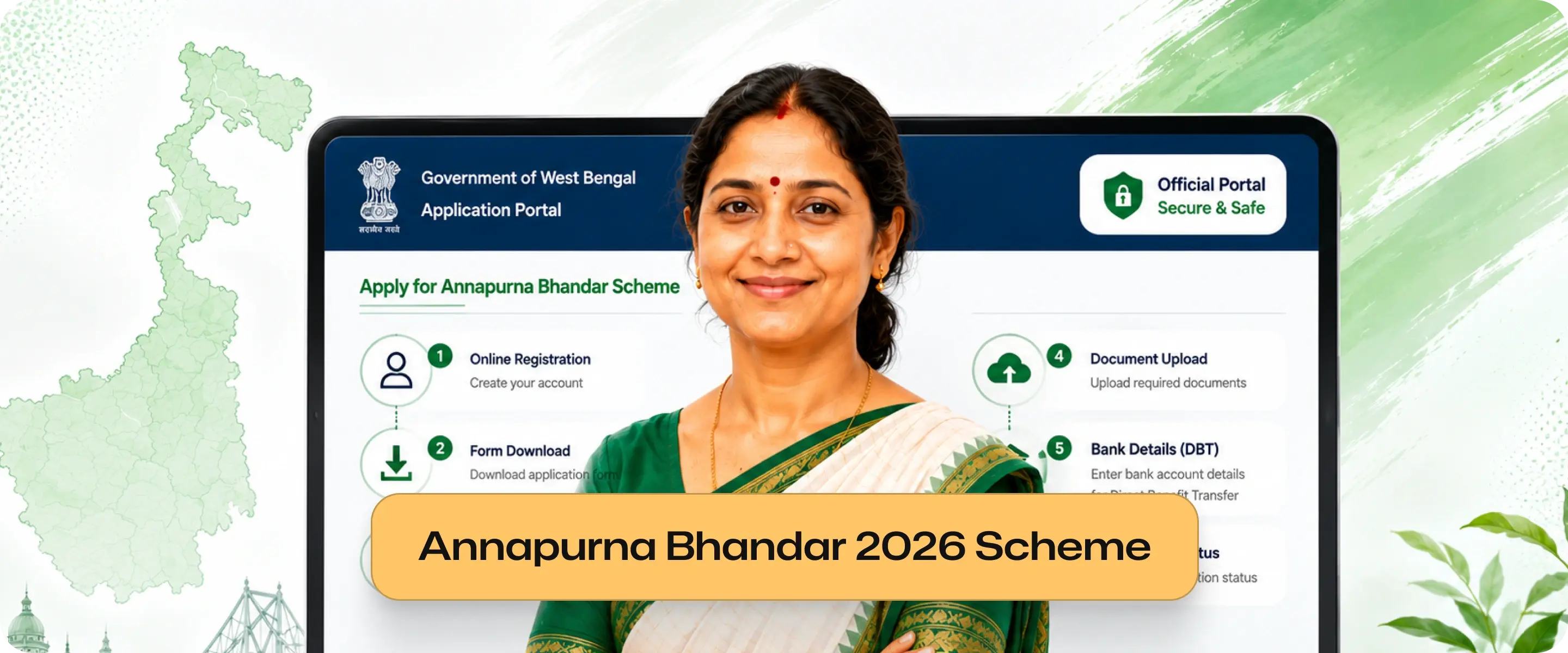
West Bengal government introduced a new scheme Annapurna Bhandar on 1 June 2026 to replace the Lakshmir Bhandar scheme which is running since 2021.
Under this scheme, the eligible women between 25 and 60 years will get Rs 3,000 per month directly in their bank account under the Direct Benefit Transfer (DBT) system linked with Aadhaar.
The application window is between 27 May and 25 August 2026. If you are preparing for UPSC or state PCS exams, this scheme is directly linked to themes in GS Paper 2 on women welfare, DBT governance, financial inclusion, and state vs center fiscal issues.
Feature | Details |
Scheme Name | Annapurna Bhandar / Annapurna Yojana |
Earlier Name | Matri Shakti Bharosa Scheme |
State | West Bengal |
Nodal Authority | Women and Child Development Department |
Launch Date | 1 June 2026 |
Monthly Benefit | Rs 3,000 (via DBT) |
Age Eligibility | 25 to 60 years |
Application Window | 27 May to 25 August 2026 (90 days) |
Official Portal | |
Replaces | Lakshmir Bhandar Scheme (2021) |
First Instalment Date | 3 June 2026 |
Sanctioning Authority | District Magistrate / KMC Commissioner |
Previous Benefit Amount | Rs 1,500 to Rs 1,700 per month |
Join our WhatsApp Community
The Annapurna Bhandar scheme is a women’s financial assistance programme run by the Government of West Bengal.
It was first proposed during the 2026 West Bengal Assembly Elections under the name Matri Shakti Bharosa Scheme, as part of the BJP’s “Bhoroshar Shopoth” manifesto.
The BJP won 207 of 293 assembly seats. Suvendu Adhikari took oath as Chief Minister on 9 May 2026.
The scheme was cleared at the state’s first cabinet meeting on 11 May 2026, and the rollout started on 1 June 2026, with the first DBT instalment credited to beneficiary accounts on 3 June 2026.
The name “Annapurna” refers to the Hindu goddess of nourishment and food. The government frames the scheme around household food security and economic stability for women.
The Trinamool Congress government launched Lakshmir Bhandar in August 2021.
It initially provided Rs 500 per month to general-category women and Rs 1,000 per month to SC/ST women, later raised to Rs 1,500 to Rs 1,700 per month.
Around 2.20 crore women were enrolled when the scheme was discontinued.
Annapurna Bhandar replaces it with a flat Rs 3,000 per month for all eligible women, regardless of social category.
The verification process is stricter: it includes Aadhaar-linked bank validation, electoral roll screening, and family data collection as part of enrollment.
Add as a preferred Source on Google
The following conditions must all be met for a woman to receive the Rs 3,000 monthly benefit:
Gender: Only women can apply.
Residency: The applicant must be a permanent resident of West Bengal with valid residence documents.
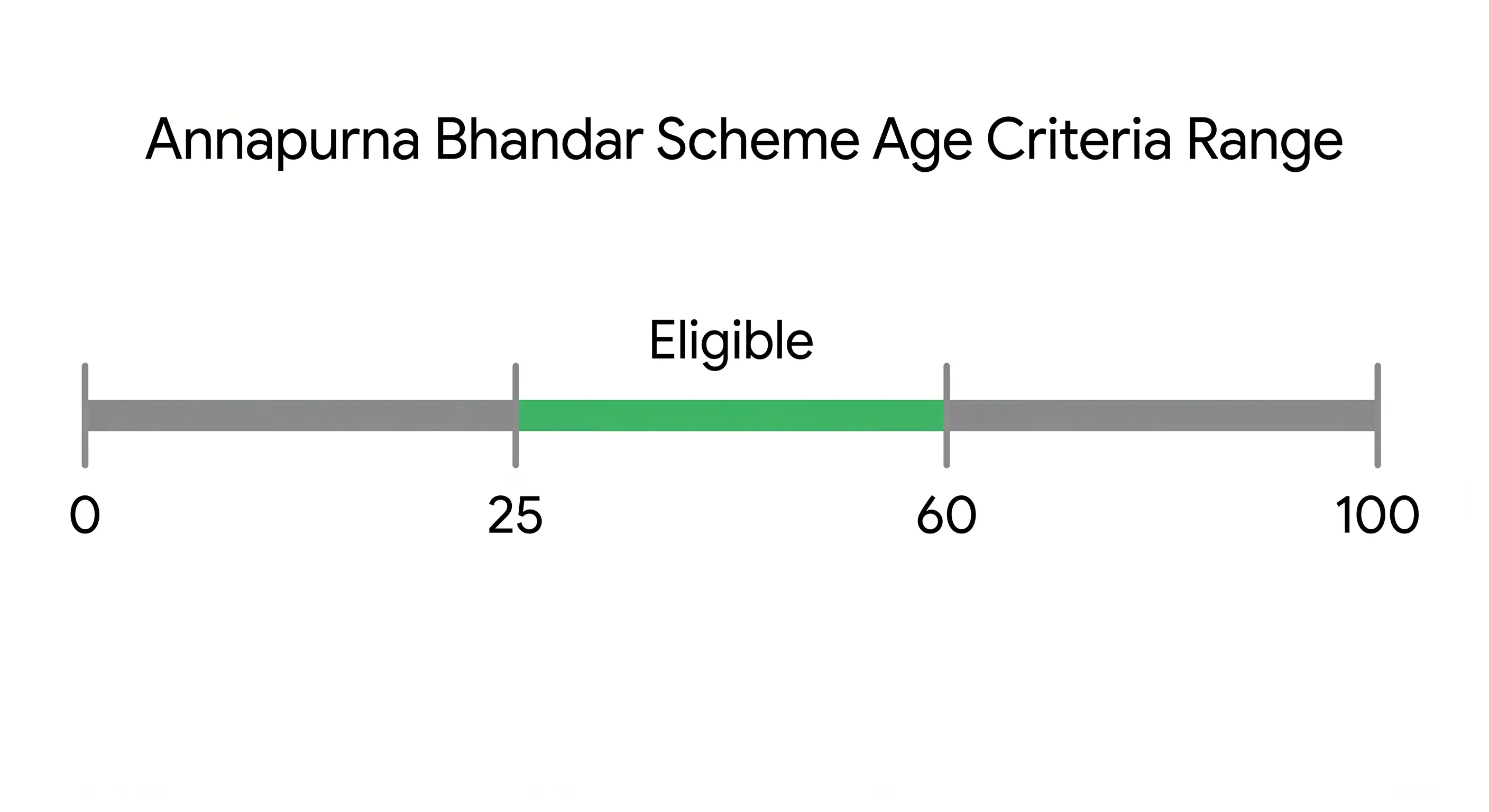
Age: Women between 25 and 60 years qualify.
Citizenship: Only Indian citizens are eligible. The state government clarified that welfare payments will not extend to illegal migrants from Bangladesh.
Who Is NOT Eligible for Annapurna Bhandar?
The scheme targets economically weaker households. The following women are excluded:
Women who file an Income Tax Return (ITR).
Women in permanent government service or receiving a salary from the Central or West Bengal government.
Employees of statutory bodies, government undertakings, municipalities, panchayats, or local authorities drawing regular government-linked income.
Teaching and non-teaching staff in government-aided educational institutions in West Bengal.
Women receiving a pension from the Central or state government.
What Happens to Existing Lakshmir Bhandar Beneficiaries?
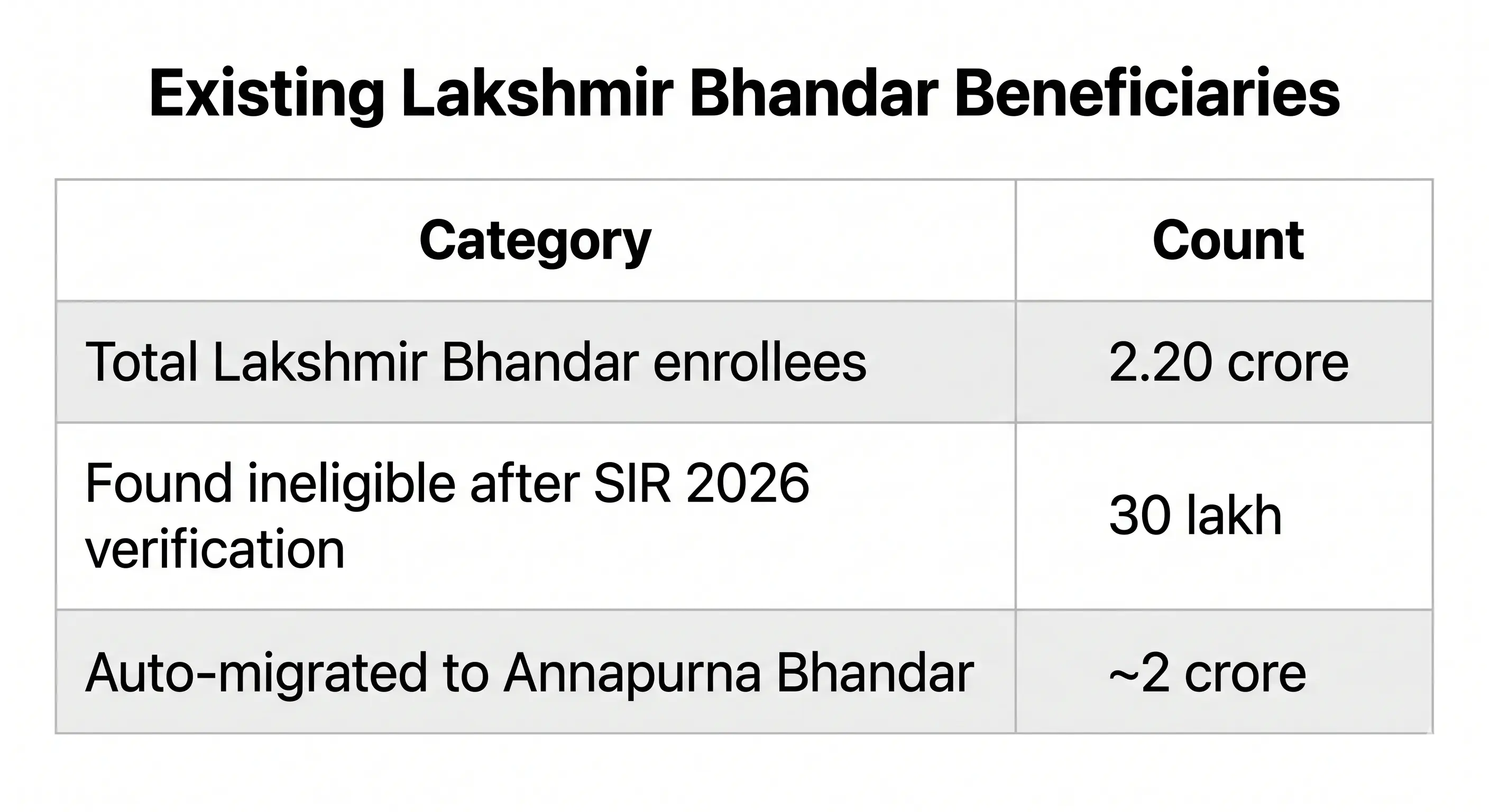
Of the 2.20 crore women enrolled under Lakshmir Bhandar, 30 lakh were found ineligible after verification. Their names were either absent from voter lists, identified as non-Indian citizens, or they had not applied to a SIR-linked tribunal or for inclusion under the Citizenship Amendment Act (CAA).
The remaining approximately 2 crore beneficiaries shift to Annapurna Bhandar automatically, with no fresh application required.
Their Lakshmir Bhandar benefits will be continued until the Annapurna Bhandar sums start getting credited to their accounts.
Women excluded from automatic migration include those who were marked as dead, shifted, deleted or absentee electors during Special Intensive Revision (SIR) 2026 of voter lists.
Those who were deleted after adjudication, and beneficiaries marked ASDD (Absent, Shifted, Dead or Duplicate) during voter slip distribution.
Women who appealed to the SIR Tribunal or applied under the CAA will continue to get benefits till their cases are resolved.
The main benefit is Rs 3,000 per month, paid directly into the Aadhaar-linked bank account of each eligible woman through the DBT system.
The cash transfer is the headline benefit, but the design choices around it also matte:
Direct financial support. Rs 3,000 per month gives women a predictable income to manage food, medicine, children’s education, and household costs.
No intermediaries. The NPCI Bharat Aadhaar Seeding Enabler (BASE) system routes funds straight into the bank account. No panchayat representative or local contractor touches the money.
Women hold the money. The transfer goes into the woman’s own account, not a joint account or her husband’s account. That matters more than it sounds.
Banking inclusion as a side effect. Every beneficiary needs an active Aadhaar-linked bank account. Women outside the formal banking system are nudged to open accounts, which widens financial inclusion across West Bengal.
Two application modes. Both online and offline channels are available, so women in rural areas with limited internet access can still apply.
Status tracking. After enrolment, beneficiaries can track their application using the official portal and their reference number.
The application window opened on 27 May 2026 and runs for 90 days until 25 August 2026. New applicants who were not on the Lakshmir Bhandar rolls can apply online or offline.
Online Application Process
Visit socialsecurity.wb.gov.in (new applicants may also use socialregistry.wb.gov.in for family-level data registration).
Register on the portal and log in with your mobile number and OTP.
Click on ‘New Application’ or ‘Apply Online’.
Fill in the seven-section application form with accurate family and personal details.
Upload all required documents (self-attested).
Submit the form and note the application reference number.
Wait for verification and approval from the District Magistrate (districts) or the Commissioner, Kolkata Municipal Corporation (KMC areas).
Offline Application Process
Collect the application form from your local block office, municipality office, or panchayat office.
MLAs have been assigned to help women fill forms. Teams under Block Development Officers (BDOs) will visit homes for assistance.
The government organized “Janakalyan Shibir” camps across West Bengal from 15 to 17 June 2026 for form submission.
Submit the completed form with self-attested documents and collect the acknowledgement receipt.
What the Application Form Asks For?
The Annapurna Bhandar Yojana form is a 12-page document available in Bengali, English, and Hindi. It has seven sections:
Section | Information Required |
Family Identity | Head of Family details, Household ID, Digital Ration Card, EPIC and bank account details of all family members |
Ration Card / Food Subsidy | Type of ration card, whether lifting monthly ration |
Assets | House, land, vehicle, and insurance ownership |
Income / Profession | Tax status, PAN, GST, employment type, annual family income |
Identity Documents | Aadhaar details, Voter ID, CAA application status if any |
Social Status / Dependents | School-going children, vaccination status |
Govt Scheme Benefits | Existing scheme benefits, reasons for exclusion if any |
Any error in the Aadhaar number, bank account details, or income declaration can delay verification or result in rejection. Fill the form carefully.
Keep these documents ready before filling the form:
Aadhaar card (mandatory for DBT linkage)
Voter ID card (EPIC)
Residence proof (any government-issued document showing West Bengal address)
Bank account passbook or account statement
Passport-size photographs
All documents need to be self-attested before submitting the offline form. For online applications, upload scanned copies.
Online Status Check
Visit socialsecurity.wb.gov.in.
Click on ‘Track Application’ or the beneficiary status section.
Enter your Application Reference Number and registered mobile number.
Complete OTP verification if prompted.
Your status appears on screen.
Offline Status Check
Visit your local block office or municipal office with your acknowledgement receipt. Officials can look up your status using the reference number.
If your payment does not arrive after successful verification, contact the nearest BDO office or call the helpline at 1800-345-5555.
How to Check Whether the DBT Payment Was Credited
After verification and approval, DBT payments go only to the Aadhaar-linked bank account. To confirm which account your Aadhaar is currently linked to, use the NPCI BASE portal:
Visit the official NPCI website.
Under the ‘Customer’ section, select ‘Bharat Aadhaar Seeding Enabler (BASE)’.
Click ‘Aadhaar Mapped Status’ and enter your Aadhaar number.
Verify with the OTP sent to your Aadhaar-linked mobile number.
Your current bank name and DBT status will display.
You can also check seeding status through the myAadhaar portal under the ‘Bank Seeding Status’ tab.
How to Update Your Bank Account for Annapurna Bhandar DBT
If your Aadhaar is linked to a closed, inactive, or wrong account, the DBT payment will fail. Update it through NPCI:
Go to the NPCI website and navigate to BASE under the Customer section.
Click ‘Aadhaar Seeding / Deseeding’.
Enter your Aadhaar number and select ‘Seeding’.
Choose your new bank and select the seeding type:
Fresh Seeding: No account was previously linked.
Movement, Same bank, different account: Change to another account within the same bank.
Movement, Different bank: Link an account at a new bank.
Enter the new account number, confirm it, and submit with OTP verification.
Once updated, the revised Aadhaar-bank mapping becomes active for DBT payments.
Annapurna Bhandar vs Lakshmir Bhandar: Side-by-Side Comparison
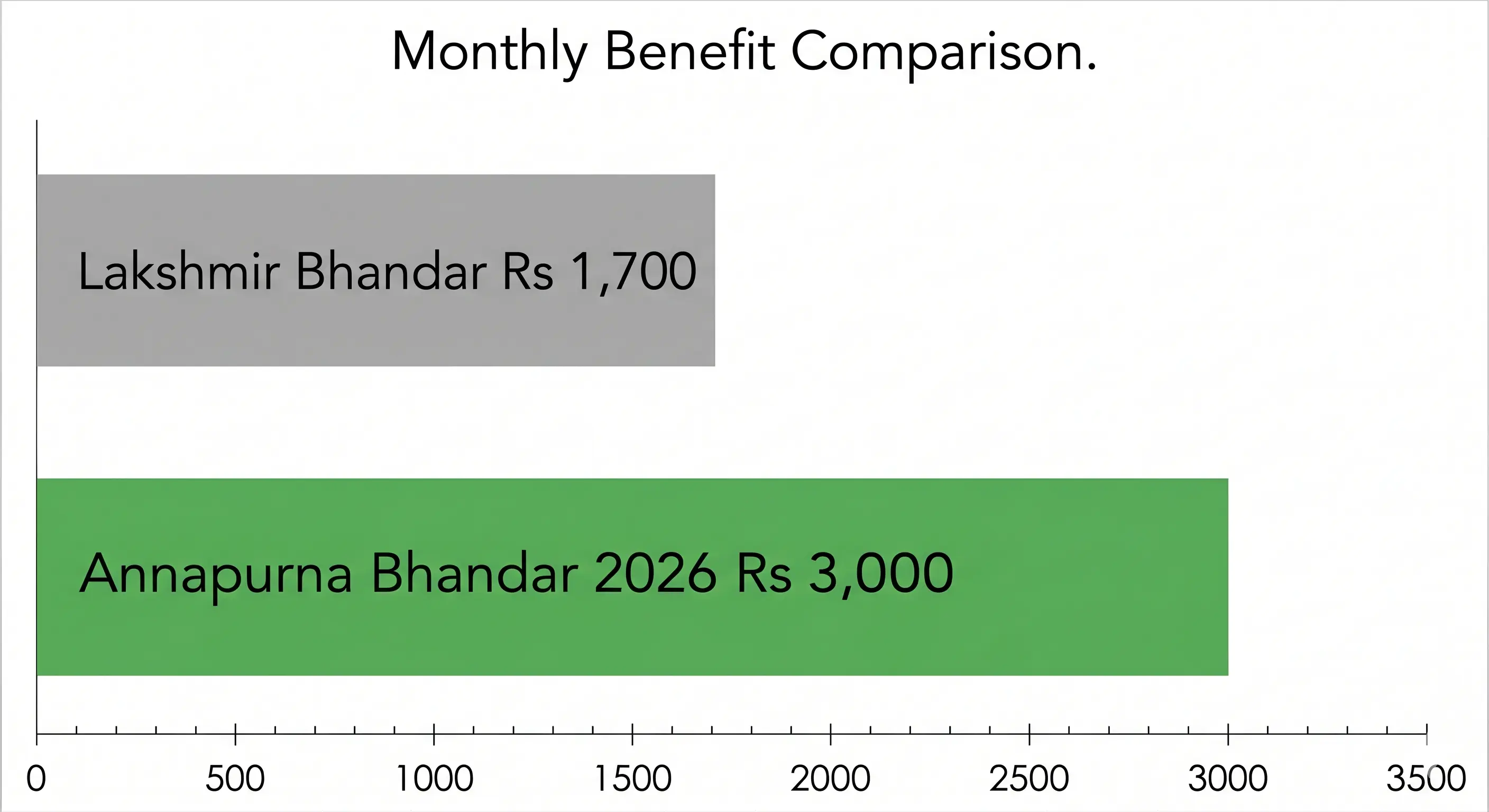
Feature | Lakshmir Bhandar | Annapurna Bhandar 2026 |
Monthly Benefit | Rs 1,500 to Rs 1,700 | Rs 3,000 |
Age Eligibility | 25 to 60 years | 25 to 60 years |
Launch Year | 2021 (Trinamool Congress) | 2026 (BJP government) |
Transfer Mode | DBT | DBT |
Benefit Structure | Category-wise (General / SC / ST) | Flat amount for all eligible women |
Verification | Basic | Stricter (electoral roll + Aadhaar + family data) |
Status | Discontinued | Active from 1 June 2026 |
Beneficiary Base | 2.20 crore enrolled | Approx. 2 crore (after 30 lakh removed) |
Is West Bengal’s Annapurna Bhandar the Same as Rajasthan’s?
No. The two are separate programmes. UPSC aspirants should not confuse them.
Rajasthan’s Annapurna Bhandar Yojana is a Public-Private Partnership (PPP) model launched in 2015.
It proposed setting up 5,000 Annapurna Bhanders at Fair Price Shops to sell branded daily essentials (oil, ghee, pulses, spices, jaggery, flour, personal care products) at subsidised rates to BPL households.
It was discontinued and Rajasthan’s current government is expected to relaunch it in 2026.
Feature | West Bengal | Rajasthan |
Nature | Direct cash transfer | Subsidised goods at fair price shops |
Target Beneficiary | Women residents of WB | BPL households under NFSA |
Benefit | Rs 3,000 per month cash | Branded goods at lower prices |
Model | State government DBT | PPP retail model |
Launch Date | 1 June 2026 | October 2015 (then discontinued) |
Is It the Same as the Central Government’s Annapurna Scheme?
No. The Central Government also has an Annapurna Scheme, but it is a completely different programme launched on 1 April 2000 under the National Social Assistance Programme (NSAP). Key features:
Launched by the Ministry of Rural Development.
Target group: Destitute senior citizens aged 65 years and above who are eligible for the Indira Gandhi National Old Age Pension Scheme (IGNOAPS) but are not yet receiving it.
Benefit: 10 kg of free food grains (rice or wheat) per month.
Selection: Done by Gram Sabhas; beneficiary lists displayed at Gram Panchayats.
Application: Offline through Gram Panchayat or Block Development Office.
West Bengal’s scheme gives Rs 3,000 cash per month to working-age women. The Centre’s scheme gives free food to destitute senior citizens. They share only a name.
UPSC questions have tested the difference between state and central schemes with similar names, so keep this distinction clear in your notes.
Administrative Structure: How the Scheme Moves from Cabinet to Bank Account
The Annapurna Bhandar 2026 scheme follows a multi-level implementation chain:
Policy Level: Cabinet decision on 11 May 2026. Notification issued by the Chief Minister’s office on 19 May 2026.
Nodal Department: Women and Child Development (WCD) Department, West Bengal.
Coordination: Chief Secretary, Finance Secretary, and district-level officers working under the guidance of Nabanna (West Bengal’s state secretariat).
Sanctioning Authority: District Magistrates in districts; Commissioner of Kolkata Municipal Corporation within KMC jurisdiction.
Field Implementation: Block Development Officers (BDOs) lead door-to-door teams; MLAs assist in form filling and verification; Janakalyan Shibir camps deployed across the state.
Verification Mechanism: Electoral roll screening (SIR 2026), Aadhaar-bank linkage validation via NPCI BASE, and family data form scrutiny.
Payment Channel: NPCI Bharat Aadhaar Seeding Enabler (BASE) system routes DBT payments to Aadhaar-linked accounts.
This chain from cabinet decision to direct bank credit, with multiple verification checkpoints, is a textbook case of cooperative federalism in welfare delivery and a strong example for UPSC answers on DBT governance.
UPSC Significance: Why This Scheme Matters for Your Exam
Prelims Quick-Reference Facts
Scheme Name: Annapurna Bhandar / Annapurna Yojana
Earlier Name: Matri Shakti Bharosa Scheme
State: West Bengal
Launch: 1 June 2026; first instalment credited 3 June 2026
Nodal Authority: Women and Child Development Department, WB
Monthly Amount: Rs 3,000 (via DBT)
Age Range: 25 to 60 years
Application Window: 90 days (27 May to 25 August 2026)
Official Portal: socialsecurity.wb.gov.in
Replaces: Lakshmir Bhandar Scheme
Automatic Migration: Approx. 2 crore existing Lakshmir Bhandar beneficiaries
Sanctioning Authority: District Magistrate (districts) / KMC Commissioner (Kolkata)
Central Annapurna Scheme under NSAP: Free 10 kg food grains for destitute senior citizens aged 65 and above. NOT the same scheme.
Mains Relevance: GS Paper 2
Women welfare and empowerment: Annapurna Bhandar directly addresses women’s economic dependency, a structural problem in Indian households.
Questions on women’s economic security, the gender pay gap, or financial inclusion appear regularly in Mains.
You can cite this scheme as an example of how state governments are using DBT to put cash directly in women’s hands, bypassing social gatekeepers.
Good governance and DBT architecture: The scheme shows how Direct Benefit Transfer, Aadhaar seeding, and NPCI’s BASE system work together to remove intermediaries.
For any Mains answer on the JAM Trinity (Jan Dhan-Aadhaar-Mobile) or digital governance of welfare, this is a live case study.
Centre-state dynamics in social welfare: Social welfare is largely a state subject. The Annapurna Bhandar scheme came into being when a new state government replaced the previous one and chose to redesign the existing programme.
The rollout of Ayushman Bharat in West Bengal alongside Annapurna Bhandar (the state approved Ayushman Bharat in its first cabinet) shows how state and central schemes can now run side by side. This is a relevant point for cooperative federalism questions.
Fiscal sustainability of direct cash transfers. West Bengal carried a debt of approximately Rs 6.9 lakh crore as of 2025.
Welfare spending already accounted for about 45% of the state’s projected 2026-27 budget, with the fiscal deficit at 3.6% of GSDP, above the 3.5% ceiling. Annapurna Bhandar, while widely appreciated as a welfare measure, raises real questions about fiscal space for infrastructure investment.
This tension between social spending and fiscal consolidation is a standard Mains theme.
Essay / Ethics angle: “Can cash transfers replace structural reform as an answer to poverty?”
The Annapurna Bhandar scheme sits right at the centre of this question, whether assured income transfers build genuine economic independence or create long-term dependence on state payments.
Real Challenges and Policy Concerns
Exclusion errors from SIR 2026 verification. The Special Intensive Revision process removed 30 lakh existing beneficiaries. Some may have been wrongly excluded, a risk that large-scale electoral verification exercises carry.
CAA-linked beneficiaries in limbo. Women who applied under the Citizenship Amendment Act for inclusion now wait for tribunal decisions to know if they stay in the scheme. This creates uncertainty for a vulnerable sub-group.
Database inaccuracies. Verifying 2.20 crore beneficiaries through electoral rolls and Aadhaar records is a large exercise. Inactive or incorrect Aadhaar-bank seeding causes payment failures.
Fiscal stress. Rs 3,000 per month for 2 crore women works out to approximately Rs 72,000 crore per year, a significant recurring liability for a state already running a high debt burden.
Infrastructure trade-off. West Bengal’s infrastructure spending fell from 5.3% to 3% of state GDP in recent years. Critics argue welfare-heavy budgets crowd out productive capital expenditure.
Frequently asked question (FAQs)
What is the Annapurna Bhandar 2026 scheme and how is it different from Lakshmir Bhandar?
How can I check Annapurna Bhandar application status online?
What is the Annapurna Bhandar eligibility, and who cannot apply?
Is the West Bengal Annapurna Bhandar scheme the same as the Central Government’s Annapurna Scheme?
Why is Annapurna Bhandar relevant for UPSC GS Paper 2?




Research methodology
PadhAI's research methodology ensures every article is accurate, UPSC-ready, and beginner-friendly. We curate current affairs analysis based on UPSC exam relevance by cross-referencing The Hindu, Indian Express, and PIB. General Studies (GS) topics are drafted from NCERTs and standard books such as M. Laxmikanth, Spectrum, and GC Leong, then reviewed by subject matter experts to eliminate factual errors. Additionally, we update aspirants with verified government exam notifications alongside expert blogs suggesting the best resources, syllabus, and comprehensive Prelims and Mains strategies.


Gajendra Singh Godara is an IIT Bombay graduate and a UPSC aspirant with 4 attempts, including multiple Prelims and Mains appearances. He specializes in Polity, Modern History, International Relations, and Economy. At PadhAI, Gajendra leverages his firsthand exam experience to simplify complex concepts, creating high-efficiency study materials that help aspirants save time and stay focused.
No comments yet. Be the first to join the discussion!