Transgender Rights Bill 2026: Amendment, Highlights, Changes
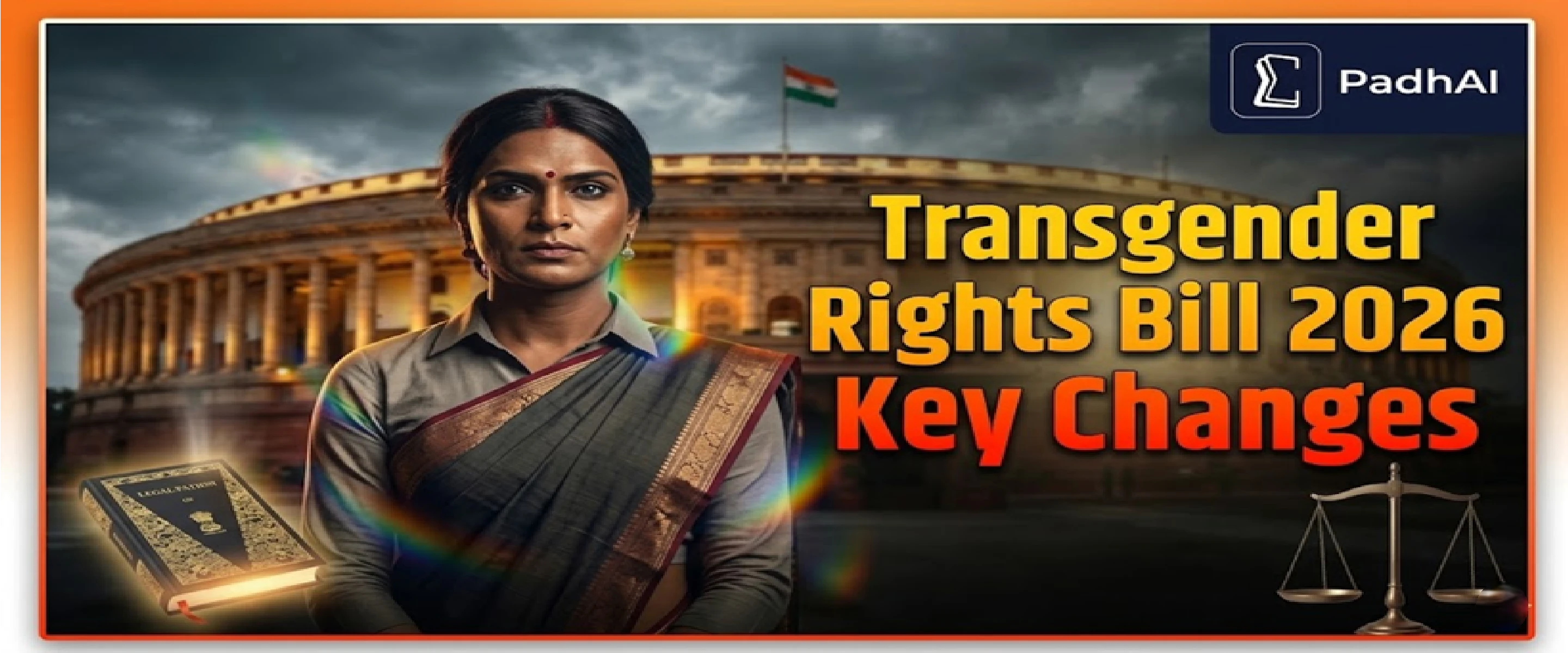
The Transgender Rights Bill 2026 revises the 2019 law by removing self-identification, introducing medical certification, and narrowing definitions. This article explains provisions, criticisms, and UPSC relevance.

Gajendra Singh Godara
Last updated
4
mins read
Key Highlights
The core features of the bill are listed below:
Removes the right to self-identify gender
Introduces mandatory medical certification
Narrows the definition of transgender persons
Creates new legal categories
Strengthens penal provisions
Alters institutional mechanisms
Raises concerns on autonomy and inclusivity
The Transgender Rights Bill 2026 is a legislative amendment that reshapes how India defines, recognises, and protects transgender persons.
It modifies the 2019 Act by introducing medical certification, limiting definitions, and strengthening penalties. For UPSC aspirants, this topic connects constitutional rights, governance, and social justice.
The Transgender Rights Bill 2026 is an amendment to the Transgender Persons (Protection of Rights) Act, 2019 that revises legal recognition, definition, and protection mechanisms for transgender persons.
It changes the original rights-based approach and introduces a structured system of certification and classification.
Join our WhatsApp Community
The bill rests on a conceptual distinction explained below:
Sex refers to biological traits such as chromosomes and hormones
Gender refers to social roles and expectations
Gender identity refers to a person’s internal sense of self
The 2019 Act treated transgender as an umbrella category covering diverse identities such as trans men, trans women, intersex persons, and non-binary individuals.
The NALSA judgment (2014) is a Supreme Court ruling that recognised transgender persons as a third gender and affirmed self-identification as a fundamental right.
It directed the state to provide legal recognition and welfare measures. The 2019 Act followed this rights-based approach.
India AI Impact Summit 2026
Add as a preferred Source on Google
1. Narrower Definition of Transgender
The bill restricts the definition to:
Specific socio-cultural identities like hijra or kinner
Persons with congenital biological variations
This replaces the broader umbrella definition.
2. Removal of Self-Identification
The bill deletes the right to self-identify gender.
Legal recognition now depends on external verification instead of personal declaration.
3. Introduction of Medical Certification
The certification process is defined as follows:
A medical board evaluates applicants
The board recommends identity certification
District authorities finalise recognition
This creates clinical involvement in identity recognition.
4. Creation of New Legal Category
The bill introduces a category for persons forced into transgender identity through coercion or harmful practices.
5. Institutional Changes
The administrative structure includes:
Medical boards led by senior officers
Higher-ranking representation in national bodies
This formalises governance mechanisms.
6. Enhanced Penal Provisions
The law introduces stricter punishments:
Severe offences may attract long-term imprisonment
Different penalties apply for adults and children
Examples include forced identity or forced begging.
What are the Positive Implications?
The benefits of the bill are listed below:
Stronger punishment may deter exploitation
Clear administrative processes improve governance
Recognition of coercion adds legal protection
These points emerge from the structured approach introduced in the amendment.
Is the New Transgender Bill More Restrictive? (Yes)
Yes. The bill introduces a restrictive framework by shifting from identity-based recognition to biological and medical criteria.
This change reduces personal autonomy in gender recognition.
India US Trade Deal
1. Violation of Self-Determination
The bill removes the right to self-identify gender, which was recognised by the Supreme Court.
2. Burden of Proof on Individuals
Individuals must prove identity through medical processes, which shifts responsibility onto the person.
3. Exclusionary Definition
The narrowed definition excludes gender-fluid and non-traditional identities.
4. Social and Institutional Barriers
Medical certification may be difficult due to stigma in healthcare systems.
5. Shift from Rights to Eligibility
The law moves from a rights-based model to an eligibility-based system controlled by authorities.
The suggested reforms are listed below:
Restore self-identification as a legal right
Keep certification primarily administrative
Maintain an inclusive definition
Strengthen anti-discrimination mechanisms
Improve awareness and institutional sensitivity
Include community participation in policymaking
These steps aim to balance protection with dignity.
Frequently asked question (FAQs)
What is the Transgender Rights Bill 2026?
Does the new transgender bill allow self-identification?
What role does the medical board play in the bill?
Why is the transgender amendment bill 2026 criticised?
How is the new transgender bill different from the 2019 Act?
The Transgender Rights Bill 2026 introduces structural changes such as medical certification, narrower definitions, and stricter penalties.
It strengthens legal safeguards against exploitation but reduces autonomy by removing self-identification. The debate centres on balancing protection with dignity and constitutional rights.






Research methodology
PadhAI's research methodology ensures every article is accurate, UPSC-ready, and beginner-friendly. We curate current affairs analysis based on UPSC exam relevance by cross-referencing The Hindu, Indian Express, and PIB. General Studies (GS) topics are drafted from NCERTs and standard books such as M. Laxmikanth, Spectrum, and GC Leong, then reviewed by subject matter experts to eliminate factual errors. Additionally, we update aspirants with verified government exam notifications alongside expert blogs suggesting the best resources, syllabus, and comprehensive Prelims and Mains strategies.


Gajendra Singh Godara is an IIT Bombay graduate and a UPSC aspirant with 4 attempts, including multiple Prelims and Mains appearances. He specializes in Polity, Modern History, International Relations, and Economy. At PadhAI, Gajendra leverages his firsthand exam experience to simplify complex concepts, creating high-efficiency study materials that help aspirants save time and stay focused.
No comments yet. Be the first to join the discussion!