Tiger Reserves in India: State-wise List 2026 & Importance
India’s 58 Tiger Reserves are the ecological backbone of global tiger conservation. Managed under the Wildlife (Protection) Act, these landscapes protect 75% of the world's wild tigers.

Gajendra Singh Godara
Last updated
15
mins read
Add a comment
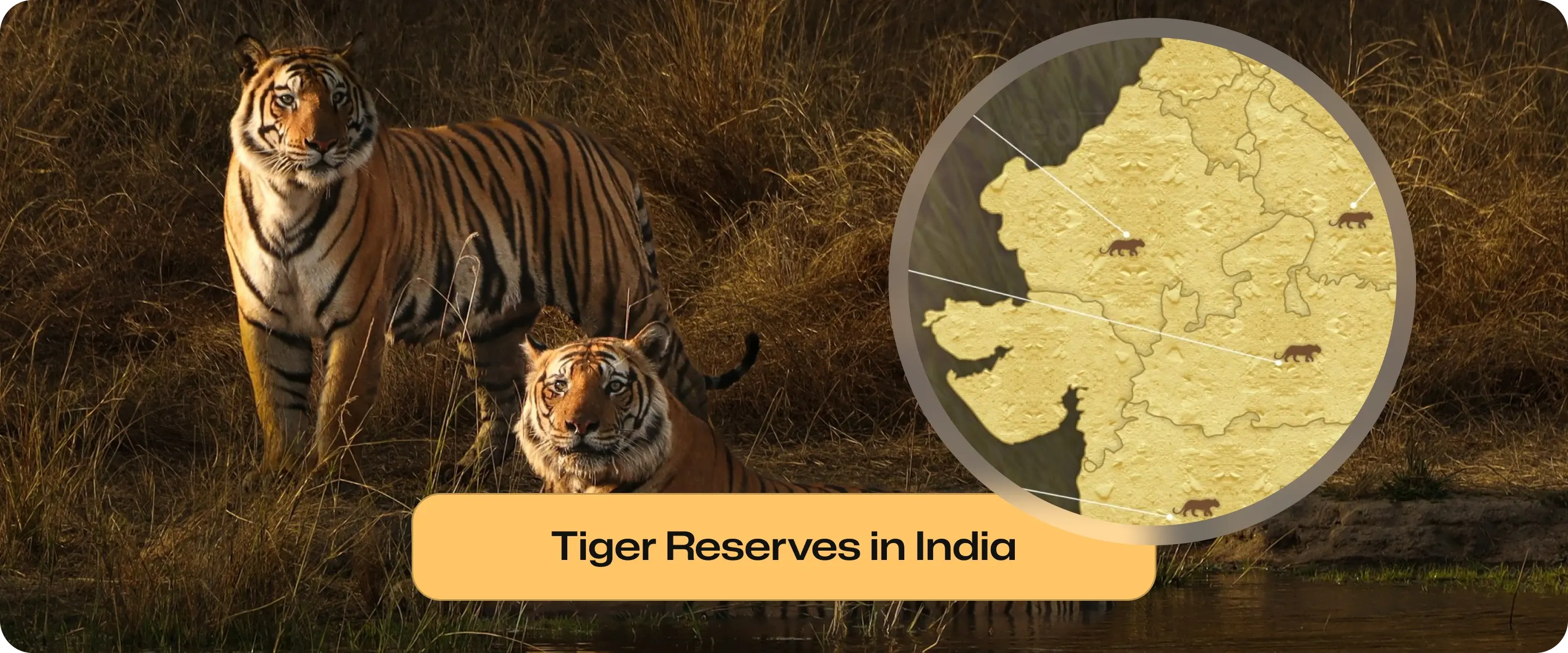
Key highlights:
Total number of tiger reserves: 58
Largest Tiger Reserve : Nagarjunsagar Srisailam (Andhra Pradesh)
Smallest Tiger reserve: Bor Tiger Reserve (Maharashtra)
Top States in tiger conservation : Madhya Pradesh, Karnataka, Uttarakhand
Tiger Population :3,682 (range 3167-3925).
At its simplest, a tiger reserve is a protected area for the tiger population in India. India is home to about 80% of the world’s tiger population.
In 1973, Project Tiger named the Bengal Tiger India’s National Animal. Therefore, tiger conservation has always been a critical issue in the Indian wildlife framework
Join our WhatsApp Community

A Tiger Reserve is defined under the Wildlife (Protection) Act (WPA), 1972, specifically through the 2006 Amendment.
Statutory Basis: Sections 38V to 38X of the WPA, 1972.
The State Government designates an area as a Tiger Reserve, but this action is contingent upon a recommendation from the National Tiger Conservation Authority (NTCA).
Approval for Changes: No boundary change or de-notification can happen without NTCA recommendation and NBWL approval.
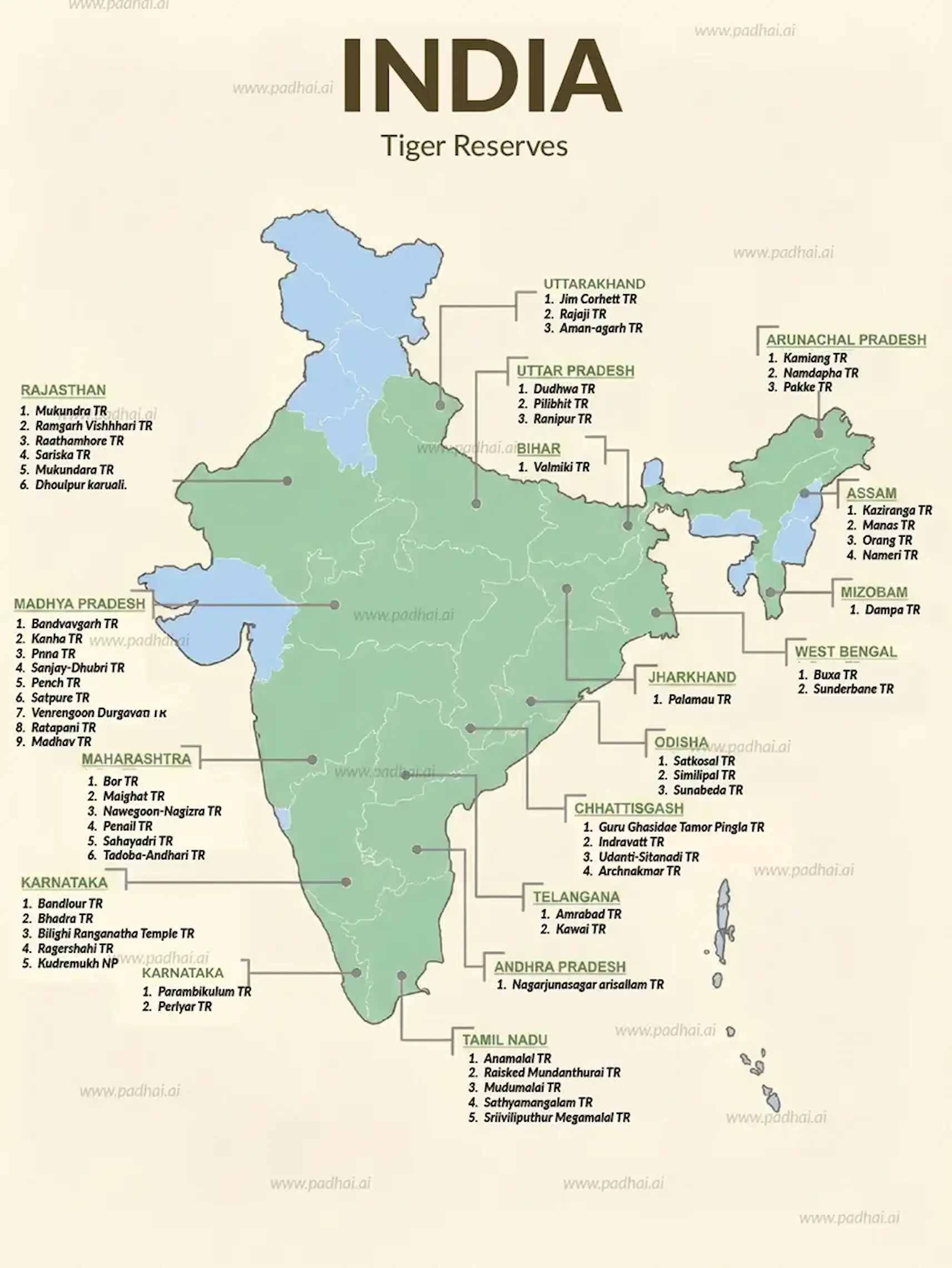
Download the Tiger Reserves Map of India PDF
The total number of tiger reserves in India is 58 as of 2026.
The list provides the names of all tiger reserves in India state-wise:
S. No. | Tiger Reserve | State | Year of Inclusion | Total Area (km2) | Key Facts & Features |
1 | Nagarjunsagar Srisailam Tiger Reserve | Andhra Pradesh | 1982-1983 | 3296.31 | Largest Tiger Reserve in India; It spans 5 districts. |
2 | Kamlang Tiger Reserve | Arunachal Pradesh | 2016-2017 | 783.00 | High-altitude habitat named after the Kamlang River. |
3 | Namdapha Tiger Reserve | Arunachal Pradesh | 1982-1983 | 2052.82 | Only TR with Tiger, Leopard, Snow Leopard & Clouded Leopard. |
4 | Pakke Tiger Reserve | Arunachal Pradesh | 1999-2000 | 1198.45 | Famous for the “Hornbill Nest Adoption” community program. |
5 | Kaziranga Tiger Reserve | Assam | 2008-2009 | 1173.58 | UNESCO site; world’s highest density of One-horned Rhinos. |
6 | Manas Tiger Reserve | Assam | 1973-1974 | 2837.10 | UNESCO site; 2nd Largest TR; borders Royal Manas (Bhutan). |
7 | Nameri Tiger Reserve | Assam | 1999-2000 | 464.00 | It shares a northern boundary with Pakke TR in Arunachal. |
8 | Orang Tiger Reserve | Assam | 2016-2017 | 492.46 | Known as “Mini Kaziranga”; smallest core area in the region. |
9 | Valmiki Tiger Reserve | Bihar | 1989-1990 | 899.38 | The only Tiger Reserve in Bihar; located in the Terai region. |
10 | Achanakmar Tiger Reserve | Chhattisgarh | 2008-2009 | 914.02 | Part of the Achanakmar-Amarkantak Biosphere Reserve. |
11 | Guru Ghasidas-Tamor Pingla Tiger Reserve | Chhattisgarh | 2024 | 2829.38 | 56th TR; 3rd Largest in India; created by merging a NP and WLS. |
12 | Indravati Tiger Reserve | Chhattisgarh | 1982-1983 | 2799.07 | Named after Indravati River; sanctuary for Wild Water Buffalo. |
13 | Udanti-Sitanadi Tiger Reserve | Chhattisgarh | 2008-2009 | 1842.54 | Crucial habitat for the state animal (Wild Buffalo). |
14 | Palamau Tiger Reserve | Jharkhand | 1973-1974 | 1129.93 | One of the original 9 reserves; located in Chota Nagpur plateau. |
15 | Bandipur Tiger Reserve | Karnataka | 1973-1974 | 1456.30 | UNESCO site; once a private hunting reserve for Mysore Maharajas. |
16 | Bhadra Tiger Reserve | Karnataka | 1998-1999 | 1064.29 | Project Tiger’s first reserve to complete village relocation. |
17 | Biligiri Ranganatha Temple (BRT) Tiger Reserve | Karnataka | 2010-2011 | 574.82 | Acts as a bridge between the Eastern and Western Ghats. |
18 | Kali Tiger Reserve | Karnataka | 2008-2009 | 1097.51 | Formerly Dandeli-Anshi; famous for rare Black Panther sightings. |
19 | Nagarahole Tiger Reserve | Karnataka | 2008-2009 | 1205.76 | Part of Nilgiri Biosphere; also called Rajiv Gandhi National Park. |
20 | Parambikulam Tiger Reserve | Kerala | 2008-2009 | 643.66 | UNESCO site; home to the world’s oldest teak tree (Kannimara). |
21 | Periyar Tiger Reserve | Kerala | 1978-1979 | 925.00 | UNESCO site; centered around a 26 km artificial lake. |
22 | Bandhavgarh Tiger Reserve | Madhya Pradesh | 1993-1994 | 1536.93 | Known for the highest density of Royal Bengal Tigers in India. |
23 | Kanha Tiger Reserve | Madhya Pradesh | 1973-1974 | 2051.79 | Only habitat of the Hard Ground Barasingha (Swamp Deer). |
24 | Madhav Tiger Reserve | Madhya Pradesh | 2025 | 1651.39 | 58th TR; newest addition; historical Gwalior hunting grounds. |
25 | Panna Tiger Reserve | Madhya Pradesh | 1994-1995 | 1598.10 | Famous for successful tiger reintroduction after 2009 extinction. |
26 | Pench Tiger Reserve (MP) | Madhya Pradesh | 1992-1993 | 1179.63 | Setting for The Jungle Book; |
27 | Ratapani Tiger Reserve | Madhya Pradesh | 2024 | 1271.46 | 57th TR; proximity to Bhimbetka rock shelters. |
28 | Sanjay-Dubri Tiger Reserve | Madhya Pradesh | 2008-2009 | 1674.50 | Critical corridor connecting Central and Eastern landscapes. |
29 | Satpura Tiger Reserve | Madhya Pradesh | 1999-2000 | 2133.31 | Only tiger reserve where walking safaris are allowed. |
30 | Veerangana Durgavati Tiger Reserve | Madhya Pradesh | 2023 | 2339.00 | Combined parts of Nauradehi and Durgavati sanctuaries. |
31 | Bor Tiger Reserve | Maharashtra | 2014-2015 | 138.12 | Smallest Tiger Reserve in India by core area. |
32 | Melghat Tiger Reserve | Maharashtra | 1973-1974 | 2768.52 | Located in the Gawilgarh Hills; first reserve of Maharashtra. |
33 | Nawegaon-Nagzira Tiger Reserve | Maharashtra | 2013-2014 | 1894.94 | Vital for central tiger landscape connectivity. |
34 | Pench Tiger Reserve (MH) | Maharashtra | 1998-1999 | 741.22 | The Maharashtra side of the interstate Pench landscape. |
35 | Sahyadri Tiger Reserve | Maharashtra | 2009-2010 | 1165.57 | UNESCO site; only tiger reserve in Western Maharashtra. |
36 | Tadoba-Andhari Tiger Reserve | Maharashtra | 1993-1994 | 1727.59 | Maharashtra’s oldest and largest National Park/Tiger Reserve. |
37 | Dampa Tiger Reserve | Mizoram | 1994-1995 | 988.00 | Famous for its high bird species and butterfly diversity. |
38 | Satkosia Tiger Reserve | Odisha | 2008-2009 | 963.87 | Located where the Mahanadi River cuts through the hills. |
39 | Similipal Tiger Reserve | Odisha | 1973-1974 | 2750.00 | World’s only habitat to Melanistic (Black) Tigers. |
40 | Dholpur-Karauli Tiger Reserve | Rajasthan | 2023 | 599.64 | 55th TR; acts as a corridor between Ranthambore and Sariska. |
41 | Mukundra Hills Tiger Reserve | Rajasthan | 2013-2014 | 759.99 | Situated in the Hadoti region; merged three sanctuaries. |
42 | Ramgarh Vishdhari Tiger Reserve | Rajasthan | 2022 | 1501.89 | 52nd TR; habitat of endangered Indian Wolf and Sloth Bear. |
43 | Ranthambore Tiger Reserve | Rajasthan | 1973-1974 | 1411.29 | Known for its 10th-century fort; famous for “lake tigers.” |
44 | Sariska Tiger Reserve | Rajasthan | 1978-1979 | 1213.34 | First reserve to successfully airlift and relocate tigers. |
45 | Anamalai Tiger Reserve | Tamil Nadu | 2008-2009 | 1479.87 | UNESCO site; formerly the Indira Gandhi Wildlife Sanctuary. |
46 | Kalakad-Mundanthurai Tiger Reserve | Tamil Nadu | 1988-1989 | 1601.54 | UNESCO site; rain forest and evergreen habitat. |
47 | Mudumalai Tiger Reserve | Tamil Nadu | 2008-2009 | 688.59 | One of the oldest sanctuaries in India; UNESCO site. |
48 | Sathyamangalam Tiger Reserve | Tamil Nadu | 2013-2014 | 1408.40 | Won the “TX2” award for doubling its tiger population. |
49 | Srivilliputhur-Megamalai Tiger Reserve | Tamil Nadu | 2021 | 1016.57 | 51st TR; protects the Vaigai River catchment area. |
50 | Amrabad Tiger Reserve | Telangana | 2014 | 2611.40 | Formerly part of Srisailam; located in the Nallamala hills. |
51 | Kawal Tiger Reserve | Telangana | 2012-2013 | 2015.44 | High diversity of dry deciduous teak forests. |
- | Amanagarh Tiger Reserve (Buffer) | Uttar Pradesh | 2012 | 80.60 | Operates as the extension/buffer for Corbett Tiger Reserve. |
52 | Dudhwa Tiger Reserve | Uttar Pradesh | 1987-1988 | 2201.77 | Home to the “Big Five” of the Terai: Tiger, Rhino, Elephant, etc. |
53 | Pilibhit Tiger Reserve | Uttar Pradesh | 2014 | 730.25 | Awarded TX2 status; highly successful conservation model. |
54 | Ranipur Tiger Reserve | Uttar Pradesh | 2022 | 529.36 | 53rd TR; first reserve in the Bundelkhand region. |
55 | Corbett Tiger Reserve | Uttarakhand | 1973-1974 | 1288.31 | India’s 1st Tiger Reserve and National Park. |
56 | Rajaji Tiger Reserve | Uttarakhand | 2015 | 1075.17 | Known for Asian Elephants and Shivalik range tigers. |
57 | Buxa Tiger Reserve | West Bengal | 1982-1983 | 757.90 | Strategic corridor for elephants moving between India and Bhutan. |
58 | Sunderbans Tiger Reserve | West Bengal | 1973-1974 | 2584.89 | UNESCO site; world’s only mangrove tiger habitat. |
Latest Additions to Official List of Tiger Reserves
As of March 2026, India has expanded its tiger conservation network to a total of 58 notified reserves.
The three new tiger reserves in India, as per the official list of NTCA, represent essential development in tiger conservation.
58th: Madhav Tiger Reserve (MP)
The newest jewel in India’s “Tiger State” ( Madhya Pradesh) is Madhav Tiger Reserve in Shivpuri, marking a key conservation step.
Madhya Pradesh houses the 58th tiger reserve in India.
It serves as a path for tigers leaving crowded Ranthambore, Rajasthan. They move toward Panna, MP, and the new Kuno National Park.
57th: Ratapani Tiger Reserve (MP)
Ratapani is India’s only reserve that blends prehistoric human history with wildlife.
The 57th tiger reserve in India surrounds the Bhimbetka Rock Shelters (a UNESCO World Heritage site). Its notification secures the catchment area of the Betwa River.
56th: Guru Ghasidas-Tamor Pingla (Chhattisgarh)
By merging Guru Ghasidas National Park with Tamor Pingla Wildlife Sanctuary, Chhattisgarh created India’s third-largest tiger reserve. It covers about 2,829 square km.
This is the 56th tiger reserve in India. It lets tigers move safely between the Bandhavgarh-Sanjay Dubri complex in MP and the Palamau landscape in Jharkhand.
Add as a preferred Source on Google
The National Tiger Conservation Authority (NTCA) mandates a “Landscape Approach” for every Tiger Reserve which has two main categories
Core Area
Buffer Zone.
Tiger Corridors are also important segments of the Buffer Zone.
Core Area: Critical Tiger Habitat
The Core Area is the “heart” of the Tiger Reserve. Legally, the government notifies these areas as National Parks or Sanctuaries.
Legal Status: It should stay free from human disturbance. This includes forestry, collecting forest products, and permanent human settlement.
Human Rights: The government must resolve any existing disputes of Scheduled Tribes or forest dwellers before the area is declared “core”.
Activities: Certain areas are designated solely for critical conservation work and tightly controlled eco-tourism.
Buffer Zones
Defined under Section 38V of the Wildlife (Protection) Act, the Buffer Area is the peripheral land surrounding the Core.
Legal Status: Unlike the “Inviolate” Core, the Buffer includes forest, revenue land, and private village land.
Human-Wildlife Synergy: This is where Eco-Development Committees (EDCs) operate. The goal is to reduce the local community’s dependence on the forest by providing LPG connections and solar fencing.
Tourism Hub: Laws limit most high-end eco-tourism and safari homestays to the Buffer Zone. This keeps the Core quiet.
Tiger Corridors
A Tiger Corridor is a narrow strip of land (often forest or scrub) that connects two or more Tiger Reserves. Without corridors, Tiger Reserves become “Islands of Extinction“ where inbreeding leads to genetic collapse.
Table 3: Discussion of critical Tiger corridors
Corridor Name | Connected Reserves | Importance |
Kanha-Pench | MP & Maharashtra | The most famous “functional” corridor in India; heavily monitored. |
Kaziranga-Karbi Anglong | Assam | Essential for tigers and elephants to escape Brahmaputra floods. |
Ranthambore-Kuno-Madhav | Rajasthan & MP | The newest high-priority corridor (2025-26) for tigers moving east. |
Corbett-Rajaji | Uttarakhand | Vital for the long-term survival of the Terai-Arc Landscape tigers. |
Nagarahole-Bandipur-Mudumalai | KA, TN, KL | Part of the Nilgiri Biosphere; highest tiger concentration in the world. |
India's tiger census stands as the most extensive wildlife monitoring effort globally. This undertaking, led by the National Tiger Conservation Authority (NTCA), occurs every four years.
As per the 2022 Tiger census, the count of tiger population stands at 3,682 (range 3167-3925).
Its purpose is to assess the well-being of the tiger population. The NTCA collaborates closely with State Forest Departments and the Wildlife Institute of India (WII) to carry out this vital work.
Method of Tiger Estimation
India uses a Double Sampling approach to ensure the accuracy of tiger census. This consists of three phases:
Phase I- Ground Survey: Forest guards walk through the jungle looking for "signs" like pugmarks (footprints), scat (droppings), and scratch marks on trees. They also count prey animals like deer.
Phase II- Camera Trapping: Motion-sensor cameras are placed in pairs along jungle paths. When a tiger walks by, it takes a photo of both sides. Since every tiger has a unique stripe pattern (like a human fingerprint), AI software can identify individual tigers and prevent double counting.
Final Phase: Scientists combine the ground signs with the camera photos to estimate the total population, even in areas where cameras couldn't be placed.
All India Tiger Estimation (AITE) 2026
The sixth cycle of the All India Tiger Estimation (tiger census for 2026) is underway as of April 2026. It has successfully completed its initial field data collection phase in several major regions and is transitioning into the analysis phase.
The important facts about the ongoing Tiger Census is given below:
Timeline: Field data gathering kicked off in January 2026, with completion anticipated by June 2026. They will release the final "Status of Tigers in India" report in early 2027.
Fully Paperless: In previous years, guards made handwritten notes and uploaded them later. Now, they use the M-STrIPES app to enter data directly in the field. If they see a tiger sign, they take a photo and the app automatically attaches the GPS location and time.
Real-Time Monitoring: Senior officials can see a "live dashboard" of where forest guards are walking. This ensures that every corner of the forest is being surveyed.
AI-Driven Identification: The AI software that matches tiger stripes can now sift through millions of photos and flag "new" tigers that weren't seen in 2022.
Focus on "Corridors": The 2026 census is putting extra effort into Tiger corridors. This helps scientists understand if tigers are becoming trapped in small pockets of forest.
Genetic Tracking: In areas where tiger sighting is very rare, the 2026 cycle is using more DNA analysis from scat to identify tigers that cameras might have missed.
Table: Technology used in 2026 Tiger Census
Component | Feature / Sub-System | Description | Use in 2026 Census / Conservation |
M-STrIPES 5.0 | AI-Integrated Patrolling | Analyzes patrol routes in real time; flags beats not covered for 48+ hours | Ensures strict patrol coverage; reduces poaching gaps |
M-STrIPES 5.0 | Instant Species ID | Neural networks identify predators from pugmarks / kill images instantly | Speeds up field verification and data accuracy |
AI-Based Warning Systems | Bio-Acoustics | AI sensors detect prey alarm calls; triggers sirens + SMS alerts to villages | Early warning system to prevent human-wildlife conflict |
AI-Based Warning Systems | PAWS (Protection and Alert Wildlife System) | GSM-enabled cameras identify tiger stripes at forest fringes | Instant alerts to rapid-response teams; improves conflict mitigation |
e-Eye (Electronic Fence) | 24/7 Surveillance | Thermal + infrared cameras track movement via heat signatures (>20 kg) | Continuous monitoring of sensitive zones |
e-Eye (Electronic Fence) | Total Darkness Tracking | Works in complete darkness from elevated towers | Enables early interception of poachers before core intrusion |
Trends from the 2022 Census
Until the 2026 results are finalized, the 2022 Census (5th Cycle) remains the official data on tiger conservation. The 2022 data revealed a "Golden Era" for Indian tigers.
Table: Data from the 2022 Tiger Census
Parameter | Data / Statistic | Key Insight / Significance |
Tiger Population (2022 Census) | Minimum: 3,167; Upper estimate: 3,925 | Confirms India as the global stronghold of wild tigers |
Growth Rate | ~6% annual growth | Healthy recovery trend; India holds ~75% of global tiger population |
State Ranking – 1 | Madhya Pradesh: 785 | Retains “Tiger State” title; strong habitat + management |
State Ranking – 2 | Karnataka: 563 | Consistent conservation success in Western Ghats landscape |
State Ranking – 3 | Uttarakhand: 560 | High density in Terai-Arc landscape |
Shifting Landscape Trend | Shivalik–Gangetic Plains: +275% (over 20 years) | Shows success of corridor-based conservation |
Shifting Landscape Trend | Western Ghats: Localised decline | Indicates habitat saturation + fragmentation risks |
Unique Discovery | Similipal (Odisha): Pseudo-melanistic (“black”) tigers | Only known population globally; highlights genetic uniqueness |
2026 is the year of "Landscape Connectivity." Previous censuses focused on how many tigers we have while the 2026 census focuses on how well they move. Mapping the functional corridors between the 58 reserves ensures that "Island Populations" don't suffer from genetic inbreeding.
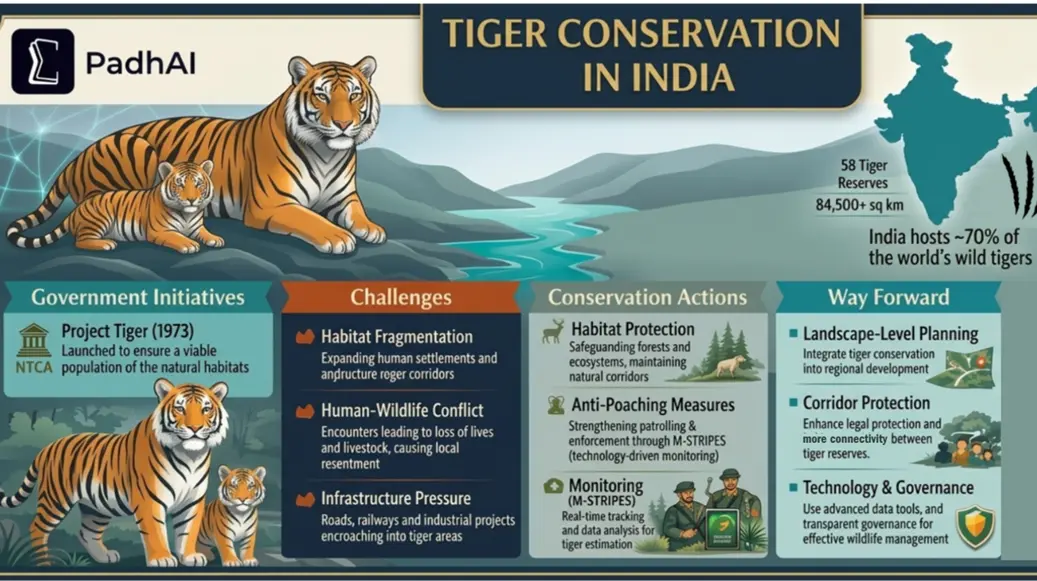
Despite India’s success in doubling its tiger population, the species remains "Endangered" on the IUCN Red List. The threats have shifted from simple hunting to complex environmental and infrastructural pressures.
Habitat Fragmentation: Forests are increasingly split into isolated patches by farms and cities. This restricts tiger movement. It leads to inbreeding, weaker genetics and high disease spread.
Human-wildlife conflict: When tigers attack livestock, villagers might retaliate. They could use poison or electric fences. In contrast, tigers can also attack people, as seen in places like the Sundarbans and the Tadoba Andhari Tiger Reserve.
Poaching and the illegal wildlife trade persist, even though the Wildlife Crime Control Bureau (WCCB) has made strides in curbing large-scale operations. Tiger parts, including bones and skin, continue to be smuggled for profit.
Depletion of the prey base: Wild herbivores face competition from domestic livestock for available grass. Furthermore, diseases such as Foot and Mouth Disease (FMD) in cattle can easily spread to the tiger population.
Emerging diseases: Diseases like Canine Distemper Virus (CDV), pose a potential threat to wild tigers, as the virus can be transmitted from feral dogs. This transmission can impact the tigers' nervous system causing them to become less careful of human presence.
Climate Change: In the Sunderbans, rising sea levels flood mangrove islands and make the water more salty. This pushes tigers closer to human settlements. It also shrinks their unique habitat.
Tigers are a “landscape-level” solution for climate change and water security. When we protect a tiger, we aren’t just saving one big cat but protecting the entire pyramid of life beneath it.
Umbrella Species
The tiger serves as an Umbrella Species. Safeguarding a sufficiently large ecosystem for a tiger’s movement inherently safeguards numerous other species of flora and fauna.
This conservation strategy provides a protective umbrella for a range of species, including the Asian Elephant, Indian Rhino, and the elusive Clouded Leopard, all of which benefit from tiger conservation efforts.
Water Security
In 2026, Tiger Reserves are frequently referred to as “Water Towers.“
River Sources: India boasts over 600 rivers that either originate in or flow through Tiger Reserves. Take, for example, the Periyar River in Kerala and the Ramganga in Uttarakhand. Both rivers are fed by pristine catchment areas. These crucial regions happen to be situated entirely within the limits of their respective reserves.
Natural sponges, in the form of dense root systems and the leaf litter found in untouched forests, function as nature’s own reservoirs. They soak up the monsoon rains, a process that replenishes groundwater supplies. This, in turn, mitigates the risk of downstream flooding during the wet season.
Furthermore, these forest systems help maintain river flow even when the Indian summer’s punishing heat sets in.
Climate Resilience
Tiger Reserves are India’s most efficient Carbon Sinks.
By curbing deforestation across roughly 2.3% of India’s land, Project Tiger has kept millions of tonnes of CO2 out of the atmosphere.
Economic Value: A 2025 study highlighted the importance of India’s ten most significant reserves, which provide essential ecosystem services like carbon sequestration and water purification. The combined annual value of these services exceeds ₹5.96 trillion.
The National Tiger Conservation Authority (NTCA) operates as a statutory body, functioning under the Ministry of Environment, Forest and Climate Change (MoEFCC).
Established in 2006 after an amendment to the Wildlife (Protection) Act, 1972, it gave Project Tiger legal support. It also sets standard rules for management.
Table: Features of NTCA
Feature | NTCA Detail |
Status | Statutory Body (under WPA 1972) |
Established | 2006 (Post-Sariska Crisis) |
Chairperson | Minister for Environment, Forest & Climate Change |
Function | Oversight, Funding, Census, and Legal Clearances |
The Ministry of Environment, Forest and Climate Change (MoEFCC) merged two centrally sponsored schemes. A formal office order was issued in June 2023. It combined the funds and administrative structures of Project Tiger and Project Elephant. They formed a single unit called the “Project Tiger and Elephant Division” (PT&E).
Reasons for merger of the projects
Landscape Overlap: Tigers and elephants share about 60% to 70% of the same habitat in India. This is most common in the Western Ghats, Terai, and North East. The government concluded that one unified management plan would be more efficient.
Rationalizing Funds: Instead of states submitting two separate budgets for the same forest, they now submit one consolidated proposal.
Administrative Efficiency: It reduces overlap among field staff and resources in areas that are Tiger Reserves and Elephant Reserves.
Table: Key differences between Project Tiger and Project Elephant
Feature | Project Tiger (NTCA) | Project Elephant |
Statutory Status | Yes. Backed by the Wildlife Protection Act (2006 Amendment). | No. Functions as an administrative guideline (Steering Committee). |
Legal Protection | Inviolate Core Area is legally mandatory. | Elephant Reserves are "notified" but don't have the same legal "inviolate" status. |
Movement | Territorial; stays within a defined home range. | Migratory; requires vast, landscape-level corridors. |
Primary Challenge | Poaching and prey base management. | Human-Elephant Conflict (HEC) and habitat loss. |
India’s tiger conservation journey, domestically and internationally, can be categorised into 4 phases:
Beginning with species protection in 1970s
Systematic conservation efforts from 2000s onwards
Connecting landscapes and scaling in 2010s to ensure in-breeding doesn't happen
Technology-driven initiatives from 2020s to current period
Table: Timeline of the key initiatives in Tiger Conservation
Timeline | Category | Initiative / Programme | Key Features | Significance |
1973 | Domestic | Project Tiger | Launch of tiger reserves; core-buffer strategy | Foundation of India’s tiger conservation success |
1994 | International | Global Tiger Forum (GTF) | Intergovernmental body (HQ: New Delhi) | Only global platform dedicated solely to tigers |
2006 | Domestic | NTCA (National Tiger Conservation Authority) | Statutory authority under WPA | Strengthened governance post-crisis (e.g., Sariska) |
2006–present | Domestic | All India Tiger Estimation | 4-year cycle; camera traps, GIS, AI | World’s largest wildlife survey |
2010 | Domestic | M-STrIPES (launched) | Digital patrolling system | Improved monitoring & accountability |
2010–2022 | International | TX2 Goal | Global effort to double tiger population | India central to achieving global recovery |
2010s–present | Domestic | Landscape Approach & Corridors | Terai Arc, Western Ghats connectivity | Ensures gene flow; reduces fragmentation |
2010s–present | International | Transboundary Cooperation | India–Nepal, Bangladesh, Bhutan coordination | Cross-border protection & habitat continuity |
2011–present | Domestic | Eco-Sensitive Zones (ESZs) | Buffer zones around reserves | Reduces human pressure & conflict |
2013–present | International | CA|TS Accreditation | Global reserve management standards | India has highest accredited tiger reserves |
2018–present | Domestic | e-Eye & AI Systems | Thermal cameras, bio-acoustics, PAWS | Tech-driven anti-poaching & conflict mitigation |
2020s–present | International | Expertise Export | Support to Cambodia, Laos reintroduction | India as global knowledge hub |
2023 | International | International Big Cat Alliance (IBCA) | India-led initiative for 7 big cats | Expands leadership beyond tigers |
2025 | International | IBCA (Treaty-based status) | Formal global alliance | Institutionalized global cooperation |
2026 | Domestic | M-STrIPES 5.0 Upgrade | AI-integrated patrolling, instant species ID | Real-time, precision conservation |
2026 | International | Global Big Cat Summit (New Delhi) | 95 range countries participation | Global policy coordination platform |
2026–ongoing | International | High Altitude Tiger Project | Mapping Himalayan migration | Climate change adaptation strategy |
Frequently asked question (FAQs)
How many Tiger Reserves are there in India?
Which is the largest tiger reserve in India?
Which is the smallest tiger reserve in India?
Which state has the most number of Tiger Reserves?
Which reserve has the highest tiger density?
By 2026, India has transitioned from 'protecting its own tigers' to leading a global movement. India’s "Project Tiger" stands as the world’s most successful species recovery program. However, the shift from 3,000 to a possible 5,000 tigers brings new challenges. These challenges require a move toward “functional landscapes” where tigers and people can live together.


Gajendra Singh Godara
Ex-UPSC Aspirant | Exam Preparation Expert
Gajendra Singh Godara is an IIT Bombay graduate and a UPSC aspirant with 4 attempts, including multiple Prelims and Mains appearances. He specializes in Polity, Modern History, International Relations, and Economy. At PadhAI, Gajendra leverages his firsthand exam experience to simplify complex concepts, creating high-efficiency study materials that help aspirants save time and stay focused.
No comments yet. Be the first to join the discussion!