Wildlife Sanctuaries in India: List, Map, Features, Importance
India has 573 wildlife sanctuaries protecting many ecosystems. Explore the state-wise list, map, features, and conservation importance.

Gajendra Singh Godara
Last updated
10
mins read
Add a comment
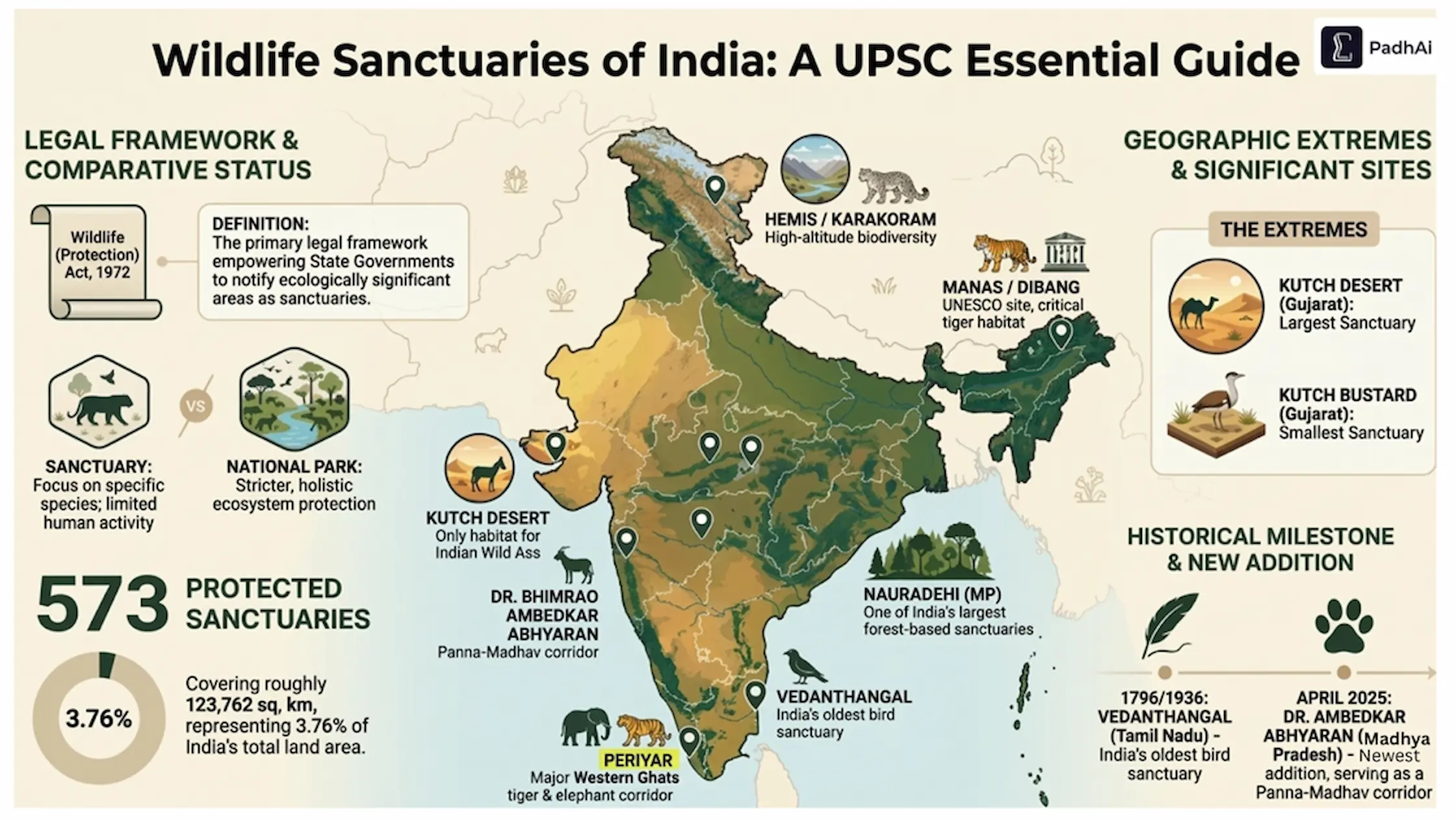
Total Number: 573 wildlife sanctuaries in India
Largest Wildlife Sanctuary: Kutch Desert Wildlife Sanctuary, Gujarat
Smallest Wildlife Sanctuary: Goose Island Wildlife Sanctuary, Andaman & Nicobar
Law: Wildlife Protection Act, 1972
Role: conservation of forests, wetlands, deserts & marine ecosystems
What is a Wildlife Sanctuary?
Wildlife sanctuary protects endangered species. These areas restrict tourism to allow wildlife conservation efforts. Wildlife Protection Act 1972 established these protected zones in India. As of 2026, there are 573 wildlife sanctuaries in India covering an area of 1,27,241 km square.
The following table shows the number of wildlife sanctuaries in each state and the area covered by them:
State / UT | State Area (km²) | Wildlife Sanctuaries | Sanctuary Area (km²) | % of State Area |
Andhra Pradesh | 160,229 | 13 | 6,771.40 | 4.23 |
Arunachal Pradesh | 83,743 | 13 | 7,614.56 | 9.00 |
Assam | 78,438 | 17 | 1,728.95 | 2.20 |
Bihar | 94,163 | 12 | 2,851.67 | 3.03 |
Chhattisgarh | 135,191 | 11 | 3,760.28 | 2.78 |
Goa | 3,702 | 6 | 647.91 | 17.50 |
Gujarat | 196,022 | 23 | 16,618.42 | 8.48 |
Haryana | 44,212 | 7 | 118.21 | 0.27 |
Himachal Pradesh | 55,673 | 28 | 6,115.97 | 10.99 |
Jharkhand | 79,714 | 11 | 1,955.82 | 2.45 |
Karnataka | 191,791 | 35 | 7,923.23 | 4.13 |
Kerala | 38,863 | 18 | 2,156.21 | 5.55 |
Madhya Pradesh | 308,245 | 24 | 7,046.19 | 2.29 |
Maharashtra | 307,713 | 48 | 7,592.30 | 2.47 |
Manipur | 22,327 | 7 | 708.14 | 3.17 |
Meghalaya | 22,429 | 4 | 94.11 | 0.42 |
Mizoram | 21,081 | 9 | 1,359.75 | 6.45 |
Nagaland | 16,579 | 4 | 43.91 | 0.26 |
Odisha | 155,707 | 19 | 7,094.65 | 4.56 |
Punjab | 50,362 | 13 | 326.60 | 0.65 |
Rajasthan | 342,239 | 25 | 5,592.38 | 1.63 |
Sikkim | 7,096 | 7 | 399.10 | 5.62 |
Tamil Nadu | 130,058 | 33 | 7,096.54 | 5.46 |
Telangana | 114,840 | 9 | 5,672.70 | 4.94 |
Tripura | 10,486 | 4 | 603.64 | 5.76 |
Uttar Pradesh | 240,928 | 26 | 5,822.20 | 2.42 |
Uttarakhand | 53,483 | 7 | 2,690.12 | 5.03 |
West Bengal | 88,752 | 16 | 1,440.18 | 1.62 |
Andaman & Nicobar Islands | 8,249 | 97 | 395.60 | 4.80 |
Chandigarh | 114 | 2 | 26.01 | 22.82 |
Dadra and Nagar Haveli and Daman and Diu | 603 | 2 | 94.36 | 15.48 |
Delhi | 1,483 | 1 | 19.61 | 1.32 |
Jammu and Kashmir | 163,090 | 14 | 1,815.04 | 1.11 |
Ladakh | 59,146 | 2 | 9,000.00 | 15.22 |
Lakshadweep | 32 | 1 | 0.01 | 0.03 |
Puducherry | 480 | 1 | 3.90 | 0.81 |
Total | 3,287,263 | 573 | 123,762.56 | 3.76 |
State-wise list of Wildlife Sanctuaries
The table below talks about the famous wildlife sanctuaries categorised by states and their unique feature:
State / UT | Official Name | Year Est. | Key Facts |
Arunachal | Dibang Wildlife Sanctuary | 1998 | High altitude; Mishmi Takin; Idu Mishmi tribe (Tigers as kin). |
Arunachal | Pakke Tiger Reserve | 1977 | Formerly Pakhui; 4 Hornbill species; Hornbill Nest Adoption. |
Assam | Pobitora Wildlife Sanctuary | 1987 | Highest density of One-horned Rhino; Brahmaputra south bank. |
Assam | Hoollongapar Gibbon Sanctuary | 1997 | Only habitat of Western Hoolock Gibbon (India’s only ape). |
Assam | Kaziranga National Park | 1905 | UNESCO site; "Big Five"; Focus on Rhino and Tiger. |
Assam | Manas National Park | 1990 | UNESCO; Golden Langur; Trans-boundary (Royal Manas, Bhutan). |
Bihar | Vikramshila Gangetic Dolphin Sanctuary | 1991 | Only sanctuary for Ganges River Dolphin; Sultanganj-Kahalgaon. |
Chhattisgarh | Udanti Wildlife Sanctuary | 1983 | Part of Udanti-Sitanadi TR; Wild Water Buffalo (State animal). |
Gujarat | Indian Wild Ass Sanctuary | 1972 | Little Rann of Kutch; Only habitat of the Khur (Wild Ass). |
Gujarat | Chhari-Dhandh Conservation Reserve | 2008 | Ramsar Site (2026); Banni Grasslands; Known for "Chir Batti." |
Gujarat | Gir National Park & Sanctuary | 1965 | Only habitat of Asiatic Lion; Maldhari pastoralist community. |
Gujarat | Nalsarovar Bird Sanctuary | 1969 | Largest wetland sanctuary in Gujarat; Ramsar site. |
Himachal | Kibber Wildlife Sanctuary | 1992 | Cold Desert; High-altitude fauna (Snow Leopard, Blue Sheep). |
Karnataka | Ranganathittu Bird Sanctuary | 1940 | Islands on Kaveri; Pakshi Kashi of Karnataka; Ramsar 2022. |
Kerala | Periyar National Park & Sanctuary | 1950 | Cardamom Hills; Elephant/Tiger reserve; Periyar & Pamba rivers. |
Kerala | Silent Valley National Park | 1984 | Lion-tailed Macaque; Tropical evergreen; Kunthipuzha River. |
Madhya Pradesh | Gandhi Sagar Wildlife Sanctuary | 1974 | Cheetah Second Home (2025/26); Chambal River. |
Madhya Pradesh | Kuno National Park | 1981 | Project Cheetah (first release); Kuno River; Dry deciduous. |
Odisha | Gahirmatha Marine Sanctuary | 1997 | World’s largest Olive Ridley nesting beach (Arribada). |
Odisha | Satkosia Wildlife Sanctuary | 1976 | Mahanadi River Gorge; Gharial conservation; Eastern Ghats. |
Rajasthan | Desert National Park | 1980 | Great Indian Bustard; Wood fossils (Akal Fossil Park). |
Rajasthan | Tal Chhapar Wildlife Sanctuary | 1966 | Blackbuck; Migratory Harriers; Semi-arid grassland. |
Uttar Pradesh | National Chambal Sanctuary | 1979 | Tri-state (UP/MP/Rajasthan); Gharial, Dolphin, Mugger. |
Uttar Pradesh | Patna Wildlife Sanctuary | 1991 | Ramsar Site (2026); Smallest in UP; Migratory waterfowl. |
West Bengal | Sundarban National Park | 1984 | UNESCO; Royal Bengal Tiger; World's largest Mangroves. |
Note: Kaziranga became a Wildlife Sanctuary in 1950 and a National Park in 1974. In 1905 it became a Reserve Forest.
List of Wildlife Sanctuaries categorised by UTs
Union Territories of India are also home to some important sanctuaries. They are listed below:
UT | Official Name | Year Est. | Key Facts (Species, Rivers, Tribes, Ecosystem) |
A&N Islands | Interview Island Wildlife Sanctuary | 1987 | Largest WLS in A&N; Created for Feral Elephants; Evergreen forests. |
A&N Islands | Narcondam Island Wildlife Sanctuary | 1987 | Home to the Endemic Narcondam Hornbill; Dormant volcano site. |
A&N Islands | Lohabarrack (Saltwater Crocodile) Sanctuary | 1983 | Focus: Estuarine Crocodiles; Mangrove ecosystem near Wandoor. |
A&N Islands | Barren Island Wildlife Sanctuary | 1987 | India's only Active Volcano; Unique volcanic soil flora/fauna. |
A&N Islands | Cuthbert Bay Wildlife Sanctuary | 1997 | Major nesting site for Olive Ridley & Leatherback Turtles. |
Chandigarh | Sukhna Lake Wildlife Sanctuary | 1986 | Shivalik foothills; Catchment area for Sukhna Lake; Migratory birds. |
DNHDD* | Fudam Bird Sanctuary | 1991 | Located in Diu; Mangrove habitat; Reef Herons and Flamingos. |
Delhi | Asola-Bhatti Wildlife Sanctuary | 1986 | Part of Southern Ridge (Aravallis); Important Leopard corridor. |
J&K | Hokersar Wildlife Sanctuary | 1992 | Ramsar Site; Natural perennial wetland in Jhelum basin. |
J&K | Hirpora Wildlife Sanctuary | 1987 | Only home of Markhor (world's largest goat); Shopian district. |
J&K | Tral Wildlife Sanctuary | 2019 | Buffer to Dachigam NP; Focus: Hangul (Kashmiri Stag) protection. |
J&K | Gulmarg Wildlife Sanctuary | 1987 | Alpine habitat; Himalayan Musk Deer & Brown Bear; Pir Panjal range. |
Ladakh | Karakoram (Nubra-Shyok) Wildlife Sanctuary | 1987 | Chiru (Tibetan Antelope - Shahtoosh wool source); Wild Yak. |
Ladakh | Changthang Cold Desert Wildlife Sanctuary | 1987 | Includes Pangong Tso & Tso Moriri; Kiang (Wild Ass). |
Lakshadweep | Pitti Bird Sanctuary | 1999 | Uninhabited coral islet; Nesting ground for Sooty Tern. |
Puducherry | Oussudu Lake Wildlife Sanctuary | 2008 | Also called Osudu; Important Bird Area (IBA) shared with TN. |
Largest Wildlife Sanctuaries in India
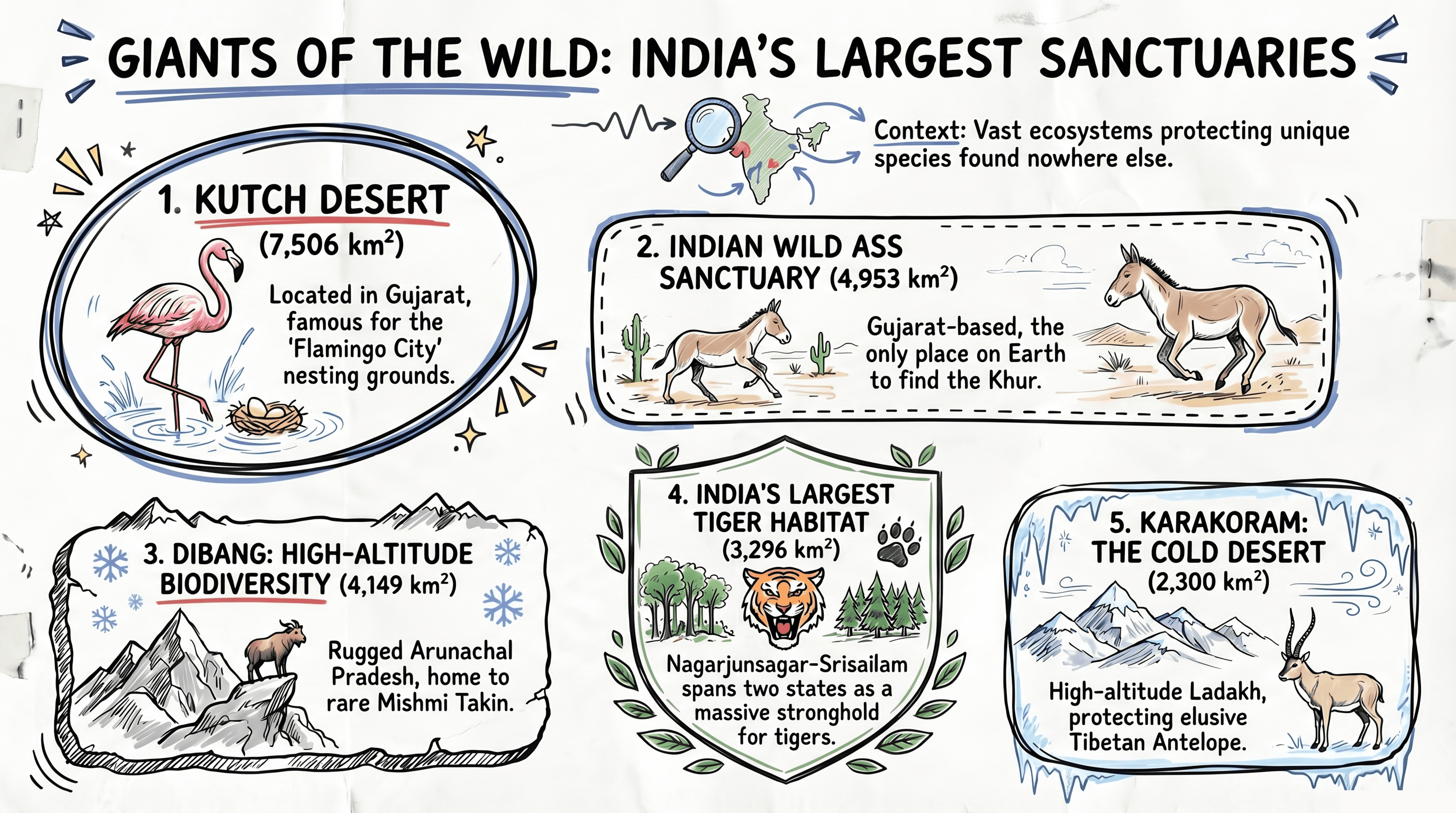
The largest wildlife sanctuary in India is Kutch Desert Wildlife Sanctuary of Gujarat stretching over 7,506 km square. Top 10 largest wildlife sanctuaries of India are provided below:
Rank | Sanctuary | State | Area (km2) | Unique Feature |
1 | Kutch Desert WLS | Gujarat | 7,506.22 | Famous for "Flamingo City" nesting grounds. |
2 | Indian Wild Ass Sanctuary | Gujarat | 4,953.70 | The only place on earth to find the Khur. |
3 | Dibang Wildlife Sanctuary | Arunachal | 4,149.00 | High-altitude biodiversity; home to Mishmi Takin. |
4 | Nagarjunsagar-Srisailam | Andhra/Telangana | 3,296.31 | Primarily a Tiger Reserve; largest tiger habitat. |
5 | Karakoram (Nubra-Shyok) | Ladakh | 2,300.00 | Cold desert; habitat of the Tibetan Antelope. |
6 | Cauvery North WLS | Tamil Nadu | 1,027.53 | Vital elephant corridor connecting TN and Karnataka. |
7 | Nauradehi WLS | Madhya Pradesh | 1,197.04 | Potential 3rd home for the Cheetah Restoration Project. |
8 | Kumbhalgarh WLS | Rajasthan | 610.50 | Known for Indian Wolves and the historic fort buffer. |
9 | Kinnerasani WLS | Telangana | 635.40 | Deciduous dry forest near the Godavari basin. |
10 | Dandeli Wildlife Sanctuary | Karnataka | 634.22 | Part of the Kali Tiger Reserve; hornbill paradise. |
Smallest Wildlife Sanctuaries in India
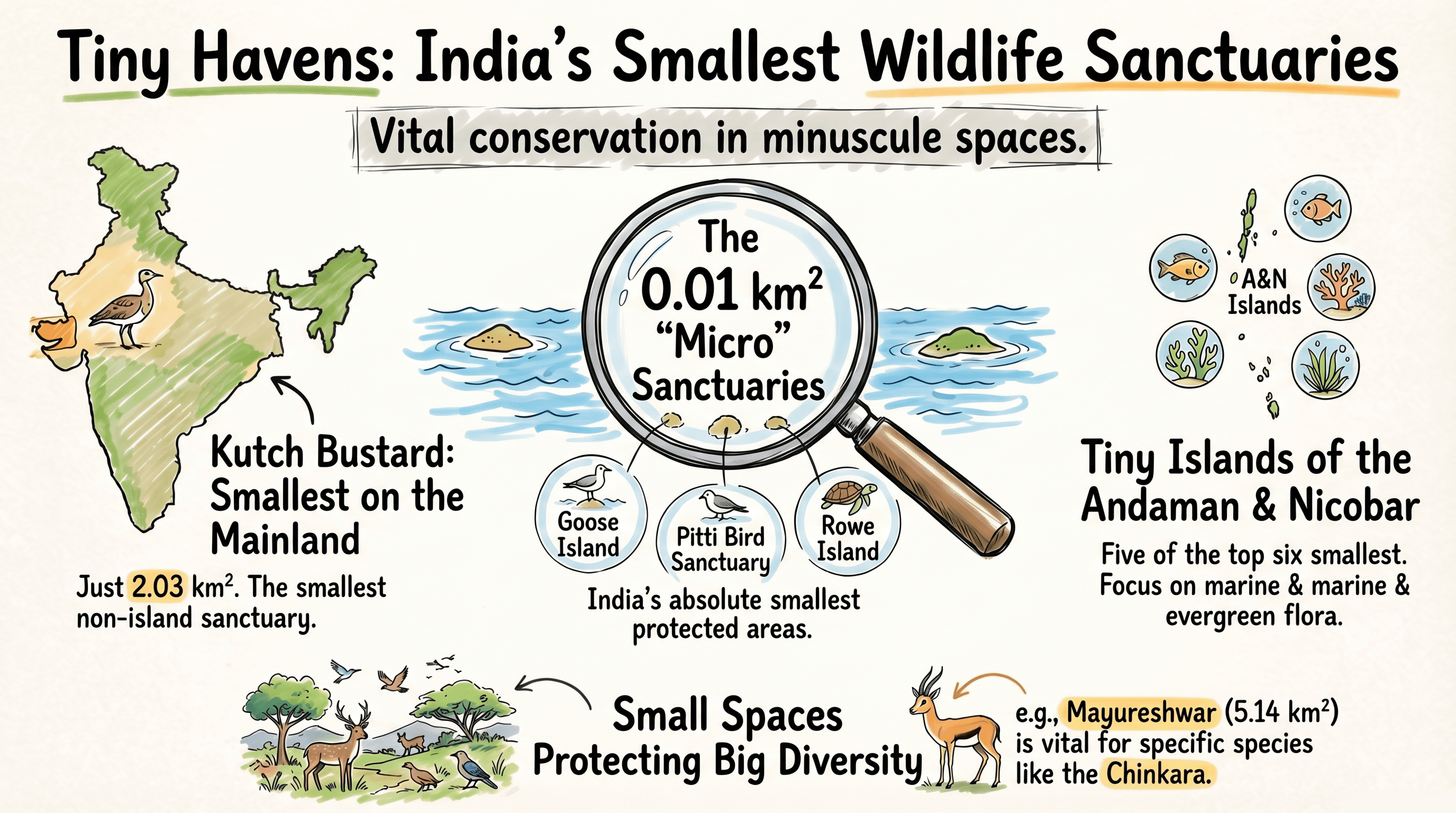
The smallest wildlife sanctuary in India’s mainland is Kutch Bustard Sanctuary, Gujarat. Occupying small geographical area in size, the following 10 smallest wildlife sanctuaries play an important role in biodiversity preservation regardless:
Rank | Official Sanctuary Name | State / UT | Area (km2) | Note |
1 | Goose Island WLS | A&N Islands | 0.01 | Often cited as the absolute smallest. |
2 | Pitti Bird Sanctuary | Lakshadweep | 0.01 | A critical pelagic bird nesting ground. |
3 | Rowe Island WLS | A&N Islands | 0.01 | A tiny coral islet. |
4 | Curlew Island WLS | A&N Islands | 0.03 | Focus on marine and littoral flora. |
5 | Snake Island‑I WLS | A&N Islands | 0.03 | Not the famous tourist Snake Island. |
6 | Arial Island WLS | A&N Islands | 0.05 | Tiny island with evergreen patches. |
7 | Kutch Bustard WLS | Gujarat | 2.03 | Smallest on the Indian Mainland. |
8 | Nawabganj Bird Sanctuary | Uttar Pradesh | 2.25 | A vital Ramsar wetland site. |
9 | Nangal WLS | Punjab | 2.87 | Man-made reservoir ecosystem. |
10 | Mayureshwar WLS | Maharashtra | 5.14 | Smallest in Maharashtra; famous for Chinkara. |
Note: While Goose Island is the smallest overall, Kutch Bustard WLS is the one most frequently asked in exams regarding the Mainland. Always check if the question specifies "Mainland" or "India" as a whole.
Famous Wildlife Sanctuaries by Region
Some of the most famous Indian wildlife sanctuaries are given below:
Region | Sanctuary Name | State | Key Facts (Species/Rivers) |
North | National Chambal Sanctuary | MP, UP, RJ | Only home of the Gharial; River Dolphins. |
North | Asola Bhatti WLS | Delhi | Critical Leopard corridor in the Aravallis. |
N. East | Pobitora WLS | Assam | Known as "Mini Kaziranga"; highest Rhino density. |
N. East | Eaglenest WLS | Arunachal | Birding paradise; famous for Bugun Liocichla. |
N. East | Hoollongapar Gibbon Sanctuary | Assam | Only home of India's only ape: Hoolock Gibbon. |
West | Indian Wild Ass Sanctuary | Gujarat | Only home of the Khur (Wild Ass) in Little Rann. |
West | Kutch Desert WLS | Gujarat | Largest WLS in India; famous for Flamingo City. |
West | Tal Chhapar WLS | Rajasthan | Known for Blackbucks and migratory Harriers. |
South | Coringa WLS | Andhra | India’s 2nd largest mangroves; Fishing Cats. |
South | Pitti Bird Sanctuary | Lakshadweep | Major nesting for Sooty Terns. |
South | Wayanad WLS | Kerala | Part of Nilgiri Biosphere; high Elephant population. |
East | Vikramshila Gangetic Dolphin | Bihar | India’s only sanctuary for River Dolphins. |
East | Gahirmatha Marine Sanctuary | Odisha | World’s largest Olive Ridley nesting beach. |
Central | Gandhi Sagar WLS | M.P. | Official second home for Cheetahs (since 2025/26). |
Central | Achanakmar WLS | Chhattisgarh | Part of the Achanakmar-Amarkantak Biosphere. |
Join our WhatsApp Community

Wildlife sanctuaries play an important role in not only protecting animals but also entire ecosystems. They are essential for humans and nature alike, with various functions provided below:
Protection of endangered species: They provide safe spaces for these animals. They protect them from hunting and habitat destruction.
Preservation of ecosystems: They protect natural forests, valleys, rivers, and waterfalls.
Cultural significance: Many tribal communities have lived with nature for centuries. Conserving the habitat helps preserve the culture and traditions of these tribes.
Biodiversity: It involves In-situ conservation of the animals. Important for biodiversity.
Eco-tourism: Tourism provides money for maintenance of these areas.
Wildlife Sanctuaries, National Parks and Biosphere reserves vary in their purpose and legal status. They also restrict different activities.The differences are given in the table below:
Feature | Wildlife Sanctuary | National Park | Biosphere Reserve |
Definition | Area created to protect wild animals and their habitat. | reserved for protection of animals and biodiversity. prohibition of human activity. | promoting conservation of biodiversity along with limited human use. |
Legal Protection | Protected under the Wildlife Protection Act, 1972, but less strict than national parks. | The Wildlife Protection Act, 1972 protects this area. It regulates entry and activities. | Protected under the Biosphere Reserves Programme (UNESCO and MoEFCC). It includes core, buffer, and transition zones. |
Human Activities | Some human activities (like grazing or tourism) may be allowed. | Minimal human interference; activities like grazing, hunting are prohibited. | Sustainable use allowed in buffer and transition zones; core zone is strictly protected. |
Purpose | Conservation of specific species and their habitat. | Conservation of entire ecosystems and wildlife. | Conservation of biodiversity, research, and sustainable development. |
Size | Generally smaller than national parks. | Usually larger, focusing on entire ecosystems. | Very large, often including multiple protected areas (parks and sanctuaries). |
Management | Managed by state forest departments. | Managed by state/central authorities with strict regulation. | Central and state authorities manage it together. It also includes local communities. |
Examples in India | Bhitarkanika (Odisha), Sajnakhali (West Bengal) | Jim Corbett (Uttarakhand), Kaziranga (Assam) | Nilgiri (TN), Sundarbans (WB & BN), Manas (Assam) |
Add as a preferred Source on Google
Many Indian sanctuaries are given the status of UNESCO World Heritage Sites:
Sanctuary / Area | State | UNESCO Category | Why it's unique |
Manas Wildlife Sanctuary | Assam | Natural (1985) | One of the few sites where the "Sanctuary" title is the primary UNESCO listing. |
Western Ghats (Cluster) | Multiple | Natural (2012) | Includes sanctuaries like Pushpagiri, Brahmagiri, and Aralam. |
Great Himalayan (Tirthan & Sainj) | Himachal | Natural (2014) | These two WLS act as the buffer/core for the GHNP World Heritage site. |
Note: The Nilgiri Biosphere Reserve is in the Western Ghats. The Western Ghats are a UNESCO World Heritage Site (2012) but Nilgiri is not a UNESCO World Heritage Site.Only UNESCO’s Man and the Biosphere Programme recognizes it.
Wildlife Sanctuaries in India face various threats that are listed below:
Poaching & Illegal Activities: These activities harm animals and ecosystems.
Habitat Loss & Fragmentation: Changes in habitat caused by urban development / agriculture.
Climate Change Impact: Changes in climate affect food, water, and migration, threatening species.
Invasive Species: Non-native plants or animals that compete with or prey on native species and ecosystems.
Here are the various ways in which government tackles the threats posed to wildlife sanctuaries:
Eco-sensitive Zones: These are buffer areas around main regions. In these areas, the government limits human activities.
National Mission for Wildlife: Schemes like Project Tiger, Project Elephant, and the Wildlife Crime Control Bureau. They aim to protect species and habitats.
Community & NGO Involvement: Participation of local communities and organizations helps in conserving wildlife and spreading awareness
International Conventions Related to Wildlife: Global treaties like CITES,Ramsar, and the Convention on Biological Diversity that guide India’s wildlife protection policies.
Table summarising India’s role in Wildlife Initiatives
Category | Initiative / Body | Role and Key Facts |
Domestic (Govt) | Project Tiger & Elephant (PT&E) | Integration Lead: Combined administrative structures to manage overlapping habitats (e.g., Corbett, Manas). |
Domestic (Govt) | Cheetah Restoration (Phase II) | Expansion: Successfully set up Gandhi Sagar WLS as the second hub. This will help species survive beyond Kuno. |
Domestic (Govt) | Eco-Sensitive Zones (ESZ) | Regulatory: The government created buffer zones around sanctuaries to limit city expansion.. It protects tribal rights under the Forest Rights Act. |
Domestic (Govt) | M-STrIPES & AI Patrol | Tech Pioneer: Deployed AI e-surveillance and thermal drones in all major high-sensitivity sanctuaries. This helped meet zero-poaching targets. |
International | Intl. Big Cat Alliance (IBCA) | New Delhi, India hosts the International Big Cat Alliance. Aims for habitat conservation, anti-poaching efforts, and knowledge sharing. |
International | Ramsar Convention | Quickly expanded the network to 98 sites, the highest in South Asia. It focused on "Wise Use" to support local livelihoods. |
International | CITES & CMS | Species Advocate: Pushed for "Appendix I" status for the Leith’s Softshell Turtle and leads the Central Asian Flyway (CAF) for migratory birds. |
International | CAFA (Central Asian Flyway) | Regional Hub: India hosts the Central Asian Flyway Secretariat, coordinating conservation for 182 migratory species visiting Indian wetlands. |
International | Global Tiger Forum (GTF) | Knowledge Partner:Knowledge Partner: India shares its “Tiger Census” method (M-STrIPES) with Southeast Asian nations. These include Cambodia and Thailand. This helps them restore tiger populations that have died out. |
Frequently asked question (FAQs)
What is a wildlife sanctuary?
Which is the most famous wildlife sanctuary in India?
Which is the largest wildlife sanctuary in India?
Which is the smallest wildlife sanctuary in India?
How many wildlife sanctuaries are there in India?
Wildlife sanctuaries give endangered species safe habitats and protect forests, wetlands, and mangroves. Sanctuaries help scientists study endangered species. They also spread awareness among people about conservation and preserve the biodiversity of India.


Gajendra Singh Godara
Ex-UPSC Aspirant | Exam Preparation Expert
Gajendra Singh Godara is an IIT Bombay graduate and a UPSC aspirant with 4 attempts, including multiple Prelims and Mains appearances. He specializes in Polity, Modern History, International Relations, and Economy. At PadhAI, Gajendra leverages his firsthand exam experience to simplify complex concepts, creating high-efficiency study materials that help aspirants save time and stay focused.
No comments yet. Be the first to join the discussion!