Bindusara: Second Mauryan Emperor and UPSC Notes
Bindusara, the second Mauryan emperor, ruled from around 297 to 273 BCE. Son of Chandragupta Maurya and father of Ashoka, he held the empire together, extended Mauryan influence into the Deccan, and kept strong ties with Greek and Egyptian kingdoms. UPSC-ready notes on his reign and legacy.

Gajendra Singh Godara
Last updated
12
mins read

Bindusara was the second ruler of the Mauryan Empire and the son of Chandragupta Maurya.
He ruled from approximately 297 BCE to 273 BCE, a reign of about 25 years.
His mother is traditionally named Durdhara; the name Bindusara means "the one who carries a drop" of poison.
Greek sources called him Amitrochates (Strabo wrote Alitrokates), from the Sanskrit title Amitraghata, "destroyer of foes".
He extended Mauryan influence into the Deccan, with his southern campaign reaching close to today's Karnataka.
He kept diplomatic ties with Seleucid Antiochus I and Ptolemy II Philadelphus of Egypt.
He was succeeded by his son Ashoka after a war of succession.

Bindusara formed the dynastic bridge between Chandragupta’s foundation and Ashoka’s transformation.
If you ask most UPSC aspirants who Bindusara is, you will probably hear a short, hesitant answer: "son of Chandragupta, father of Ashoka".
That is true, but it is also what makes him easy to forget. Between the empire-builder and the great reformer sits a ruler who held one of the largest empires of the ancient world together for about 25 years.
Bindusara was the second emperor of the Mauryan Empire. He ascended the throne around 297 BCE and ruled until about 273 BCE, from the Mauryan capital at Pataliputra.
He inherited a vast territory from his father, extended it further into the Deccan, kept the administrative machinery that Chanakya had set up, and ran a sophisticated foreign policy with the Hellenistic world.
For UPSC, learning about bindusara is less about memorising a biography and more about understanding how empires survive their second generation. His reign is the quiet, often ignored bridge that made Ashoka's story possible.
Image 1 suggestion — Hero infographic: "Bindusara, Second Mauryan Emperor" with a stylised silhouette, dates (c. 320–273 BCE) and the Amitraghata title.
Join our WhatsApp Community
Field | Detail |
|---|---|
Dynasty | Mauryan |
Position | Second emperor of the Mauryan Empire |
Born | c. 320 BCE |
Died | c. 273/272 BCE |
Reign | c. 297 BCE – 273 BCE (approx. 25 years) |
Capital | Pataliputra (modern Patna) |
Father | Chandragupta Maurya |
Mother | Durdhara (traditional sources) |
Chief wife | Subhadrangi (also called Dharma, mother of Ashoka) |
Successor | Ashoka (after a war of succession) |
Greek names | Amitrochates (Athenaeus), Alitrokates (Strabo) |
Sanskrit title | Amitraghata, "destroyer of foes" |
Known for | Consolidating the empire, extending Mauryan reach into the Deccan, diplomatic ties with Seleucid Syria and Ptolemaic Egypt |
The father of Bindusara was Chandragupta Maurya, the founder of the Mauryan Empire, who had defeated the Nanda dynasty with the help of his legendary minister Chanakya (Kautilya).
His mother is traditionally named Durdhara, the chief queen of Chandragupta.
The Jain text Parishishtaparvan and the Buddhist Vamsatthappakasini record a dramatic story about Bindusara's birth.
Chanakya, worried about assassination attempts on Chandragupta, is said to have added tiny doses of poison to the king's food to build immunity over time. One day, the pregnant Durdhara unknowingly ate from this poisoned meal and died.
To save the unborn child, Chanakya is said to have performed an emergency delivery. A single drop (bindu) of poison had already reached the baby's head, and the child was named Bindusara, literally "the one who carries a drop". The traditional Sanskrit verse quoted in these texts is:
Vishabindush cha sankratas tasya balasya murdhani. Tatashcha gurubhir Bindusara ityabhidhayee.
Whether or not the story is historically accurate, two things remain consistent across sources: the mother of Bindusara is named Durdhara, and the meaning of his name is tied to the "drop of poison" tradition. For UPSC, Durdhara is the standard answer for bindusara mother name.
Add as a preferred Source on Google
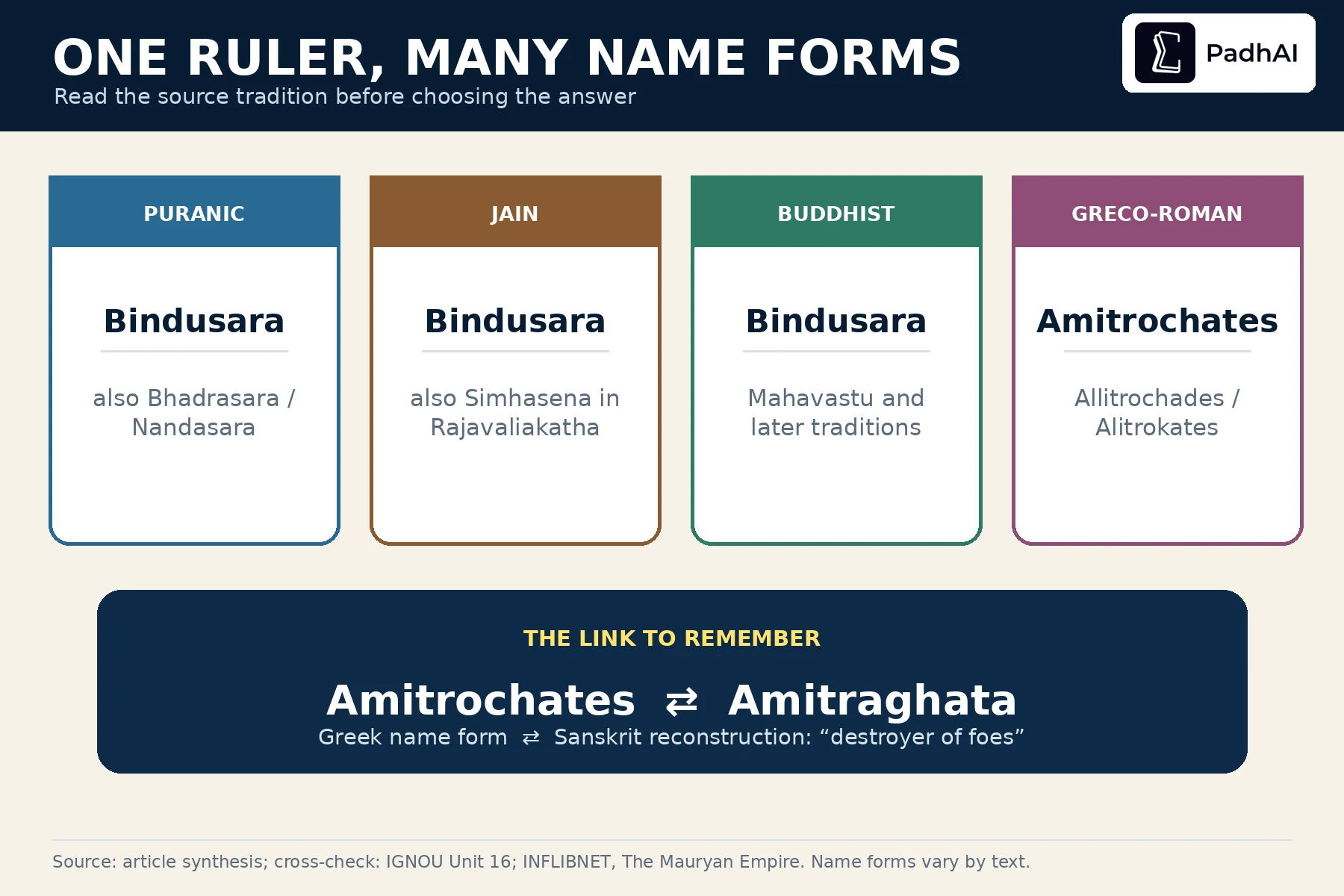
Textual traditions preserve several name forms; the Greek forms are linked to the Sanskrit Amitraghata.
Few Mauryan rulers appear in as many different texts and languages as Bindusara. The variety of names also tells us he was recognised far beyond the subcontinent.
Source tradition | Text | Name used |
|---|---|---|
Hindu Puranic | Vishnu Purana | Bindusara |
Hindu Puranic | Brahmanda Purana | Bhadrasara |
Hindu Puranic | Vayu Purana | Nandasara |
Jain | Parishishtaparvan | Bindusara |
Jain | Rajavaliakatha | Simhasena |
Buddhist | Mahavastu | Bindusara |
Greco-Roman | Athenaeus (Roman) | Amitrochates |
Greco-Roman | Strabo (Greek) | Alitrokates |
The scholar J. F. Fleet argued that the Greek forms Amitrochates and Alitrokates are phonetic renderings of the Sanskrit Amitraghata (also written as Amitrakhada), meaning "slayer of enemies" or "destroyer of foes".
The phrase Amitranam Hanta appears in the Aitareya Brahmana and the Mahabharata, where it is used as a warrior title. The use of this title for Bindusara suggests his contemporaries saw him as a successful military ruler, not just a caretaker king.
Bindusara ascended the Mauryan throne around 297 BCE, soon after Chandragupta Maurya abdicated and, according to Jain tradition, embraced the Digambara monastic life under Bhadrabahu.
Some texts place the start of his reign at 298 BCE and others at 297 BCE; the small gap reflects the fact that ancient Indian chronologies are reconstructed from later Puranic and Buddhist records rather than from dated inscriptions of his own.
At the time of his accession, the Mauryan Empire already covered most of northern India, from the Hindu Kush in the north-west to Bengal in the east and the Vindhyas in the south. Bindusara inherited:
The administrative structure built by Chanakya, laid out in the Arthashastra
A standing army and a provincial governance system based on four main provinces: Taxila, Ujjain, Tosali and Suvarnagiri
The friendly treaty with Seleucus I signed by his father
His task was less about new conquest and more about consolidation. Second-generation rulers of ancient empires often lost territory as regional governors turned restive. Bindusara's quiet achievement is that he passed on a larger, not smaller, empire to Ashoka.
Ancient Indian sources do not give a clean, verified number for how many wives of bindusara there were. What we have is a mix of Buddhist chronicles, Jain legends and Puranic genealogies, each with its own claim.
What the sources suggest:
Chief wife: Subhadrangi, also called Dharma or Janapadakalyani in different Buddhist traditions. The Divyavadana and the Ashokavadana name her as the mother of Ashoka and his brother Tissa (also called Vitashoka).
Senior queen (another consort): The mother of Prince Sushim (also spelled Susima), the eldest son and crown prince, is named as a separate queen in Buddhist accounts.
Multiple consorts: Both the Mahavamsa and the Divyavadana claim that Bindusara had around 101 sons, which implies a large royal household with several wives. The number 101 is traditional and may be more symbolic than literal.
Known or named queens | Source | Children associated |
|---|---|---|
Subhadrangi / Dharma | Divyavadana, Ashokavadana | Ashoka, Tissa (Vitashoka) |
Mother of Sushim (unnamed) | Buddhist accounts | Sushim (crown prince) |
Other consorts | Mahavamsa, Divyavadana | Attributed with the remaining of the "101 sons" |
The safe UPSC answer is: Bindusara had several wives, with Subhadrangi named most often as the chief queen and mother of Ashoka. An exact number cannot be verified from the sources.
If there is a single reason the title Amitraghata stuck to Bindusara, it is his southward push. His reign is traditionally associated with the extension of Mauryan influence into the Deccan, bringing much of the peninsula under one umbrella for the first time.
Scope of the campaign:
Southern campaign reaching close to today's Karnataka
Possible subjugation or submission of regions in modern Andhra Pradesh and parts of Maharashtra
The Tibetan Buddhist scholar Taranatha credits Chanakya (serving as his minister) with destroying the ruling houses of "sixteen kingdoms", making Bindusara master of the land "from the eastern sea to the western sea" (Bay of Bengal to Arabian Sea).
Where he stopped:
The extreme south, home to the Cholas, Pandyas and Cheras, was never incorporated into the Mauryan Empire.
Mauryan sources and Ashoka's later edicts refer to these southern kingdoms as friendly neighbours, not subjects. This is widely read to mean that diplomacy, not conquest, defined the southern frontier.
A note of caution for aspirants: some modern historians argue that the credit for the southern expansion is divided among Chandragupta, Bindusara and the later Mauryans.
Bindusara's role is best described as consolidating and extending Mauryan reach in the Deccan, rather than being its sole architect.
Image 2 suggestion — Map: "Mauryan Empire under Bindusara (c. 273 BCE)" with the Deccan push and the Chola/Pandya/Chera zone outside the empire.
Two major revolts during Bindusara's reign are specifically recorded in Buddhist tradition, and both are useful for Prelims-style questions.
First Taxila revolt
The Buddhist text Divyavadana records that Taxila (Takshashila), the empire's north-western provincial capital, rose in revolt.
The complaint of the people was striking: they were loyal to the Mauryan crown, but local ministers were oppressing them. The citizens are quoted as telling Prince Ashoka:
Na vayam kumarasya viruddhah napi rajno Bindusarasya. Apitu dushtamatya asmakam paribhavam kurvanti.
("We are not against you, Prince, nor against King Bindusara, but the corrupt ministers are humiliating us.")
Bindusara dispatched his son Ashoka, then a young prince, to restore order. Ashoka reportedly succeeded without a prolonged war, which gave him an early reputation as a capable administrator.
Khas and Nepal revolt
After Taxila, Ashoka is said to have moved on to the Khas region in or near today's Nepal, which had also risen against Mauryan authority. Taranatha credits him with bringing the Khas and Nepal regions back under Mauryan control.
Second Taxila revolt
Later in Bindusara's reign, Taxila revolted a second time. Ashoka was then posted at Ujjain, so Bindusara sent his eldest son, Prince Sushim (Susima), to deal with it.
The accounts suggest the second revolt was handled with mixed success, and the tension between Sushim and Ashoka would later shape the war of succession.
The two revolts tell a larger story about Bindusara's governance: he leaned on capable sons as viceroys in distant provinces, which held the empire together but also set up the succession struggle after his death.
Foreign Diplomacy and the Wine Letter

Greco-Roman writers connect Bindusara’s court with Seleucid Syria and Ptolemaic Egypt.
One of the most under-studied aspects of Bindusara's reign, and a strong Mains point, is his sophisticated foreign diplomacy. He kept Mauryan India firmly inside the Hellenistic world's circle of great powers.
Ties with the Seleucid Empire (Syria)
The friendly relations between Chandragupta and Seleucus I continued under Bindusara. The Greek geographer Strabo records that the Seleucid king Antiochus I Soter sent a Greek ambassador named Deimachus to Bindusara's court at Pataliputra.
This was a permanent, resident ambassadorship, not a one-off mission. Diodorus separately notes that the ruler of Pataliputra was held in high regard by the Greeks.
Ties with Ptolemaic Egypt
According to Pliny the Elder, the Egyptian king Ptolemy II Philadelphus (reigned 285–247 BCE) sent an ambassador called Dionysius to the Mauryan court.
This is remarkable: Bindusara was simultaneously running friendly diplomacy with both Seleucid Syria and Ptolemaic Egypt, two kingdoms that were in open rivalry with each other.
Foreign power | Ruler | Ambassador to Bindusara | Source |
|---|---|---|---|
Seleucid Empire | Antiochus I Soter | Deimachus | Strabo |
Ptolemaic Egypt | Ptolemy II Philadelphus | Dionysius | Pliny the Elder |
The famous wine, figs and philosopher letter
The Greek writer Athenaeus preserves one of the most charming diplomatic anecdotes from ancient India. Bindusara is said to have written to Antiochus asking for three things:
Sweet wine
Dried figs
A Greek philosopher
Antiochus happily sent the wine and the figs, but politely refused the philosopher, explaining that Greek law did not permit the sale of philosophers.
The exchange suggests two things, both relevant to Mains: Bindusara was an intellectually curious ruler, and the Mauryan court saw itself as an equal participant in the wider Hellenistic cultural world.
Administration and Religious Patronage

Archaeological remains at Kumhrar provide physical context for Pataliputra, the Mauryan capital.
Chanakya as minister
The Tibetan Buddhist scholar Taranatha and some Jain oral traditions say that Chanakya (Kautilya) continued to serve as Bindusara's chief minister in the early part of his reign, as he had under Chandragupta. If true, this would explain why the empire's administrative machinery, built on the Arthashastra, held steady during the transition.
Khallataka and other ministers
Some traditions mention Khallataka as a later minister during Bindusara's reign and record a story of nearly 500 royal councillors, hinting at a large advisory establishment at Pataliputra. These later sources should be treated as traditional rather than fully verified.
Religious plurality
Bindusara's religious outlook was broad for a king of his time.
The Sri Lankan Buddhist chronicle Mahavamsa records that Bindusara "honoured sixty thousand Brahmins", suggesting he was a strong patron of Brahmanical tradition.
The Divyavadana records that Ajivika ascetics, a prominent heterodox sect of the time, frequented his court. One famous story has an Ajivika seer predicting that Ashoka would become a world ruler.
His letter to Antiochus asking for a Greek philosopher shows an openness to foreign intellectual traditions as well.
This religious pluralism, decades before Ashoka's own policy of dhamma, provided the cultural backdrop against which Ashoka's later patronage of Buddhism would unfold.
Death, Succession and the Rise of Ashoka
Bindusara died around 273/272 BCE, at Pataliputra. His death set off a succession dispute that is central to the Mauryan story.
The main contenders:
Sushim (Susima): The eldest son and declared crown prince, supported by many senior ministers.
Ashoka: Then viceroy at Ujjain, a battle-tested administrator who had already handled the Taxila revolt.
Other brothers whose names and roles are preserved only patchily in Buddhist tradition.
Buddhist chronicles like the Mahavamsa and Divyavadana claim that Ashoka killed many of his brothers in a four-year succession war before formally being crowned around 269/268 BCE. The gap between Bindusara's death and Ashoka's formal consecration is itself a clue that the transfer of power was contested.
For UPSC, the key points to remember are:
Bindusara's death did not immediately bring Ashoka to the throne; there was a succession struggle.
Ashoka was not the designated heir; he emerged through the struggle.
The claim that Ashoka killed 99 brothers in Buddhist tradition is a traditional account and is debated by modern historians.
Bindusara's Reign Duration Debate
Ancient sources do not agree on exactly how long Bindusara ruled. For UPSC Prelims, the standard answer is approximately 25 years, but it is useful to know why the numbers differ.
Source | Reign duration (years) |
|---|---|
Puranas | 24 |
Mahavamsa (Sri Lankan Buddhist chronicle) | 27 |
Aryamanjushrimoolakalpa | 20 |
Modern historical calculation | ~25 |
The modern figure of around 25 years comes from counting back from Ashoka's consecration (around 269/268 BCE) and forward from Chandragupta's traditional abdication date (around 297 BCE). The three ancient figures reflect different chronological systems and are not errors; they are different accounting traditions.
For the exam, keep c. 297 BCE – 273 BCE and "about 25 years" as the headline numbers, and remember that the exact dates vary by source.
Significance of Bindusara in Indian History
Bindusara does not have a flashy legacy of inscriptions, grand monuments or famous reforms. His significance is quieter, and arguably more important:
Consolidation of the empire. He held together a territory that stretched "from the eastern sea to the western sea" through a critical second-generation transition.
Deccan expansion. He pushed Mauryan influence southward into the Deccan, laying the groundwork for the subcontinent-wide empire that Ashoka would inherit.
Hellenistic diplomacy. His simultaneous friendships with Seleucid Syria and Ptolemaic Egypt placed India firmly inside the great power system of the Hellenistic world.
Religious plurality. His patronage of Brahmins, Ajivikas and interest in Greek philosophy created a culture of openness that Ashoka would later channel into dhamma.
Delegated governance. By posting his sons as viceroys in Taxila and Ujjain, he developed a model of distributed authority that strengthened the empire even if it set up the later succession fight.
In one line, Bindusara's job was to inherit and preserve, and he did it well enough that Ashoka could later transform. Without a stable, functioning Mauryan Empire in 273 BCE, the Ashoka of the Kalinga war and the rock edicts simply would not have been possible.
UPSC Relevance: Prelims and Mains
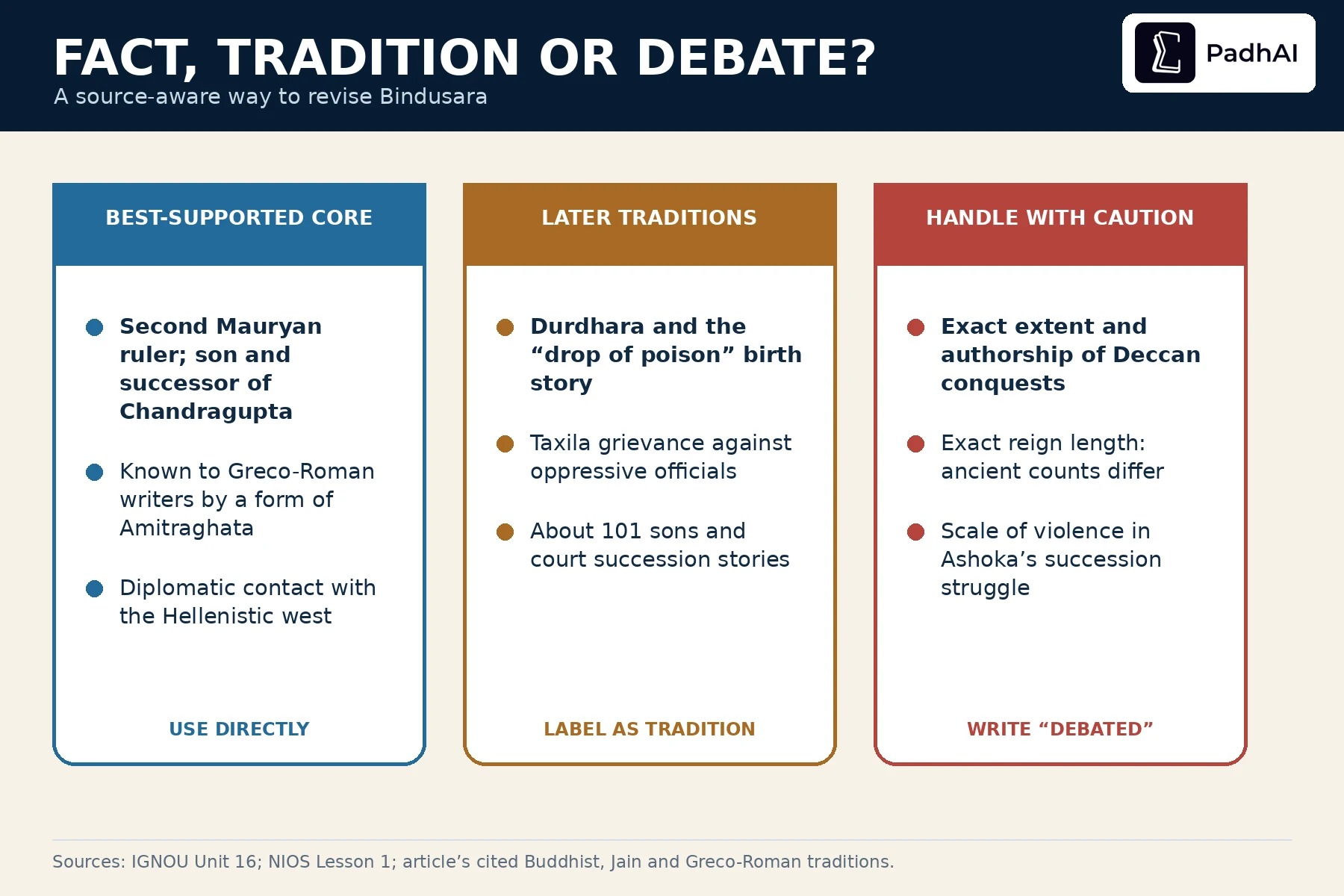
A source-aware revision sheet separates the historical core from later narrative traditions and disputed claims.
Stage | Where it fits | What to focus on |
|---|---|---|
Prelims | Ancient History, Mauryan Empire | Dates (c. 297–273 BCE), parents, titles (Amitraghata), Greek sources, Taxila revolt, ambassadors (Deimachus, Dionysius) |
Mains GS Paper I | Ancient Indian polity, administration, cultural history | Consolidation of empire, Deccan expansion, religious plurality, Hellenistic diplomacy |
Mains Essay | Themes on empire-building, continuity, leadership | Bindusara as a case study of the second-generation ruler |
Interview | Mauryan history, ancient diplomacy | Short, confident answers on name, dates, parents, successor |
Related read: Pair this blog with the Mauryan Empire pillar and the broader Ancient History hub.
Frequently asked question (FAQs)
Who is Bindusara?
Who was the father of Bindusara?
What is bindusara mother name?
How many wife of Bindusara are known from sources?
Why was Bindusara called Amitraghata?
Bindusara is the kind of ruler that exam-focused reading tends to skim over because he sits between two giants.
That is also why he is a reliable Prelims topic. Dates (c. 297–273 BCE), parents (Chandragupta and Durdhara), successor (Ashoka), his Greek title (Amitraghata / Amitrochates), his southern campaign up to Karnataka, and his two foreign ambassadors (Deimachus and Dionysius) carry most of the marks.
For Mains, remember that Bindusara's story is really a story about continuity: how a second-generation ruler keeps a new empire from fragmenting, how he projects soft power abroad, and how he quietly sets the stage for a reformer. Learn him as the bridge between Chandragupta and Ashoka, not as a footnote.
Facts verified against Britannica, Vajiram & Ravi and HistoryGuruji, cross-referenced with the Mauryan Empire guide on padhai.ai, R. S. Sharma's Ancient India, Romila Thapar's Early India, and NCERT Themes in Indian History Part I.
Bindusara is rarely asked as a standalone question, but he appears often as an option, a date-match, or part of a Mauryan dynasty question. Representative themes include:
Prelims Questions
Mains Questions



Gajendra Singh Godara
Ex-UPSC Aspirant | Exam Preparation Expert
Gajendra Singh Godara is an IIT Bombay graduate and a UPSC aspirant with 4 attempts, including multiple Prelims and Mains appearances. He specializes in Polity, Modern History, International Relations, and Economy. At PadhAI, Gajendra leverages his firsthand exam experience to simplify complex concepts, creating high-efficiency study materials that help aspirants save time and stay focused.

No comments yet. Be the first to join the discussion!