UPSC Principal & Vice Principal Recruitment 2026: 828 Posts
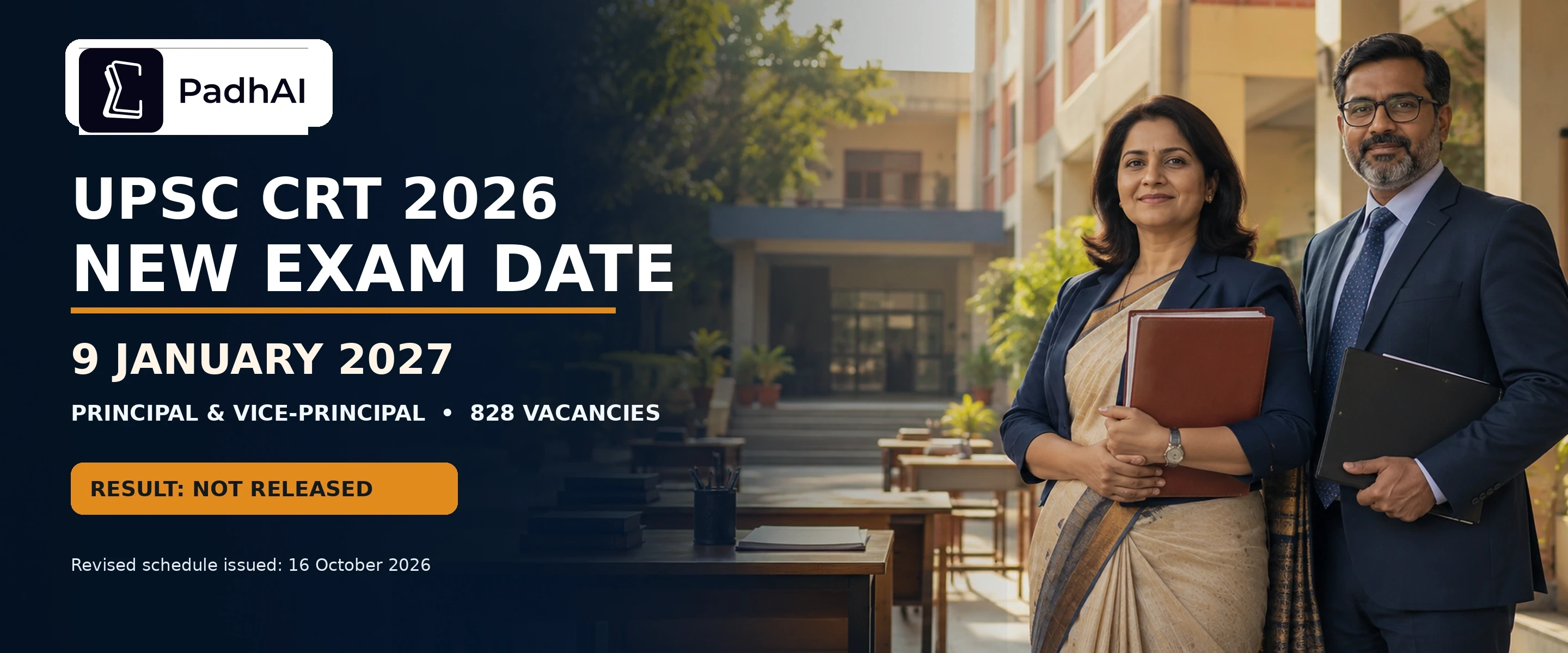
UPSC has released Special Advertisement No. 51/2026 for 828 Principal and Vice-Principal posts in the Education Department, Government of NCT of Delhi. Applications open on the ORA portal from 25 July to 14 August 2026. Here is the full breakdown of vacancies, eligibility, age limits, pay levels and selection.

Last updated

Particular | Detail |
Recruiting body | Union Public Service Commission (UPSC) |
Advertisement number | Special Advertisement No. 51/2026 |
Notice released on | 21 July 2026 |
Posts | Principal and Vice-Principal |
Department | Education Department, Government of NCT of Delhi |
Total vacancies | 828 |
Principal vacancies | 124 |
Vice-Principal vacancies | 704 |
Application window | 25 July 2026 to 14 August 2026 |
Mode of application | Online, through the UPSC ORA portal |
Application portal | upsconline.nic.in/ora |
Application fee | ₹25 for male UR, OBC and EWS candidates |
Fee exemption | All women candidates, plus SC, ST and PwBD candidates |
Recruitment method | Direct Recruitment by Selection |
Pay Level (Principal) | Level 12, 7th CPC Pay Matrix |
Pay Level (Vice-Principal) | Level 10, 7th CPC Pay Matrix |
Job location | National Capital Territory of Delhi |
Crucial date for age and eligibility | 14 August 2026 |
Most people who see "UPSC" in a headline assume a Prelims, a Mains and an interview. This one works differently, and understanding that difference will save you three weeks of preparing for an exam that may never be held in the form you imagine.
The UPSC Principal Recruitment 2026 falls under the Commission's Recruitment by Selection route, handled through the Online Recruitment Application (ORA) portal rather than the examination wing.
This is the same channel UPSC uses for specialist and senior posts across ministries:
Assistant Professors, Scientists, Medical Officers, Deputy Directors and so on. Candidates are shortlisted on the strength of qualifications and experience, and the final call is made by an interview board.
The employer here is not a central ministry in the usual sense. These 828 posts sit with the Education Department, Government of NCT of Delhi, and the appointees will run Delhi government schools.
UPSC is doing the recruiting because Union Territories do not have their own Public Service Commissions, so the Commission performs that function for them.
There is a clean division of labour worth knowing. Teaching posts in Delhi government schools, meaning PRT, TGT and PGT, are recruited by the Delhi Subordinate Services Selection Board (DSSSB) because they fall in Group B and Group C.
School leadership posts at Principal and Vice-Principal level are recruited by UPSC. So this notification is, in practical terms, a promotion ladder for people already inside the school system.
Join our WhatsApp Community
The upsc principal vacancy 2026 count of 828 splits sharply between the two posts. Vice-Principal accounts for roughly 85 percent of the total.
Post | Vacancy number | Male | Female | Total |
Principal | 26075101725 | 72 | 52 | 124 |
Vice-Principal | 26075102725 | 340 | 364 | 704 |
Total | 412 | 416 | 828 |
Vice-Principal is the only post in this cycle where female vacancies outnumber male ones. That reflects the gender-segregated structure of many Delhi government schools, where separate boys' and girls' sections need their own leadership.
Principal Post: Category-Wise Reservation
Category | Male | Female | Total |
UR | 37 | 32 | 69 |
EWS | 07 | 04 | 11 |
OBC | 07 | 11 | 18 |
SC | 13 | 03 | 16 |
ST | 08 | 02 | 10 |
Total | 72 | 52 | 124 |
PwBD reservation. Seven of the 124 Principal posts are reserved for Persons with Benchmark Disability, of which five are fresh vacancies and two are backlog.
For Vice-Principal, 28 of the 704 posts carry PwBD reservation. PwBD reservation is horizontal, which means these seats are carved out of the existing category totals rather than added on top of them, in line with the Rights of Persons with Disabilities Act, 2016, which raised the reservation for government posts from 3 percent to 4 percent.
A caution worth stating plainly: the category-wise split for Vice-Principal is being reported inconsistently across job portals right now, with internal totals that do not reconcile.
Verify the reservation table directly against the official PDF on upsc.gov.in before you decide which category slot you are competing in.
If you scan only the headline, you will read this as a Principal notification. It is not. Under upsc vice principal recruitment 2026, 704 of the 828 posts, roughly 85 percent, belong to the junior leadership role.
Three things make the upsc vice principal post the more realistic target for most applicants:
The experience bar is low. Two years as a PGT or three as a TGT, against ten years for Principal.
The age ceiling is tight. Thirty-five years for UR and EWS, so this is aimed squarely at teachers in their late twenties and early thirties.
The volume is large. With 704 seats, the ratio of posts to genuinely eligible applicants is far friendlier than any UPSC examination you will sit.
The trade-off is the age limit. A 38-year-old UR candidate with eight years of teaching is caught in a gap: too old for Vice-Principal, too short on experience for Principal.
If that is you, the Principal post in a later cycle is the realistic plan, and every additional year of documented PGT service moves you closer.
Add as a preferred Source on Google
Event | Date |
Short notice released | 21 July 2026 |
Online application opens | 25 July 2026 |
Detailed advertisement expected | On or around 25 July 2026 |
Last date to apply | 14 August 2026 |
Crucial date for age and qualification | 14 August 2026 |
Recruitment Test date | Not yet announced |
Interview | To be notified after shortlisting |
Now, the honest answer on the upsc principal exam date 2026. The Commission has not announced one.
Under Recruitment by Selection, UPSC holds a Recruitment Test only when the applicant pool is large enough that shortlisting on qualifications alone becomes impractical.
With 828 posts and a very wide pool of eligible serving teachers, a screening test is plausible, but the short notice does not commit to it.
What you should do in the meantime is straightforward. Prepare your documents, not a syllabus.
If a test is announced, UPSC typically gives six to ten weeks of notice, which is enough time to prepare for a screening paper on school administration, pedagogy and the education policy landscape.
The upsc principal eligibility criteria rest on three pillars: degree, teaching qualification and years of classroom experience.
All three must be completed on or before 14 August 2026. Experience earned after the closing date does not count, and this is the single most common reason applications get rejected at the scrutiny stage.
Requirement | Principal | Vice-Principal |
Degree | Master's degree from a recognised university | Master's degree from a recognised university |
Teaching qualification | B.Ed. or equivalent | B.Ed. or equivalent |
Experience | 10 years of teaching as PGT or TGT | 2 years as PGT or 3 years as TGT |
Nature of experience | Regular teaching in a recognised school | Regular teaching in a recognised school |
The experience gap between the two posts is dramatic. Ten years for Principal against two or three years for Vice-Principal is what pushes 704 of the 828 vacancies into the junior post.
If you are a PGT with four years behind you, Vice-Principal is your route, and this notification is essentially your fastest available promotion.
One nuance that trips up applicants: the two-versus-three year rule for Vice-Principal is not arbitrary.
A PGT qualifies for two years while a TGT needs three, because the PGT grade already sits higher in the pay hierarchy.
If you have served in both grades, read the detailed advertisement carefully on how mixed experience is counted before you compute your own eligibility.
Age Limit for UPSC Principal and Vice Principal Recruitment 2026
Category | Principal (maximum age) | Vice-Principal (maximum age) |
UR / EWS | 50 years | 35 years |
OBC | 53 years | 38 years |
SC / ST | 55 years | 40 years |
Note the mismatch. EWS gets no age relaxation, the same as UR. This follows the standard rule that Economically Weaker Sections reservation, introduced by the 103rd Constitutional Amendment Act, 2019, provides a 10 percent quota in seats but does not carry the age or fee relaxations available to OBC, SC and ST candidates. It surprises EWS applicants every single cycle.
Further relaxation applies to Persons with Benchmark Disability, Ex-Servicemen and departmental candidates as per Government of India rules. Age is calculated as on 14 August 2026.
Category | Fee |
UR, OBC and EWS male candidates | ₹25 |
All female candidates | Nil |
SC, ST and PwBD candidates | Nil |
Payment is made online through net banking, debit card, credit card or UPI on the ORA portal.
Step-by-step application process:
Go to upsconline.nic.in/ora.
Complete your One Time Registration (OTR) if you have not already. OTR is a permanent profile that carries across every UPSC recruitment, so you fill your basic details once.
Log in and open Active Advertisements, then select Special Advertisement No. 51/2026.
Choose your post, Principal or Vice-Principal, using the correct vacancy number.
Fill in academic details, employment history and experience periods with exact dates.
Upload your photograph, signature, degree certificates, B.Ed. certificate, experience certificates and category or PwBD certificate in the prescribed format.
Pay the fee if applicable.
Submit and download the printed confirmation page.
Document checklist: Matriculation certificate for date of birth, Master's degree marksheets and certificate, B.Ed. certificate, experience certificates on official letterhead with joining and relieving dates, category certificate in the prescribed central government format, EWS income and asset certificate if applicable, PwBD certificate if applicable, and a No Objection Certificate if you are already in government service.
That last one deserves emphasis. Serving government employees must route the application through proper channels or attach an NOC
Applications without it are treated as provisional and can be rejected at the interview stage.
Post | Pay Level | Basic pay range (7th CPC Pay Matrix) |
Principal | Level 12 | ₹78,800 to ₹2,09,200 |
Vice-Principal | Level 10 | ₹56,100 to ₹1,77,500 |
On top of the basic pay come Dearness Allowance, House Rent Allowance at the X-city rate applicable to Delhi, Transport Allowance and medical benefits. New entrants come under the National Pension System, not the old pension scheme.
A useful comparison for aspirants weighing options: Vice-Principal enters at Level 10 with a basic of ₹56,100, which is the exact same entry level as an IPS or IAS officer at the start of their career, and the same as a CAPF Assistant Commandant.
Principal enters at Level 12 with a base of ₹78,800, which corresponds roughly to a Junior Administrative Grade officer with about nine years of service. In pure pay terms, these are strong senior positions.
Actual in-hand pay will vary with the prevailing DA rate and deductions, so treat the basic pay range as the reliable figure and any in-hand number you see online as an estimate.
Stage | What happens |
Application scrutiny | UPSC verifies degree, B.Ed. and experience against the advertisement |
Shortlisting or Recruitment Test | Candidates shortlisted on merit of qualifications, or through a screening test if applications are very high |
Interview or Personality Test | Conducted by a UPSC selection board at Dholpur House, New Delhi |
Document verification | Originals checked before recommendation |
Final recommendation | Merit list forwarded to the Education Department, GNCTD |
The interview is the decisive stage here, not a written paper. UPSC selection boards for education posts typically probe your subject depth, your handling of school administration, discipline and staff management, your familiarity with NEP 2020, the Right of Children to Free and Compulsory Education Act, 2009, CBSE assessment reforms, and how you would respond to real situations such as a parent complaint or a teacher shortage.
If you have led a department, run a school committee, handled board result improvement or managed CBSE inspections, document it with dates and outcomes.
Recruitment by Selection rewards a verifiable track record far more than it rewards general knowledge.
Why This Recruitment Matters for UPSC Aspirants Beyond the Job
Even if you are not applying, this notification is a live case study for General Studies Paper 2.
The constitutional basis. UPSC is a constitutional body established under Article 315, which provides for a Public Service Commission for the Union and for each State.
Article 320 lays down its functions, including conducting examinations for appointments to the services of the Union and being consulted on recruitment methods and suitability of candidates. Article 321 allows Parliament or a State legislature to extend the Commission's functions to additional services.
Article 322 charges its expenses to the Consolidated Fund of India, and Article 323 requires an annual report to the President, which is laid before Parliament along with a memorandum on any case where the Commission's advice was not accepted.
That last provision is the accountability mechanism examiners like to ask about.
The Delhi angle. The National Capital Territory of Delhi has a special constitutional position under Article 239AA, inserted by the 69th Constitutional Amendment Act, 1991, which gave Delhi a Legislative Assembly and a Council of Ministers while keeping public order, police and land with the Union. Services in Delhi have been contested territory.
A Constitution Bench of the Supreme Court held in May 2023 that the elected Delhi government has legislative and executive control over services other than the three excluded subjects.
Parliament then passed the Government of National Capital Territory of Delhi (Amendment) Act, 2023, creating the National Capital Civil Service Authority to make recommendations on transfers and postings of officers, with the Lieutenant Governor holding the final word.
That dispute concerns the posting and transfer of officers serving in Delhi, not UPSC's recruitment function, which continues under Article 320 regardless.
But if you can hold both threads in your head, you have a ready-made answer on Centre-State and Centre-UT administrative relations.
The policy angle. A single drive for 828 school leadership posts points to a large accumulated vacancy in Delhi's school administration.
NEP 2020 places heavy emphasis on school leadership and on School Complexes, and vacant Principal posts are a recognised bottleneck in implementing it.
That is a usable example for questions on education governance and capacity gaps in public service delivery.
Five Mistakes That Get Applications Rejected
Counting experience past the closing date. Everything must be complete by 14 August 2026, not by the interview.
Applying for Principal with under 10 years. The experience requirement is not relaxable and the scrutiny is strict.
Assuming EWS gets age relaxation. It does not. EWS follows the UR age ceiling.
Skipping the OTR step. Without a completed One Time Registration you cannot even open the application form, and doing it on 14 August is asking for trouble.
Applying without an NOC while in government service. Get the paperwork moving the week you apply, not the week of the interview.
Frequently asked question (FAQs)
How many vacancies are there in UPSC Principal Recruitment 2026?
What is the UPSC principal exam date 2026?
What is the UPSC principal eligibility criteria for 2026?
What is the age limit for UPSC vice principal recruitment 2026?
What is the salary for UPSC Principal and Vice-Principal posts?
The UPSC Principal Recruitment 2026 is a rare event. Delhi government schools do not open 828 leadership posts in a normal year, and the two-to-three year experience bar on Vice-Principal makes it unusually accessible for teachers early in their careers.
For anyone tracking upsc vice principal recruitment 2026 specifically, the 704-post count makes this the single largest school leadership opening Delhi has advertised in years.
The window is short: 25 July to 14 August 2026, with no indication that it will be extended.
Do not wait for the exam date. Under Recruitment by Selection, your application is your first exam, and it is graded on documents.
Get your experience certificates in order this week, finish your OTR, and read the detailed advertisement line by line the day it appears on upsc.gov.in.




No comments yet. Be the first to join the discussion!