18th BRICS Summit 2026: Members, dates, theme and UPSC notes
Gajendra Singh Godara
Last updated
8
mins read
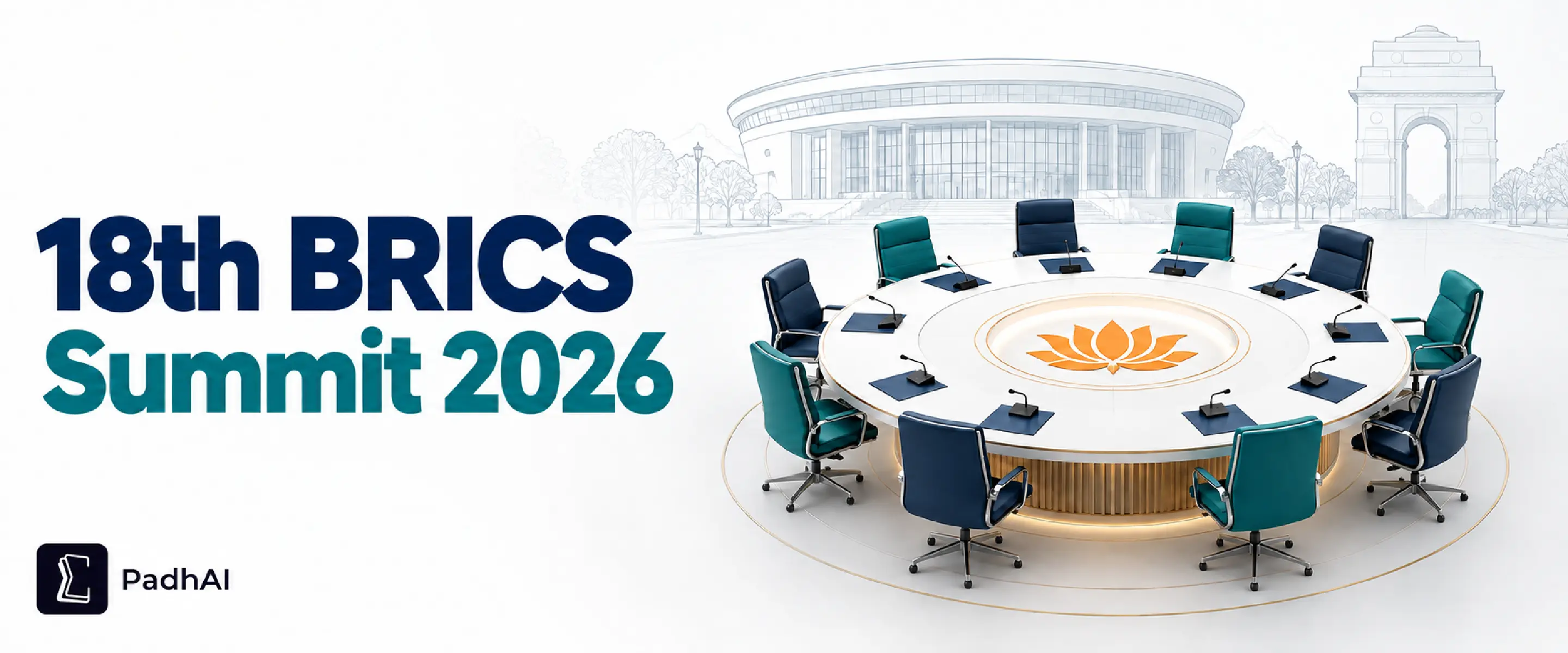
New Delhi, 12 September 2026. The 18th BRICS Summit opens at Bharat Mandapam and runs until 13 September. India holds the BRICS 2026 chairship and is the host this year.
The official theme is "Building for Resilience, Innovation, Cooperation and Sustainability." Leaders from member and partner countries are attending, alongside outreach invitees. India built its chairship around the people-centred phrase "Humanity First."
The BRICS Business Forum met on 11 September, a day before the leaders' summit. While speaking there, the Prime Minister asked for annual tracking of three business goals: identify the 10 largest trade barriers inside BRICS, help 100 start-ups enter other BRICS markets each year, and create 1,000 business partnerships.
You should treat these as proposals for the BRICS Business Council rather than final summit commitments.
Key Highlights
Summit: 18th BRICS Summit
Dates: 12-13 September 2026
Venue: Bharat Mandapam, New Delhi
Chair and host: India
Official list: 11 BRICS members and 10 partner countries
Chairship scale: more than 350 meetings and high-level engagements across over 25 Indian cities
Three pillars: political and security; economic and financial; cultural and people-to-people cooperation
Latest verified development: BRICS Business Forum held on 11 September; leaders' summit began on 12 September
Goldman Sachs created the term in a 2001 paper, "Building Better Global Economic BRICs," for Brazil, Russia, India and China.
These were four large emerging economies with growing global weight. Governments turned the label into their own political forum.
Foreign ministers started meeting in 2006, and the first leaders' summit happened in 2009.
South Africa joined in 2010 and attended its first summit in 2011, which changed BRIC to BRICS.
Egypt, Ethiopia, Iran and the United Arab Emirates became full members on 1 January 2024. Indonesia joined in January 2025.
It is the newest full member and a common Prelims topic.
India became the BRICS chair on 1 January 2026. This is its fourth turn after 2012, 2016 and 2021. The year also marks a round-number anniversary: 20 years since formal BRICS cooperation started in 2006, and 25 years since the BRIC term first appeared in 2001.
Watch out for this exam trap: the acronym and the forum are different ages. The name came first, but organised political cooperation began a few years later.
Join our WhatsApp Community
Item | Verified detail |
Edition | 18th BRICS Summit |
BRICS summit dates | 12-13 September 2026 |
Venue | Bharat Mandapam, New Delhi |
BRICS 2026 host country | India |
Chairship theme | Building for Resilience, Innovation, Cooperation and Sustainability |
Guiding approach | Humanity First; people-centred and inclusive cooperation |
Participation | Leaders of member and partner countries, plus outreach invitees |
Status on 12 September | Leaders' summit under way; final declaration and final summit outcomes pending |
Source: Government of India announcement on the 18th BRICS Summit, 27 August 2026; Prime Minister's BRICS Business Forum address, 11 September 2026. Checked 12 September 2026.
The official announcement does not mention a summit budget, treaty article or financial outlay. You should avoid attaching an invented figure or legal clause to this meeting when you write an answer.
Full BRICS members
The 2026 PIB list from India contains 11 BRICS countries.
Joining phase | BRICS members |
Original BRIC forum | Brazil, Russia, India, China |
First expansion | South Africa |
Full members from 2024 | Egypt, Ethiopia, Iran, United Arab Emirates |
Full member from 2025 | Indonesia |
Included in India's official 2026 list | Saudi Arabia |
BRICS partner countries
Partner status differs from full membership. This category was created at the 16th BRICS Summit in Kazan in October 2024.
Partners can take part in selected meetings and cooperation tracks, but they do not belong to the core grouping.
The 10 partner countries are Belarus, Bolivia, Cuba, Kazakhstan, Malaysia, Nigeria, Thailand, Uganda, Uzbekistan and Vietnam. Vietnam officially became the tenth partner in June 2025.
Add as a preferred Source on Google
BRICS operates as a platform for intergovernmental cooperation instead of a military alliance, a customs union, or a body with a founding charter similar to the UN.
The chair rotates, officials meet throughout the year, and the annual leaders' summit sets the broad political direction.
India's 2026 programme is organised around three established pillars:
Political and security cooperation covers global and regional issues, security concerns and reform of global institutions.
Economic and financial cooperation covers trade, investment, development finance, payment systems and related policy coordination.
Cultural and people-to-people cooperation covers youth, education, culture, business, civil society and exchanges among citizens.
Members make decisions by consultation and consensus. This protects the sovereignty of members, but it also means agreement can be slow when national interests pull in different directions.
The theme works as a ready-made structure for a Mains answer.
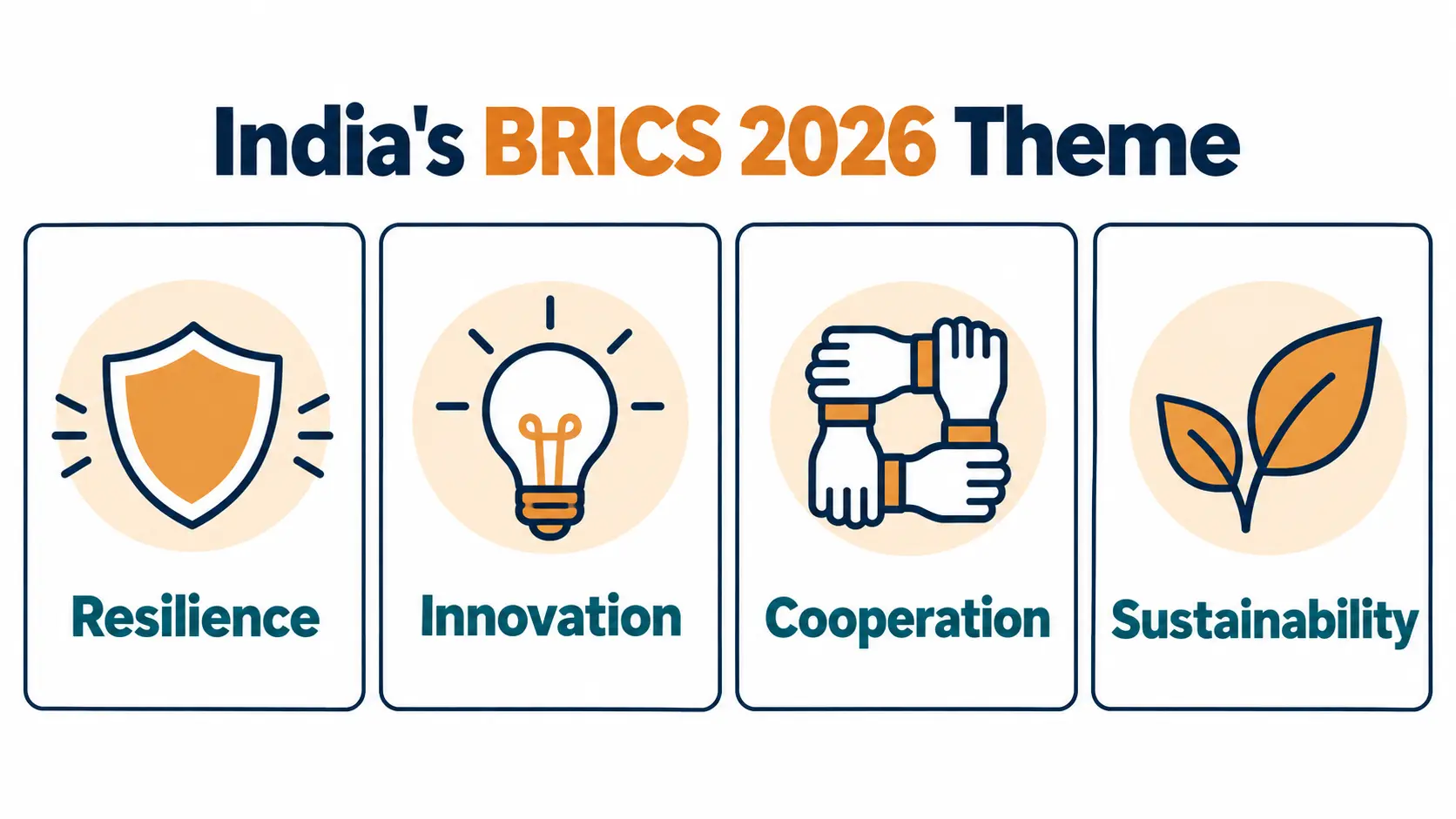
Theme word | Plain meaning | UPSC link |
Resilience | Capacity to absorb shocks and recover | Supply chains, health, food and energy security, disaster risk |
Innovation | Use of science and technology for public benefit | Digital public infrastructure, AI, research and start-ups |
Cooperation | Practical work despite political differences | South-South cooperation, trade, finance and diplomacy |
Sustainability | Growth that protects future welfare | Climate action, clean energy and sustainable development finance |
India's chairship produced a set of sectoral outcomes before the leaders even met in New Delhi. You do not need to memorise every single initiative.
The table below picks the most useful examples and states where each one stands.
Area | Verified 2026 outcome | Status and UPSC link |
Agriculture | Centres of Excellence on Agro-Ecology; BRICS Network on Digital Agriculture; BRICS AGRIN for seeds, germplasm and farm inputs | Cooperation frameworks. Connect with climate-resilient farming, food security and use of AI in agriculture. |
Health | BRICS Mission for Healthy Lifestyle with a 2026-2029 roadmap; mental-health training and centres coordinated by NIMHANS | Adopted cooperation tracks. Link with preventive health, non-communicable diseases and primary healthcare. |
Trade and MSMEs | Jaipur Consensus to study an invoice-discounting mechanism; credit-assessment principles for export-oriented MSMEs; GVC Action Plan 2026-2030 | The invoice mechanism is to be studied. The action plan and principles were adopted by trade ministers. |
Industry and start-ups | SME cooperation framework, BRICS Incubator Network, MSME portal and BRICS Startup Innovation Fund initiative | Chairship initiatives. Their operating rules, funding and delivery need follow-up. |
Energy and cities | Guiding principles on energy storage and smart grids; Digital Centre of Excellence; Urban Mobility Hub and principles for climate-resilient urban infrastructure | Cooperation tools rather than binding treaties. Link with energy transition and sustainable urbanisation. |
Customs and standards | Customs agreement approved in principle; memorandum among national standards bodies signed | A signed MoU and an agreement awaiting signature are not the same legal stage. This distinction is useful for Prelims. |
Source: PIB BRICS chairship backgrounder, 10 September 2026; PIB releases on the BRICS Industry Ministers' Meeting, 6 August 2026, and Trade Ministers' Meeting, 7 August 2026. Checked 12 September 2026.
Pay attention to the status labels. A roadmap, a voluntary principle, a proposed fund and a signed agreement represent four different levels of obligation. When you write a Mains answer, judge BRICS by whether these arrangements receive money, timelines and regular progress reviews.
While speaking at the 11 September forum, the Prime Minister described the MSME portal, Incubator Network and Startup Innovation Fund as chairship initiatives.
He also called for secure sea lanes, open supply routes and protection for seafarers. That last point ties the economic agenda to maritime security, which is a linkage that works in both GS Paper 2 and GS Paper 3.
Source: Prime Minister's address at the BRICS Business Forum, 11 September 2026. Checked 12 September 2026.
The summit is currently under way. You should treat the following points as open questions until the final New Delhi declaration and signed documents appear:
wording on reform of the UN, IMF, World Bank and other global institutions;
practical steps on trade, investment, local-currency settlement and cross-border payments;
the role of the New Development Bank in infrastructure and sustainable development;
cooperation on digital systems, innovation and resilient supply chains;
positions on major global and regional conflicts;
the role given to partner countries; and
mechanisms to monitor delivery after the summit.
A speech, a proposal or a media report does not count as an adopted BRICS decision. This article was updated on 12 September 2026, so the final declaration, the official participant list and any new financial commitment were all still pending at that time.
BRICS institutions: NDB and CRA
Members agreed on the New Development Bank and the Contingent Reserve Arrangement at the sixth BRICS Summit in Fortaleza, Brazil, in July 2014.
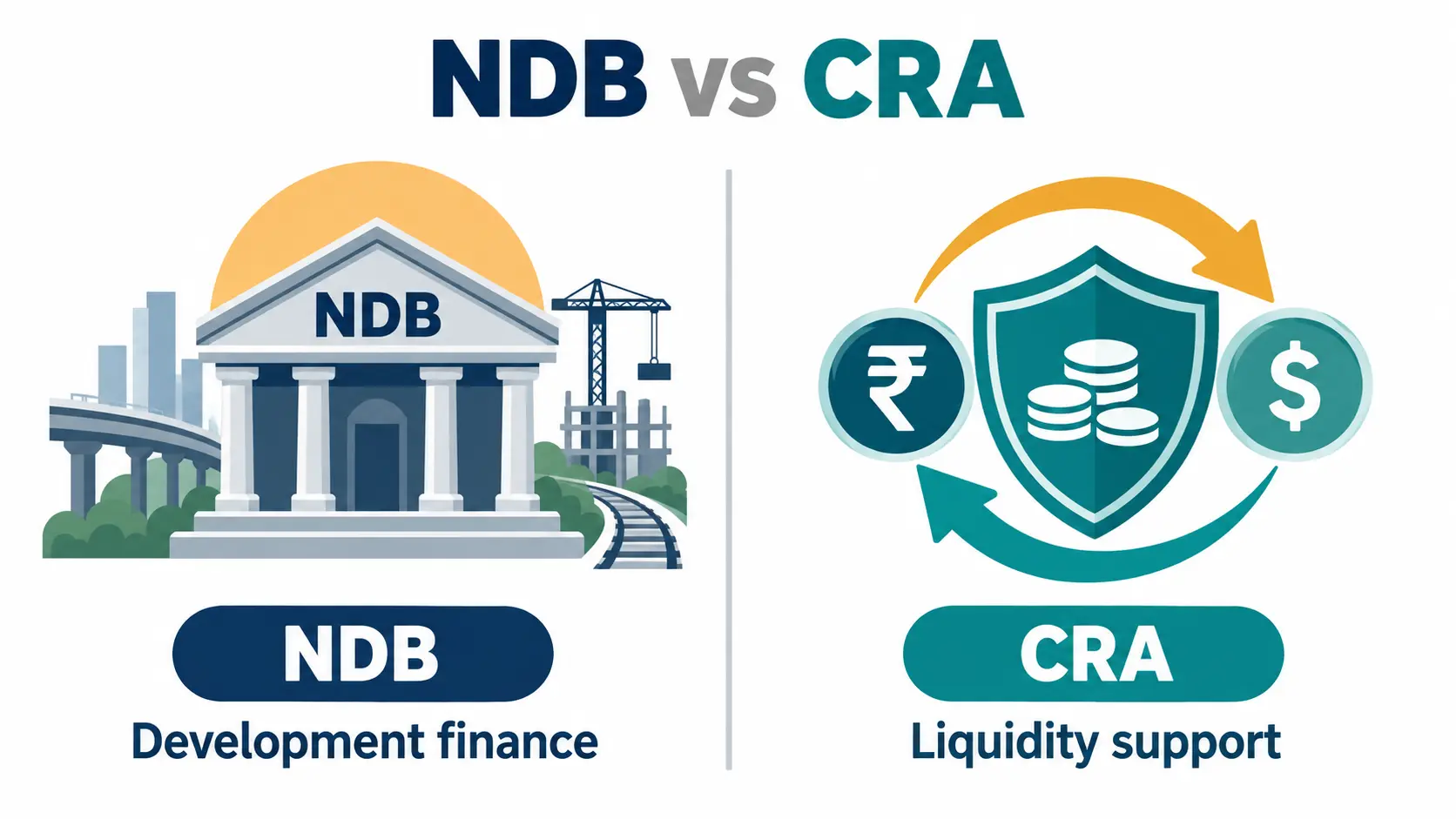
This produced the Fortaleza Declaration, which examiners like to ask about in both Prelims and Mains.
The 2012 New Delhi Summit discussed a BRICS development bank, and the 2013 Durban Summit declared the idea feasible.
Officials signed the NDB Agreement at Fortaleza on 15 July 2014, and the bank began operations in 2015 with K. V. Kamath as its first president.
Feature | New Development Bank (NDB) | Contingent Reserve Arrangement (CRA) |
Main purpose | Mobilise resources for infrastructure and sustainable development | Provide short-term balance-of-payments and liquidity support |
Legal anchor | NDB Agreement; purpose in Article 2 of the annex | CRA Treaty; purpose in Article 1 |
Size at creation | Authorised capital USD 100 billion; initial subscribed capital USD 50 billion | Total committed resources USD 100 billion |
Location | Headquarters in Shanghai under Article 4 | No lending-bank headquarters; it is a reserve pool arrangement |
How it helps | Project finance and related assistance | Swap access during external-payment pressure |
Key Prelims trap | A development bank is not an emergency reserve pool | A reserve arrangement is not a project-finance bank |
Source: Agreement on the New Development Bank, signed 15 July 2014; CRA Treaty, signed 15 July 2014. Checked 12 September 2026.
China committed USD 41 billion under the CRA. Brazil, Russia and India committed USD 18 billion each, and South Africa committed USD 5 billion. Those shares come from the original five-country treaty, so you should avoid mixing them up with the membership of the expanded BRICS today.
Current NDB membership needs careful wording
The NDB member page currently lists 10 countries as effective members: Brazil, Russia, India, China, South Africa, Bangladesh, the UAE, Egypt, Algeria and Uzbekistan.
Uzbekistan is the latest effective member shown, and its membership date is 5 June 2026.
The bank also lists Uruguay, Colombia, Ethiopia, Angola and Zimbabwe as prospective members.
Their membership becomes official only when they deposit the required instrument of accession.
The NDB history page states the Board admitted Colombia and Ethiopia in 2025. You should read that against the disclaimer on the member page.
Board approval or admission differs from completed legal membership. This distinction also corrects a misleading "11 NDB members" line that appeared in the audit report.
Dilma Rousseff was re-elected NDB president on 19 March 2025. Her current term runs from 7 July 2025 to 6 July 2030.
Why BRICS matters for India
A stronger voice for the Global South
BRICS gives India a stage to press for fairer representation of developing countries in the UN and the global financial institutions. It does this alongside the case India makes in the G20 and other forums.
Strategic autonomy
India works with Western partners in the Quad and elsewhere while it still sits at the table with Russia, China and the other BRICS countries. This gives India room to cooperate issue by issue instead of joining a fixed geopolitical camp.
Development finance
The NDB adds another channel for infrastructure and sustainable development finance. India is a founding member and has a hand in shaping the bank.
Energy, markets and technology
The expanded grouping puts major energy producers, big consumer markets, manufacturing centres and technology capabilities in the same room. Cooperation has room to grow, but commercial gains still depend on workable rules and actual projects.
Diplomatic contact
BRICS meetings keep lines open with countries India disagrees with in other settings. Dialogue does not settle disputes, but it can stop a single disagreement from blocking work on shared interests.
The Mains debate: Reform platform or rival bloc?
India's own position frames this debate. At the 2024 Kazan Summit, the Prime Minister said BRICS should stay non-divisive, work in humanity's interest and pursue reform of global institutions rather than their replacement.
He also stressed consensus and respect for the diversity of the group.
That framing suits India. A reform platform can push for wider representation without dragging every member into a single foreign-policy line.
A rigid anti-West bloc would narrow the choices available to India and complicate cooperation with its other partners.
Expansion buys representation at the price of consensus. Eleven members bring different political systems, security concerns, trade patterns and regional priorities.
The real test is whether they can agree on a small set of practical actions and then actually deliver them.
Payment cooperation is where loose language causes the most damage. Official BRICS documents talk about local-currency settlement, correspondent banking and voluntary cross-border payment initiatives.
None of this amounts to launching a common BRICS currency. You should keep a payment mechanism and a shared currency as two separate ideas in your answers.
BRICS shares one weakness with other consensus-based groupings when it comes to institutional risk. Momentum drops when bilateral tensions take over the agenda. This comparison does not equate BRICS and SAARC.
BRICS has wider membership, a global agenda and financial institutions of its own.
You should resist the urge to force a verdict in Mains. BRICS has given developing countries another forum and built financial institutions of its own.
How much influence it wields still depends on consensus, credible finance and delivery.
Concerns and the other side
Slower consensus: expansion adds regions, and those regions bring more national priorities.
Geopolitical differences: members do not form a single camp, and bilateral tensions can weaken common statements.
Implementation gap: a long list of meetings matters only if projects, funding, deadlines and review systems follow.
Economic asymmetry: members vary greatly in economic size and administrative capacity.
Institutional overlap: BRICS initiatives must add value alongside the UN, G20, IMF, World Bank and regional bodies.
Safeguards: faster development finance should not dilute environmental, social, procurement or debt-sustainability standards.
The other side of that diversity is a wider base. BRICS pulls together countries from Asia, Africa, West Asia, Latin America and Eurasia in a single forum. Agreement takes longer, but a decision accepted across this membership carries wider legitimacy.
Way forward
Select a small number of goals with clear timelines, finance and responsible institutions.
Publish progress reports on major summit commitments.
Strengthen NDB lending while preserving project safeguards and financial discipline.
Build transparent, voluntary and interoperable payment cooperation.
Give partner countries meaningful roles without blurring the difference between partner and member.
Keep BRICS non-divisive and focused on reform, development and practical cooperation.
Protect India's strategic autonomy while using the forum to widen the voice of the Global South.
The 2026 summit can widen representation, but credibility will come only from delivery. The best outcome for India is a practical, reform-oriented BRICS that works across divides without hardening into a closed bloc.
UPSC relevance
Exam area | What to prepare |
GS Paper 2 | Bilateral, regional and global groupings involving India; effect of global politics on India's interests; international institutions |
GS Paper 3 | Infrastructure finance, payment systems, energy security, technology and sustainable development |
Prelims | Summit number, dates, venue, chair, members versus partners, newest member, NDB headquarters, NDB versus CRA, Fortaleza |
Mains | India's strategic autonomy, Global South, reform of multilateral institutions, benefits and limits of expansion |
Essay | Multipolarity, cooperation among developing countries, institutions and global governance |
Two revision paths
Time available | Revision plan |
2-3 hours | Memorise the at-a-glance table; learn members versus partners; revise the NDB-CRA table; attempt the two PYQs; write the practice answer outline |
8-10 hours | Add the official history, theme, India-interest sections and Mains debate; read the linked official sources; write a 250-word answer and revise it after the summit declaration |
Frequently asked question (FAQs)
When and where is the BRICS Summit 2026 being held?
Which country is hosting BRICS in 2026?
How many BRICS members are there in 2026?
Which country is the newest full BRICS member?
Is BRICS launching a common currency at the 2026 summit?
Prelims Questions
Mains Questions


Gajendra Singh Godara
Ex-UPSC Aspirant | Exam Preparation Expert
Gajendra Singh Godara is an IIT Bombay graduate and a UPSC aspirant with 4 attempts, including multiple Prelims and Mains appearances. He specializes in Polity, Modern History, International Relations, and Economy. At PadhAI, Gajendra leverages his firsthand exam experience to simplify complex concepts, creating high-efficiency study materials that help aspirants save time and stay focused.

No comments yet. Be the first to join the discussion!