Form 6 Voter Registration: SIR Declaration Rolled Back

Gajendra Singh Godara
Last updated
4
mins read

Why in the News
The Election Commission removed the extra SIR-linked declaration from the online Form 6 on 30 September 2026. This applies only to States where the Special Intensive Revision has finished.
That declaration no longer appears on the ECINET app, the ECINET portal, or the Chief Electoral Officer portals of those States.
A person applying for new voter registration in those States now fills only the statutory Form 6 prescribed under the Registration of Electors Rules, 1960.
Key Highlights
Extra declaration withdrawn in States where SIR is over, such as Kerala
Removed from ECINET, its app and the CEO portals
Follows the full Commission meeting of 26 September 2026
It asked whether the applicant, parents or grandparents were in the last SIR roll
EC Vivek Joshi objected in May 2026 that a statutory form needs a rule amendment
Two petitions pending, in the Supreme Court and the Bombay High Court
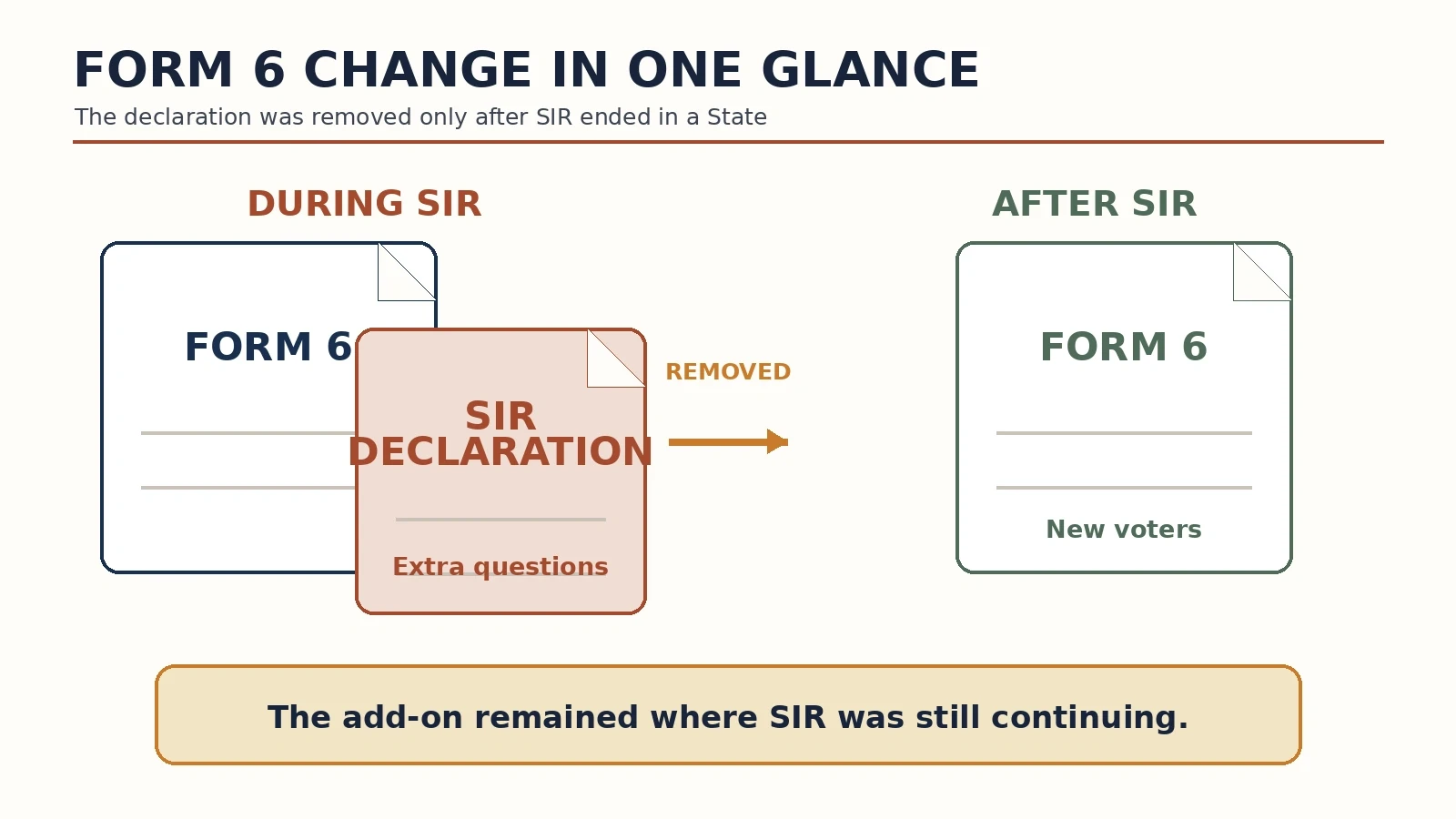
Existing voters received enumeration forms from Booth Level Officers during the Special Intensive Revision. New applicants did not get one. They are not on the roll yet.
So the Commission attached a declaration to the online Form 6. It largely copied the SIR enumeration form. The question was whether the applicant, or a parent or grandparent, appeared in the roll of the last intensive revision.
Where it sat was the problem. The Registration of Electors Rules, 1960 prescribes Form 6, and a prescribed form carries legal weight.
Join our WhatsApp Community
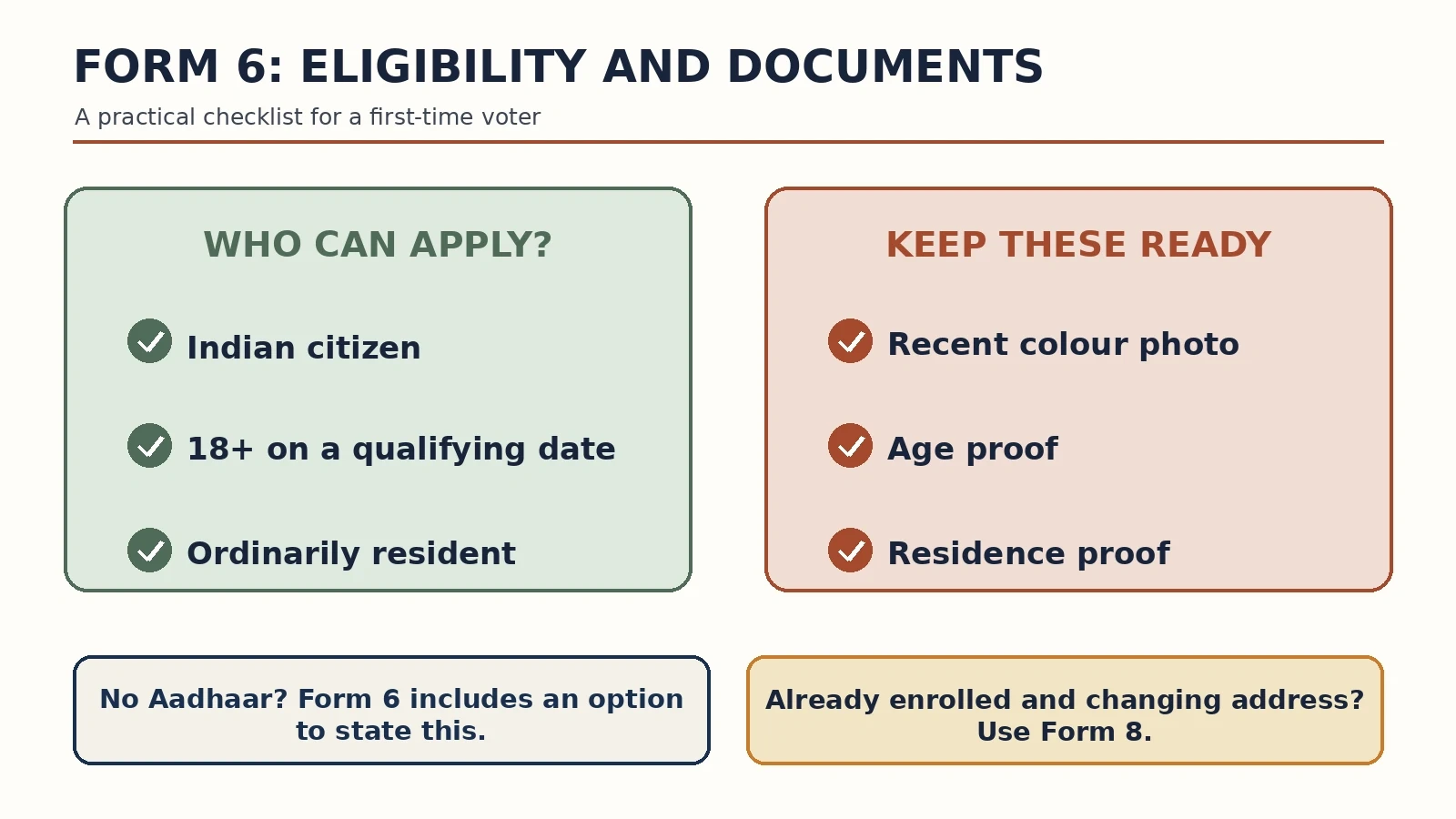
Form 6 is the application for new voter registration. A first-time voter uses it. Someone shifting to a new constituency uses it too.

Form | Purpose |
Form 6 | Enrolment of a new voter or shifting to another constituency |
Form 6A | Enrolment of an overseas elector |
Form 6B | Voluntary submission of Aadhaar number |
Form 7 | Objection to a name, or deletion |
Form 8 | Correction of details, replacement of EPIC, marking as person with disability |
Three Eligibility Conditions Apply:
The applicant must be an Indian citizen, at least 18 on the qualifying date, and an ordinary resident of the constituency. Proof of age, address and identity gets attached.
This is the core of the story. It is also the part worth writing in a Mains answer.

Section 28 of the Representation of the People Act, 1950 gives the Central Government power to make rules under the Act, after consulting the Election Commission. The Registration of Electors Rules, 1960 came from that power. The forms sit inside those Rules.
Rules made under an Act are delegated legislation. The executive frames them, but Parliament sees them and can modify or annul them.
So here is the argument. A form that sits inside the Rules cannot be changed without changing the Rules.
That is the Central Government's job, not the Commission's. And it passes through parliamentary scrutiny. A change made on a portal skips both steps.
Vivek Joshi recorded this objection in May 2026. Sukhbir Singh Sandhu later agreed and asked for the extra questions to be removed.
Add as a preferred Source on Google
Case | Forum | What Is Sought |
PIL by Advocate Shailendra Mani Tripathi | Supreme Court | Restoration of the original Form 6, an SIT probe into voter exclusion, and action against officials |
Petition by Prathamesh Gavankar and others | Bombay High Court | Quashing of the Form 6 changes and a judicial inquiry |
Both matters are yet to be decided.
The Commission says the declaration during SIR was upheld by the Supreme Court, and that outside the SIR period the 1960 Rules apply.
Critics disagree with that reading. They say the Court's observation was about documentation during a revision, not a ruling that the Commission may redraft a statutory form.
Provision | What It Does |
Article 324(1) | Superintendence, direction and control of rolls and elections with the ECI |
Article 326 | Adult suffrage, voting age 18 |
RP Act 1950, Section 21 | Preparation and revision of electoral rolls |
RP Act 1950, Section 28 | Central Government's power to make rules, after consulting the ECI |
Registration of Electors Rules, 1960 | Prescribes the forms and the procedure |
Rule 19 of the 1960 Rules | ERO must give notice of hearing on claims and objections not disposed of earlier |
For the wider story of the revision and the platform, read our explainer on electoral roll revision and ECINET, and revise the basics on the polity section.
Image 3: Flow diagram from Section 28 to the 1960 Rules to Form 6. Alt text: How Form 6 is prescribed under the Registration of Electors Rules 1960.
Process concern. A statutory form got altered on a portal, without a rule amendment, without going before Parliament.
Burden on the young. A first-time voter had to supply grandparents' details from an old roll. Many do not have those records.
Partial rollback. The declaration has gone only where SIR is complete. Where the revision is still running, it continues to apply.
The Commission's side. During a revision, new applications and re-inclusion requests come through the same form. So a link to the previous roll was needed. The Commission says the requirement was always meant only for the SIR period.
And a practical point. Two of three Commissioners objected, and the withdrawal came quickly. That shows internal disagreement can correct a decision.
Amend the Rules first if a form needs to change
Publish every form change with a dated note
Keep one form for one purpose, instead of using Form 6 for new voters and re-inclusion
Accept alternative proofs where old family records do not exist
Place portal changes before the full Commission
Stage | Angle |
Prelims | Form 6, 6A, 6B, 7 and 8; Section 28 of the RP Act 1950; Registration of Electors Rules 1960; Article 326 |
GS Paper 2 | Election Commission, delegated legislation, parliamentary oversight of rules |
Mains | Limits of executive rule-making, inclusion of voters |
Interview | Should a poll body be able to change a form on its own? |
Frequently asked question (FAQs)
What is Form 6 used for?
What was the SIR declaration in Form 6?
Has the declaration been removed everywhere?
Why was the change to Form 6 controversial?
Who can apply through Form 6?
The rollback looks small. But the principle behind it is large. When a form sits inside the Rules, how it gets changed matters as much as what it asks.
For the exam, remember three points. Form 6 is a statutory form. It comes from the Registration of Electors Rules, 1960 made under Section 28 of the RP Act 1950.
And executive rule-making still answers to Parliament. Track the two pending cases on our daily current affairs page.
Sources: Election Commission press note dated 26 September 2026 and subsequent portal changes; Representation of the People Act, 1950, Sections 21 and 28; Registration of Electors Rules, 1960; petitions filed in the Supreme Court and the Bombay High Court as reported.
Prelims Questions
Mains Questions





Gajendra Singh Godara
Ex-UPSC Aspirant | Exam Preparation Expert
Gajendra Singh Godara is an IIT Bombay graduate and a UPSC aspirant with 4 attempts, including multiple Prelims and Mains appearances. He specializes in Polity, Modern History, International Relations, and Economy. At PadhAI, Gajendra leverages his firsthand exam experience to simplify complex concepts, creating high-efficiency study materials that help aspirants save time and stay focused.

No comments yet. Be the first to join the discussion!