PadhAI, ChatGPT, Gemini and Claude Compared for UPSC

Last updated
8
mins read
For UPSC preparation, use the tool that matches the job. PadhAI.ai is the stronger fit for current affairs, Previous Year Questions (PYQs), doubts, quizzes and Mains (written examination) feedback in one connected workflow.
ChatGPT, Gemini and Claude are more flexible for general explanations, brainstorming, research and document work. Many aspirants will get more value from using both types.
Artificial Intelligence (AI) can shorten research and feedback time. It cannot decide which fact deserves trust, write your exam by hand or build discipline for you.
This comparison looks at study tasks and evidence, not brand popularity. If you want a wider list first, see these UPSC preparation apps.
Key Highlights
PadhAI reduces the setup needed for common UPSC tasks because its current affairs, PYQs, AI Tutor, BookChat, quizzes and Mains evaluation sit in a connected exam workflow.
ChatGPT is useful for step-by-step explanations, uploaded PDFs, brainstorming and general learning. You still need to supply the syllabus, source and evaluation rules.
Gemini suits broad learning, source exploration, files and Google-connected work. Claude is useful for long document discussions, learning through questions and source-based synthesis.
The 2023 headline that ChatGPT failed UPSC describes an older, third-party experiment. It is not a current product benchmark.
PadhAI's reported 2024 Prelims score is noteworthy, but it covered one objective paper. It did not prove a Civil Services Examination rank or selection outcome.
The safest rule is simple: keep official sources and standard books as your factual base, use AI for assistance, then verify and practise yourself.
Decision rule: Choose PadhAI for a connected UPSC practice and feedback cycle. Choose a general AI assistant for flexible explanation, research or document work. Use both when they perform different jobs in the same study session.
How this comparison was made: PadhAI publishes this page and includes its own product. We checked current first-party product pages on 25 August 2026 and treated the comparison as research-based.
We did not run an equal model-by-model performance test. PadhAI is an independent education platform and is not associated with the Union Public Service Commission (UPSC).
The key difference is not which chatbot sounds cleverest. It is how much UPSC context you must supply before the tool becomes useful.
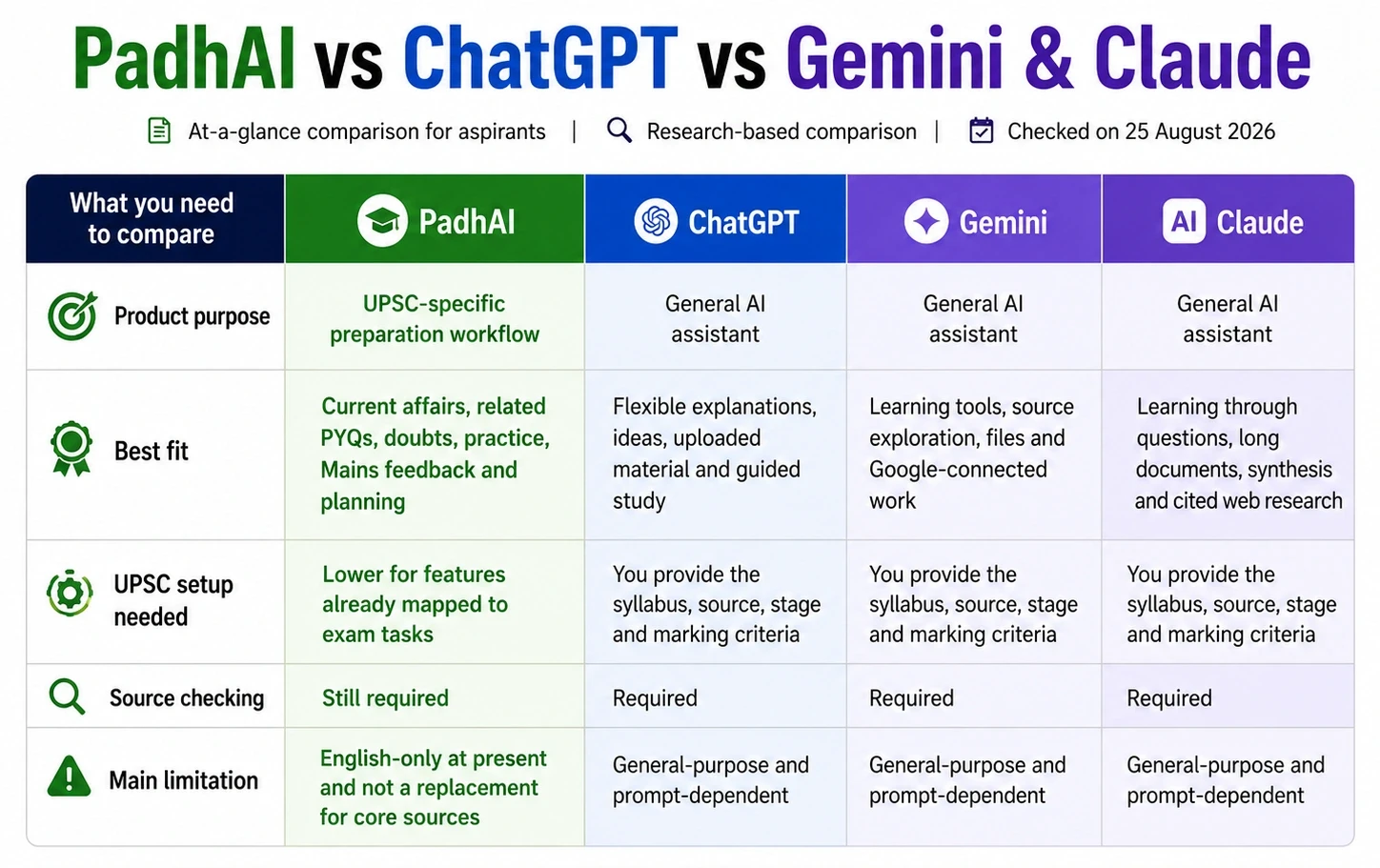
What you need to compare | PadhAI | ChatGPT | Gemini | Claude |
|---|---|---|---|---|
Product purpose | UPSC-specific preparation workflow | General AI assistant | General AI assistant | General AI assistant |
Best fit | Current affairs, related PYQs, doubts, practice, Mains feedback and planning | Flexible explanations, ideas, uploaded material and guided study | Learning tools, source exploration, files and Google-connected work | Learning through questions, long documents, synthesis and cited web research |
UPSC setup needed | Lower for features already mapped to exam tasks | You provide the syllabus, source, stage and marking criteria | You provide the syllabus, source, stage and marking criteria | You provide the syllabus, source, stage and marking criteria |
Source checking | Still required | Required | Required | Required |
Main limitation | English-only at present and not a replacement for core sources | General-purpose and prompt-dependent | General-purpose and prompt-dependent | General-purpose and prompt-dependent |
Sources checked on 25 August 2026: PadhAI product page, ChatGPT Study Mode, Google's student learning tools and Claude for Education.
If you dislike rebuilding prompts for every topic, PadhAI has the practical advantage. If you need broad research or flexible document work, use a general tool.
Join our WhatsApp Community
Yes. ChatGPT can help you understand a difficult concept, question your reasoning, discuss an uploaded PDF, draft an answer outline and create practice questions.
OpenAI says Study Mode can ask interactive questions, break concepts into stages, check understanding and work with uploaded images or PDFs.
That is useful, but Study Mode is a general learning feature. Its official documentation does not describe a built-in UPSC syllabus, a linked PYQ bank or a dedicated Mains evaluation workflow. You have to provide that context.
Start with the relevant UPSC syllabus, then give ChatGPT five things:
Role: “Act as a UPSC General Studies mentor.”
Stage: “I am preparing for Prelims” or “I am practising a 150-word Mains answer.”
Source: Paste the official release, book passage or verified note it must use.
Task: Ask for one clear output, such as a concept explanation, outline or quiz.
Verification rule: Tell it to separate source-backed facts from inferences and list anything you must verify.
A usable prompt could be: “Explain the basic structure doctrine to a beginner. Use only the Supreme Court summary pasted below.
Then ask me three questions. Flag any statement not present in the source.” That gives the tool less room to fill gaps with guesswork.
ChatGPT works best when you bring the exam context. If you expect the tool to supply the syllabus, source, PYQ connection and marking rubric by itself, your results will vary more.
The “ChatGPT failed UPSC” claim comes from a historical media experiment, not a current UPSC result.
A March 2023 India Today report said an earlier ChatGPT version answered 54 of 100 questions correctly on the 2022 Civil Services Preliminary Examination General Studies Paper I.
The article treated the result as below the reported general cut-off.
Several details needed for a clean benchmark were not published in that article. These include the exact model build, the full prompt, browsing conditions, unanswered questions and treatment of negative marking. Current ChatGPT also has features that the 2023 product did not have.
What this does not prove: It does not show that present-day ChatGPT cannot answer UPSC questions. It also does not show that ChatGPT can clear the full Civil Services Examination. It shows how one earlier system reportedly performed in one third-party test.
Going deeper
A raw count of correct answers cannot be compared safely with a cut-off unless the test records how wrong and unanswered questions were treated.
A defensible benchmark needs the exact answer sheet, scoring method and official key. UPSC publishes answer keys and cut-off marks through separate official archives.
Add as a preferred Source on Google
Gemini and Claude have the same broad advantage as ChatGPT: they can work across many subjects and formats. They also share the same basic risk.
A polished answer can still contain an outdated date, a weak source or a confident mistake.
Gemini for UPSC
Google's current Gemini help pages document file analysis, quizzes and flashcards, and Deep Research.
Use it when you want to examine a document, create recall material or explore sources around a topic.
For UPSC work, give it an official document and ask for a syllabus map, a fact table and open questions.
Then check the links it provides. The official product material does not describe an integrated UPSC PYQ bank or a dedicated UPSC Mains evaluator, so you still have to add that exam layer yourself.
Claude for UPSC
Anthropic describes Claude's learning mode as a question-led tutor. Its education page also focuses on long research discussions and source synthesis.
Claude's web-search documentation says searched responses include citations and source links.
A long committee report is a sensible Claude task. You can compare arguments or check whether evidence supports a conclusion.
Citations help you trace the answer, but you still need to open the source before keeping a claim.
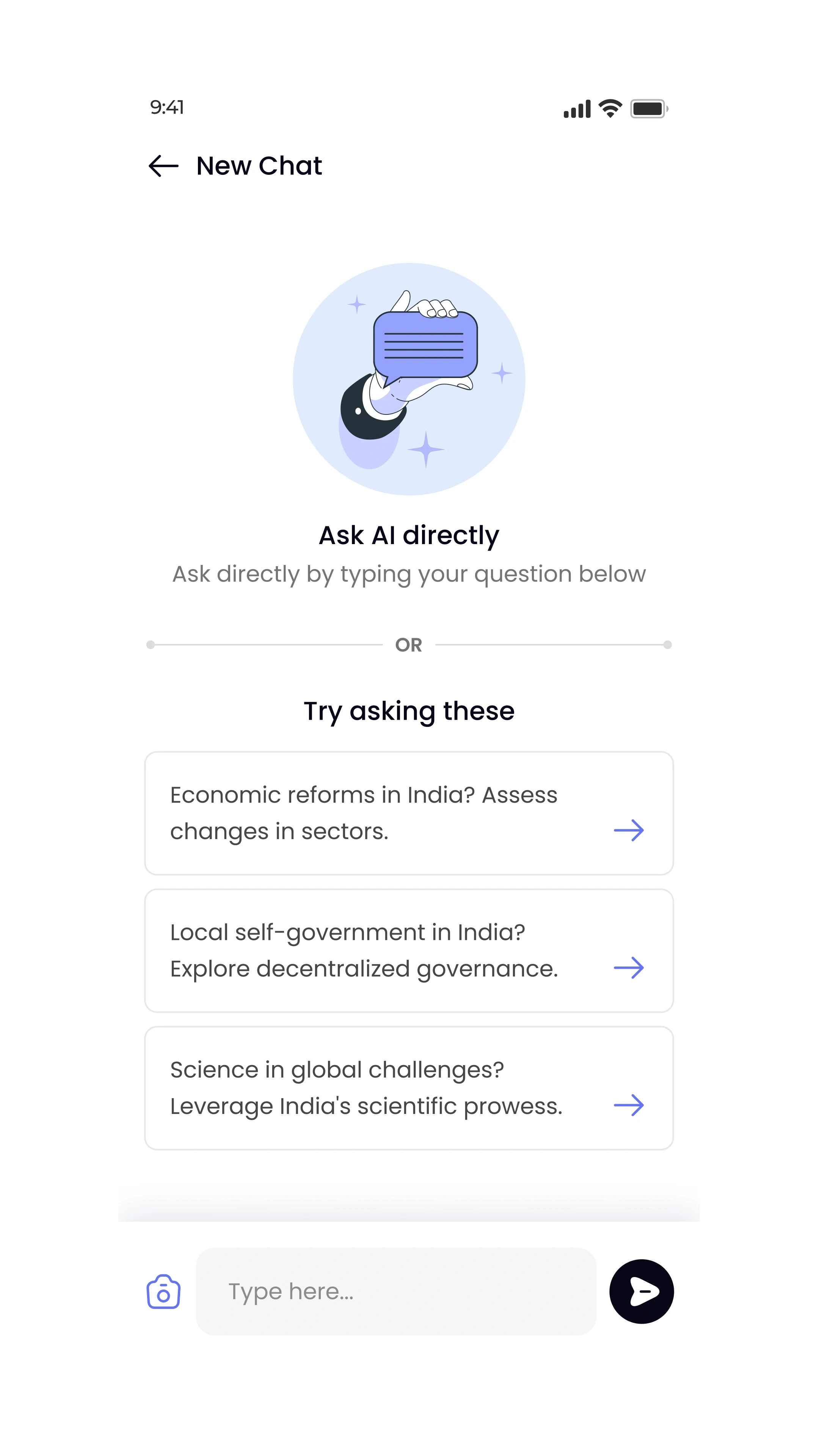
PadhAI is built around the work an aspirant repeats every week. You read an issue, connect it to the syllabus, inspect related PYQs, clear doubts, practise recall, write an answer, review feedback and plan the next revision.
The benefit is not that every answer becomes automatically correct. The benefit is less manual stitching between separate tools.
Reader problem | PadhAI feature | What you do | Practical study result | Boundary to remember |
|---|---|---|---|---|
News feels disconnected from the exam | Daily current affairs with related PYQs | Read one daily current-affairs brief, open the linked questions and add one usable example to your notes | News turns into exam practice instead of passive reading | Verify important facts from the original release or ministry page |
A doubt blocks the next chapter | AI Tutor | Ask one focused syllabus question, then request a simpler explanation or practice question | You can continue the session without waiting for a scheduled doubt class | Check consequential claims before adding them to notes |
A standard book passage is unclear | BookChat | Open a relevant title from the UPSC booklist, question the passage and inspect the cited lines | The discussion stays tied to the selected book | Read the cited page and judge the interpretation yourself |
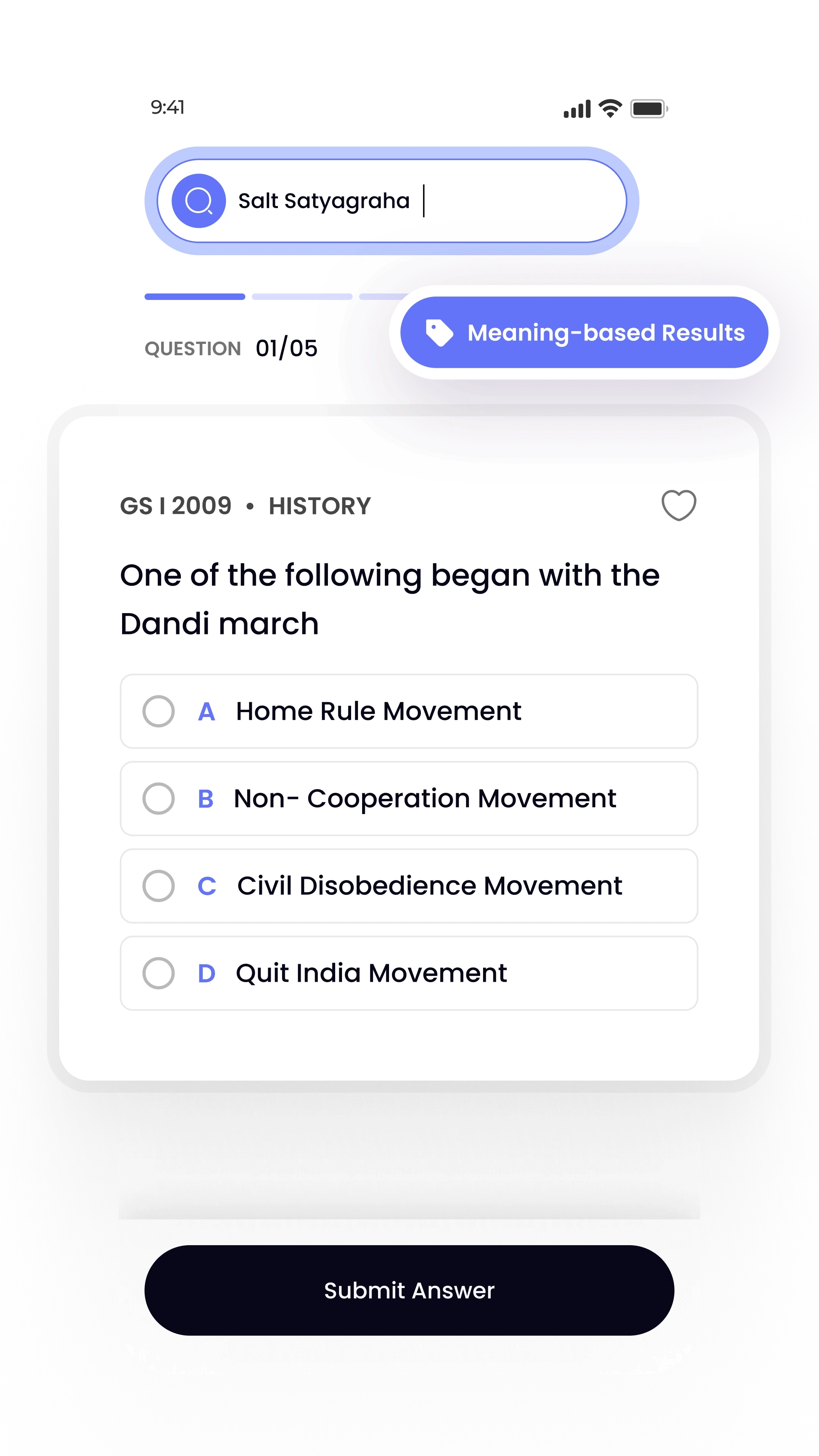
Keyword search misses related questions | Meaning-based PYQ search | Search a concept or alternate phrase, then solve the matching UPSC previous-year questions | You see how UPSC frames the idea across different wordings | Finding a question is not the same as analysing it |
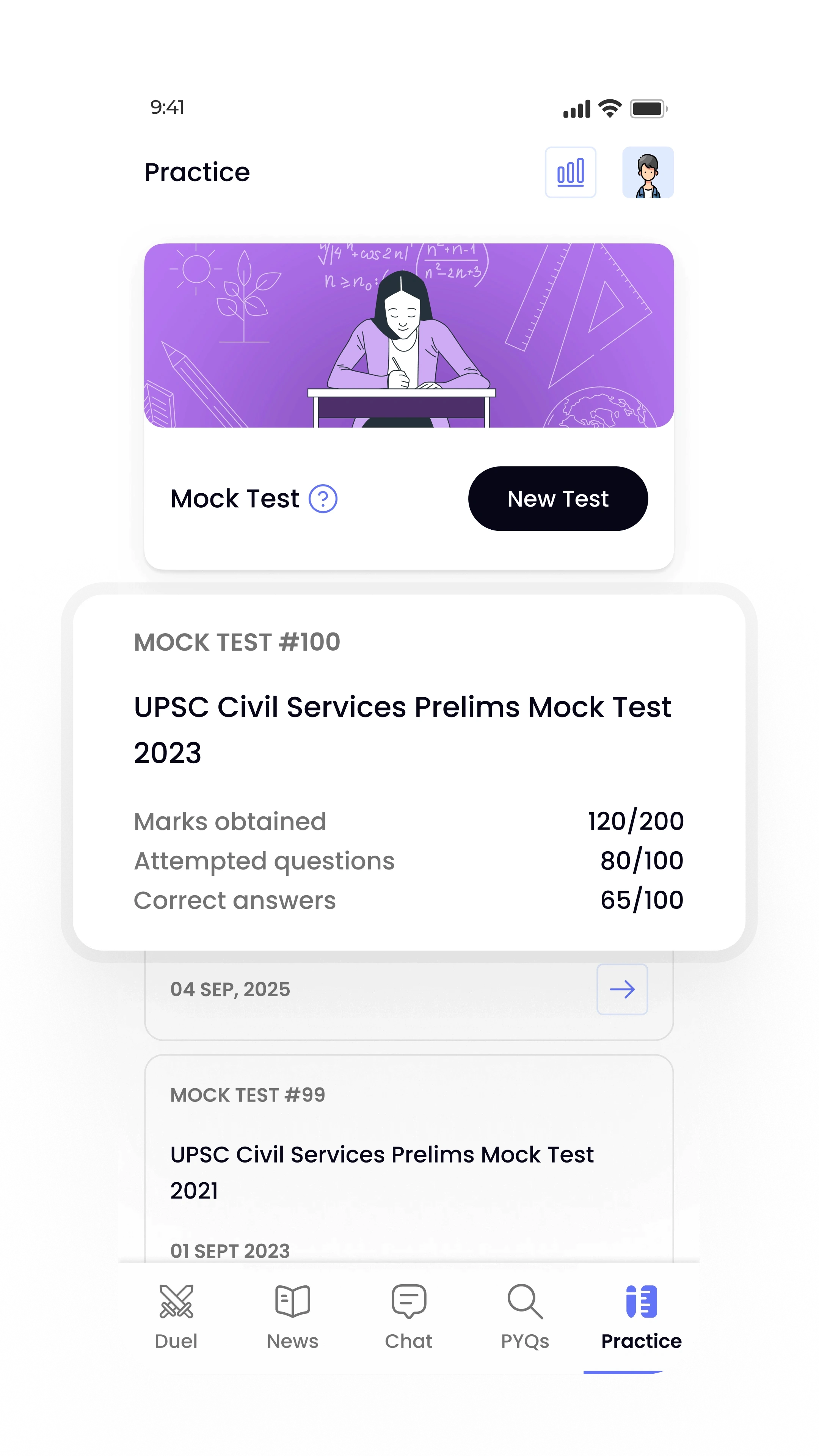
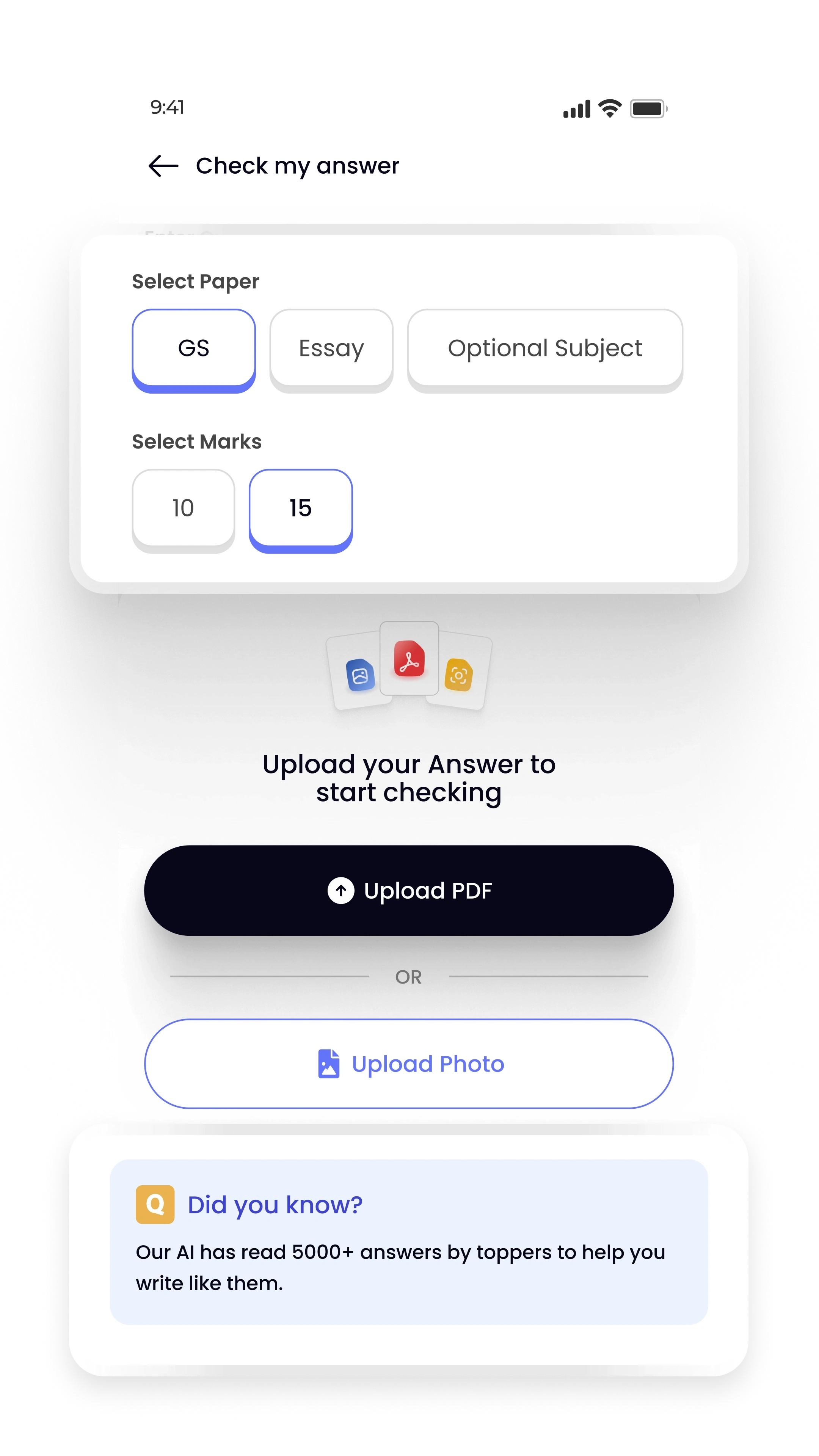
Mains practice lacks quick feedback | Mains answer evaluation | Submit an answer, review structure and content feedback, then use the same session for Mains answer-writing practice | You create an answer, feedback and rewrite loop | Keep handwritten practice and use human review for deeper mentoring |
Revision keeps slipping | Daily quizzes, Duels and study planner | Take a daily UPSC quiz, note weak areas and place them in the UPSC study planner | Recall practice leads to a dated revision task | Quiz performance does not predict selection |
Feature source: PadhAI's current official site and Google Play listing, checked on 25 August 2026.
Here is how that changes for different aspirants:
A beginner can read one current-affairs issue, ask the AI Tutor to explain the background, then solve related PYQs. This prevents random reading from becoming the whole session.
A working professional can use a short commute or lunch break for a quiz, then reserve the evening for one book chapter or Mains answer. The planner holds the next revision date.
A repeater or Mains candidate can search PYQ patterns, write an answer, inspect the evaluation and rewrite it by hand. Another long lecture may be less useful if the real gap is feedback.
PadhAI is currently English-only. It also does not replace official sources, standard books, optional-subject expertise, handwritten answers or human judgment.
A learner who needs daily live teaching or human interview coaching may need a different format alongside it.
A research-based comparison cannot name one winner for every task. Ask which workflow needs the least unnecessary setup for the job in front of you.
UPSC task | PadhAI | ChatGPT | Gemini | Claude | Best fit for this task |
|---|---|---|---|---|---|
Syllabus grounding | Exam-specific workflow | Add the syllabus line yourself | Add the syllabus line yourself | Add the syllabus line yourself | PadhAI for lower setup, any general tool with a supplied syllabus |
Daily current affairs | Curated UPSC news linked to PYQs | Summarises sources you provide or retrieve | Useful for source exploration and summaries | Useful for cited web synthesis | PadhAI for a repeatable exam workflow, general tools for broader research |
Related PYQ discovery | Meaning-based search in a UPSC question bank | Needs supplied questions or manual research | Needs supplied questions or manual research | Needs supplied questions or manual research | PadhAI |
Standard-book discussion | BookChat with cited book passages | Discusses uploaded or pasted material | Analyses uploaded files | Discusses long uploaded material | PadhAI for supported books, general tools for other documents |
Mains answer feedback | Dedicated answer evaluation and rewrite loop | Needs your rubric and word limit | Needs your rubric and word limit | Needs your rubric and word limit | PadhAI for lower setup, human mentor for nuanced review |
Quiz and recall | Daily quizzes, custom practice and Duels | Generates a quiz from your prompt or file | Creates quizzes, flashcards and practice tests | Generates questions from supplied material | PadhAI for UPSC-linked routine, Gemini for flexible study sets |
Weekly planning | Study planner tied to preparation tasks | Builds a plan from your inputs | Builds schedules or plans from your inputs | Builds a plan from your inputs | PadhAI for UPSC routine, any general tool for flexible planning |
General brainstorming | Can answer UPSC-focused doubts | Flexible across topics | Flexible across topics and Google-connected work | Strong fit for argument and document synthesis | ChatGPT, Gemini or Claude |
Source traceability | Book citations and links within supported workflows | Depends on mode, source and prompt | Depends on selected tools and source links | Web search provides cited sources | Tool with accessible source links, followed by manual checking |
Manual setup | Lower for integrated UPSC tasks | Higher | Higher | Higher | PadhAI when setup time is the problem |
Sources: PadhAI's official product page and store listing, OpenAI's Study Mode note, Google's linked Gemini feature documents, and Anthropic's education and web-search pages. Checked on 25 August 2026. Criteria: documented product purpose, visible workflow and setup required. This is not a controlled accuracy ranking.
The public evidence does not support that wording as an established fact. In a public demonstration held after the 2024 Civil Services Preliminary Examination, PadhAI was reported to score more than 170 out of 200 on General Studies Paper I.
Reports say it completed the paper in under seven minutes. Contemporary coverage also says the early scoring used answer keys from coaching institutes.
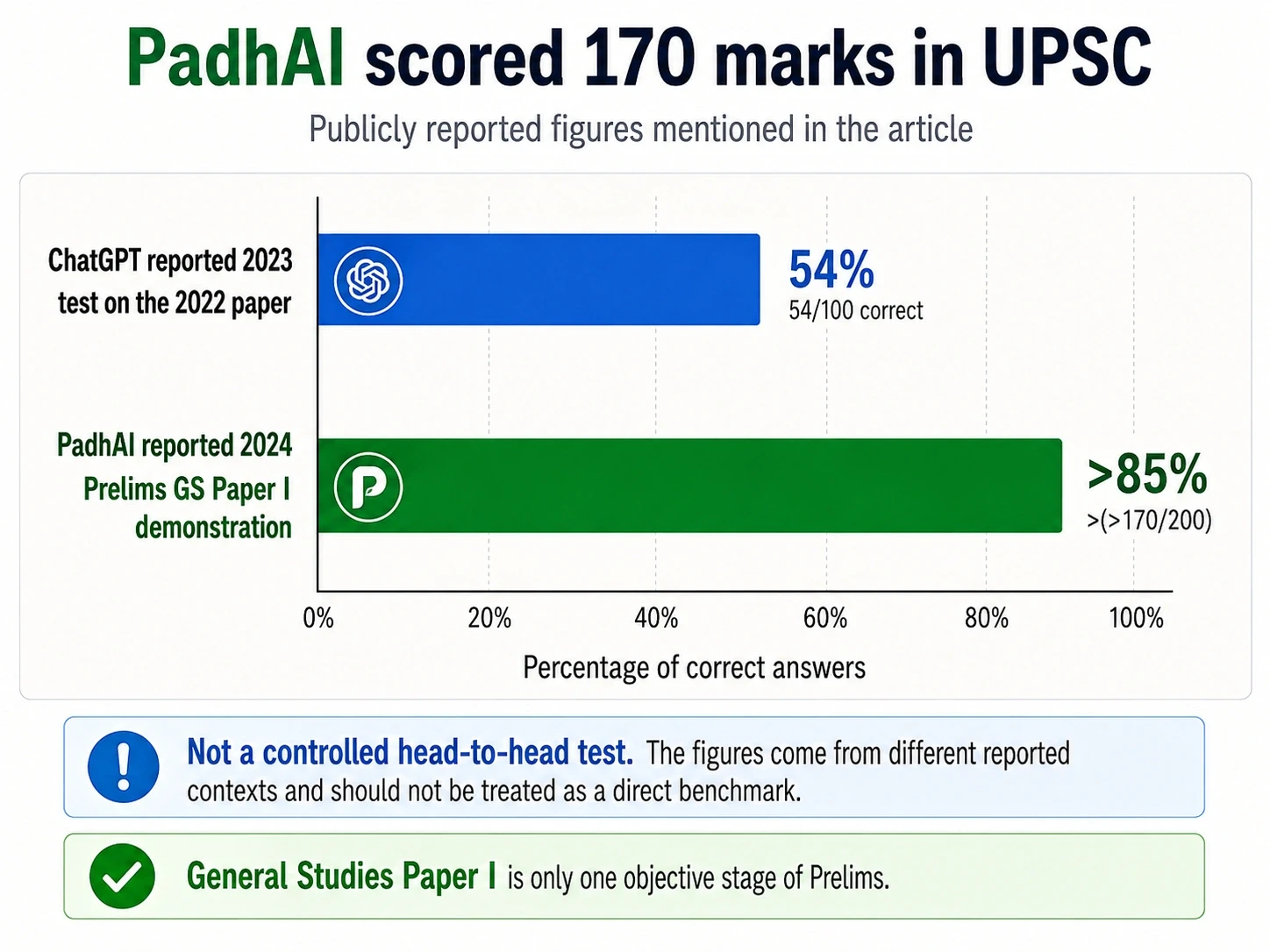
Public claim | What was reported | Evidence type | What remains unresolved | Safe conclusion |
|---|---|---|---|---|
ChatGPT and the 2022 paper | 54 of 100 answers correct in a reported 2023 test | Secondary media report | Exact model, full prompt and scoring controls | A historical experiment, not current capability |
PadhAI and the 2024 paper | More than 170 out of 200 in under seven minutes | Public event reported from a company release | Official-key recalculation from a preserved answer sheet | A reported score on one defined paper |
“Higher than any human” | Appeared in promotional and article wording | First-party claim repeated downstream | No official nationwide Prelims rank list supports the comparison | Do not state it as a verified fact |
Sources: Outlook India through PTI, India Today and Business Today, published 17 June 2024. The reports substantially repeat the same upstream company release. Treat them as one evidence cluster, not three independent tests.
Going deeper
General Studies Paper I is one objective stage of Prelims. The full Civil Services Examination also tests qualifying aptitude, descriptive Mains answers and a Personality Test.
Speed on one paper does not measure handwritten expression, judgment, retention, optional-subject depth or performance across the complete examination.
What can you take from it? A UPSC-focused system reportedly performed strongly on a defined objective paper under the described conditions.
It does not prove an All India Rank, selection outcome or superiority over every human.
Yes, if you give each tool a different job. Using four chatbots to produce four versions of the same note usually adds reading, not learning. A better companion workflow is:
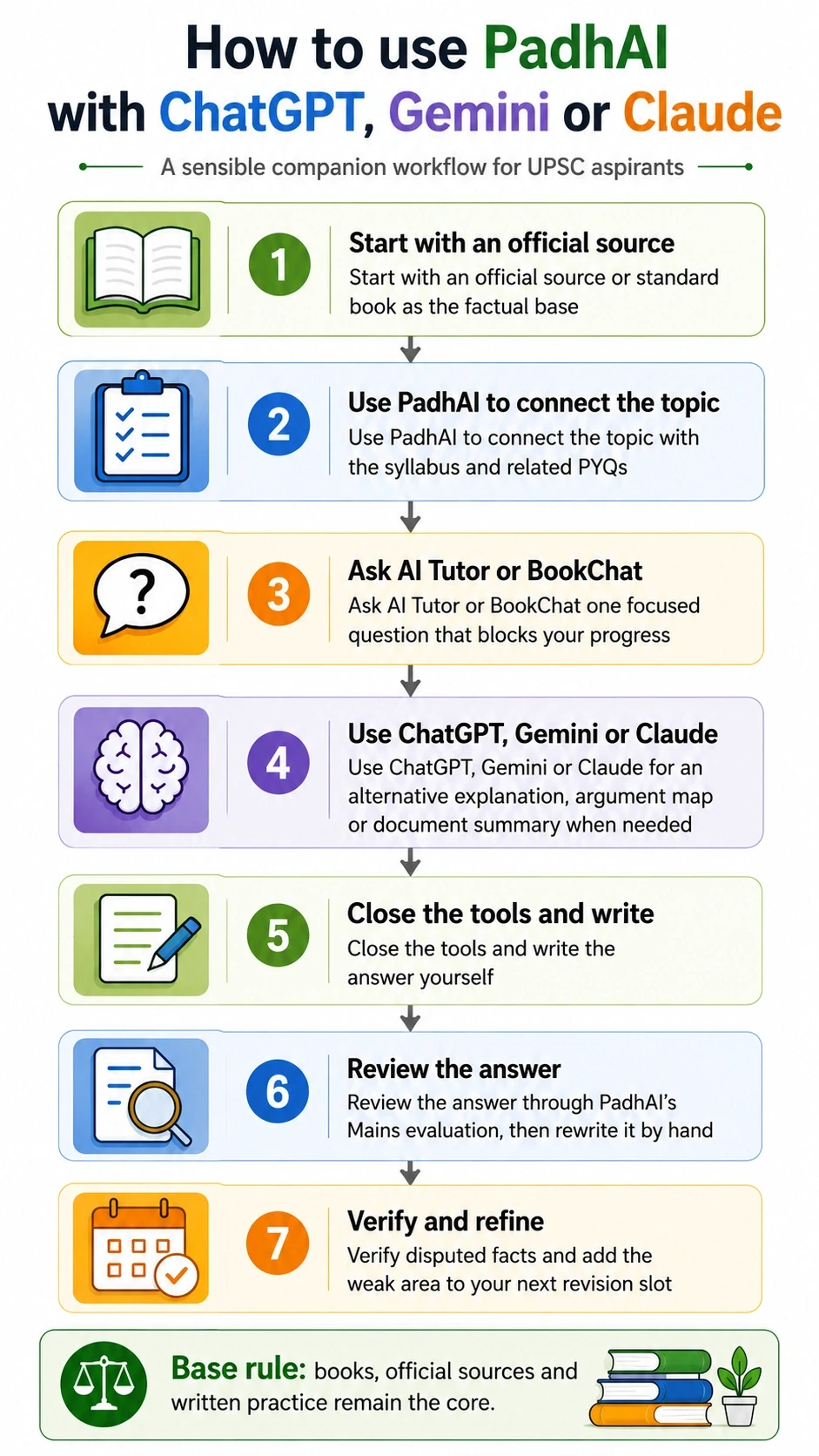
Start with an official source or standard book as the factual base.
Use PadhAI to connect the topic with the syllabus and related PYQs.
Ask AI Tutor or BookChat one focused question that blocks your progress.
Use ChatGPT, Gemini or Claude for an alternative explanation, argument map or document summary when needed.
Close the tools and write the answer yourself.
Review the answer through PadhAI's Mains evaluation, then rewrite it by hand.
Verify disputed facts and add the weak area to your next revision slot.
This division matters. PadhAI carries more of the exam workflow. A general AI assistant gives you flexibility outside that workflow. Your books, official sources and written practice remain the base.
Do not paste a fluent AI answer into your notes just because it sounds complete. A wrong committee year or invented scheme feature can survive several revisions if you never open the source.
Which AI tool should you choose?
Choose by the task that currently wastes your time. Do not add another tool unless it changes what you actually practise this week.
Your situation | Sensible starting choice | Why | Poor fit to watch for |
|---|---|---|---|
Beginner who needs an exam route | PadhAI plus standard books, with a general AI tool for extra explanations | The syllabus, PYQs and practice loop need less manual assembly | AI cannot replace basic reading or a teacher when concepts remain weak |
Working professional with 2 to 3 hours daily | PadhAI for current affairs, quizzes, feedback and planning | Short sessions can end with a visible practice or revision action | Too many parallel chat threads can consume the time you meant to save |
Repeater with complete notes | PadhAI for PYQ search and Mains evaluation | Practice and feedback may matter more than another broad content library | Re-reading AI summaries without solving questions |
Mains candidate | PadhAI plus a human rubric or mentor where available | Fast feedback supports more rewrite cycles | Treating automated feedback as the final judgment |
Research-heavy user | Gemini or Claude for sources and long documents, PadhAI for the UPSC link | General tools offer broader document and research workflows | Collecting sources without converting them into PYQs, notes or answers |
Aspirant who likes flexible questioning | ChatGPT plus PadhAI | ChatGPT handles open-ended exploration while PadhAI supports exam practice | Asking broad prompts without a source or syllabus boundary |
This table uses reader fit, setup effort and study action as its criteria. It is not a score of model intelligence.
Test the tools for seven days before deciding
You don't need a month of casual use. Test whether a tool moves one topic from reading to recall, writing and revision.
Day | Task | 2 to 3 hours per day | 8 to 10 hours per day | What to record |
|---|---|---|---|---|
1 | Syllabus explanation | Test one weak topic | Test two linked subtopics | Accuracy, clarity and setup time |
2 | Current affairs | Map one official item | Map two items and make notes | Syllabus link and source fidelity |
3 | PYQs | Find and solve three | Find and solve six | Relevance and quality of your own analysis |
4 | Doubts | Resolve one blocked concept | Compare two explanations | Facts that still need checking |
5 | Recall | Take one short quiz | Take a longer subject set | Weak areas found |
6 | Mains | Write and rewrite one short answer | Write two answers or one full response | Feedback you acted on |
7 | Planning | Build next week's minimum plan | Build a full revision and practice plan | Whether the workload is realistic |
Method: use the same topic and source material across tools. Record what led to real practice, not response length or confident tone.
At the end, keep the tool that reduces setup and leads to more solved questions, rewritten answers or scheduled revisions. Drop the one that mainly produces extra text to read.
Frequently asked question (FAQs)
Can ChatGPT help in UPSC preparation?
Which AI tool is best for UPSC preparation?
Is PadhAI better than ChatGPT for UPSC?
Can I use PadhAI with ChatGPT, Gemini or Claude?
Did ChatGPT fail the UPSC exam?
PadhAI is the practical starting point if your main problem is joining current affairs, PYQs, doubts, practice, feedback and planning.
ChatGPT, Gemini and Claude remain useful when you need broader explanations or research. You do not need to choose a permanent winner. You need a workflow that ends in your own recall and writing.
Use the wider UPSC preparation strategy to decide where AI fits in your study plan. Then download PadhAI on Google Play and test one topic from start to finish.
Read the current-affairs brief, open related PYQs, ask the AI Tutor, take a quiz and review one Mains answer. Keep the workflow only if it improves your next study session.



No comments yet. Be the first to join the discussion!