UPSC Foundation Day 2026: 100 Years of Its Formation

Last updated

A hundred years have passed since India got its first Public Service Commission on 1 October 1926. UPSC Foundation Day on 1 October 2026 marks that full century.
What started as an advisory body under colonial rule eventually became the Union Public Service Commission, an independent constitutional authority governed by Articles 315 to 323 of the Constitution.
Bharat Mandapam in New Delhi is hosting the centenary across two days, 30 September and 1 October 2026. Day one carried the title Shatabdi Samaroh - Manthan and centred on where civil services go next, how public administration can innovate, and what constitutional values mean in practice.
The Prime Minister attends the 1 October programme. A commemorative coin, a commemorative stamp, and a book covering 100 landmark judgments that shaped the work of UPSC and State Public Service Commissions are all part of the official releases.
For an aspirant, UPSC foundation day works as a current-affairs topic because it ties history to Indian Polity, governance, constitutional bodies, civil service reforms, and ethics in public administration.UPSC Foundation Day 2026: Key Highlights
Item | Details |
Foundation Day | 1 October |
Centenary date | 1 October 2026 |
Institution established | Public Service Commission, 1 October 1926 |
Present status | Independent constitutional body |
Constitutional provisions | Articles 315 to 323, Part XIV |
Centenary venue | Bharat Mandapam, New Delhi |
Two-day programme | 30 September and 1 October 2026 |
Day 1 | Shatabdi Samaroh - Manthan |
Day 2 | Centenary culmination programme |
Centenary releases | Commemorative coin, stamp and book on 100 landmark judgments |
The year-long UPSC Centenary Celebrations kicked off on 1 October 2025, which was the Commission's 99th Foundation Day.
They wrap up on UPSC Foundation Day, 1 October 2026. That 2025 opening came with a new UPSC logo, a centenary emblem, and a set of outreach initiatives.
Join our WhatsApp Community
The date goes back to 1 October 1926. That is when India's first Public Service Commission came into existence.
The thinking behind it had started earlier, under the Government of India Act, 1919. Then the Lee Commission of 1924 pushed for a statutory Public Service Commission to be set up quickly.
Sir Ross Barker chaired that first Commission. It had one Chairman and four Members. Its powers were narrow, mostly advisory in nature.
But it gave India a permanent institutional mechanism for recruitment and service matters. And that is the reason the Commission counts its history from 1926, even though the body only took its current constitutional form after the Constitution came into force in 1950.
For a quick background on the institution, aspirants can also read PadhAI's UPSC history and functions guide.
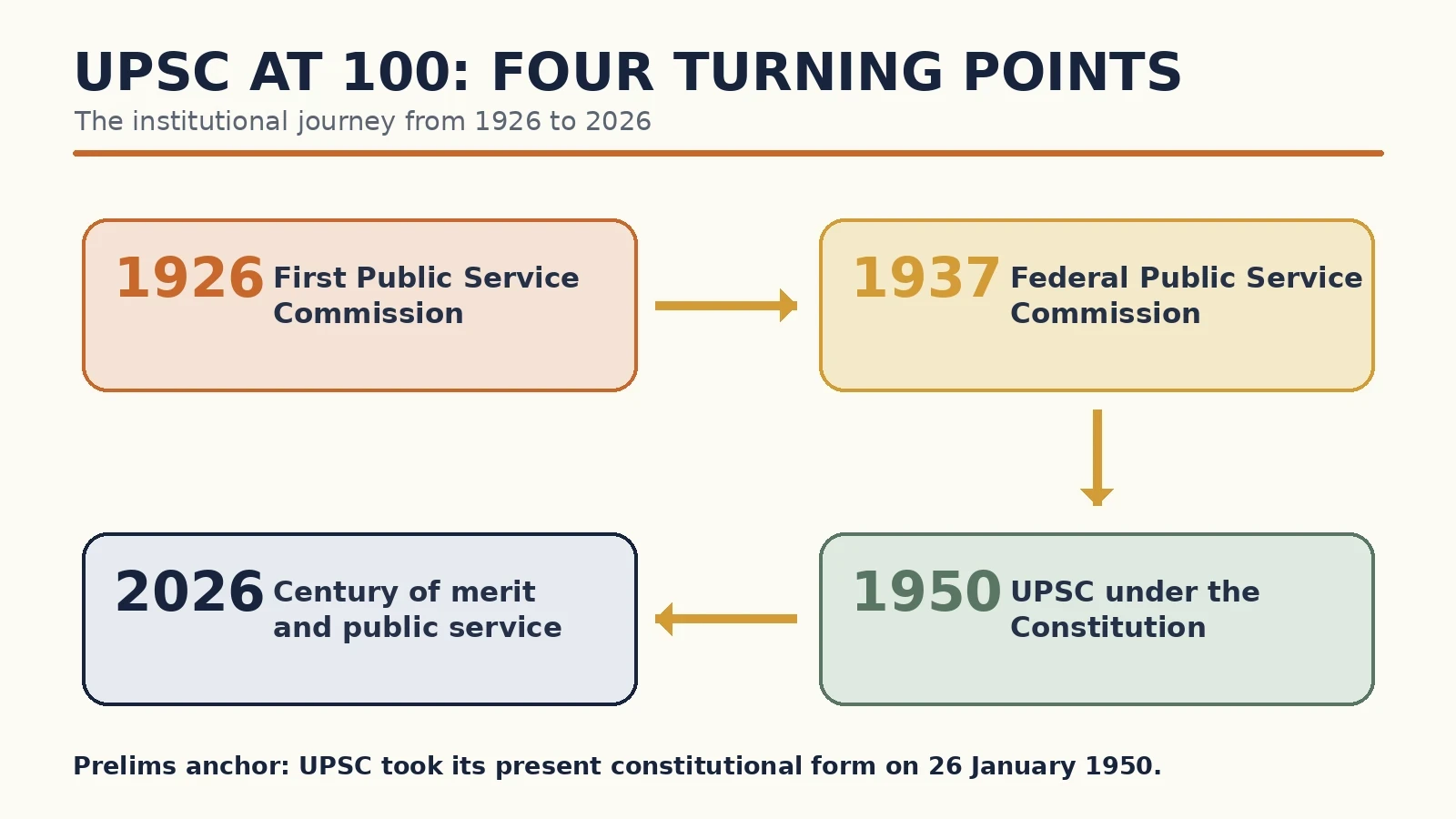
For UPSC foundation day revision, a short timeline covers how the institution shifted shape over 100 years.
Year | What changed |
1926 | First Public Service Commission established in India |
1937 | Renamed the Federal Public Service Commission |
1950 | Became the Union Public Service Commission under the Constitution |
1979 | Three-stage Civil Services Examination system introduced: Prelims, Mains and Interview |
1989 | Optical Mark Recognition technology introduced |
2013 | Civil Services Main Examination restructured with four General Studies papers and Ethics |
2021 | Women appeared in the NDA and NA examination for the first time |
2025-26 | Centenary year focused on inclusion, technology, exam integrity and institutional reform |
The bigger shift was in how public servants got recruited. Open competition for the Indian Civil Service started in 1855, but the exam was held only in London at that point.
The Public Service Commission created in 1926 brought a permanent recruitment body to Indian soil.
After Independence, constitutional safeguards went in to protect impartiality and cut down political or administrative interference in recruitment.
Add as a preferred Source on Google
For Prelims and GS Paper 2, UPSC foundation day connects straight to Part XIV of the Constitution. Articles 315 to 323 cover the Union and State Public Service Commissions.

Article | What aspirants should remember |
Article 315 | Provides for Public Service Commissions for the Union and States |
Article 316 | Deals with appointment and term of the Chairman and Members |
Article 317 | Provides safeguards for removal and suspension |
Article 318 | Allows regulations on conditions of service of Members and staff |
Article 319 | Places restrictions on offices held after a Member leaves the Commission |
Article 320 | Lists functions, including examinations, recruitment advice, promotions and disciplinary matters |
Article 321 | Allows Parliament or a State Legislature to extend Commission functions |
Article 322 | Charges Commission expenses on the Consolidated Fund |
Article 323 | Requires an annual report to the President or Governor, as applicable |
The Commission is not just an examination body. It advises the Government on recruitment rules, promotions, induction into All India Services, and disciplinary cases.
According to the official PIB centenary backgrounder, UPSC processed the records of 24,581 officers for promotion in 2023-24. In that same period, 532 officers were inducted into the All India Services.
Those numbers show why the constitutional role of the Commission stretches well past the Civil Services Examination.
On 30 September, the first day of the two-day centenary programme at Bharat Mandapam took the name Shatabdi Samaroh - Manthan.
Public functionaries, members of Public Service Commissions, and other speakers gathered to discuss how civil services and recruitment institutions should adapt to new demands.
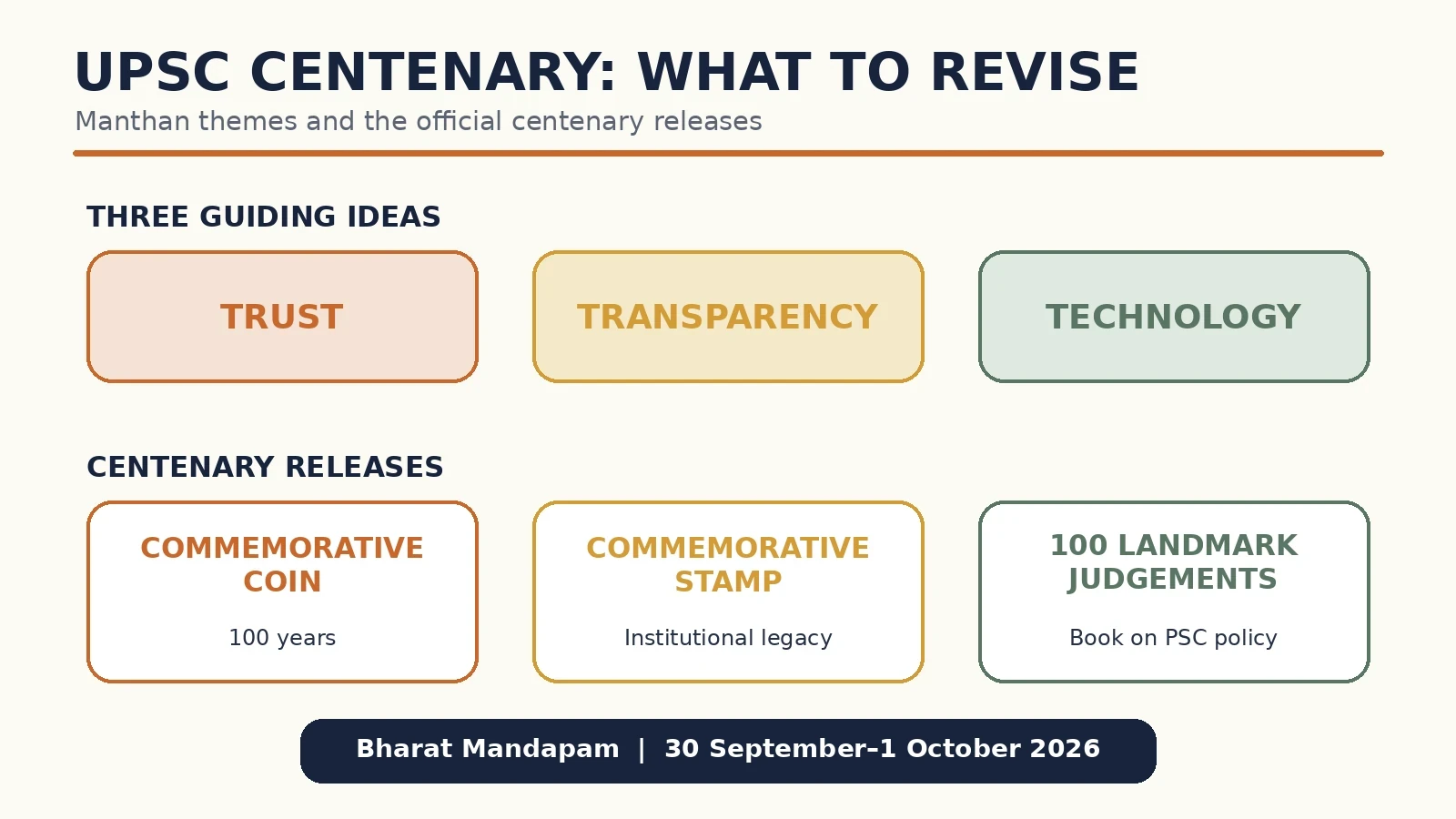
UPSC Chairman Dr. Ajay Kumar framed the Commission's next phase around three ideas: Trust, Transparency and Technology.
The discussion kept merit, fairness, and equal opportunity as the institutional core while looking at how recruitment methods and administrative systems can change.
Three broad areas in the Manthan sessions matter for UPSC preparation:
Role of Civil Services in Viksit Bharat: Outcome-based administration, breaking departmental silos, and improving delivery at the ground level were the focus here.
Public Service Commissions as constitutional bodies: Speakers traced the evolution of public recruitment and the importance of independence, fairness, and public trust.
Innovations in public service: Artificial intelligence, data analytics, digital systems, and the need for faster, more responsive administration came up in these deliberations.
The theme connects directly to GS Paper 2 topics on civil services, constitutional bodies, and governance.
It also fits Ethics questions on impartiality, public service values, and accountability.
The year-long UPSC Centenary Celebrations reach their final programme on UPSC Foundation Day, 1 October 2026, at Bharat Mandapam, New Delhi. The Prime Minister's Office and PIB announced the programme in advance.
Three centenary releases are part of the official programme:
a UPSC Centenary Commemorative Coin;
a Commemorative Stamp; and
the book 100 Landmark Judgements - Shaping the Policies of UPSC and Public Service Commissions in India.
That book gives the centenary a legal dimension. UPSC has also referred to its collaboration with NALSAR, Hyderabad, for a compendium of 100 landmark judicial verdicts connected with Public Service Commissions.
Chairmen and Members of State Public Service Commissions, senior Government of India officers, academicians, and UPSC officials all attend the UPSC foundation day event.
This gives the centenary a federal dimension because the constitutional framework covers both the Union and State Commissions.
UPSC Foundation Day 2026 also shows how much the volume of public recruitment has grown.
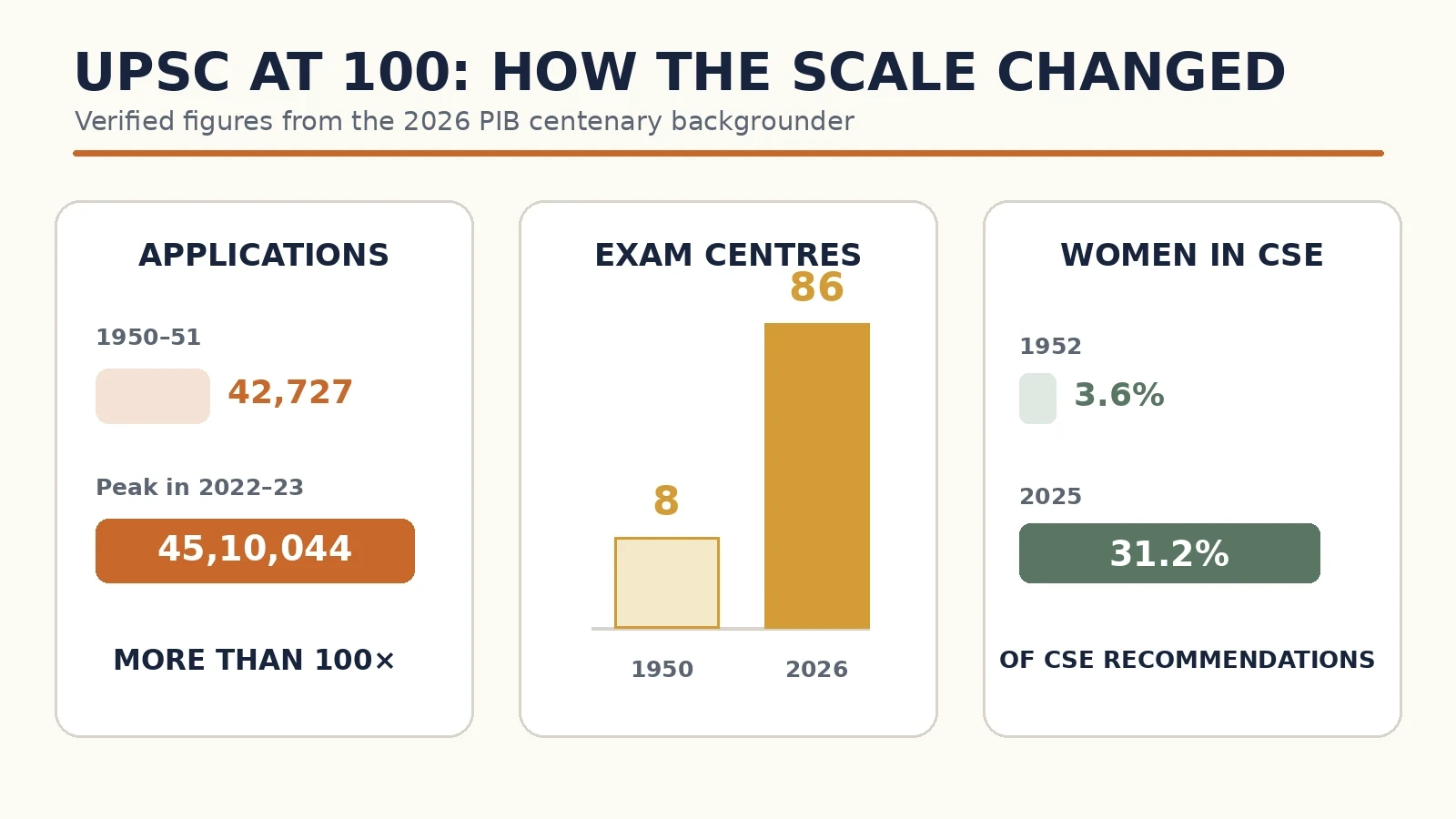
Applications across examinations and recruitment by selection went from 42,727 in 1950-51 to a peak of 45,10,044 in 2022-23, according to the official 2026 PIB backgrounder. Examination centres rose from 8 in 1950 to 86 in 2026.
Participation became more representative too. In the Civil Services Examination, women accounted for 3 of 83 candidates recommended in 1952. By CSE 2025, that figure was 299 of 958 recommended candidates, or 31.2 per cent.
The same official backgrounder records large increases in participation by Scheduled Caste, Scheduled Tribe, and Persons with Benchmark Disabilities candidates over the decades.
Technology changed the examination system as well. UPSC began using computers in 1978 and introduced OMR technology in 1989. Recent reforms include the Universal Registration Number, randomised interview boards, a dedicated Candidate Helpdesk, wider examination-centre coverage, and digital identity checks.
For CSE Prelims 2026, UPSC used AI-based facial authentication at scale for about 5.50 lakh candidates, according to PIB.
The Commission has also introduced a provisional answer-key process and the QPRep portal for representations on questions.
But the constitutional purpose stays the same. What changes is the method used to protect fairness and equal opportunity as exam scale, technology, and candidate needs shift.
UPSC Foundation Day can be revised in three simple buckets: Prelims facts, GS Paper 2 analysis, and Ethics examples.
Prelims
Remember the date, constitutional articles and institutional evolution:
1 October 1926: first Public Service Commission established;
1937: Federal Public Service Commission;
26 January 1950: Union Public Service Commission;
Articles 315 to 323: constitutional framework;
Article 320: core functions.
Mains GS Paper 2
The centenary can support answers on:
constitutional and statutory bodies;
role of civil services in a democracy;
independence and accountability of recruitment institutions;
civil service reforms;
use of technology in public administration.
In a Mains answer, do not stop at 'UPSC conducts CSE'. Add its advisory role in recruitment rules, promotions, disciplinary matters and induction into All India Services.
Ethics and Essay
The centenary gives you concrete Ethics examples: impartiality, merit, fairness, transparency, accountability and equal opportunity.
The Manthan theme of Trust, Transparency and Technology also shows a simple point: processes can modernise without changing constitutional values.
If you are planning the next exam cycle, keep these institutional updates alongside the UPSC Calendar 2027 and the UPSC notifications hub.
UPSC Foundation Day: 5 points for quick revision
India's first Public Service Commission was established on 1 October 1926, which is why UPSC foundation day is observed on 1 October.
The Commission became the Federal Public Service Commission in 1937 and the Union Public Service Commission on 26 January 1950.
Articles 315 to 323 of Part XIV of the Constitution provide the constitutional framework for UPSC and State Public Service Commissions.
The 2026 UPSC Centenary Celebrations include Shatabdi Samaroh - Manthan and the centenary culmination programme at Bharat Mandapam.
UPSC's centenary theme connects merit and constitutional independence with newer priorities such as inclusion, digital systems, and exam integrity.
Frequently asked question (FAQs)
When is UPSC Foundation Day observed?
Why is UPSC Foundation Day 2026 important?
What are the UPSC Centenary Celebrations?
What is Shatabdi Samaroh - Manthan?
Which Articles of the Constitution deal with UPSC?






No comments yet. Be the first to join the discussion!