UPSC Notification 2026 Out: PDF Download, Vacancies, Dates

The Union Public Service Commission released the UPSC Notification 2026 on February 4, 2026. The Preliminary Examination is scheduled for May 24, 2026. There are 933 vacancies available for recruitment.

UPSC Prelims

Current affairs

Latest Update

Gajendra Singh Godara
Feb 4, 2026
5
mins read
UPSC Notification 2026 Out

Key Highlights

  • Notification Date: 4th February 2026

  • Last Date to Apply: 24th February 2026 (6:00 PM)

  • Prelims Exam Date: 24th May 2026

  • Total Vacancies: 933

  • Age Limit: 21–32 Years

  • Official PDF: Available for download at upsc.gov.in

The UPSC Notification 2026 is the official regulatory mandate released by the Union Public Service Commission to initiate the Civil Services Examination (CSE) cycle for the year. 

This gazette serves as the legal framework that governs the recruitment of officers into Group A and Group B services, including the Indian Administrative Service (IAS) and Indian Police Service (IPS).

PadhAI centralizes these critical updates, past year questions, and AI-driven revision tools to help aspirants study smarter and remain consistent throughout this rigorous cycle. The commission activated the upsc online notification link on February 4, 2026, marking the start of the application window.

What is the UPSC Notification 2026?

What is the UPSC Notification 2026?

What is the UPSC Notification 2026?

What is the UPSC Notification 2026?

The UPSC Notification 2026 is a comprehensive document that defines the rules, eligibility, and syllabus for the Civil Services Examination. It acts as the primary reference point for all aspirants regarding age limits, educational qualifications, and the examination structure. 

UPSC Official Notification 2026 PDF Released

The document lists the specific services participating in the examination and the approximate number of vacancies available for recruitment. Candidates must read this document to understand the medical and physical standards required for specific services like the IPS or IRMS.
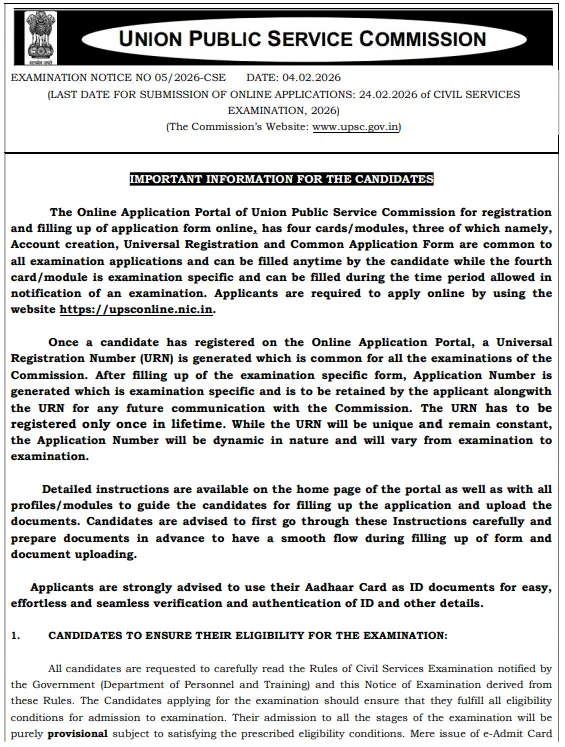
UPSC Official Notification 2026

Download UPSC Official Notification 2026 PDF

Join our WhatsApp Community

Join our WhatsApp Community

Join our WhatsApp Community

Join our WhatsApp Community

Official Exam Schedule and Key Dates

Official Exam Schedule and Key Dates

Official Exam Schedule and Key Dates

Official Exam Schedule and Key Dates

The UPSC latest notification establishes a strict timeline for the 2026 examination cycle. The Commission adheres to these dates rigidly. Aspirants must complete their registration processes within the allotted twenty-day window.

Table 1: Important Dates for UPSC CSE 2026

Event

Date

Notification Release Date

04 February 2026

Application Start Date

04 February 2026

UPSC Notification 2026 Last Date to Apply

24 February 2026 (6:00 PM)

Admit Card Release

May 2026 (Last working day of preceding week)

Preliminary Examination

24 May 2026

Mains Examination

21 August 2026

The upsc recent notification explicitly states that the link to fill applications will be disabled precisely at 6:00 PM on the closing date.

UPSC Current Affairs Magazines

UPSC Current Affairs Magazines

UPSC Current Affairs Magazines

UPSC Current Affairs Magazines

Read Latest UPSC Current Affairs

Read Latest UPSC Current Affairs

Read Latest UPSC Current Affairs

Read Latest UPSC Current Affairs

Vacancy Breakdown for 2026

Vacancy Breakdown for 2026

Vacancy Breakdown for 2026

Vacancy Breakdown for 2026

The UPSC new notification announces approximately 933 vacancies for the current year. This number is subject to change based on the final intake reported by Cadre Controlling Authorities. The government reserves specific slots for various categories to promote inclusivity.

Table 2: Vacancy Distribution

Category

Vacancy Details

Total Vacancies

933 (Approx.)

Reserved for PwBD

33

Blindness/Low Vision

07

Deaf/Hard of Hearing

11

Locomotor Disability

08

Multiple Disabilities

07

The reservation for Scheduled Castes, Scheduled Tribes, Other Backward Classes, and Economically Weaker Sections applies as per government policy fixed for these vacancies.

Add as a preferred Source on Google

Add as a preferred Source on Google

Add as a preferred Source on Google

Add as a preferred Source on Google

Eligibility Criteria

Eligibility Criteria

Eligibility Criteria

Eligibility Criteria

The UPSC CSE notification outlines three primary eligibility parameters: Age, Nationality, and Educational Qualification.

Age Limit and Relaxations

A candidate must be between 21 and 32 years of age as of 1st August 2026. This means the candidate must have been born not earlier than 2nd August 1994 and not later than 1st August 2005.

Table 3: Category-Wise Age Relaxations

Category

Relaxation

Maximum Age

General / EWS

None

32 Years

SC / ST

5 Years

37 Years

OBC

3 Years

35 Years

Defence Services Personnel

3 Years

35 Years

Ex-Servicemen

5 Years

37 Years

PwBD

10 Years

42 Years

Educational Qualification

A candidate must hold a Graduate degree from a recognized University or possess an equivalent qualification. Candidates awaiting their final year results can also apply for the Preliminary Examination but must produce proof of passing before the Main Examination.

Application Procedure and Fees

Application Procedure and Fees

Application Procedure and Fees

Application Procedure and Fees

Aspirants must submit their forms online. The process involves registering on the One Time Registration (OTR) platform and then filling out the specific exam application.

Table 4: Application Fee Structure

Category

Fee Amount

General / OBC / EWS (Male)

Rs. 100

Female (All Categories)

Exempt (Nil)

SC / ST / PwBD

Exempt (Nil)

Steps to Apply:

  1. Navigate to upsconline.nic.in.

  2. Complete the upsc otr registration to generate a Universal Registration Number (URN).

  3. Log in and select the active exam notification.

  4. Fill in the upsc application form with personal and educational data.

  5. Upload scanned photographs and signatures as per the specifications.

  6. Pay the fee via Net Banking, Card, or UPI.

Check the UPSC notifications page regularly for updates regarding the rejection of applications or window for corrections.

Exam Pattern and Structure

Exam Pattern and Structure

Exam Pattern and Structure

Exam Pattern and Structure

The UPSC exam notification prescribes a three-stage selection process.

Stage 1: Preliminary Examination

This stage serves as a screening test. It consists of two objective papers.

  • Paper I (General Studies): 200 Marks. Counts for merit ranking for Mains.

  • Paper II (CSAT): 200 Marks. Qualifying nature (33% minimum required).

Stage 2: Main Examination

Candidates who clear Prelims advance to the Mains. This stage comprises nine papers of conventional essay type questions.

  • Qualifying Papers: Paper A (Indian Language) and Paper B (English) - 300 Marks each.

  • Merit Papers: Essay, GS I-IV, and two Optional Subject papers - 250 Marks each.

Stage 3: Personality Test

Candidates selected from the Mains appear for an interview carrying 275 marks.

Critical Questions for Aspirants

Critical Questions for Aspirants

Critical Questions for Aspirants

Critical Questions for Aspirants

Is Negative Marking Applicable in Prelims?

Yes. There is a penalty for wrong answers in the Objective Type Question Papers. One-third (0.33) of the marks assigned to a question are deducted for every incorrect answer.

Is the Application Fee Refundable?

No. The fee once paid is not refundable under any circumstances.

Can I Withdraw My Application?

No. The UPSC notification 2026 pdf clearly states that candidates are not allowed to withdraw their applications after submission.

How to Prepare Using Official Resources

How to Prepare Using Official Resources

How to Prepare Using Official Resources

How to Prepare Using Official Resources

Aspirants should download the UPSC notification 2026 pdf to access the detailed syllabus in Appendix I. PadhAI integrates this official syllabus into its AI-powered tutor to generate relevant practice questions and revision duels. You should verify all updates regarding centers and admit cards directly from the official website.

Frequently asked question (FAQs)

When was the UPSC Notification 2026 released?
What is the last date to apply for UPSC CSE 2026?
How many vacancies are available in UPSC 2026?
When is the UPSC Prelims 2026 exam date?
Is there a fee exemption for female candidates?

Conclusion

Conclusion

The UPSC Notification 2026 sets the stage for the 2026 recruitment cycle with 933 vacancies. The Prelims will take place on May 24, 2026. Aspirants must finalize their applications by February 24, 2026, to avoid disqualification.

Suggested posts

2026 UPSC Mains Paper A: Rules, Exemption List

Key Highlights

  • Qualifying Nature: Marks do not count toward the final rank.

  • Passing Score: Minimum 75 marks (25%) are necessary.

  • Exemptions: Candidates from six North-Eastern states need not appear.

  • Syllabus: Essay, Reading Comprehension, Precis, Translation, and Grammar.

Paper A in UPSC Mains acts as a mandatory gateway for aspirants. This qualifying examination tests proficiency in specific Indian languages. Candidates must secure 25% marks. The Union Public Service Commission exempts residents of six North-Eastern states from this requirement.

2026 UPSC Mains Paper A: Rules, Exemption List

Key Highlights

  • Qualifying Nature: Marks do not count toward the final rank.

  • Passing Score: Minimum 75 marks (25%) are necessary.

  • Exemptions: Candidates from six North-Eastern states need not appear.

  • Syllabus: Essay, Reading Comprehension, Precis, Translation, and Grammar.

UPSC New Cadre Allocation Policy
Paper A in UPSC Mains acts as a mandatory gateway for aspirants. This qualifying examination tests proficiency in specific Indian languages. Candidates must secure 25% marks. The Union Public Service Commission exempts residents of six North-Eastern states from this requirement.

IAS Civil List: Cadre-Wise Officer Data | PDF Download

Key Highlights

  • Official Registry: The Civil List 2025 documents IAS officers as of January 1, 2025.

  • Cadre Strength: AGMUT holds the highest authorized strength among listed cadres.

  • Pay Matrix: Officers range from Level 10 (Entry) to Level 17 (Apex).

  • Jurisdiction: Defines allocations for states like UP, Bihar, and Maharashtra.

IAS Civil List
Download PDF of IAS Civil List. Explore state-wise officer data, cadre strength, and pay matrix levels for UPSC aspirants. Current as of January 2025.

IAS Civil List: Cadre-Wise Officer Data | PDF Download

Key Highlights

  • Official Registry: The Civil List 2025 documents IAS officers as of January 1, 2025.

  • Cadre Strength: AGMUT holds the highest authorized strength among listed cadres.

  • Pay Matrix: Officers range from Level 10 (Entry) to Level 17 (Apex).

  • Jurisdiction: Defines allocations for states like UP, Bihar, and Maharashtra.

IAS Civil List
Download PDF of IAS Civil List. Explore state-wise officer data, cadre strength, and pay matrix levels for UPSC aspirants. Current as of January 2025.

2026 UPSC New Cadre Allocation Policy | PDF Download

The Department of Personnel & Training (DoPT) released the UPSC New Cadre Allocation Policy 2026 on January 23, 2026. This framework mandates how the government assigns successful Civil Services Examination candidates to specific state or joint cadres. The policy applies strictly to the Indian Administrative Service (IAS), Indian Police Service (IPS), and Indian Forest Service (IFoS).

The central government revised these rules to balance regional representation and maintain administrative efficiency. The most significant structural shift is the removal of the "Zonal" system in favor of four distinct "Groups". This modification alters how aspirants submit their preferences and how the Department allocates final postings.

Key Highlights of the 2026 Policy

Zone Abolition: The policy replaces the previous five zones with four alphabetical state groups (I–IV) to simplify the preference submission process.

Dynamic Rotation: The allocation roster rotates groups annually; Group I moves to the bottom of the list in the second year to prevent permanent regional dominance.

Insider Cycles: Authorities allocate home state vacancies using strict cycles of 25 based on merit rank and category availability.

Vacancy Exchange: Unfilled insider slots trigger a specific waterfall exchange mechanism (e.g., UR vacancy offers to ST → SC → OBC) before conversion to outsider slots.

EWS Integration: The Department classifies Economically Weaker Section (EWS) vacancies under Unreserved (UR) slots for roster calculations.

UPSC New Cadre Allocation Policy
The UPSC New Cadre Allocation Policy 2026 replaces the zonal system with four state groups to guarantee balanced officer distribution. It mandates annual group rotation and strict insider-outsider vacancy cycles for IAS, IPS, and IFoS officers starting with the Civil Services Examination 2026

2026 UPSC New Cadre Allocation Policy | PDF Download

The Department of Personnel & Training (DoPT) released the UPSC New Cadre Allocation Policy 2026 on January 23, 2026. This framework mandates how the government assigns successful Civil Services Examination candidates to specific state or joint cadres. The policy applies strictly to the Indian Administrative Service (IAS), Indian Police Service (IPS), and Indian Forest Service (IFoS).

The central government revised these rules to balance regional representation and maintain administrative efficiency. The most significant structural shift is the removal of the "Zonal" system in favor of four distinct "Groups". This modification alters how aspirants submit their preferences and how the Department allocates final postings.

Key Highlights of the 2026 Policy

Zone Abolition: The policy replaces the previous five zones with four alphabetical state groups (I–IV) to simplify the preference submission process.

Dynamic Rotation: The allocation roster rotates groups annually; Group I moves to the bottom of the list in the second year to prevent permanent regional dominance.

Insider Cycles: Authorities allocate home state vacancies using strict cycles of 25 based on merit rank and category availability.

Vacancy Exchange: Unfilled insider slots trigger a specific waterfall exchange mechanism (e.g., UR vacancy offers to ST → SC → OBC) before conversion to outsider slots.

EWS Integration: The Department classifies Economically Weaker Section (EWS) vacancies under Unreserved (UR) slots for roster calculations.

UPSC New Cadre Allocation Policy
The UPSC New Cadre Allocation Policy 2026 replaces the zonal system with four state groups to guarantee balanced officer distribution. It mandates annual group rotation and strict insider-outsider vacancy cycles for IAS, IPS, and IFoS officers starting with the Civil Services Examination 2026
a close up of a cell phone with a blurry background

About Author

Gajendra Singh Godara

Growth | FTE| Resident at SigIQ

Gajendra Singh Godara brings authentic UPSC preparation insights from his four-attempt journey, having successfully cleared Prelims and written Mains multiple times. His deep expertise spans Polity, Modern History, International Relations, and Economy. At PadhAI, Gajendra transforms his extensive exam experience into accessible content that simplifies complex concepts for aspirants at every preparation stage. His firsthand understanding of UPSC's demands enables him to create targeted materials that save time while maximizing learning efficiency for current affairs, general studies, and optional subjects.

a close up of a cell phone with a blurry background

About Author

Gajendra Singh Godara

Growth | FTE| Resident at SigIQ

Gajendra Singh Godara brings authentic UPSC preparation insights from his four-attempt journey, having successfully cleared Prelims and written Mains multiple times. His deep expertise spans Polity, Modern History, International Relations, and Economy. At PadhAI, Gajendra transforms his extensive exam experience into accessible content that simplifies complex concepts for aspirants at every preparation stage. His firsthand understanding of UPSC's demands enables him to create targeted materials that save time while maximizing learning efficiency for current affairs, general studies, and optional subjects.

a close up of a cell phone with a blurry background

About Author

Gajendra Singh Godara

Growth | FTE| Resident at SigIQ

Gajendra Singh Godara brings authentic UPSC preparation insights from his four-attempt journey, having successfully cleared Prelims and written Mains multiple times. His deep expertise spans Polity, Modern History, International Relations, and Economy. At PadhAI, Gajendra transforms his extensive exam experience into accessible content that simplifies complex concepts for aspirants at every preparation stage. His firsthand understanding of UPSC's demands enables him to create targeted materials that save time while maximizing learning efficiency for current affairs, general studies, and optional subjects.

a close up of a cell phone with a blurry background

About Author

Gajendra Singh Godara

Growth | FTE| Resident at SigIQ

Gajendra Singh Godara brings authentic UPSC preparation insights from his four-attempt journey, having successfully cleared Prelims and written Mains multiple times. His deep expertise spans Polity, Modern History, International Relations, and Economy. At PadhAI, Gajendra transforms his extensive exam experience into accessible content that simplifies complex concepts for aspirants at every preparation stage. His firsthand understanding of UPSC's demands enables him to create targeted materials that save time while maximizing learning efficiency for current affairs, general studies, and optional subjects.

Latest UPSC Exam 2026 Updates

UPSC Calendar 2026 is released on 15th May, 2025.

UPSC Mains Result 2025 is now released.

Check out the updated and latest UPSC Syllabus 2026 here.

UPSC Notification 2025 was released on 22nd January 2025.

UPSC Prelims 2026 will be conducted on 24th May, 2026 & UPSC Mains 2026 will be conducted on 21st August 2026.

The UPSC Prelims 2026 is scheduled for May 24, 2026, while the UPSC Mains 2026 will be conducted from August 21, 2026.

The UPSC Selection Process is of 3 stages-Prelims, Mains and Interview.

UPSC Result 2024 is released with latest UPSC Marksheet 2024. Check Now!

Latest UPSC Exam 2026 Updates

UPSC Calendar 2026 is released on 15th May, 2025.

UPSC Mains Result 2025 is now released.

Check out the updated and latest UPSC Syllabus 2026 here.

UPSC Notification 2025 was released on 22nd January 2025.

UPSC Prelims 2026 will be conducted on 24th May, 2026 & UPSC Mains 2026 will be conducted on 21st August 2026.

The UPSC Prelims 2026 is scheduled for May 24, 2026, while the UPSC Mains 2026 will be conducted from August 21, 2026.

The UPSC Selection Process is of 3 stages-Prelims, Mains and Interview.

UPSC Result 2024 is released with latest UPSC Marksheet 2024. Check Now!

Latest UPSC Exam 2026 Updates

UPSC Calendar 2026 is released on 15th May, 2025.

UPSC Mains Result 2025 is now released.

Check out the updated and latest UPSC Syllabus 2026 here.

UPSC Notification 2025 was released on 22nd January 2025.

UPSC Prelims 2026 will be conducted on 24th May, 2026 & UPSC Mains 2026 will be conducted on 21st August 2026.

The UPSC Prelims 2026 is scheduled for May 24, 2026, while the UPSC Mains 2026 will be conducted from August 21, 2026.

The UPSC Selection Process is of 3 stages-Prelims, Mains and Interview.

UPSC Result 2024 is released with latest UPSC Marksheet 2024. Check Now!

Latest UPSC Exam 2026 Updates

UPSC Calendar 2026 is released on 15th May, 2025.

UPSC Mains Result 2025 is now released.

Check out the updated and latest UPSC Syllabus 2026 here.

UPSC Notification 2025 was released on 22nd January 2025.

UPSC Prelims 2026 will be conducted on 24th May, 2026 & UPSC Mains 2026 will be conducted on 21st August 2026.

The UPSC Prelims 2026 is scheduled for May 24, 2026, while the UPSC Mains 2026 will be conducted from August 21, 2026.

The UPSC Selection Process is of 3 stages-Prelims, Mains and Interview.

UPSC Result 2024 is released with latest UPSC Marksheet 2024. Check Now!

PadhAI UPSC App

PadhAI UPSC App

PadhAI UPSC App

We're PadhAI - a free UPSC prep app built by IITians, AI PhDs & top UPSC experts.

Why choose PadhAI?

Why choose PadhAI?

Why choose PadhAI?

Read daily top news (TH & IE) & Solve Current Affairs MCQs
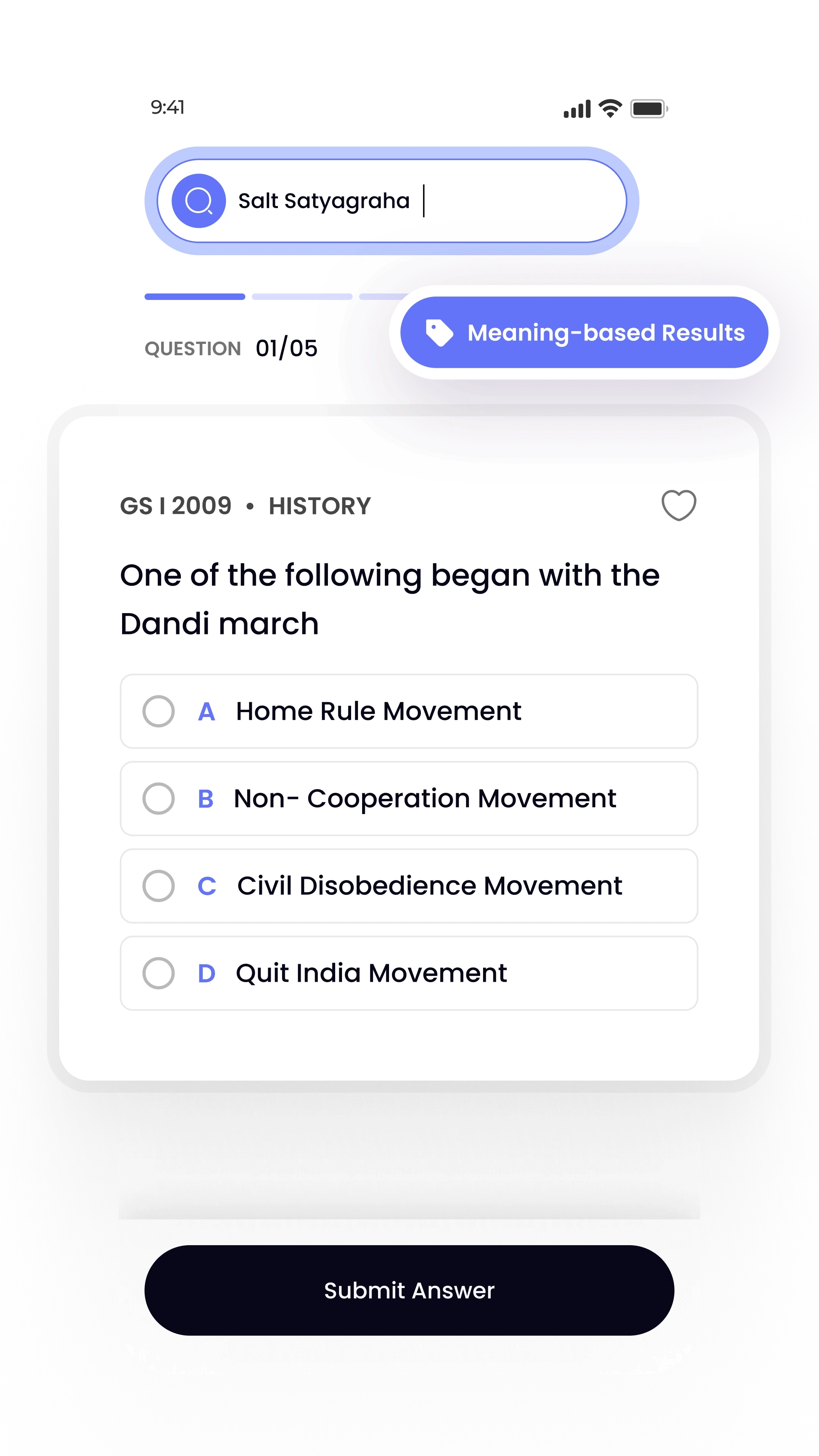
Topic-wise search of 30+ yrs PYQs
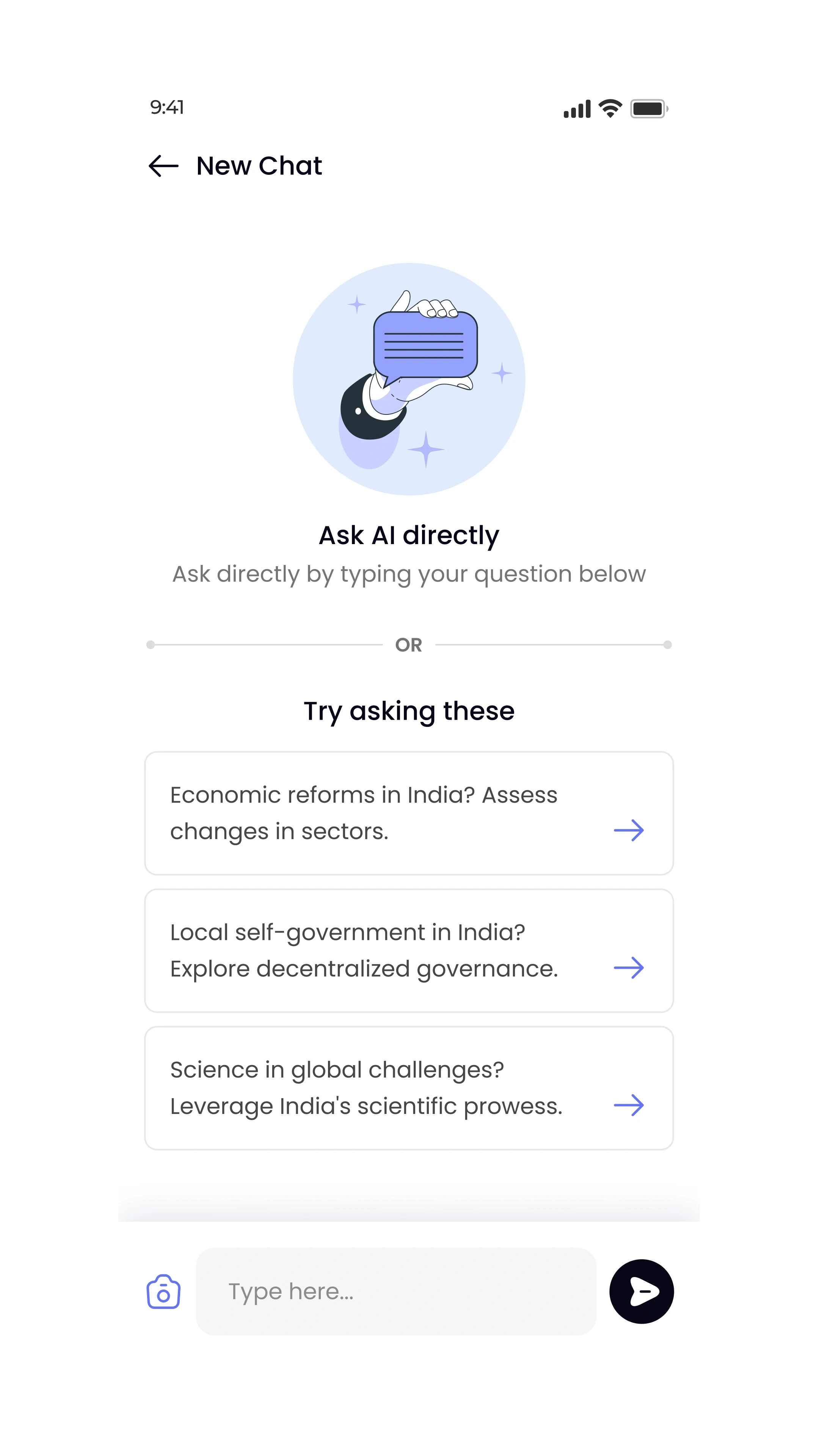
24×7 AI tutor for doubt resolution
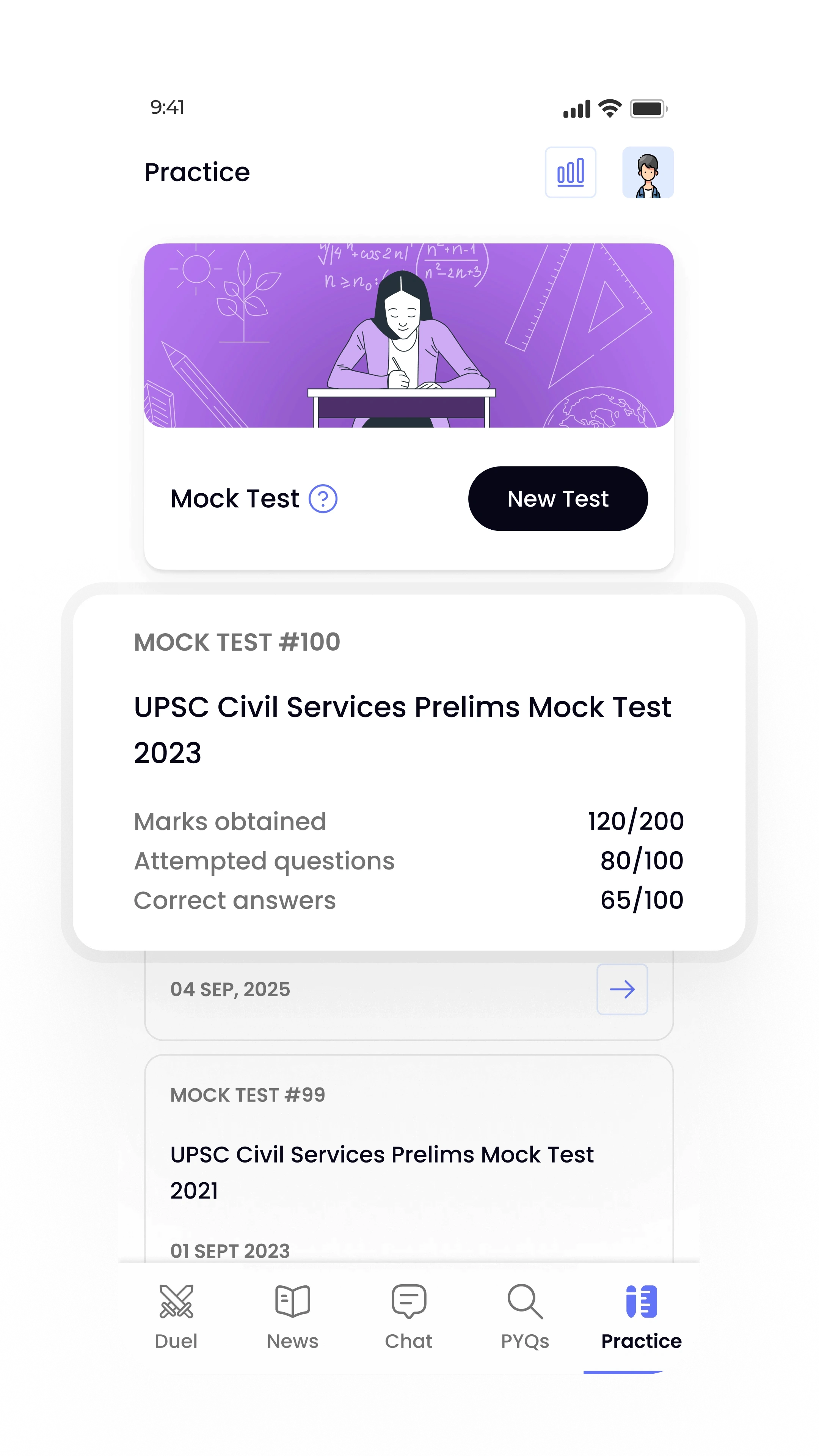
Practice 30k+ MCQs & full GS + CSAT mocks
Play Duel UPSC quizzes with fellow aspirants
Practice 30k+ MCQs & full GS + CSAT mocks
Play Duel UPSC quizzes with fellow aspirants
Practice 30k+ MCQs & full GS + CSAT mocks
Play Duel UPSC quizzes with fellow aspirants

Why choose PadhAI?

Read daily top news (TH & IE) & Solve Current Affairs MCQs

Topic-wise search of 30+ yrs PYQs

24×7 AI tutor for doubt resolution

Practice 30k+ MCQs & full GS + CSAT mocks

Play Duel UPSC quizzes with fellow aspirants

PadhAI UPSC App

We're PadhAI - a free UPSC prep app built by IITians, AI PhDs & top UPSC experts.

Why choose PadhAI?

Read daily top news (TH & IE) & Solve Current Affairs MCQs

Topic-wise search of 30+ yrs PYQs

24×7 AI tutor for doubt resolution

Practice 30k+ MCQs & full GS + CSAT mocks

Play Duel UPSC quizzes with fellow aspirants

PadhAI UPSC App

We're PadhAI - a free UPSC prep app built by IITians, AI PhDs & top UPSC experts.
Suggested posts

Suggested posts

Suggested posts

UPSC New Cadre Allocation Policy
2026 UPSC Mains Paper A: Rules, Exemption List
Paper A in UPSC Mains acts as a mandatory gateway for aspirants. This qualifying examination tests proficiency in specific Indian languages. Candidates must secure 25% marks. The Union Public Service Commission exempts residents of six North-Eastern states from this requirement.
IAS Civil List
IAS Civil List
IAS Civil List: Cadre-Wise Officer Data | PDF Download
Download PDF of IAS Civil List. Explore state-wise officer data, cadre strength, and pay matrix levels for UPSC aspirants. Current as of January 2025.
UPSC New Cadre Allocation Policy
2026 UPSC New Cadre Allocation Policy | PDF Download
The UPSC New Cadre Allocation Policy 2026 replaces the zonal system with four state groups to guarantee balanced officer distribution. It mandates annual group rotation and strict insider-outsider vacancy cycles for IAS, IPS, and IFoS officers starting with the Civil Services Examination 2026
UPSC New Cadre Allocation Policy
2026 UPSC Mains Paper A: Rules, Exemption List
Paper A in UPSC Mains acts as a mandatory gateway for aspirants. This qualifying examination tests proficiency in specific Indian languages. Candidates must secure 25% marks. The Union Public Service Commission exempts residents of six North-Eastern states from this requirement.
IAS Civil List
IAS Civil List: Cadre-Wise Officer Data | PDF Download
Download PDF of IAS Civil List. Explore state-wise officer data, cadre strength, and pay matrix levels for UPSC aspirants. Current as of January 2025.
UPSC New Cadre Allocation Policy
2026 UPSC New Cadre Allocation Policy | PDF Download
The UPSC New Cadre Allocation Policy 2026 replaces the zonal system with four state groups to guarantee balanced officer distribution. It mandates annual group rotation and strict insider-outsider vacancy cycles for IAS, IPS, and IFoS officers starting with the Civil Services Examination 2026
UPSC CSE Mains Interview Date 2026 postponed
UPSC CSE Mains 2026 Interview Postponed: New Dates & Official Notice
The UPSC revised the schedule for the CSE Mains 2025 Personality Test for specific candidates. This modification impacts aspirants originally assigned to the afternoon session on January 22, 2026. The Commission cited administrative requirements regarding Republic Day celebrations as the cause for this shift.

Download PadhAI App

Don't get left behind in your preparation

Download PadhAI App

Don't get left behind in your preparation

Download PadhAI App

Don't get left behind in your preparation

Download PadhAI App

Don't get left behind in your preparation

Current Affairs

UPSC Resources

UPSC updates

General studies

UPSC Preparation