UPSC PSIR Optional Paper 2026: Download Paper 1 & 2 PDF

Last updated
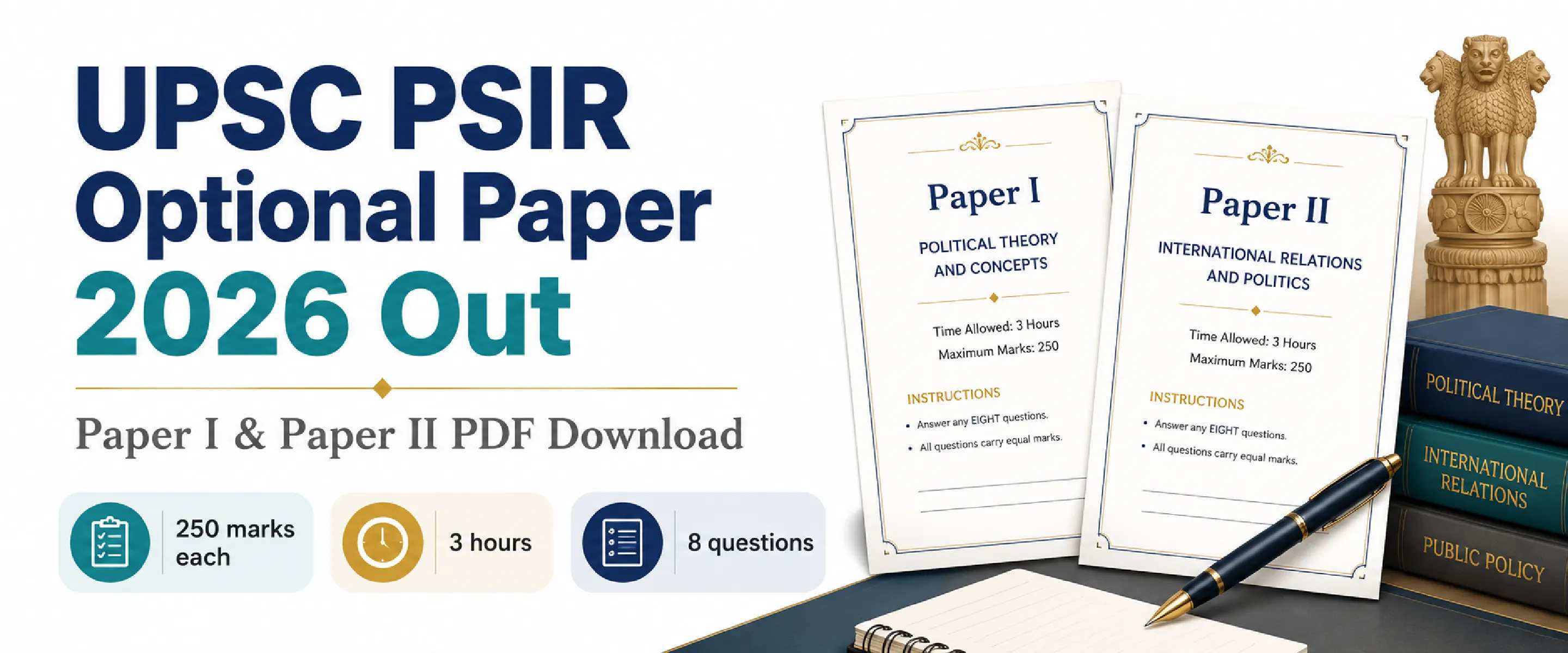
The UPSC PSIR Optional Paper 2026 is out for both Paper 1 and Paper 2.
UPSC conducted Political Science and International Relations on 30 August 2026 and has uploaded both question papers to its official previous-question-paper archive.
The direct UPSC PDF links are given below. (Source: Union Public Service Commission, 2026)
For anyone preparing PSIR for the next Mains cycle, the papers are useful for more than checking what was asked.
Paper 1 moves repeatedly between political theory and present-day Indian politics. Paper 2 combines core IR concepts with current foreign-policy questions.
That mix gives a good picture of how UPSC expects static PSIR preparation to connect with contemporary events.
The official UPSC PSIR Optional Paper 2026 PDFs are available for both papers. It is better to practise from the UPSC copies because the question wording, marks and instructions are exactly as issued in the examination.
Paper | Official PDF | Exam session | Maximum marks |
PSIR Paper 1 | 30 August 2026, 9:00 AM to 12:00 noon | 250 | |
PSIR Paper 2 | 30 August 2026, 2:30 PM to 5:30 PM | 250 |
Source: Union Public Service Commission, Civil Services (Main) Examination 2026 timetable and official PSIR question papers.
Keep the paper beside the UPSC PSIR optional syllabus while analysing it. For a longer PYQ comparison, use the UPSC CSE previous year papers.
Join our WhatsApp Community
The UPSC PSIR Optional Paper 2026 formed Paper VI and Paper VII of the Civil Services (Main) Examination. Both papers were held on 30 August 2026, the final day of the Mains timetable.
Paper 1 was held in the morning and Paper 2 in the afternoon. (Source: Union Public Service Commission, 2026)
Particular | Paper 1 | Paper 2 |
UPSC paper number | Paper VI | Paper VII |
Subject | Political Science and International Relations | Political Science and International Relations |
Date | 30 August 2026 | 30 August 2026 |
Time | 9:00 AM to 12:00 noon | 2:30 PM to 5:30 PM |
Duration | 3 hours | 3 hours |
Maximum marks | 250 | 250 |
Sections | 2 | 2 |
Questions printed | 8 | 8 |
Questions to attempt | 5 | 5 |
Compulsory questions | Question 1 and Question 5 | Question 1 and Question 5 |
Together, the two optional papers carry 500 marks in the written examination. Each paper carries 250 marks.
The paper pattern is simple on paper, but the choice rule affects how a candidate should prepare and attempt the exam.
Each PSIR paper contains eight questions divided into Section A and Section B. Candidates answer five questions. Question 1 and Question 5 are compulsory.
From the remaining six questions, a candidate chooses three, with at least one question from each section. (Source: UPSC PSIR Paper 1 and Paper 2, 2026)
Questions 1 and 5 each contain five short-answer parts of 10 marks. UPSC asks candidates to answer these parts in about 150 words.
The remaining questions contain longer 15-mark and 20-mark parts. Both papers are printed in Hindi and English. (Source: UPSC PSIR Paper 1 and Paper 2, 2026)
This matters because PSIR does not reward narrow preparation. The two compulsory questions already test a wide spread of topics.
Even in the longer questions, the section rule prevents a candidate from ignoring one side of the paper.
Add as a preferred Source on Google
Paper 1 of the UPSC PSIR Optional Paper 2026 covered political theory, political thinkers, Indian government and politics.
Much of it was familiar syllabus territory, but UPSC often asked candidates to use a concept rather than merely define it.
Political theory and thinkers
The short-answer portion tested the resurgence of political theory, post-colonial theories of the state, legitimacy as a social construct and Herbert Marcuse's engagement with Freudian thought.
The longer questions brought in Laski on rights and the state, Machiavelli on virtue and fortune, Ambedkar on democracy and state socialism, and J. S. Mill's position within liberal thought. (Source: UPSC PSIR Paper 1, 2026)
The paper did not stop with the most predictable thinkers. Mary Wollstonecraft's feminist critique appeared alongside Gandhi's trusteeship, the capability approach to equality, representative democracy and Kautilya's Saptanga theory.
The Kautilya question asked for contemporary political relevance. That is a useful reminder: a thinker note should not end with definition and criticism.
It should also contain one or two ways the idea can be connected to current politics or governance.
For preparation, this makes concise thinker sheets more useful than long biographical notes. A good sheet should cover the central argument, major concepts, criticism and contemporary relevance.
Indian politics and governance
Section B moved between historical, constitutional and current political themes.
Questions linked Swadeshi with Swaraj, examined secularism in the Indian constitutional setting, discussed identity in modern politics and raised the problem of proxy leadership in Panchayati Raj. Liberalisation and its impact on agriculture also appeared in the compulsory short answers. (Source: UPSC PSIR Paper 1, 2026)
The longer questions covered women in the freedom struggle, coalition politics and Centre-State relations under Article 293.
UPSC also asked about voting behaviour and astroturfing, constitutional limits on executive power, ethnic conflicts, inter-State water disputes, changes in the functioning of Parliament and political will in dealing with environmental degradation.
The mix matters. A standard topic such as federalism can appear beside a newer term such as astroturfing. Candidates therefore need solid constitutional and political-process notes, but they also need enough current awareness to recognise how those concepts are being expressed today.
Paper 2 of the UPSC PSIR Optional Paper 2026 was strongly application based. Section A tested comparative politics and international relations theory.
Section B moved into India's foreign policy, neighbourhood relations and ties with major partners.
Comparative politics and international relations
The compulsory short-answer set covered criticism of the institutional approach in comparative politics, extractive capitalism, balance of power, clientelism, and identity and technology in defensive realism.
Longer questions dealt with the changing nature of the state in industrial societies, international human-rights frameworks, diplomacy, NATO, objectivity in IR theory and power-transition theory in the context of US-China relations. (Source: UPSC PSIR Paper 2, 2026)
The paper also included the QUAD, the Council for Mutual Economic Assistance and UNCLOS. This is typical of what makes PSIR Paper 2 difficult: theory, institutions and current geopolitics are not separate compartments.
A candidate may know the definition of power transition, for example, but still need current US-China developments to build a convincing answer.
That is why current affairs should be filed under syllabus headings.
A date-wise current-affairs notebook is difficult to use in an optional answer unless the material is later reorganised around themes such as realism, regionalism, international institutions, major powers and India's foreign relations.
India and the world
Section B was closely tied to current foreign policy.
The compulsory short answers covered India's objections in WTO agriculture negotiations, India's options amid Pakistan-Afghanistan tensions, India-Israel security cooperation, the India-Bangladesh land-boundary settlement and India-Brazil economic cooperation. (Source: UPSC PSIR Paper 2, 2026)
The longer questions widened the geographical spread. Topics included China's influence across South Asia, India-Maldives relations, India-EU trade and security ties, illegal cross-border migration, Katchatheevu, India's multi-alignment, India-Russia relations, West Asian rivalries and India-South Africa cooperation.
Paper 2 therefore cannot be prepared from a monthly current-affairs compilation alone. The useful approach is to attach current events to static PSIR frames.
India-EU developments belong inside India-EU relations. A NATO development should sit under security institutions and alliance politics.
A South Asian event should be linked with neighbourhood policy, regional security and the relevant bilateral relationship.
The UPSC PSIR Optional Paper 2026 gives a few clear preparation lessons.
1. Concepts have to travel into current issues. Kautilya was linked with present politics, while power-transition theory was connected with US-China relations.
A definition is usually only the starting point of a good answer.
2. Indian politics needs contemporary vocabulary. Astroturfing, coalition politics, executive restraint and ethnic conflict show why political developments matter even when the underlying syllabus headings remain unchanged.
3. Thinkers remain central to Paper 1. Laski, Machiavelli, Ambedkar, Mill, Wollstonecraft, Gandhi and Marcuse appeared across the paper.
Revision should therefore preserve a dependable thinker base rather than replace it with current affairs.
4. Paper 2 needs organised current affairs. QUAD, NATO, US-China relations, India-EU ties, India-Russia relations, South Asia and West Asia appeared alongside IR theory.
The better system is to update the syllabus topic itself whenever an important development occurs.
5. Short answers punish selective preparation. Questions 1 and 5 together account for 100 marks in each paper.
Both are compulsory. Weak coverage across the syllabus can therefore hurt even when a candidate is comfortable with the longer questions.
The UPSC PSIR Optional Paper 2026 is most useful as a diagnostic test, not as a PDF saved for later.
1. Attempt one paper in the actual time limit
Set aside three uninterrupted hours. Follow the examination rules: attempt five questions, including Questions 1 and 5, and satisfy the section requirement.
Do not pause to check notes. This quickly shows whether the main problem is content, recall, question selection or writing speed.
2. Map every question to the syllabus
After the attempt, place each question under the exact PSIR syllabus heading. This exposes weakly organised notes.
If a topic looks familiar but you cannot locate it quickly in the syllabus, your preparation may be source driven rather than exam driven.
3. Separate static gaps from current-affairs gaps
A weak answer on Laski, legitimacy or the capability approach points to a conceptual gap. A weak answer on India-EU relations or Chinese influence in South Asia may be a current-affairs consolidation problem. These weaknesses need different fixes.
4. Rewrite the weakest answers first
Rewriting every answer immediately can consume time without improving the weakest areas.
Start with answers where the structure was poor, the thinker or theory was thin, examples were missing, or the conclusion simply repeated the introduction.
Rewrite within the same time and word limits.
5. Compare with older PSIR PYQs
Once the 2026 attempt is complete, compare it with earlier UPSC papers. Look for recurring syllabus areas, but do not assume UPSC will repeat the same framing.
PadhAI's previous year question archive can be used with the PSIR syllabus to build a topic-wise PYQ list.
The UPSC PSIR Optional Paper 2026 broadly follows the established split between political theory and Indian politics in Paper 1, and comparative politics, international relations and India's external relations in Paper 2.
Paper | Broad syllabus areas | 2026 examples |
Paper 1, Section A | Political theory, ideologies, Western and Indian political thought | Political theory, post-colonial state, Laski, Machiavelli, Ambedkar, Mill, Wollstonecraft, Gandhi, Kautilya |
Paper 1, Section B | Indian nationalism, Constitution, political processes, federalism and governance | Swaraj, secularism, Panchayati Raj, coalition politics, Article 293, voting behaviour, Parliament, water disputes |
Paper 2, Section A | Comparative politics and theories of international relations | Institutional approach, balance of power, defensive realism, NATO, US-China relations, QUAD, UNCLOS |
Paper 2, Section B | India and the world | WTO, neighbourhood, India-Israel, India-EU, India-Russia, West Asia, South Africa, multi-alignment |
Use this table as a revision map, not as a replacement for the complete syllabus. The broader UPSC syllabus 2026 is useful when checking how optional preparation fits into the rest of Mains.
Frequently asked question (FAQs)
Is the UPSC PSIR Optional Paper 2026 PDF out?
When was the UPSC PSIR Optional Paper 2026 conducted?
How many marks does PSIR optional carry in UPSC Mains?
How many questions are attempted in each PSIR paper?
How should I analyse the 2026 PSIR papers?
The UPSC PSIR Optional Paper 2026 is a useful benchmark for the next group of PSIR candidates.
Paper 1 stayed rooted in political thought and Indian politics but repeatedly demanded contemporary application. Paper 2 placed theory beside live geopolitical and foreign-policy issues.
Download both official PDFs and attempt them under the three-hour limit. Then map the questions to the syllabus.
That exercise shows where preparation is actually weak, whether the gap is conceptual, current-affairs based or simply a problem of writing under time pressure.





No comments yet. Be the first to join the discussion!