EC Appointment Law: SC Split Verdict Explained for UPSC
On 23 September 2026, a two-judge Supreme Court Bench split on whether the challenge to the 2023 EC appointment law needs a Constitution Bench. The case now goes to the Chief Justice of India. Here is the full UPSC breakdown of the Act, Article 324 and both opinions.
Last updated
4
mins read

Two judges. One bench. No agreement.
On 23 September 2026, Justices Dipankar Datta and S.C. Sharma could not reach a common conclusion on the petitions that question how Election Commissioners get appointed under the current law.
The disagreement was narrow. Should the challenge to the EC appointment law move to a Constitution Bench? Justice Datta said it should not. Justice Sharma said it must.
Both directed the papers to the Chief Justice of India. The Bench had reserved its decision on 30 July 2026.
The split was about procedure, not the law's validity
Justice Datta held that Anoop Baranwal already settled the principles, so no reference was needed
Justice Sharma found a substantial question of law worth a larger Bench
Both judges sent the matter to the CJI rather than ordering fresh litigation
Justice Datta called the panel's third member "largely ornamental"
The 2023 Act remains in force
Join our WhatsApp Community
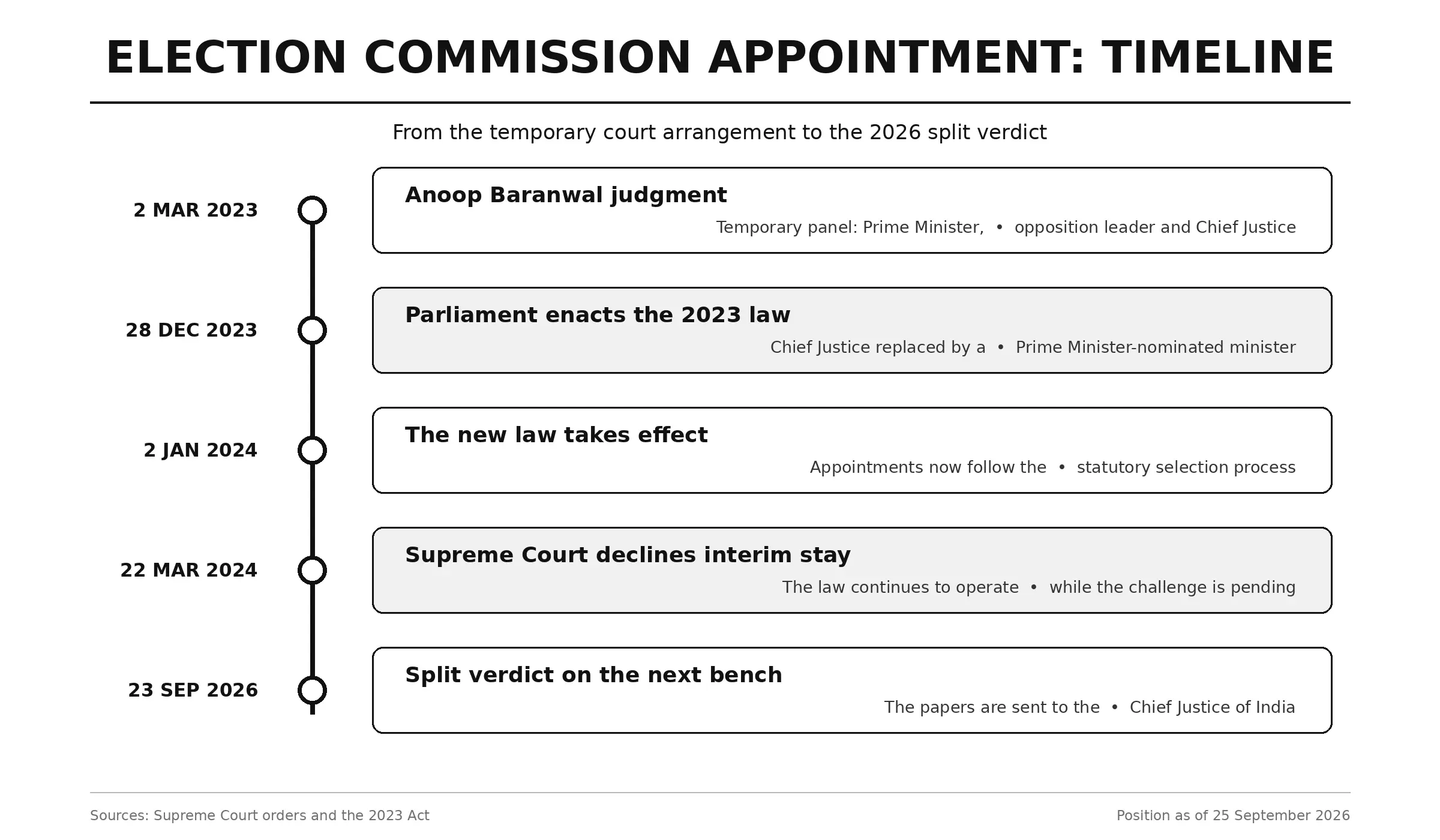
For decades, no EC appointment law existed. The President simply acted on the government's advice.
That changed in March 2023. A five-judge Constitution Bench in Anoop Baranwal v Union of India ruled that a committee of the Prime Minister, the Leader of Opposition, and the Chief Justice of India must pick the CEC and Election Commissioners. But the ruling was temporary. It applied only until Parliament passed its own law. Parliament did exactly that within the year.
The Chief Election Commissioner and Other Election Commissioners (Appointment, Conditions of Service and Term of Office) Act, 2023 took effect in January 2024. It replaced the 1991 Act. One particular swap drew the most criticism.
Selection Committee | Anoop Baranwal (2023) | The 2023 Act |
Member 1 | Prime Minister | Prime Minister, as Chairperson |
Member 2 | Leader of Opposition, Lok Sabha | Leader of Opposition, Lok Sabha |
Member 3 | Chief Justice of India | Union Cabinet Minister nominated by the PM |
Effective balance | 1 government, 1 opposition, 1 judiciary | 2 government, 1 opposition |
Other Provisions Worth Knowing
Provision | What It Says |
Search Committee | Headed by the Cabinet Secretary with two secretary-rank officers, prepares a panel of five names |
Eligibility | Persons holding or having held a post equivalent to Secretary to the Government of India |
Selection Committee's power | May consider names beyond the search panel |
Term | Six years, or until the age of 65, whichever is earlier |
Salary | On par with a Supreme Court judge, after Parliament amended the original proposal of Cabinet Secretary rank |
In March 2024, the Court refused to stay the law. Two Election Commissioners were appointed under it shortly after.
Add as a preferred Source on Google
Question | Justice Dipankar Datta | Justice S.C. Sharma |
Does it need a Constitution Bench? | No | Yes |
Reason | Principles settled in Anoop Baranwal, only the law needs testing | Raises a substantial question of law |
On the reference plea | Called it re-packaging a settled principle | Deserves a larger Bench |
Justice Datta's Key Observations
Independence must be visible. The ECI cannot simply be independent. It must look independent to the public.
The third seat is ornamental. A minister nominated by the Prime Minister is unlikely to disagree with him, as the Attorney General conceded. Two of three members come from the government. That reduces the Leader of Opposition's presence to a formality.
The CJI was never meant to be permanent. Anoop Baranwal included the Chief Justice as a stopgap arrangement. Had the Bench intended that to be binding, it would have said so explicitly.
"Judges appoint judges" is a myth. On the collegium comparison, Justice Datta noted that the executive already vets judicial appointments and clears collegium recommendations selectively.

Normally, a split sends the case to a three-judge Bench. Here, both judges sent it straight to the CJI. No hearing date is fixed.
The Bench strength is not known. Justice Datta urged the CJI to consider a permanent five-judge Bench for constitutional cases.
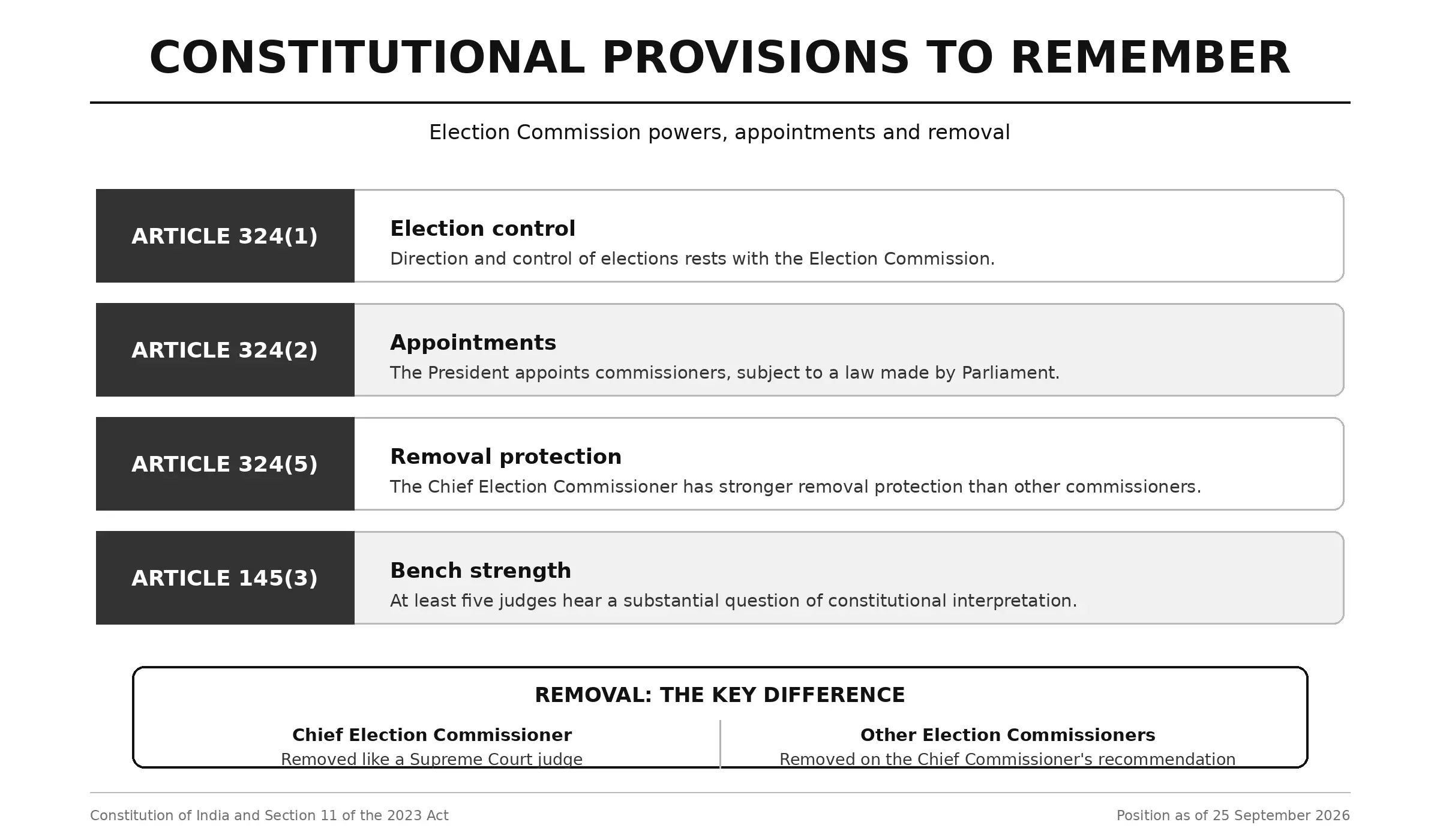
Article 324(1): Control of elections vests in the Election Commission.
Article 324(2): The President appoints the CEC and ECs, subject to any law made by Parliament. This is the government's strongest argument.
Article 324(5): The CEC is removable only like a Supreme Court judge. Other ECs go only on the CEC's recommendation, so they have weaker protection.
Article 145(3): At least five judges must decide a substantial question of constitutional interpretation.
Free and fair elections are part of the basic structure.
The Dinesh Goswami Committee (1990) and the Law Commission's 255th Report (2015) had both wanted a panel including the CJI.
Basics: PadhAI polity section.
Parliament is doing its job. Article 324(2) expressly allows an EC appointment law, and the Court's 2023 panel was always temporary.
Separation of powers is the other argument. Putting the CJI on a selection panel blurs the line with the executive, and may compromise the Court if that appointment is later challenged before it. The Leader of Opposition, in any case, now sits on the panel.
Decide quickly, through a permanent Constitution Bench
Rebalance the panel with a neutral third member
Equalise removal protection for ECs and the CEC
Publish the shortlist and selection reasons
Strengthen ECI finances through charged expenditure
UPSC Relevance
Stage | Angle |
GS Paper 2 | Constitutional bodies, separation of powers, judicial review |
Prelims | Article 324 clauses, panel composition, Anoop Baranwal, Article 145(3), removal procedure |
Mains | Election Commission independence, appointment reform |
Frequently asked question (FAQs)
What is the EC appointment law of 2023?
What was the Supreme Court split verdict about?
Is the 2023 law still in force?
How is this different from the Anoop Baranwal judgment?
Can Parliament make a law on EC appointments?
Prelims Questions
Mains Questions




Research methodology
PadhAI's research methodology ensures every article is accurate, UPSC-ready, and beginner-friendly. We curate current affairs analysis based on UPSC exam relevance by cross-referencing The Hindu, Indian Express, and PIB. General Studies (GS) topics are drafted from NCERTs and standard books such as M. Laxmikanth, Spectrum, and GC Leong, then reviewed by subject matter experts to eliminate factual errors. Additionally, we update aspirants with verified government exam notifications alongside expert blogs suggesting the best resources, syllabus, and comprehensive Prelims and Mains strategies.


No comments yet. Be the first to join the discussion!