UPI MDR 2026: New UPI Charges for Merchants Explained
From 15 October 2026, a 0.4% UPI MDR will apply to merchant payments above Rs 2,000. Person to person transfers stay free at any value, and small merchants stay exempt. Here is what changed in the law, who pays, who does not, and how to use this news in Prelims and Mains.

Gajendra Singh Godara
Last updated
mins read
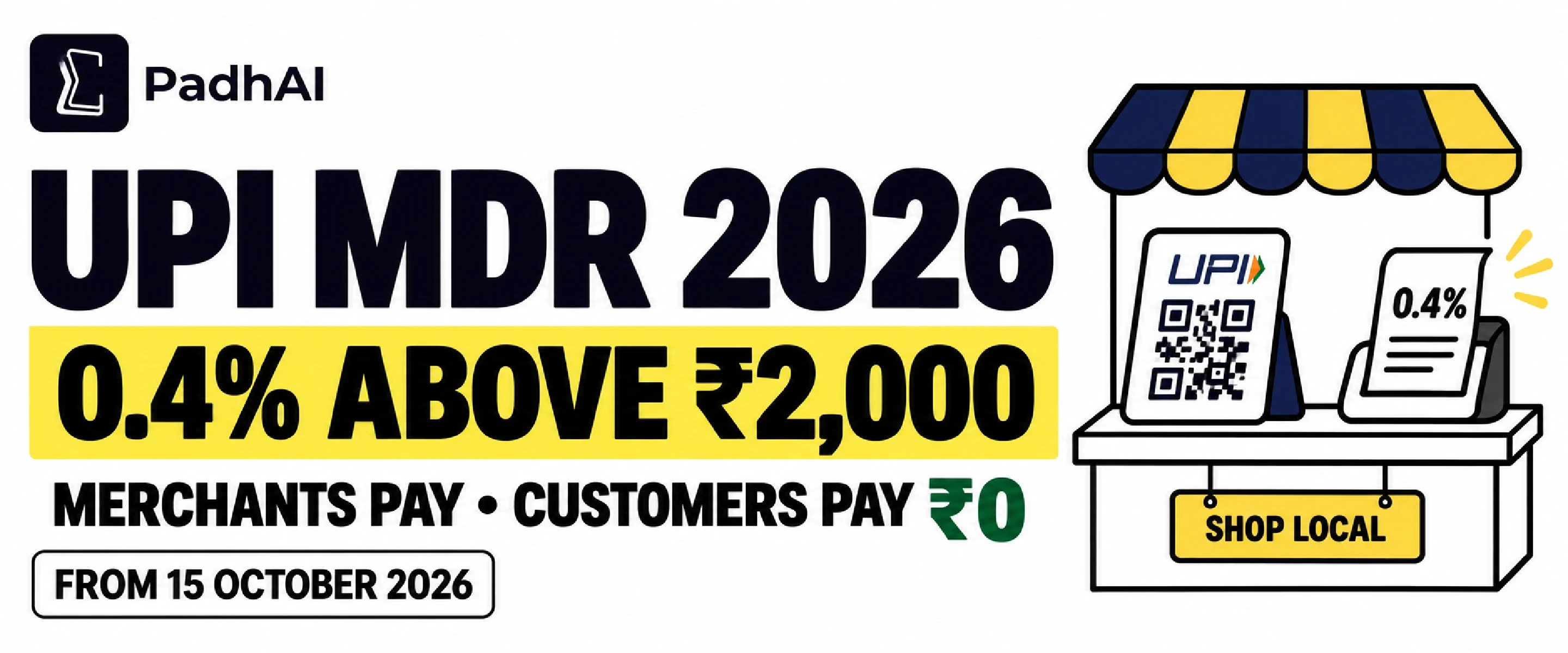
A 0.4% UPI MDR hits merchant payments over Rs 2,000 starting 15 October 2026. Regular person to person transfers remain completely free regardless of amount. Small merchants also keep their exemption.
This guide covers the legal shifts, the exact payment liabilities, and the specific angles you need for Prelims and Mains.
Why in News
The Ministry of Finance confirmed on 15 September 2026 that individual UPI transfers avoid all fees. Meanwhile, a 0.4% Merchant Discount Rate targets specific person to merchant transactions exceeding Rs 2,000.
Timing played a big role here. A gazette notification on 14 September locked in zero MDR for UPI transactions up to Rs 2,000. The very next day, the National Payments Corporation of India released a comprehensive circular.
Their UPI steering committee had already finalized the exact rates, maximum caps, and fee distribution models. These rules officially begin on 15 October 2026.
Merchant fees vanished from UPI back in January 2020. Bringing them back now marks a clear policy shift rather than just another administrative update.
Start date: 15 October 2026
Person to person transfers: zero charge across all transaction values
Merchant payments under Rs 2,000: zero charge
Merchant payments over Rs 2,000: 0.4% standard UPI MDR
Payments hitting Rs 75,000 or more: charge capped at Rs 300 per transaction
Essential sectors: flat Rs 5 per transaction for amounts over Rs 2,000
Capital market payments: 0.02%, with a Rs 300 cap
Small merchants in the P2PM category: zero MDR for up to Rs 1 lakh received monthly via UPI QR
Payer: the merchant pays their acquiring bank, never the customer
Expected coverage: government estimates suggest only about 4% of merchant transactions will face any charge
Join our WhatsApp Community
Shops pay a fee called the Merchant Discount Rate to accept digital money. This percentage of the total bill gets divided among the merchant's bank, the customer's bank, the payment network, and the app itself.
Picture swiping a card at a restaurant. Your bill says Rs 1,000, but the restaurant actually pockets slightly less than Rs 1,000. That missing slice is the MDR. You still hand over exactly Rs 1,000. The business absorbs the cost.
Public debate often gets tangled up over the word "charges". A UPI MDR does not tax the person sending the money. It simply covers the cost of receiving funds, and the receiver foots that bill.
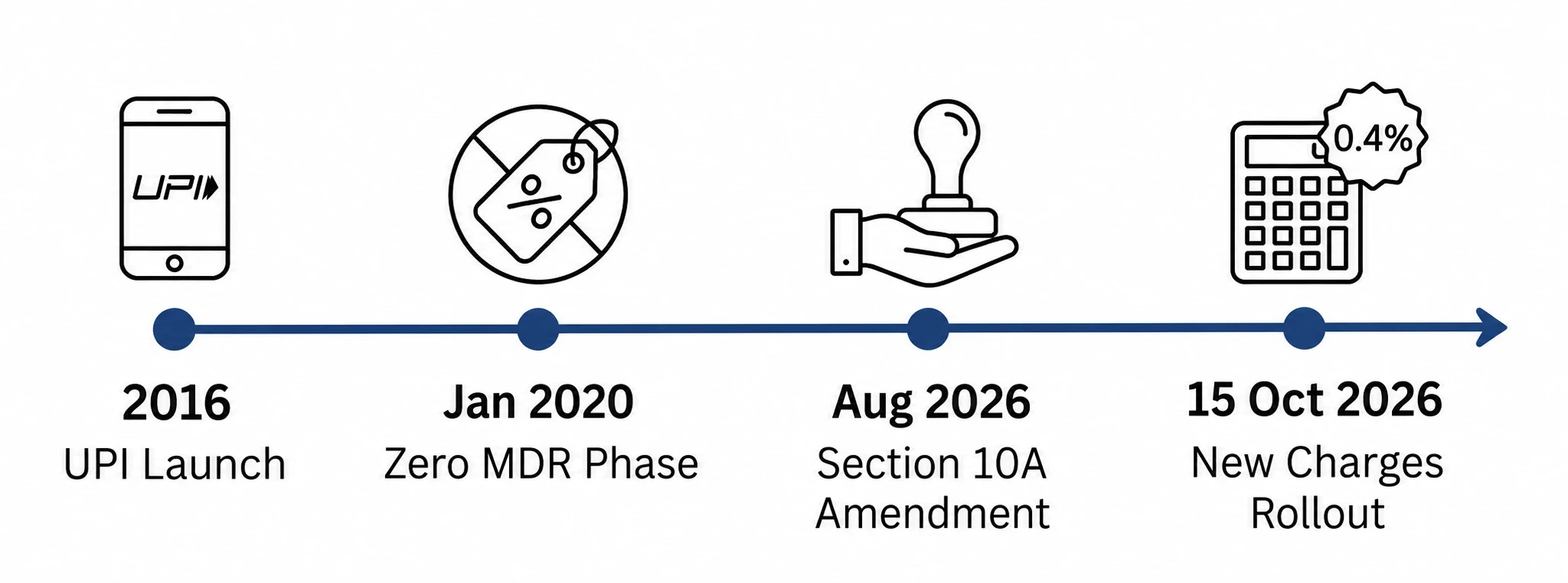
Zero-MDR rules from January 2020
Lawmakers deliberately forced UPI into a zero-fee model. It did not happen by chance.
Parliament added Section 10A to the Payment and Settlement Systems Act, 2007 via the Finance (No. 2) Act, 2019.
This specific section stopped banks and system providers from applying direct or indirect charges to electronic modes listed under Section 269SU of the Income-tax Act, 1961.
Businesses earning over Rs 50 crore in turnover must offer these prescribed digital payment modes under Section 269SU. A December 2019 gazette notification officially named UPI and RuPay debit cards as those required modes.
This created a statutory zero MDR on UPI and RuPay debit card merchant payments starting 1 January 2020.
Taxpayers covered the resulting financial gap. From 2021-22, a government incentive scheme reimbursed banks and payment providers for low-value merchant transactions.
Payouts hit Rs 1,389 crore in 2021-22, jumped to Rs 2,210 crore in 2022-23, and reached Rs 3,631 crore in 2023-24.
August 2026 Section 10A amendment
Parliament altered the underlying legal foundation in August 2026.
Lok Sabha members saw the Taxation and Other Laws (Amendment) Bill, 2026 introduced on 4 August 2026 and passed it by 6 August 2026.
A central clause in this bill amends Section 10A of the PSS Act, 2007. Drafters swapped out the phrase "the electronic modes of payment prescribed under section 269SU of the Income-tax Act, 1961".
They replaced it with "one or more electronic modes of payment as the Central Government may, by notification, specify".
That specific word swap tells the entire story. A strict list in tax law previously locked in the zero-fee guarantee. The Central Government now holds the power to decide which modes remain free via simple notification.
The amendment itself did not levy a single rupee. It merely transferred decision-making authority from Parliament straight to the executive branch.
Officials exercised this newly transferred power for the very first time with the September 2026 notification.
Add as a preferred Source on Google
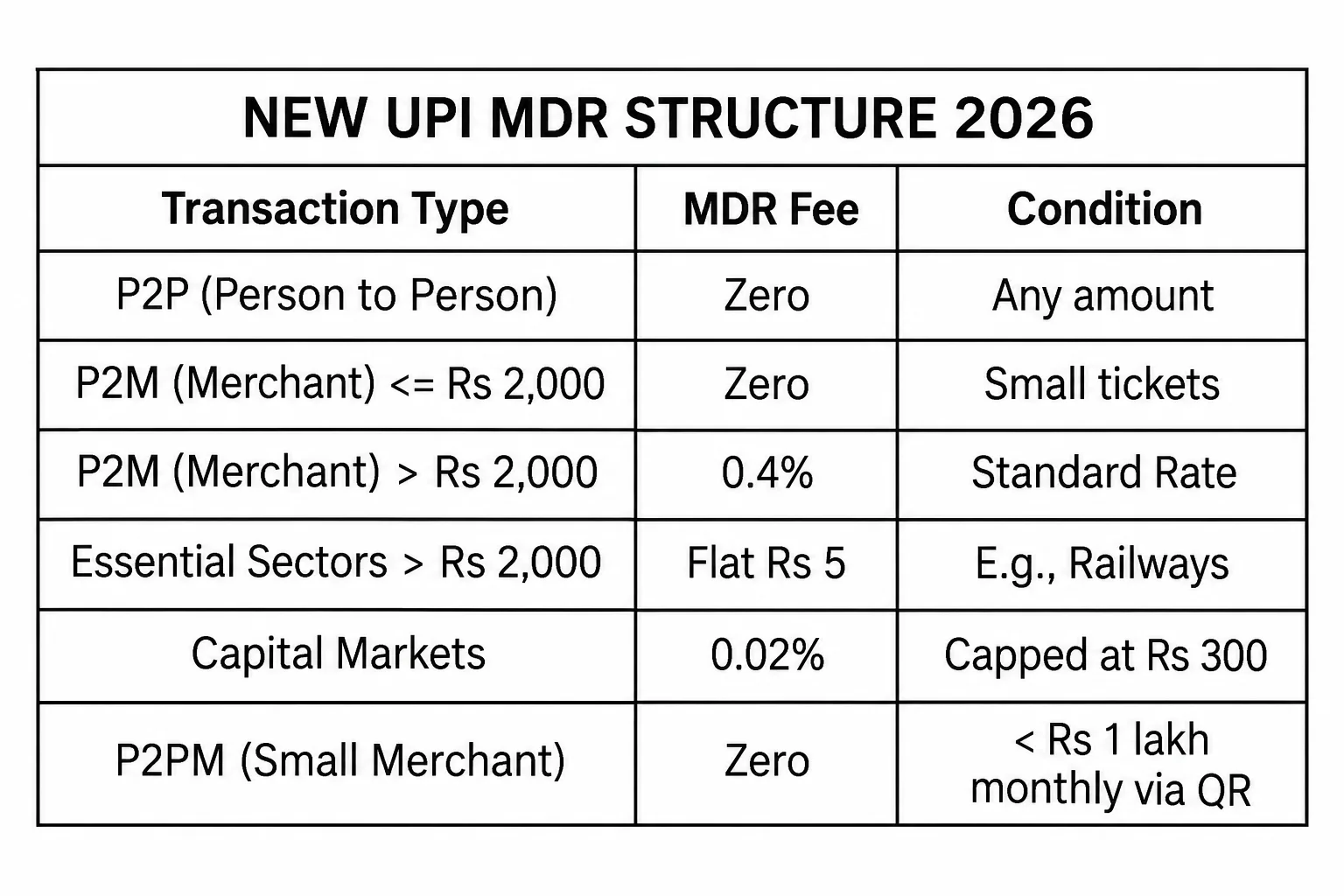
Transaction type | UPI MDR | Condition |
Person to person (P2P) | Zero | Any value, no upper limit |
Merchant payment up to Rs 2,000 | Zero | Applies even to large commercial merchants |
Merchant payment above Rs 2,000 | 0.4% | Standard rate, shared across the payment chain |
Merchant payment of Rs 75,000 and above | Capped at Rs 300 | Fixed ceiling replaces the percentage |
Essential sectors above Rs 2,000 | Flat Rs 5 | Railways, telecom, insurance, fuel, agriculture inputs and others |
Mutual funds, securities, brokers and dealers | 0.02%, capped at Rs 300 | Lower rate to keep investing cheap |
Small merchants under P2PM | Zero | Up to Rs 1 lakh a month through UPI QR |
UPI app platform fees on customers | Not permitted | No platform or hidden fees |
You will find the complete list of categories qualifying for the flat Rs 5 rate inside the official NPCI circular.
Ignore any sector lists circulating on social media until you verify them against the actual circular.
Actual Merchant Payment Costs
Bill amount | UPI MDR rate | Amount paid by merchant |
Rs 1,500 | Zero | Rs 0 |
Rs 3,000 | 0.4% | Rs 12 |
Rs 50,000 | 0.4% | Rs 200 |
Rs 1,00,000 | Capped | Rs 300, instead of Rs 400 |
Most summaries completely overlook the cap. The percentage stops climbing once a bill crosses Rs 75,000.
A jeweller or car dealer therefore knows their absolute worst-case scenario is Rs 300 per transaction.
Exemptions and Excluded Merchants
Headlines make the new UPI charges for merchants sound broad, but two specific protections keep the actual scope quite narrow.
A Rs 2,000 floor provides the first layer of protection. The vast majority of Indian UPI payments fall below this line. Your local tea stall, auto ride, and grocery run remain completely untouched.
The P2PM category forms the second shield. Merchants holding a P2PM classification pay absolutely nothing, even on individual bills exceeding Rs 2,000, provided they receive under Rs 1 lakh a month via UPI QR code.
Street vendors, kirana shops, and small service providers mostly fall into this bucket. Liability depends on the merchant's official classification rather than just the size of one random bill.
Unchanged Rules for Regular Customers
Person to person transfers carry no charge at any value.
Payments up to Rs 2,000 avoid all charges.
UPI apps remain barred from levying platform fees or hidden charges on users.
Users face no monthly free-usage quotas, volume limits, or tiered caps on free usage.
Daily transaction limits ranging from Rs 1 lakh to Rs 5 lakh still apply depending on the category, but these act strictly as risk controls rather than fee thresholds.
Regulators advised banks to ensure merchants keep the MDR off customer bills. Pay close attention to the word advised.
This functions as a supervisory instruction rather than a hard statutory ban. An interview panel might easily probe that exact nuance.
The UPI network currently operates at a loss. Bank servers, fraud checks, settlement systems, and customer support consume resources during every single transaction.
Banks and the exchequer previously carried that entire cost through the incentive scheme because of the zero MDR rule.
That subsidy model lacked long-term scalability. NPCI data shows UPI processed 24.51 billion transactions worth Rs 29.82 lakh crore in August 2026 alone. A few thousand crore in incentive payouts simply cannot keep pace with a network expanding at over 20% annually.
Parliament actually flagged this issue previously. The government tied the new framework directly to the 32nd report from the Standing Committee on Finance.
That specific report demanded a viable revenue mechanism to guarantee long-term UPI sustainability.
Policymakers deliberately kept the burden narrow. Exempting P2P transfers, small tickets, and small merchants forces the cost onto large-value commercial payments. A 0.4% fee in that commercial space still undercuts credit cards and payment gateways.
A portion of that money flows back down the chain. A dedicated fund will receive five per cent of total MDR collections to expand UPI acceptance among small merchants, particularly across rural and semi-urban regions.
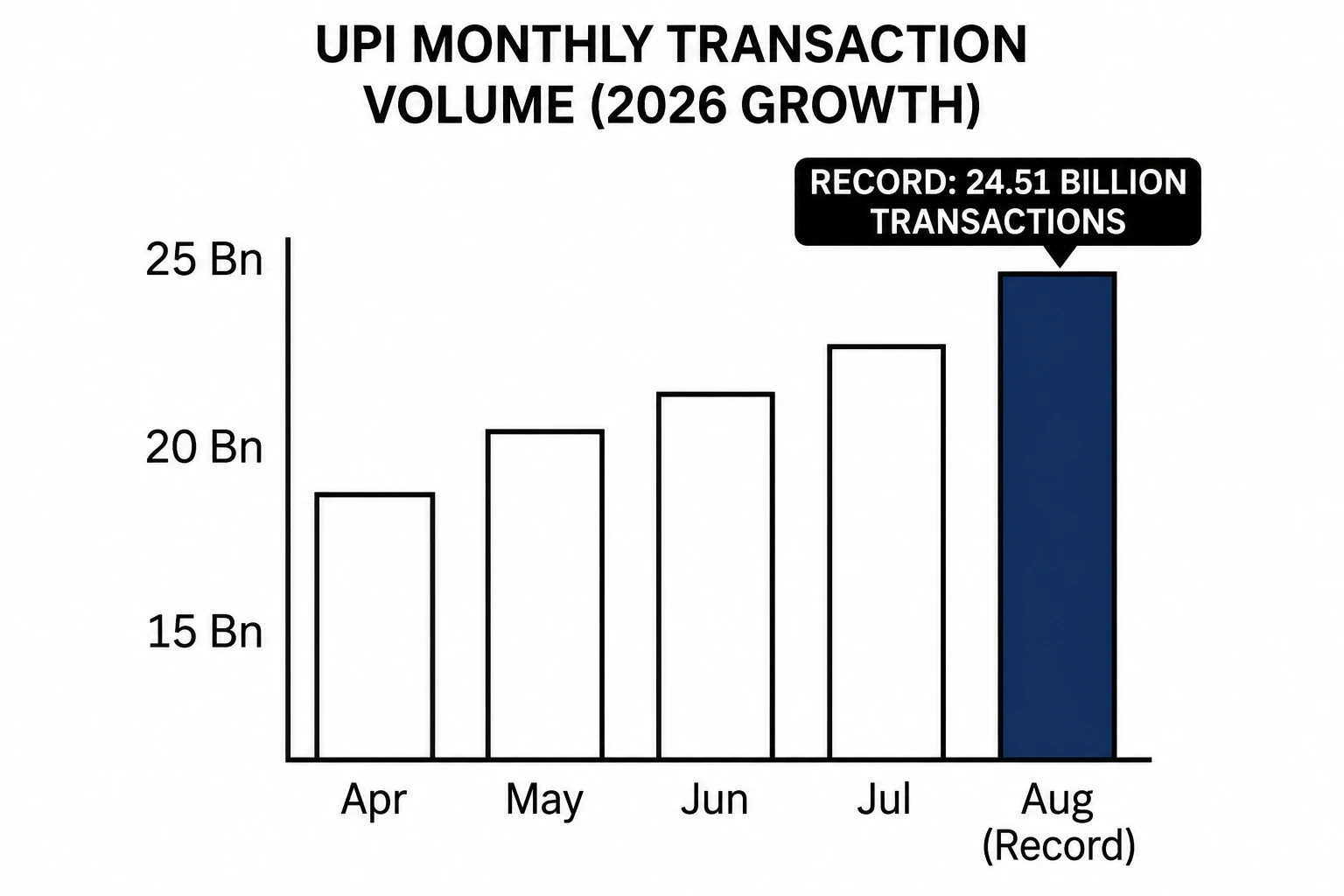
Indicator | Figure |
Transactions in August 2026 | 24.51 billion, an all-time monthly high |
Value in August 2026 | Rs 29.82 lakh crore |
Average per day | About 791 million transactions, Rs 96,205 crore |
Year-on-year growth | 22% by volume, 20% by value |
Share of P2P in UPI | About 37% by volume, around 70% by value |
Share of essential-sector P2M | About 17% by volume, about 46% by value |
Merchant transactions expected to attract MDR | About 4% |
Government incentive payout, 2023-24 | Rs 3,631 crore |
Any complete answer must address the substantive objections raised by critics.
A strict guarantee turned into executive discretion. The statute previously protected the zero MDR rule. It now rests entirely on a notification that a future government can revise without ever returning to Parliament. Critics argue this weakened the safeguard, regardless of how modest today's rates appear.
Merchants often pass costs down to the buyer. A shop facing a new fee might quietly raise overall prices or simply offer a cash discount. The advisory instruction given to banks will prove incredibly difficult to enforce across crores of individual merchants.
Strict thresholds invite transaction splitting. A merchant could easily ask a customer to send Rs 1,900 twice instead of processing Rs 3,800 all at once. Every threshold system carries this exact risk, and policing such behavior is never simple.
Digital-first businesses take the hardest hit. Firms operating on thin margins with high average ticket sizes, like fuel retailers and travel operators, land squarely in the affected band despite the flat Rs 5 relief.
This move might nudge certain users back toward cash. The formalisation gains of the past decade rely partly on UPI remaining free at the acceptance point. Even the mere perception of a cost can slow adoption among newly digital users.
Supporters offer a fair counter. A payments system that nobody funds is never truly free, just heavily subsidised. Building long-term sustainability might protect the network far better than keeping it artificially costless.
Authorities should publish the category list and review it openly so merchants know exactly where they stand before 15 October.
Regulators must monitor pass-through costs using sample checks to see if merchants are adding surcharges or offering cash discounts.
Officials need to watch for transaction splitting during the first two quarters and adjust the design if that pattern becomes visible.
The small merchant fund requires strict ring-fencing and transparent spending reports so the 5% share does not vanish into general accounts.
Policymakers should include a sunset or review clause with a stated date for reassessing the rates against actual cost recovery.
Lawmakers must protect the statutory floor for P2P and low-value payments so the zero-fee promise on everyday transactions remains credible.
UPSC Relevance and Syllabus Hooks
Exam stage | How it can be asked |
Prelims | What MDR means, who pays it, the Rs 2,000 threshold, NPCI's status, Section 10A of the PSS Act, P2PM classification |
GS Paper 2 | Government policies and interventions, executive versus legislative power, delegated legislation |
GS Paper 3 | Indian economy, digital payments infrastructure, inclusive growth, mobilisation of resources |
Essay | Technology and inclusion, who pays for public digital infrastructure |
Interview | Should a public digital utility be free, and if not, who should fund it |
Revise these static hooks alongside the current news: the Payment and Settlement Systems Act, 2007, along with the RBI's role as the regulator of payment systems under it.
Look at the NPCI as an umbrella organisation for retail payments, set up under the PSS Act framework and registered as a not-for-profit company. Check Section 269SU of the Income-tax Act.
Finally, review the broader idea of Digital Public Infrastructure, where UPI stands as India's showcase example.
Check the PadhAI economy section, the Economic Survey 2025-26 highlights, and the Union Budget 2026 notes for related revision material.
Quick Fact Summary
Item | Detail |
What changed | Merchant Discount Rate returns to selected UPI merchant payments |
Announced | Gazette notification 14 September 2026, NPCI circular 15 September 2026 |
Effective from | 15 October 2026 |
Standard rate | 0.4% above Rs 2,000 |
Cap | Rs 300 for payments of Rs 75,000 and above |
Enabling law | Section 10A, Payment and Settlement Systems Act, 2007, as amended in August 2026 |
Earlier regime | Zero MDR since 1 January 2020 |
Regulator | Reserve Bank of India, under the PSS Act |
Operator | National Payments Corporation of India |
Paid by | The merchant, to its acquiring bank |
Frequently asked question (FAQs)
Will customers have to pay UPI charges now?
When do the new UPI charges for merchants apply?
Are person to person UPI transfers still free?
Which merchants are exempt from UPI MDR?
What is the legal basis for charging MDR on UPI?
Ignore the political noise and you will see a narrow change carrying wide implications. It remains narrow because roughly 96% of merchant transactions and every single rupee sent between individuals stay completely free.
It carries wide implications because a promise that previously lived in strict statute now survives inside a simple executive notification.
Focus on three core elements while preparing for questions on the new UPI MDR and charges for merchants.
Memorize the exact numbers, trace the legal chain running from Section 269SU to Section 10A, and understand the honest trade-off between keeping a public utility free versus keeping it funded.
Examiners want that specific trade-off analysis, not just a recited rate card.
Keep watching this space well past 15 October. Early data covering merchant behaviour and any resulting pass-through complaints will definitely be worth adding to your revision notes. Our daily current affairs page will carry all those subsequent updates.
Prelims Questions
Mains Questions


Gajendra Singh Godara
Ex-UPSC Aspirant | Exam Preparation Expert
Gajendra Singh Godara is an IIT Bombay graduate and a UPSC aspirant with 4 attempts, including multiple Prelims and Mains appearances. He specializes in Polity, Modern History, International Relations, and Economy. At PadhAI, Gajendra leverages his firsthand exam experience to simplify complex concepts, creating high-efficiency study materials that help aspirants save time and stay focused.

No comments yet. Be the first to join the discussion!