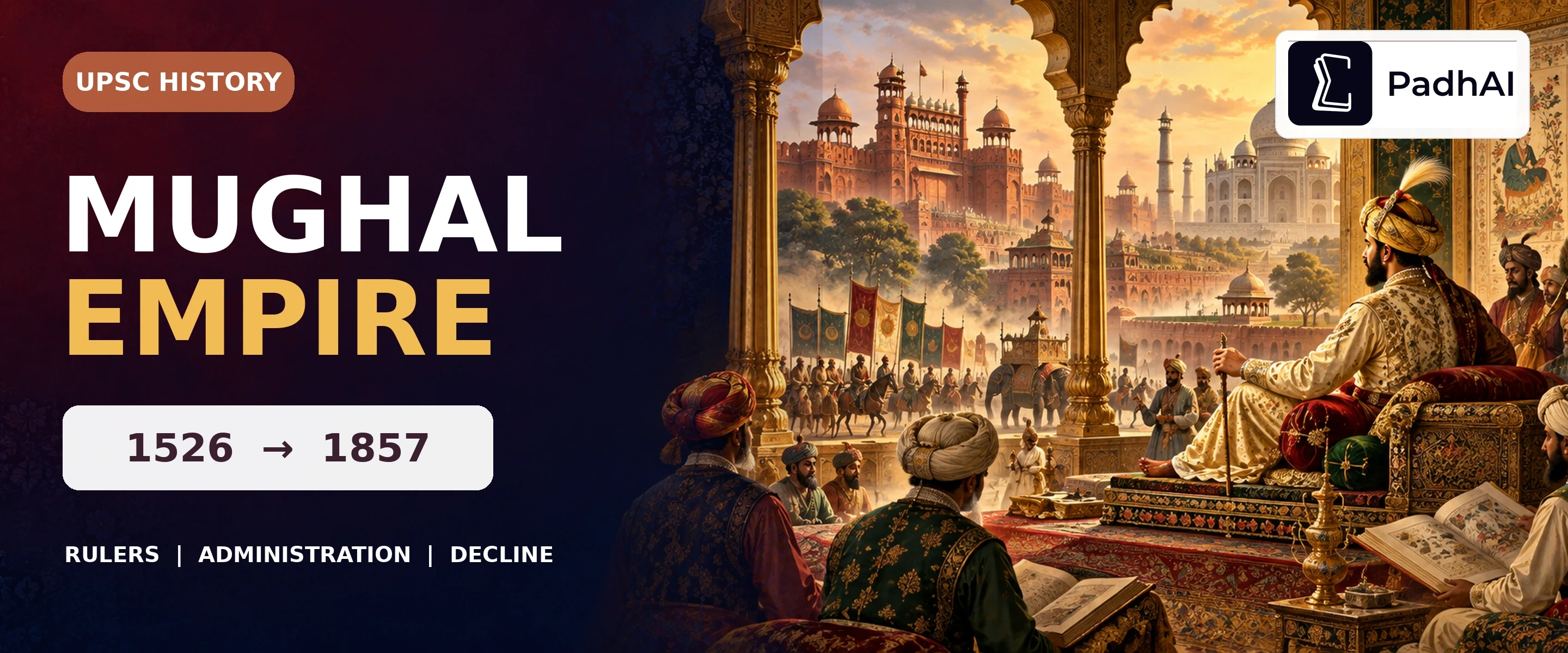
The Mughal Empire stretched across 331 years, beginning with Babur's win at Panipat in 1526 and ending when the British exiled Bahadur Shah Zafar in 1858. At its peak, it spanned four million square kilometres and governed roughly a quarter of all people alive. This guide walks through every ruler, the administrative machinery, the art, the collapse, and what UPSC actually tests.

Gajendra Singh Godara
Last updated
11
mins read
Founded: 21 April 1526, First Battle of Panipat, Babur defeats Ibrahim Lodi
Six Great Mughals: Babur, Humayun, Akbar, Jahangir, Shah Jahan, Aurangzeb
Interrupted 1540 to 1555 by the Sur Empire under Sher Shah Suri
Greatest extent 1690: about 4 million sq km under Aurangzeb
Population around 1700: roughly 150 to 158 million, close to a quarter of the world
Last emperor: Bahadur Shah Zafar, deposed 1857, exiled to Rangoon on 7 October 1858
From 1526 through the mid-nineteenth century, the Mughal Empire held dominant power across the Indian subcontinent. Babur founded it. His descendants ruled for more than three centuries. And the history of the Mughal Empire is, above everything else, the story of a Central Asian dynasty making itself Indian.
"Mughal" is a European corruption of "Mongol", and the label misleads a little. The Mughals were Timurid, not Mongol in any cultural sense that matters.
Babur traced his father's line to Timur and his mother's to Genghis Khan. The dynasty called itself Gurkani, drawn from Timur's title Gurkan, meaning son-in-law of the Khan.
Three points are worth locking in before the detail begins.
Two distinct lives shaped the empire. Between 1526 and 1707, it functioned as a real imperial state. After Aurangzeb died in 1707, it survived on paper for another 150 years while actual power shifted to the Marathas, the regional nawabs, and eventually the British.
A Muslim dynasty governed a Hindu-majority population. How each ruler handled that fact is the central question running through the whole Mughal period.
Akbar and Aurangzeb sit at opposite poles, and UPSC asks about that contrast more than any other.
Administratively, the empire built things that lasted. The mansabdari system, the zabti revenue settlement, the provincial structure: these were genuine institutional achievements. Parts of them survived into British India.
Join our WhatsApp Community
Point | Detail |
Founded | 21 April 1526, First Battle of Panipat |
Founder | Babur (Zahir-ud-din Muhammad Babur) |
Dynastic origin | Timurid, self-designated Gurkani |
Capitals | Agra, Fatehpur Sikri, Lahore, Delhi (Shahjahanabad) |
Court language | Persian |
Area, c. 1600 | About 3.2 million sq km |
Area, 1690 | About 4 million sq km, the peak |
Population, c. 1700 | Roughly 150 to 158 million, estimates vary widely |
Currency | Rupee, dam, taka |
Interregnum | Sur Empire, 17 May 1540 to 22 June 1555 |
Last emperor | Bahadur Shah II "Zafar" (1837 to 1857) |
Formally ended | Emperor exiled to British Burma, 7 October 1858 |
A word about those population numbers. Estimates for the Mughal period swing enormously, from about 110 million to 158 million depending on which historian you read. Serious assessments cluster between 116 and 145 million.
Treat any single figure with caution, and say so in a Mains answer rather than asserting one.
Here is the full line of Mughal rulers, in order. The first six are the Great Mughals. Everyone after 1707 is a Later Mughal.
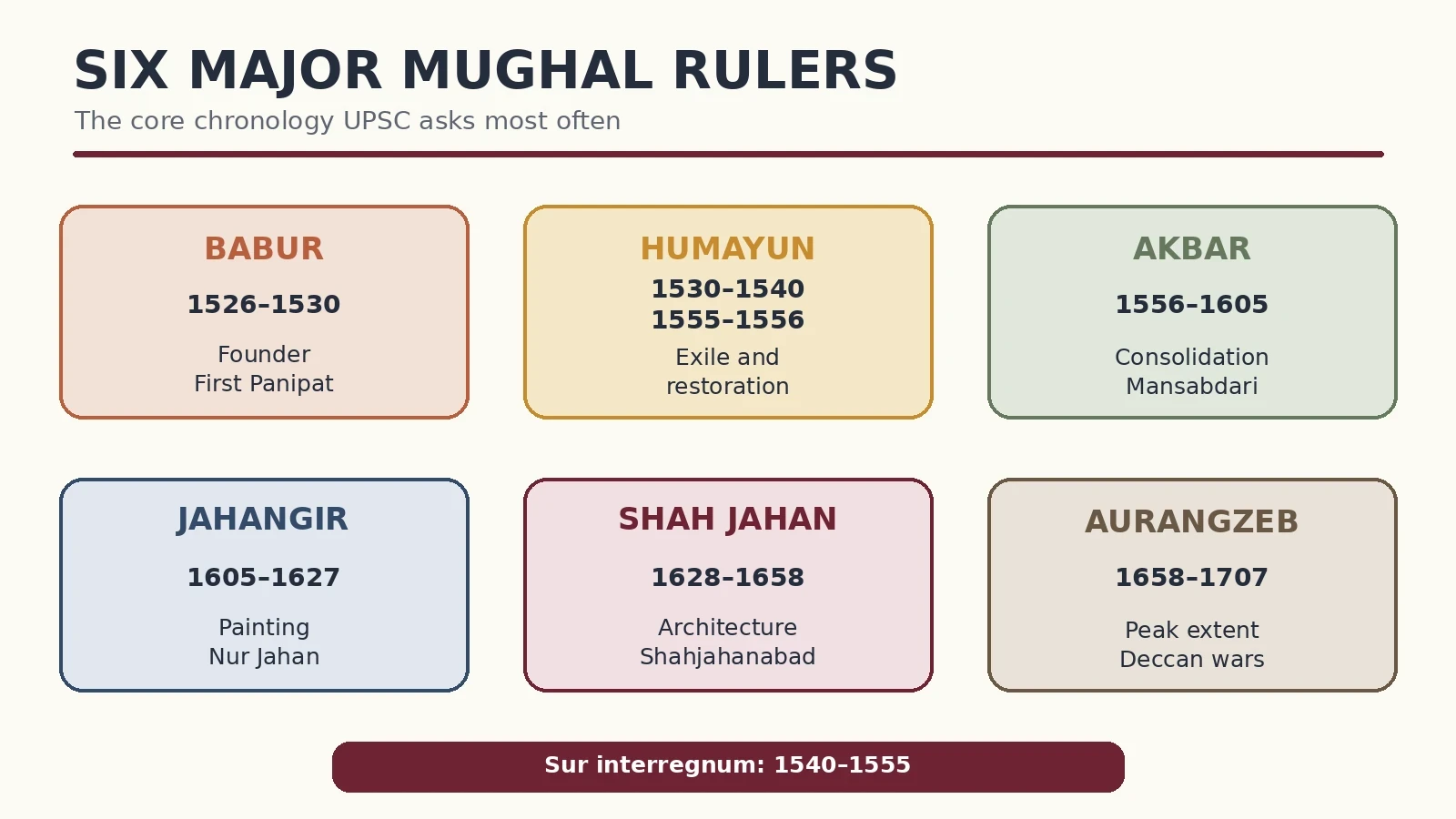
Seventeen Mughal kings held the throne across 331 years, and the Mughal Empire that the last of them presided over bore almost no resemblance to the one the first built.
# | Emperor | Reign | Remembered for |
1 | Babur | 1526–1530 | Founded the empire; wrote the Baburnama |
2 | Humayun | 1530–1540, 1555–1556 | Lost the empire to Sher Shah, regained it, died a year later |
(gap) | Sur Empire | 1540–1555 | Sher Shah Suri's interregnum |
3 | Akbar | 1556–1605 | Consolidation, mansabdari, sulh-i-kul |
4 | Jahangir | 1605–1627 | Nur Jahan, painting, first English embassies |
5 | Shah Jahan | 1628–1658 | Taj Mahal, Red Fort, Peacock Throne |
6 | Aurangzeb | 1658–1707 | Greatest extent, Deccan wars, jizya restored |
7 | Bahadur Shah I | 1707–1712 | First of the Later Mughals |
8 | Jahandar Shah | 1712–1713 | Deposed within a year |
9 | Farrukhsiyar | 1713–1719 | Issued the 1717 farman to the English Company |
10 | Rafi-ud-Darajat | 1719 | Puppet of the Sayyid Brothers |
11 | Shah Jahan II | 1719 | Puppet of the Sayyid Brothers |
12 | Muhammad Shah "Rangila" | 1719–1748 | Nadir Shah's invasion of 1739 |
13 | Ahmad Shah Bahadur | 1748–1754 | Ahmad Shah Abdali's raids begin |
14 | Alamgir II | 1754–1759 | Battle of Plassey, 1757 |
15 | Shah Alam II | 1759–1806 | Lost at Buxar 1764; granted Diwani in 1765 |
16 | Akbar II | 1806–1837 | A British pensioner; sent Ram Mohan Roy to London |
17 | Bahadur Shah II "Zafar" | 1837–1857 | The last emperor of Mughal India |
Notice where the line breaks. Farrukhsiyar's farman of 1717 gave the English East India Company duty-free trade in Bengal.
Shah Alam II's grant of the Diwani in 1765 handed it the revenue of Bengal, Bihar and Odisha.
Two generations before the empire formally ended, it had already signed away its own economic base.
Add as a preferred Source on Google
Across the first six reigns of the Mughal Empire, the family tree of Mughals is simpler than it looks. Succession ran father to son each time.
Timur → ... → Babur → Humayun → Akbar → Jahangir → Shah Jahan → Aurangzeb
What complicates things is the war of succession. One happened at almost every transition. The Timurids had no law of primogeniture.
The throne went to whichever son won, a principle sometimes summed up as takht ya takhta, throne or coffin.
Transition | What happened |
After Babur, 1530 | Humayun faced revolt from his brothers Kamran, Askari and Hindal |
After Humayun, 1556 | Akbar was 13; Bairam Khan acted as regent until 1560 |
After Akbar, 1605 | Jahangir's own son Khusrau rebelled and was blinded |
After Jahangir, 1627 | Shah Jahan defeated his rivals, including Shahryar |
After Shah Jahan, 1658 | Aurangzeb defeated Dara Shikoh, Shuja and Murad; Dara was executed and Shah Jahan imprisoned |
That last transition matters beyond the drama. Dara Shikoh was the eldest son and Shah Jahan's choice, a scholar who translated the Upanishads into Persian as the Sirr-i-Akbar.
His defeat by Aurangzeb gets presented often as the moment the empire abandoned its syncretic direction. It is a neat framing.
But a good Mains answer will note that it is also a simplification: Aurangzeb employed more Hindu mansabdars than Akbar did in absolute terms.
Born on 14 February 1483 in Andijan, in the Fergana valley, Babur, founder of the Mughal Empire, inherited a small principality at eleven. He lost Samarkand repeatedly.
He took Kabul in 1504. India became his target only after Central Asia closed its doors to him.

Source: Babur portrait, c. 1640. Public domain, via Wikimedia Commons/Smithsonian.
His four decisive battles:
Battle | Year | Defeated | Outcome |
First Panipat | 21 April 1526 | Ibrahim Lodi | Delhi and Agra taken; the empire founded |
Khanwa | 1527 | Rana Sanga of Mewar | Rajput confederacy broken; position secured |
Chanderi | 1528 | Medini Rai | Malwa secured |
Ghaghra | 1529 | Afghan confederates under Mahmud Lodi | Eastern flank settled |
What he brought that the Lodis did not have: field artillery and matchlocks, paired with the tulughma flanking manoeuvre and the araba formation, carts lashed together as a mobile barricade. Panipat is one of the earliest Indian battles decided by gunpowder.
Babur died at Agra on 26 December 1530. His memoir, the Baburnama, written in Chagatai Turkish, is one of the first true autobiographies in Islamic literature and a primary source in its own right. He is buried in Kabul, by his own wish.
Humayun ruled the Mughal Empire from 1530 to 1540, lost everything, and came back in 1555 for barely six months.
His problem was structural as much as personal. Timurid custom expected the empire to be shared among brothers, so Kamran held Kabul and Punjab while Humayun faced Afghan resistance in the east with half an empire.
Sher Shah Suri defeated him at Chausa (1539) and again at Kannauj, also called Bilgram (1540). Humayun spent fifteen years in exile, much of it in Safavid Persia.
The Sur Empire (1540–1555)
Sher Shah ruled only five years. But his reforms outlasted him, and UPSC asks about them often:
Rebuilt the Grand Trunk Road from Bengal to the north-west, with sarais at intervals
Issued a standardised silver coin, the rupiya, ancestor of the rupee
Systematic land measurement and revenue assessment, which Todar Mal later carried into Akbar's system
An efficient dak postal service and a reorganised administration
His tomb at Sasaram is often described as the culmination of Sultanate architecture and a bridge to the Mughal style.
Humayun recovered Delhi in 1555 after the Sur empire fragmented. He died in January 1556, falling from the staircase of his library at Sher Mandal in Purana Qila.
His tomb in Delhi, built by his widow Hamida Banu Begum, is the first great Mughal garden tomb and the architectural ancestor of the Taj Mahal.
Akbar the Great took the throne at thirteen. He is the ruler UPSC examines most closely.
Second Battle of Panipat, 5 November 1556. Mughal forces under Bairam Khan defeated Hemu, who had captured Delhi for the Sur cause.
Bairam Khan governed as regent until 1560. A period of influence by the harem faction followed, sometimes called the petticoat government, until Akbar took full control in 1564.

Source: Nar Singh, Akbar in the Ibadat Khana, c. 1605. Public domain, via Wikimedia Commons.
Religious policy
Year | Measure |
1562 | Marriage alliance with Amber; Rajputs enter the nobility |
1563 | Pilgrimage tax abolished |
1564 | Jizya abolished |
1575 | Ibadat Khana built at Fatehpur Sikri for religious debate |
1579 | Mahzar issued, giving him authority to arbitrate between conflicting religious interpretations |
1582 | Din-i-Ilahi proclaimed |
The governing idea was sulh-i-kul, universal peace, meaning the state would not privilege one faith. Din-i-Ilahi was never a mass religion.
It attracted a handful of courtiers, and Abul Fazl was its main intellectual advocate. Treat it as a court order of loyalty rather than a faith.
PadhAI has a full model answer on Akbar's religious syncretism worked to UPSC Mains structure.
Administration and conquest
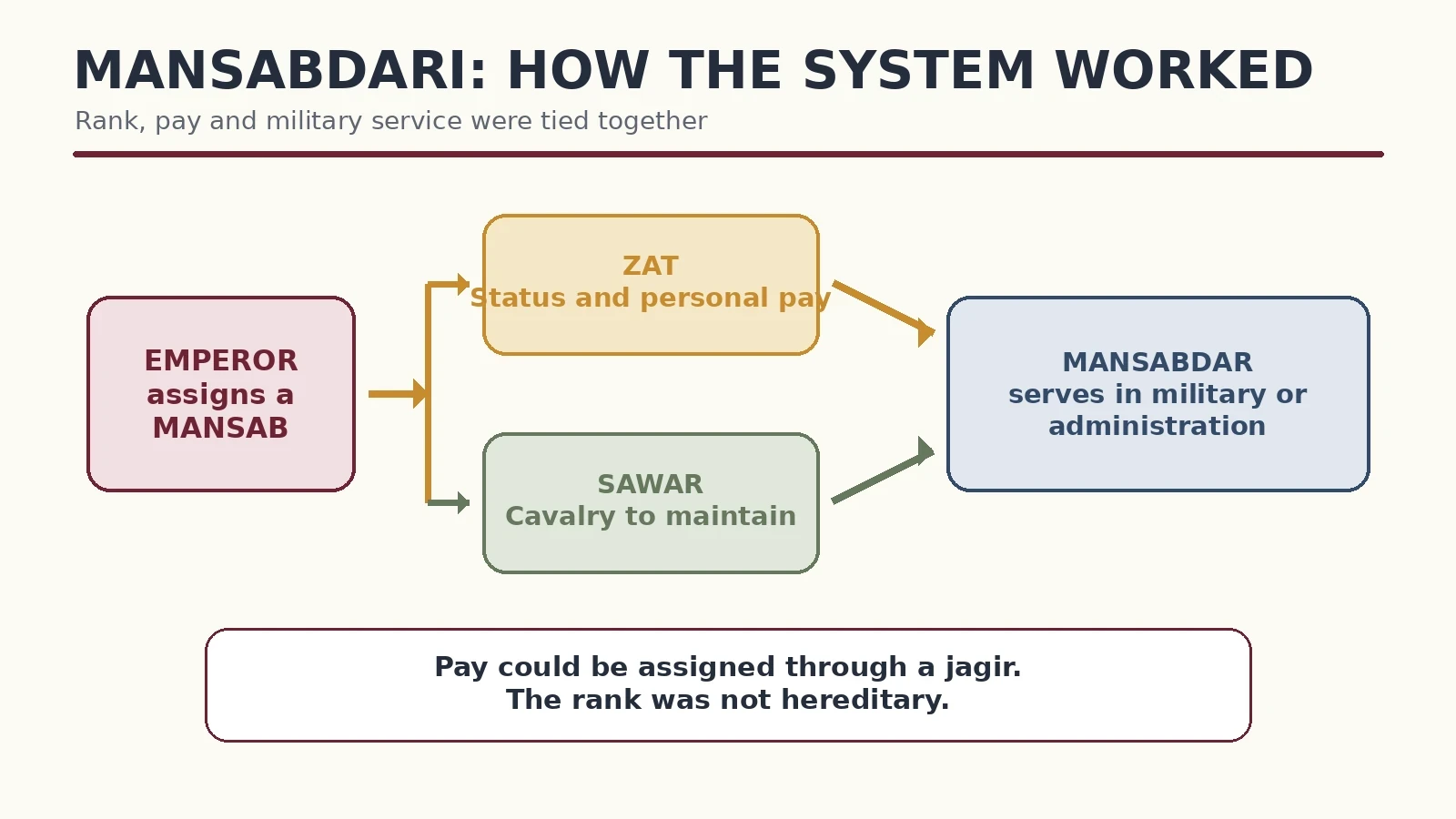
Mansabdari system: every officer held a numerical rank with two figures, zat fixing personal status and pay, and sawar fixing the cavalry he had to maintain
Dahsala or Zabti system, settled by Raja Todar Mal around 1580, fixing revenue on a ten-year average of produce and prices
Haldighati, 1576: Mughal forces under Raja Man Singh fought Maharana Pratap of Mewar. Mewar was not fully subdued, and Pratap held out until his death in 1597
Gujarat (1572), Bengal (1576), Kashmir (1586), Sindh (1591) and Kandahar (1595) annexed
His court included the Navaratnas, the nine gems, among them Abul Fazl, Faizi, Tansen, Birbal, Todar Mal and Man Singh.
Abul Fazl's Ain-i-Akbari and Akbarnama are the single most important sources for the period.
Jahangir, born Salim, inherited a stable Mughal Empire and mostly consolidated rather than expanded it.
Installed the zanjir-i-adl, a chain of justice at Agra Fort that any petitioner could pull
His memoir, the Tuzuk-i-Jahangiri, is a sharp observational record, strong on natural history and painting
Nur Jahan, whom he married in 1611, became the most powerful woman in Mughal political history. Coins were struck in her name and she effectively led a court faction with her father Itimad-ud-Daulah and brother Asaf Khan
Mewar submitted in 1615, settling a conflict Akbar could not finish
The English arrived: Captain William Hawkins in 1608 and Sir Thomas Roe, ambassador of James I, from 1615 to 1619, who secured trading rights at Surat
Two darker entries belong in a complete account. Guru Arjan Dev was executed in 1606 after supporting the rebel prince Khusrau, a turning point in Mughal-Sikh relations.
And the loss of Kandahar to Persia in 1622 was the first serious territorial reverse.
Painting reached its peak under Jahangir, who was a genuine connoisseur. Artists such as Ustad Mansur, Abul Hasan and Bishandas worked in a naturalistic style he personally directed.
Shah Jahan's reign is the architectural summit of the Mughal dynasty. Fiscally, it is where the Mughal Empire began to strain.
The Taj Mahal at Agra, built for Mumtaz Mahal, begun around 1632 and substantially complete by the early 1650s

Source: Taj Mahal, Agra. Photograph by Simon Steinberger, CC0.
Shahjahanabad, the new Delhi capital, with the Red Fort and the Jama Masjid
The Peacock Throne, later carried off by Nadir Shah in 1739
The Moti Masjid at Agra and extensive work at Lahore Fort
Beyond building, his reign saw costly and largely unsuccessful campaigns in Balkh and Badakhshan in Central Asia, and repeated failures to recover Kandahar. The Deccan campaigns continued.
He fell ill in 1657. His four sons fought. Aurangzeb won. Shah Jahan was imprisoned in Agra Fort from 1658 until his death in 1666, reportedly with a view of the Taj Mahal.
Aurangzeb ruled for forty-nine years, took the Mughal Empire to its greatest extent, and left it strained past recovery. Both halves of that sentence belong in any answer about him.

Source: Portrait of Emperor Aurangzeb, 17th century. The Metropolitan Museum of Art, CC0.
Expansion. He annexed Bijapur in 1686 and Golconda in 1687, and by 1690 the empire covered roughly 4 million square kilometres, from Kabul to the Kaveri.
Religious policy. He took the title Alamgir, reimposed the jizya in 1679, ended court music and painting patronage, and commissioned the Fatawa-i-Alamgiri, a vast compilation of Hanafi legal opinion.
Guru Tegh Bahadur was executed in 1675, which led to Guru Gobind Singh's founding of the Khalsa in 1699.
The Deccan trap. He spent the last 26 years of his life campaigning in the Deccan. The Marathas under Shivaji, crowned Chhatrapati in 1674, and after him Sambhaji and the Maratha confederacy, fought a guerrilla war the Mughal army was not built for.
Aurangzeb captured forts and could not hold the countryside. The campaigns drained the treasury, tied down the nobility, and produced what historians call a jagirdari crisis: more mansabdars than there was assigned land to pay them with.
He died at Ahmadnagar on 3 March 1707, aged 88, and is buried in a deliberately plain grave at Khuldabad.
The historiographical debate, worth knowing for Mains. The older view, associated with Jadunath Sarkar, treats his religious policy as the primary cause of decline.
Later historians, including Satish Chandra and M. Athar Ali, emphasise the jagirdari and mansabdari crisis and the structural impossibility of holding the Deccan. A strong answer presents both rather than picking one.
The Mughal administration is examined for its structure and its vocabulary, so learn the terms precisely. This machinery is what let the Mughal Empire function at continental scale.
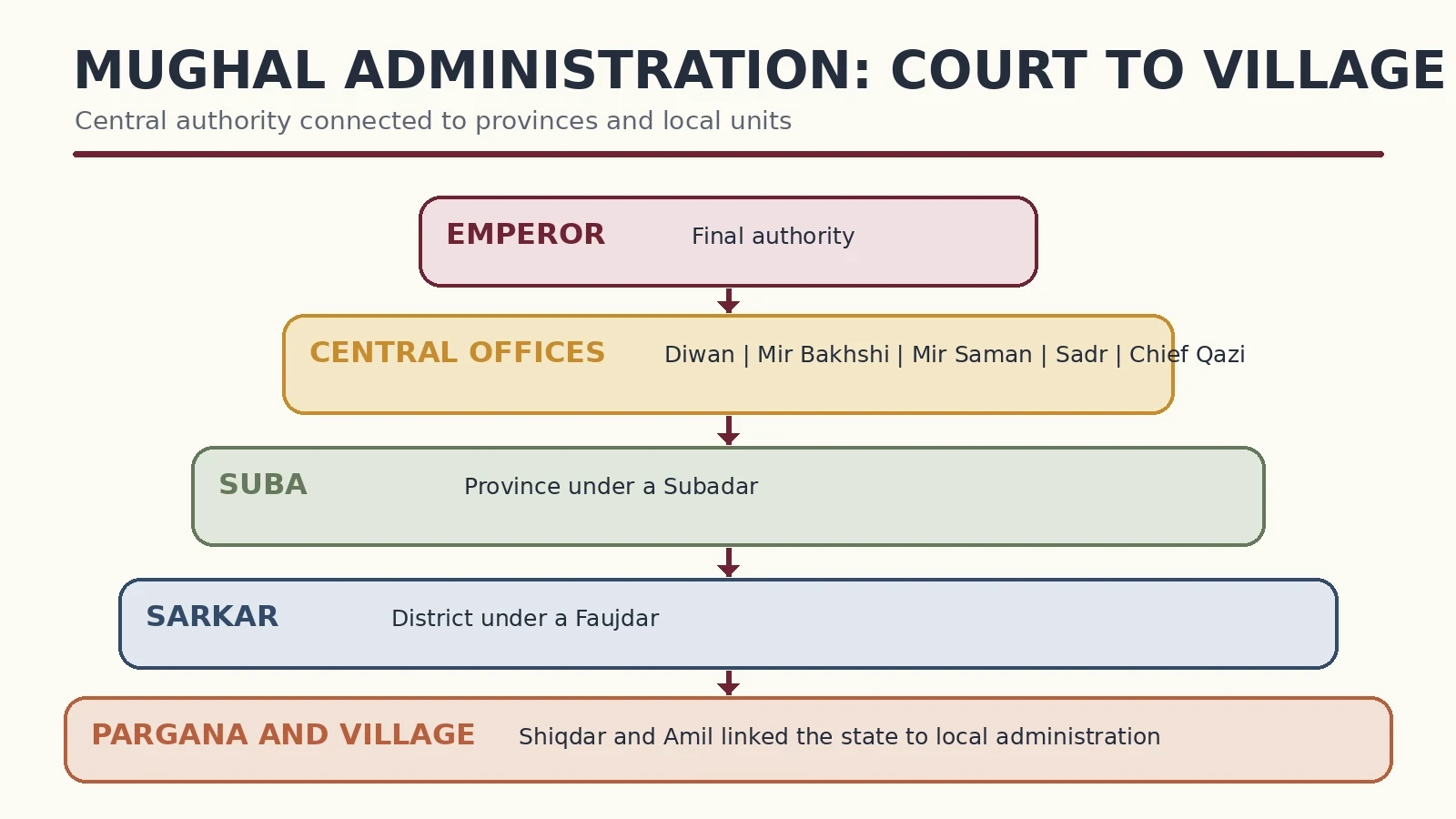
Central structure
Office | Responsibility |
Wazir / Diwan | Revenue and finance |
Mir Bakhshi | Military pay, mansab records, intelligence |
Mir Saman | Imperial household and karkhanas |
Sadr-us-Sudur | Religious endowments, charity, and judicial appointments |
Qazi-ul-Quzat | Chief judicial officer |
Provincial and local
Suba (province, under a subadar) → Sarkar (under a faujdar) → Pargana (under a shiqdar and amil) → Village. Akbar organised the empire into 12 subas, later expanded to about 21 under Aurangzeb.
The two systems that matter most
Mansabdari. Every noble held a rank expressed as zat and sawar. Zat set personal pay and status; sawar set the cavalry contingent he maintained.
Ranks were not hereditary, and on a mansabdar's death his property reverted to the state under the escheat practice.
The system gave the emperor direct control over the nobility, and it broke down when there were more mansabdars than jagirs.
Land revenue. Under the zabti or dahsala system, revenue was fixed in cash at roughly one-third of average produce, calculated on ten-year averages of yield and price.
Other methods were used where measurement was impractical: ghalla-bakhshi or crop-sharing, kankut by estimate, and nasaq.
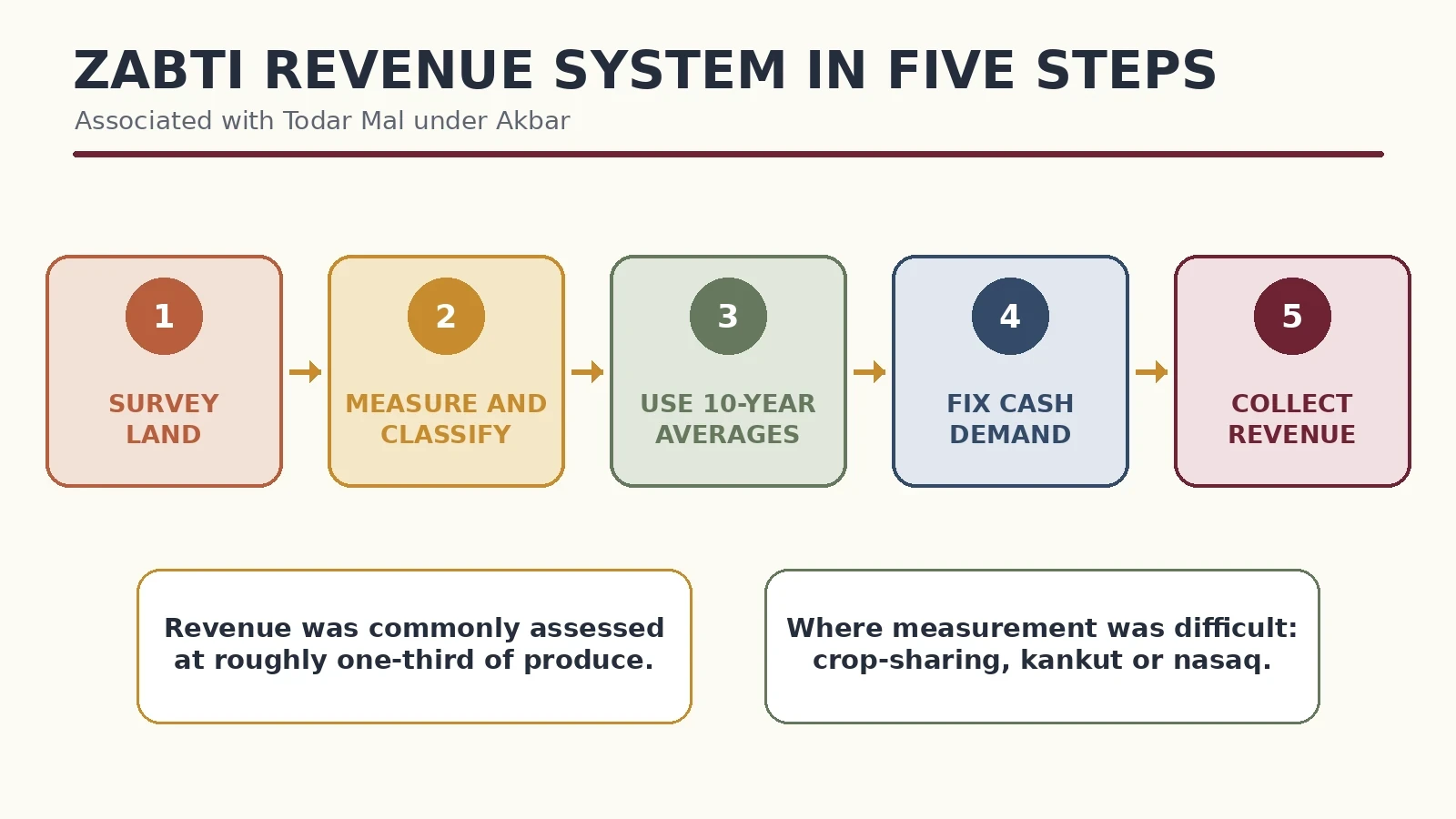
This structure is why the empire could function at all across four million square kilometres with seventeenth-century communications, and its collapse is inseparable from the empire's.
A part most notes skip, and it explains both the empire's strength and the European interest that eventually replaced it.
Land revenue was the state's spine. Roughly a third of agricultural produce, collected in cash, funded the entire military and administrative machine.
This is why revenue reform mattered so much: the zabti settlement was not accounting, it was the empire's power supply.
India was a manufacturing exporter, not an importer. Bengal muslin, Gujarati and Coromandel cottons, Bihar saltpetre, and indigo went west in volume.
Europe paid largely in silver bullion, because it had little the Mughal market wanted. That inflow of silver is what monetised the rural economy and made cash revenue collection possible at all.
The karkhanas, imperial workshops under the Mir Saman, produced textiles, weapons, jewellery and manuscripts for the court, and set standards that spread outward into commercial production.
Surat was the principal western port and the hajj embarkation point, which is one reason its loss of security mattered politically as well as commercially. Shivaji sacked it in 1664 and again in 1670, and the humiliation was felt in Delhi.
The vulnerability is visible in hindsight. An economy this rich, taxed this heavily, with a coastline the empire never seriously defended by sea, was an obvious target. The Mughals had no navy worth the name. The English and the Portuguese did.
You will see a figure claiming the Mughal Empire produced about a quarter of world GDP. It comes from Maddison-style reconstructions, it is an estimate built on thin data, and it is disputed. Use it only with that attribution attached.
Mughal art, architecture and literature are a reliable source of Prelims questions, usually on attribution: which building, which emperor, which text. This is the Mughal Empire's most visible legacy.
Architecture
Monument | Built by |
Humayun's Tomb, Delhi | Hamida Banu Begum, for Humayun |
Fatehpur Sikri, Buland Darwaza, Panch Mahal | Akbar |
Akbar's Tomb, Sikandra | Begun by Akbar, completed by Jahangir |
Itimad-ud-Daulah's Tomb, Agra | Nur Jahan, for her father |
Taj Mahal, Red Fort, Jama Masjid, Moti Masjid | Shah Jahan |
Bibi ka Maqbara, Aurangabad; Badshahi Mosque, Lahore | Aurangzeb's reign |
The style fuses Persian form with Indian material and detail: the charbagh garden, the bulbous dome, pietra dura inlay, and a shift from Akbar's red sandstone to Shah Jahan's white marble. Itimad-ud-Daulah's tomb is often called the "Baby Taj" because it is the first Mughal building in full marble with pietra dura, predating the Taj.
Painting
Mughal miniature painting began with Humayun bringing Persian masters Mir Sayyid Ali and Abd-us-Samad from Persia. It peaked under Jahangir and declined under Aurangzeb, whose withdrawal of patronage pushed artists into regional courts, seeding the Rajput and Pahari schools.
Literature
Persian was the court language throughout. Key texts: the Baburnama (Chagatai), Humayun-nama by Gulbadan Begum, Akbarnama and Ain-i-Akbari by Abul Fazl, Tuzuk-i-Jahangiri, Padshahnama by Abdul Hamid Lahori, and Dara Shikoh's Sirr-i-Akbar. Akbar's translation bureau rendered the Mahabharata into Persian as the Razmnama.
A map of Mughal Empire territory is worth studying in four snapshots, because the shape of the empire changes the story of the Mughal period more than any date does.
Year | Extent |
1530 | Kabul, Punjab, the Ganga-Yamuna doab, Agra and Delhi |
1605 | North India from Kabul to Bengal, plus Gujarat, Kashmir, Sindh, northern Deccan |
1658 | Consolidated north, deeper into the Deccan |
1690 | Peak, about 4 million sq km, from Kabul to the Kaveri |
Two features explain most Mughal military history. The north-west frontier was where the dynasty came from and where invasions kept arriving, from Nadir Shah in 1739 to Ahmad Shah Abdali.
And the Deccan was never really held. Every emperor from Akbar onwards campaigned there, and it eventually consumed the empire.
The Mughal Empire flag was the alam, and it was not a national flag in the modern sense at all.
Primarily moss green
Displayed a lion and a sun, the Sher-o-Khurshid, facing the hoist
The Mughals traced the alam back to Timur, which is the point: it was a dynastic standard, not a state emblem
It was displayed to the right of the throne, at the entrance to the emperor's camp, and carried before him on the march
Depictions vary. The Padshahnama, the chronicle of Shah Jahan's reign held at Windsor, shows both scarlet pennons with green borders and green fields, each with a lion and rising sun.
The nuance worth carrying into an answer: pre-modern empires did not have fixed national flags. The alam marked the emperor's presence, not a country's identity.
Reading it as a "national flag" imports a nineteenth-century idea into a sixteenth-century one.
The decline of Mughals is a standard Mains question, and it needs causes grouped rather than listed. No single failure brought the Mughal Empire down.
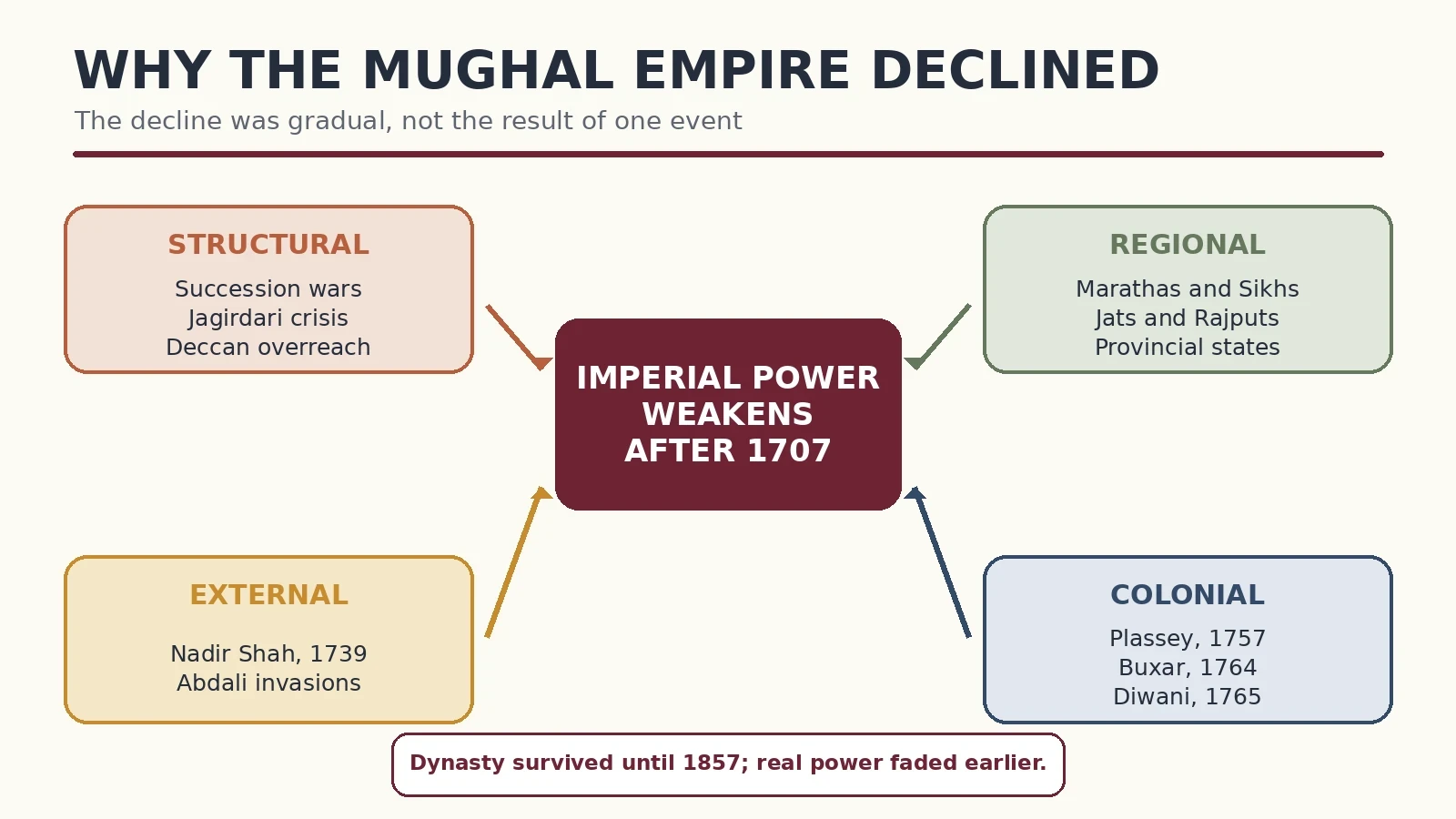
Structural
The jagirdari crisis: too many mansabdars, too little assignable land
No law of succession, so every transition produced a civil war
Over-extension into the Deccan, militarily and financially
Political
Maratha expansion under the Peshwas across the Deccan and into north India
Regional powers becoming independent in all but name: Bengal, Awadh, Hyderabad
Rajput, Sikh and Jat resistance in the north
External
Nadir Shah, 1739: Karnal, the sack of Delhi, and the loss of the Peacock Throne and the Koh-i-Noor
Ahmad Shah Abdali's repeated invasions from 1748
Colonial
Plassey, 1757 and Buxar, 1764
The Treaty of Allahabad, 1765, under which Shah Alam II granted the Diwani of Bengal, Bihar and Odisha to the East India Company, making it the revenue authority in the richest province
The last emperor of Mughal India
Bahadur Shah II, known as Zafar, came to the throne in 1837 as a pensioner of the East India Company, a poet whose writ barely extended past the Red Fort.

Source: Robert Tytler and Charles Shepherd, Bahadur Shah Zafar, May 1858. Public domain/British Library.
In May 1857 the rebel sepoys who reached Delhi proclaimed him Shahenshah-e-Hindustan, giving the revolt a legitimising figurehead. He was eighty-two and had no army of his own.
Delhi fell on 21 September 1857. Zafar was captured at Humayun's Tomb, tried by a military commission, and exiled to Rangoon on 7 October 1858, where he died on 7 November 1862. Several of his sons were shot without trial by Major William Hodson.
With that, a dynasty founded on a battlefield in 1526 ended in a courtroom 331 years later.
The Mughal Empire sits in GS Paper I under medieval Indian history and the art and culture syllabus, and it is among the most heavily examined topics in the whole period.
Prelims tests attribution and pairing:
Which emperor built which monument
Which text was written by whom, and in which language
Administrative terms: zat, sawar, zabti, jagir, mansab, suba, faujdar
Battles with years and opponents
Who abolished and who reimposed jizya
Mains asks judgement:
The causes of decline, weighing religious policy against structural crisis
Akbar's religious policy and whether sulh-i-kul was conviction or statecraft
The mansabdari system's strengths and its built-in failure
Mughal contributions to composite culture
The single most useful revision habit here is a one-page attribution table: emperor, monument, text, administrative innovation, key battle.
Build it once and revise it monthly. Pull past questions by topic from our previous year questions, and structure Mains answers the way our guide to UPSC Mains answer writing practice sets out.
For the contemporary southern picture, which UPSC often pairs with Mughal questions, see the Vijayanagar Empire, and the rest of the period sits on the medieval history hub. NCERT's medieval India volume remains the base text; our NCERT book list covers the sequence.
Frequently asked question (FAQs)
Who founded the Mughal Empire and when?
Who was the last emperor of Mughal India?
Why did the Mughal Empire decline?
What is the difference between the zat and sawar ranks?
What did the Mughal Empire flag look like?


Gajendra Singh Godara
Ex-UPSC Aspirant | Exam Preparation Expert
Gajendra Singh Godara is an IIT Bombay graduate and a UPSC aspirant with 4 attempts, including multiple Prelims and Mains appearances. He specializes in Polity, Modern History, International Relations, and Economy. At PadhAI, Gajendra leverages his firsthand exam experience to simplify complex concepts, creating high-efficiency study materials that help aspirants save time and stay focused.

No comments yet. Be the first to join the discussion!