UPSC Direct Recruitment 2026: Vacancy & Apply Online
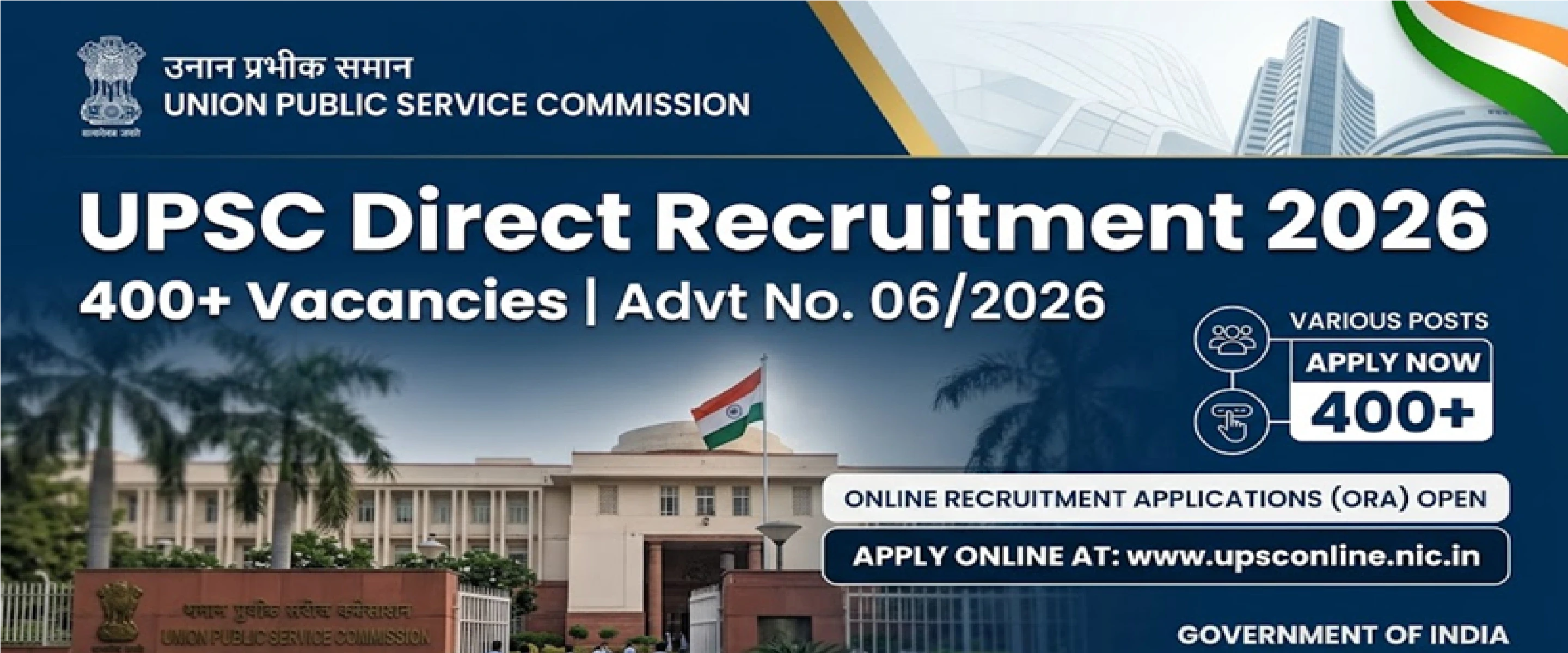
UPSC Direct Recruitment 2026 (Advt No. 06/2026) offers 400+ vacancies across 98 Group A and B posts in central government ministries. Applications are open on the ORA portal from 13 June to 3 July 2026. This guide covers vacancy details, eligibility, age relaxation, the interview-based selection process, and how to apply.

Last updated
Key Highlights
Particulars | Details |
Recruiting Body | Union Public Service Commission (UPSC) |
Advertisement No. | 06/2026 |
Notification Date | 12 June 2026 |
Total Vacancies | 400+ (across 98 posts) |
Application Start Date | 13 June 2026 |
Last Date to Apply | 3 July 2026 (6:00 PM) |
Mode of Application | Online via ORA portal |
Official Portal | upsconline.nic.in/ora |
Post Type | Group A and Group B Gazetted |
Selection Method | Shortlisting + Interview (Recruitment Test if needed) |
Application Fee | Rs. 25 (exempt for SC/ST/PwBD/Women) |
Service Liability | Pan-India |
If you are a working professional, a fresh postgraduate, or a specialist looking to join the central government without sitting through the Civil Services Examination, the UPSC Direct Recruitment 2026 is the opportunity to watch right now.
The Union Public Service Commission has released Advertisement No. 06/2026, opening more than 400 vacancies across 98 different posts in central government ministries, departments, and Union Territory administrations.
The biggest thing to understand: this is not the IAS or IPS exam. UPSC Direct Recruitment fills specialist and technical posts based on your qualifications and experience, not on a written competitive exam in every case.
That makes it a realistic route into government service for doctors, engineers, scientists, lawyers, professors, and administrators.
This blog walks you through the full UPSC direct recruitment notification: vacancy details, eligibility, age relaxation rules, the interview-based selection process, application fee, and a clear step-by-step guide on how to apply before the 3 July 2026 deadline.
UPSC Direct Recruitment is a method through which the Union Public Service Commission fills specialist, technical, scientific, medical, and academic posts in the central government by direct selection, rather than through a large competitive written examination.
The Commission derives its authority from Article 315 of the Constitution of India, which establishes the Union Public Service Commission as the central recruiting agency for the Government of India.
Under this mandate, UPSC conducts recruitment by selection to Group A and Group B Gazetted posts across central ministries, scientific organisations, regulatory bodies, and the Central Health Services.
The 2026 cycle, notified under Advertisement No. 06/2026, is one of the most expansive direct recruitment drives of the year.
It covers more than 400 vacancies across 98 posts spread across multiple government bodies.
How Is Direct Recruitment Different from the Civil Services Exam?
This is the single most common confusion among aspirants, so let us settle it clearly.
Feature | Civil Services Exam (CSE) | UPSC Direct Recruitment |
Posts filled | IAS, IPS, IFS and allied services | Specialist, technical, scientific, medical, academic |
Selection basis | Prelims + Mains + Interview | Qualification + experience + interview |
Written exam | Mandatory, multi-stage | Often none (Recruitment Test only if applications are very high) |
Eligibility | Bachelor's degree in any discipline | Specific degree, experience, and skills per post |
Who should apply | General graduates aiming for civil services | Working professionals and specialists |
In short, the Civil Services Exam is for those who want to become an IAS or IPS officer through a rigorous exam.
UPSC Direct Recruitment is for qualified professionals who want a central government post matching their specialisation, selected mainly on merit of qualification and experience.
Join our WhatsApp Community
The UPSC direct recruitment notification 2026 covers 98 distinct posts. While the exact total has been reported as 400-plus across sources (with some listings citing higher figures), the official Advertisement No. 06/2026 remains the definitive reference for the precise post-wise count.
The vacancies span engineering, aviation, scientific research, administration, law, healthcare, education, and technical roles.
Major Vacancies in UPSC Direct Recruitment 2026
Post | Department / Ministry | Approx. Vacancies |
Specialist Grade-III (medical) | Ministry of Health and Family Welfare | 121 |
Assistant Director Grade-II (Economic) | Ministry of MSME | 50 |
Assistant Professor (various) | Ministry of Defence (CME, Pune) | ~40-50 |
Junior Scientific Officer | Various central departments | As per notification |
Operations Officer / Air Safety Officer | DGCA | As per notification |
Scientist 'B' | CFSL (Forensic Science) | As per notification |
Assistant Public Prosecutor | CBI | As per notification |
Administrative / Technical / Healthcare | UT of Ladakh | As per notification |
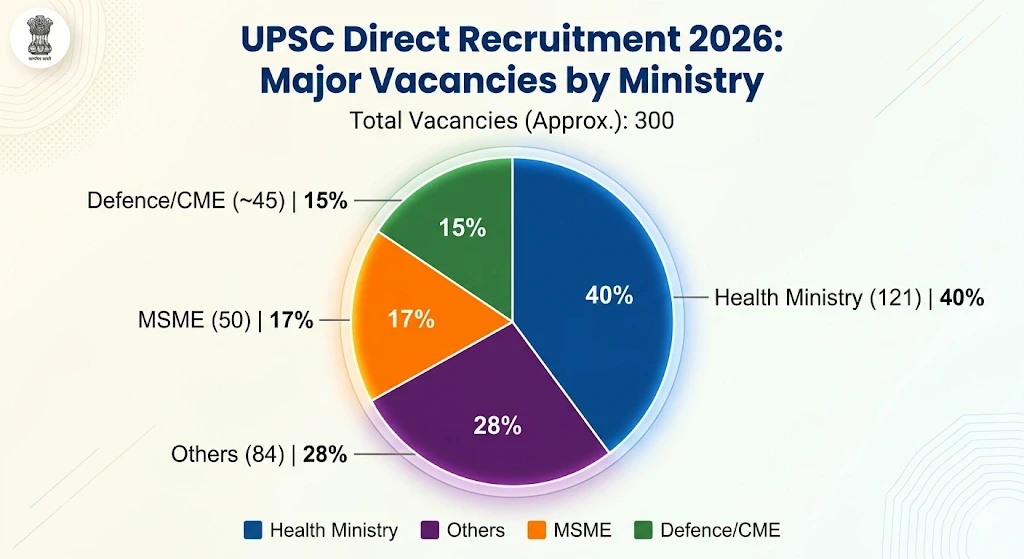
The largest single block of vacancies sits in the Ministry of Health and Family Welfare, with 121 Specialist Grade-III medical positions.
The next biggest are 50 Assistant Director Grade-II (Economic) posts under MSME, followed by Assistant Professor roles at the College of Military Engineering, Pune, under the Ministry of Defence.
A note on the numbers: because UPSC bundles many posts into a single advertisement, vacancy counts reported by different portals vary slightly.
Always confirm the exact figure for your target post in the official notification PDF on upsconline.nic.in before applying.
Mark these dates carefully. The application window is short, and UPSC does not usually extend deadlines.
Event | Date |
Notification Release (Advt No. 06/2026) | 12 June 2026 |
Online Application Start Date | 13 June 2026 |
Last Date to Apply Online | 3 July 2026 (6:00 PM) |
Last Date for Fee Payment | 3 July 2026 |
Mode of Application | Online (ORA portal only) |
The most important rule here: applications close at 6:00 PM on 3 July 2026. Server congestion is common in the final hours of any UPSC recruitment, so submit your application well before the deadline rather than on the last evening.
Add as a preferred Source on Google
Eligibility for the UPSC direct recruitment varies from post to post, because each of the 98 posts has its own qualification and experience requirement.
That said, the broad framework is consistent.
Educational Qualification
The required degree depends entirely on the post. Common requirements across the 98 posts include:
For medical posts (Specialist Grade-III): a recognised medical degree (MBBS plus a postgraduate qualification in the relevant specialty), with the qualification listed in the appropriate Schedule of the relevant Act.
For engineering posts: a degree in the relevant engineering branch.
For scientific posts (Scientist 'B'): a Master's degree or higher in the relevant science discipline.
For teaching posts (Assistant / Associate Professor): a postgraduate degree with the qualifications prescribed by the relevant regulatory body.
For legal posts (Assistant Public Prosecutor): a law degree with the prescribed years of practice or experience.
Candidates must read the specific post requirement in Advertisement No. 06/2026, because applying without the exact qualification leads to rejection at the scrutiny stage.
Experience Requirement
Many UPSC direct recruitment posts require a minimum number of years of relevant professional experience.
This is a key difference from the Civil Services Exam, which has no experience requirement. The exact experience demanded is listed against each post in the notification.
Nationality
Candidates must generally be Indian citizens. Some posts allow subjects of Nepal, Bhutan, or certain other categories as specified, but a candidate must be eligible to be appointed under the rules for that specific post.
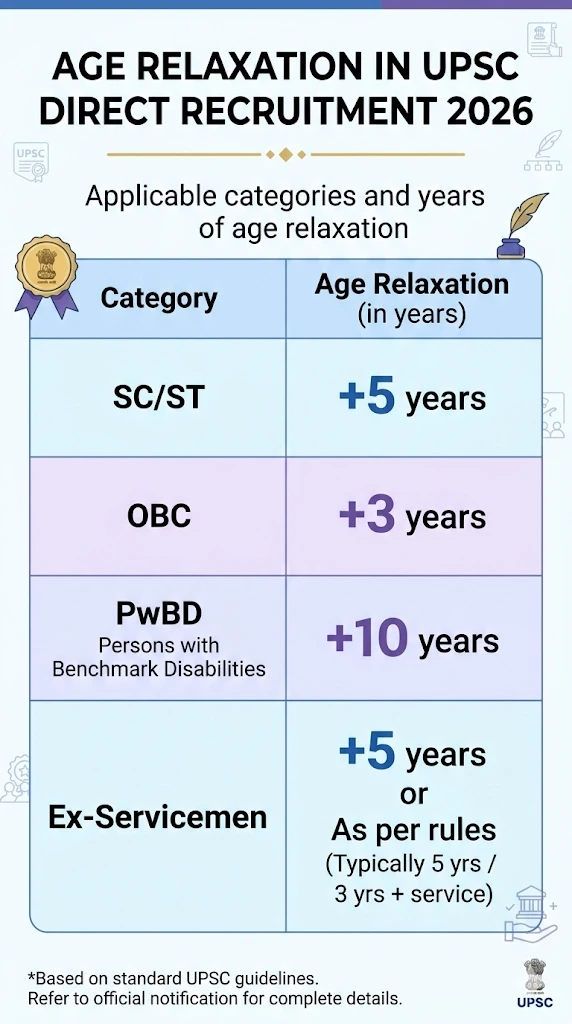
Age relaxation rules in the direct recruitment of UPSC follow central government norms. The standard relaxations over the upper age limit are:
Category | Age Relaxation |
SC / ST | 5 years |
OBC (non-creamy layer) | 3 years |
Persons with Benchmark Disability (PwBD) | Up to 10 years (over and above category relaxation) |
Ex-Servicemen | As per government rules |
Central Government servants | Up to 5 years for departmental candidates (per rules) |
The PwBD relaxation of up to 10 years applies across posts where a vacancy is reserved or identified for persons with benchmark disability, and it is granted in addition to any category-based relaxation a candidate is otherwise entitled to.
A practical tip on age relaxation in direct recruitment of UPSC: the relaxation applies to the upper age limit specified for each post.
Since different posts carry different upper age limits, always calculate your eligibility against the specific post you are applying for, not a general figure.
The application fee for UPSC direct recruitment is modest and is paid online.
Category | Application Fee |
General / OBC / EWS (male) | Rs. 25 |
SC / ST | Exempted (Rs. 0) |
Persons with Benchmark Disability (PwBD) | Exempted (Rs. 0) |
All Women candidates | Exempted (Rs. 0) |
Fee payment is made online through Net Banking, Visa/Master/RuPay Credit or Debit Card, or UPI, or by cash deposit at any branch of the State Bank of India using the system-generated pay-in-slip. Always confirm the exact payment options in the notification.
The selection process for UPSC direct recruitment is different from the multi-stage Civil Services Examination, and understanding it helps you prepare the right way.
Step 1: Scrutiny and Shortlisting
UPSC first scrutinises all applications against the eligibility criteria for each post. Candidates who do not meet the exact qualification or experience requirement are filtered out at this stage.
Step 2: Shortlisting Criteria (If Applications Are High)
When the number of applications for a post is very large, the Commission may shortlist candidates using additional filters.
The notification specifically allows UPSC to shortlist using desirable qualifications, higher educational qualifications, higher or more relevant experience, or by conducting a Recruitment Test.
This means that even though the standard route is selection by interview, a Recruitment Test can be introduced for posts that attract heavy competition.
Keep an eye on the UPSC ORA portal for any such announcement for your post.
Step 3: UPSC Direct Recruitment Interview
The final and most important stage for most posts is the interview, also called the personality test or selection interview.
Shortlisted candidates are called to UPSC's office at Dholpur House, New Delhi, for a face-to-face interview before a selection board.
The UPSC direct recruitment interview assesses your domain knowledge, professional experience, problem-solving ability, communication, and suitability for the specific role.
Unlike the Civil Services personality test, this interview is heavily focused on your technical and professional expertise in the post you applied for.
Step 4: Final Selection and Recommendation
Based on the interview (and Recruitment Test marks, where applicable), UPSC prepares the final merit list and recommends candidates for appointment.
The recommended candidate then undergoes document verification and joins the respective ministry or department.
The entire application process is online through the ORA portal. Here is the step-by-step guide.
Step 1: Visit the ORA portal. Go to upsconline.nic.in/ora.
Step 2: Complete One-Time Registration (OTR). If you have not registered on the new UPSC portal before, create your OTR profile with your basic details. This profile is reusable across UPSC recruitments.
Step 3: Log in and find the advertisement. Log in with your OTR credentials and locate Advertisement No. 06/2026 in the active list.
Step 4: Select your post. Choose the specific post you are eligible for and qualified for. You must submit a separate application for each post you wish to apply for.
Step 5: Fill the application form. Enter your educational qualifications, accurate personal details, and complete work experience exactly as per your documents.
Step 6: Upload documents. Upload clean, scanned copies of your photograph, signature, and the certificates required for the post.
Step 7: Pay the fee. Pay Rs. 25 online (if applicable; SC/ST/PwBD/Women are exempt).
Step 8: Submit and save. Review every entry carefully, submit the form, and download and print the final application for your records.
A practical reminder: you can apply for more than one post if you meet the eligibility for each, but each requires a separate application through the ORA portal.
Mandatory Face Authentication
For UPSC Direct Recruitment 2026, candidates must undergo mandatory face authentication at the examination venue or interview hall.
Reach the venue well in time for identity verification and frisking, and carry a valid photo ID along with your admit card or interview call letter.
Documents Required for UPSC Direct Recruitment 2026
Keep the following ready in scanned format before you start the application:
Recent passport-size photograph and scanned signature
Matriculation / Class 10 certificate (for date of birth proof)
Degree and postgraduate certificates as required for the post
Experience certificates from employers
Caste / category certificate (SC / ST / OBC / EWS), if applicable
PwBD certificate, if applicable
Any registration certificate required for the post (for example, medical or legal council registration)
Having these prepared in the correct format and size prevents upload errors and last-minute rejection.
Why UPSC Direct Recruitment Matters: Benefits and Trade-Offs
UPSC direct recruitment offers a genuine path into central government service, and it is worth weighing both the advantages and the realities.
The benefits are clear: a permanent central government appointment, structured pay under the 7th Central Pay Commission, professional recognition, and long-term career stability with promotion through cadre seniority.
For specialists, it is often the only UPSC route that values their professional experience directly.
The honest trade-off is service liability. Most posts carry pan-India transferability, meaning you may be posted anywhere in India.
Medical posts can include a Defence service liability of up to four years. Candidates should consider these realities before applying, and pick posts that match both their qualifications and their long-term plans.
A focused strategy works better than applying everywhere. UPSC values quality over quantity, so strong academic credentials, relevant experience, and a clear understanding of the role you apply for significantly improve your selection chances.
UPSC Direct Recruitment 2026: Quick Revision Table
Aspect | Summary |
Advertisement | No. 06/2026, dated 12 June 2026 |
Vacancies | 400+ across 98 posts |
Application window | 13 June to 3 July 2026 (6 PM) |
Portal | upsconline.nic.in/ora |
Biggest block | 121 Specialist Grade-III (Health Ministry) |
Selection | Shortlisting + interview (Recruitment Test if needed) |
Fee | Rs. 25 (exempt: SC/ST/PwBD/Women) |
Constitutional basis | Article 315 of the Constitution |
Service liability | Pan-India; medical posts may have Defence liability |
Frequently asked question (FAQs)
What is UPSC Direct Recruitment 2026 and how is it different from the IAS exam?
What is the last date to apply for UPSC Direct Recruitment 2026?
What is the age relaxation in direct recruitment of UPSC?
How does the UPSC direct recruitment interview work?
Can I apply for more than one post in UPSC Direct Recruitment 2026?
UPSC Direct Recruitment 2026 is one of the most accessible routes into central government service for qualified professionals who do not want to take the full Civil Services Examination.
With 400-plus vacancies across 98 posts, ranging from medical specialists and scientists to engineers, professors, and legal officers, there is genuine breadth here for the right candidates.
The keys to success are simple. Apply only for posts that match your exact qualifications and experience.
Read Advertisement No. 06/2026 carefully for post-specific requirements. Submit your ORA application well before the 3 July 2026 deadline.
Prepare seriously for the interview, since it is the decisive stage for most posts.
Always verify the latest details, including the exact vacancy count for your target post and any Recruitment Test announcements, directly on the official UPSC portal at upsconline.nic.in before applying.




No comments yet. Be the first to join the discussion!