Maiya Samman Yojana 2026: Eligibility, Apply & Status Check

Gajendra Singh Godara
11
mins read
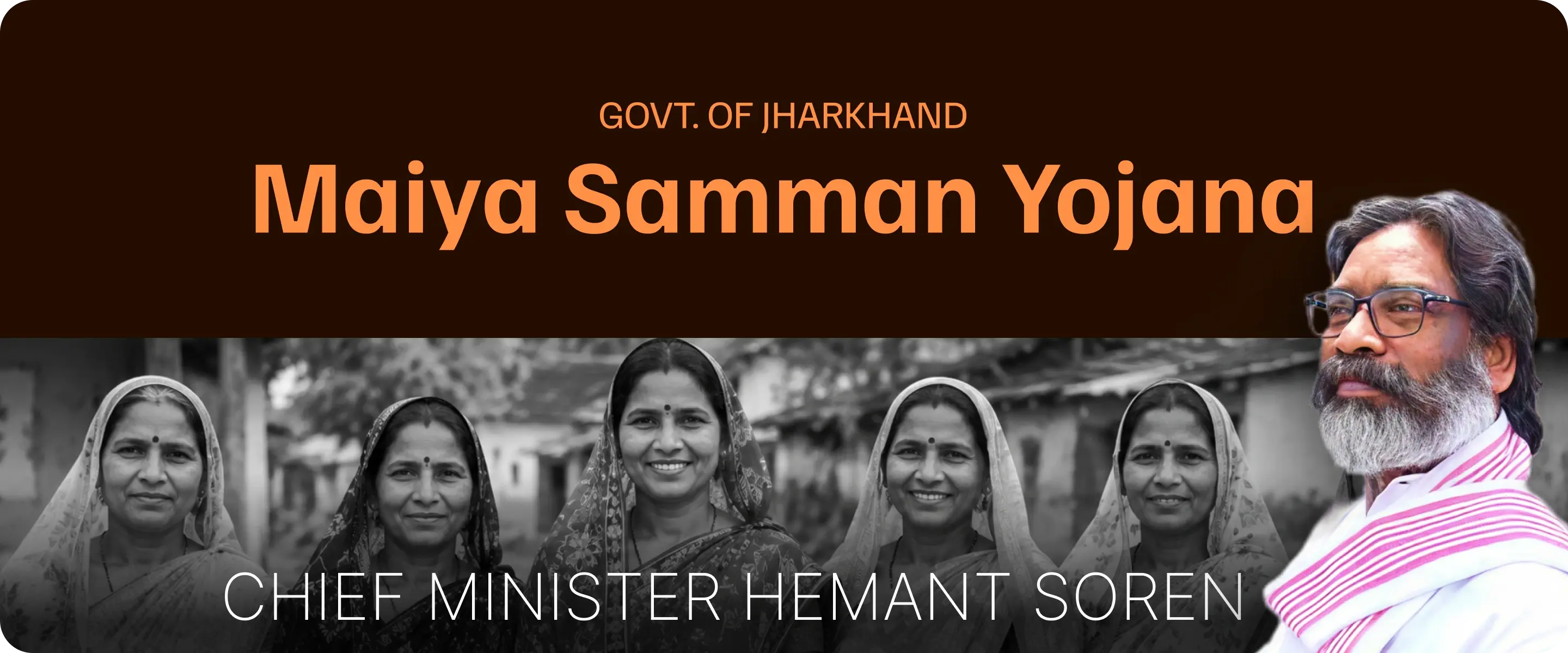
The Jharkhand government’s cash transfer scheme Maiya Samman Yojana gives eligible women ₹2,500 per month directly into their Aadhaar-linked bank account.
Officially called Mukhyamantri Maiya Samman Yojana, it started in August 2024 at ₹1,000 a month and was raised to ₹2,500 in December 2024.
By mid-2026 it covers around 56 lakh women, which makes it one of the largest women-focused welfare programmes any Indian state has ever attempted.
If you are preparing for UPSC or a state PCS, this is exactly the kind of scheme that shows up in Prelims as a one-liner and in Mains as a debate about welfare, state finances, and women's empowerment.
If you or someone in your family is a beneficiary, you also need the practical bits: how to apply, how to check status, and what the new verification rule means for your payment. This guide covers both sides.
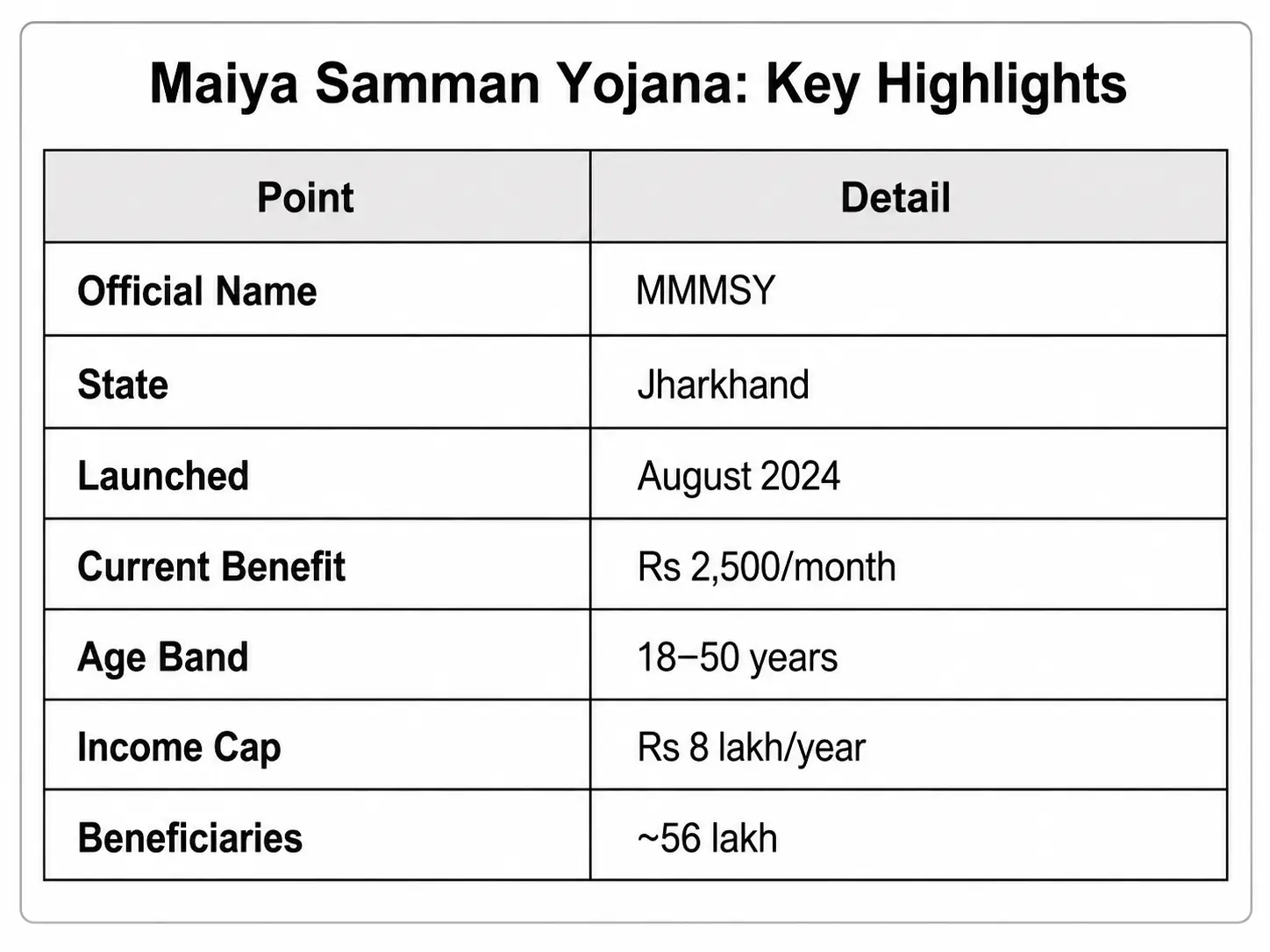
Point | Detail |
Official name | Mukhyamantri Maiya Samman Yojana (MMMSY) |
Official portal | |
State | Jharkhand |
Launched | August 2024 |
Monthly benefit | ₹2,500 (₹30,000 per year) |
Age band | 18 to 50 years |
Family income cap | Up to ₹8 lakh per year |
Mode of payment | Direct Benefit Transfer to Aadhaar-linked bank account |
Beneficiaries | About 56 lakh (mid-2026) |
Estimated annual outgo | Roughly ₹15,000 to ₹17,000 crore |
Application mode | Offline camps and Anganwadi centres, online verification |
Helpline | 181 |
Join our WhatsApp Community
Maiya Samman Yojana is an income support scheme for women in Jharkhand. The idea is simple.
Every eligible woman aged 18 to 50 gets a fixed ₹2,500 in her own bank account each month, no strings attached.
She can spend it on food, her children's school fees, medicines, or whatever the household needs most. The money is hers to decide.
The scheme is run by the Department of Women, Child Development and Social Security, Government of Jharkhand.
The actual work on the ground is done by Anganwadi workers, Panchayat secretaries, and Block Development Officers, while the money moves through the Direct Benefit Transfer (DBT) system so it lands in the bank account without any middleman taking a cut.
A small point on the name, since it confuses people. You will see it written as Maiya Samman, Mainiyan Samman, or Mंईयां Samman.
These are all the same scheme. "Maiya" means mother, and the scheme is meant to honour and support the woman of the house.
On the central myScheme portal it is listed under the code JMMSY, short for Jharkhand Mukhyamantri Maiya Samman Yojana.
Why the amount jumped from ₹1,000 to ₹2,500
This part matters for both beneficiaries and exam answers. When the scheme launched in August 2024, it paid ₹1,000 a month.
The first few installments reached women just before the November 2024 Jharkhand Assembly election.
The ruling JMM-led alliance promised that if voted back, it would raise the amount to ₹2,500.
The alliance won 56 seats, returned to power under Chief Minister Hemant Soren, and kept the promise.
From December 2024, the monthly payment became ₹2,500, and arrears were credited in some cases.
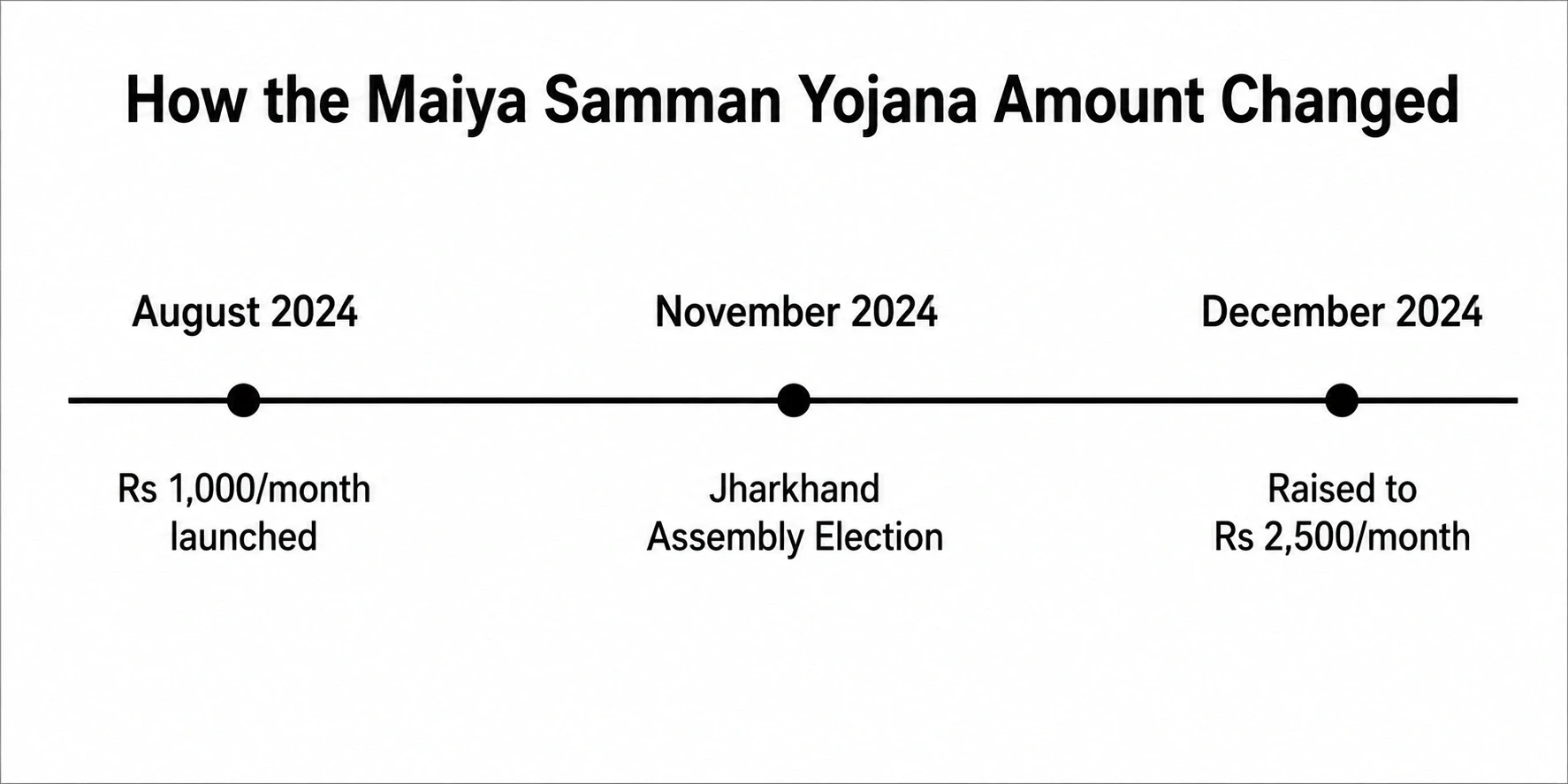
That timeline is why analysts treat the scheme as a textbook example of welfare that also worked as a political tool. We will come back to that debate in the UPSC section.
A woman qualifies for the Jharkhand Mukhyamantri Maiya Samman yojana only if she meets every condition below, not just some of them.
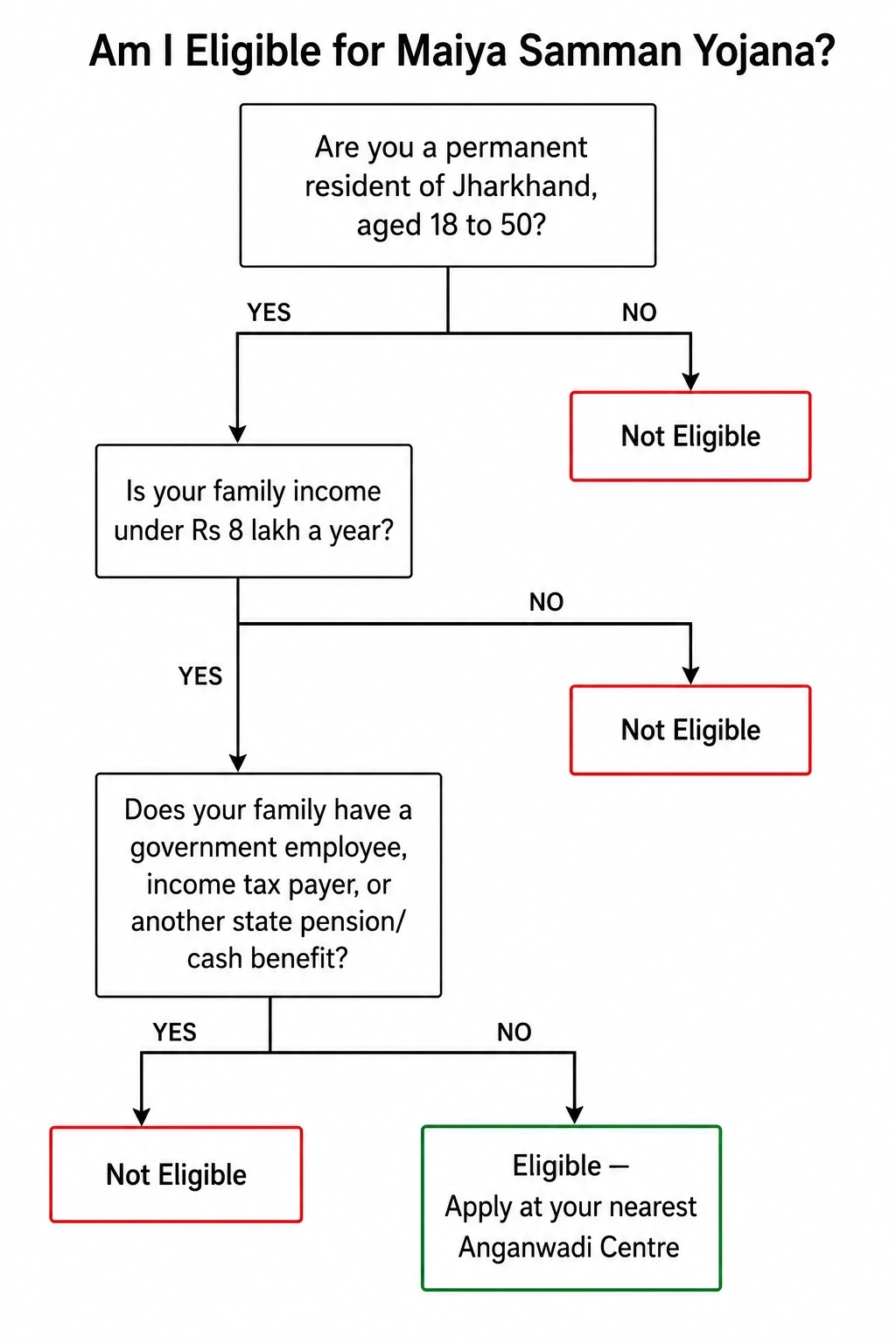
Condition | What it means |
Residence | Must be a permanent resident of Jharkhand, with a valid domicile or ration card in the state |
Age | Between 18 and 50 years |
Income | Family income should not cross ₹8 lakh per year |
Documents | Must have Aadhaar, a ration card, and an Aadhaar-linked bank account |
No double benefit | Should not already receive a similar cash or pension benefit from another government scheme |
Who is not eligible
Some families are kept out by design, so the money reaches those who need it more:
Women whose family member pays income tax
Women whose family has a permanent central or state government employee (Group A, B, or C)
Women already drawing another state pension or cash transfer
Women who are not residents of Jharkhand
A quick nuance here. The ₹8 lakh income cap is self-declared at the time of applying, and the income-tax filter is the main check that backs it up.
That gap between what you declare and what gets verified is one of the criticisms of the scheme, and it is a useful point to remember for a Mains answer on targeting.
Add as a preferred Source on Google
The benefit is straightforward: ₹2,500 a month, which adds up to ₹30,000 a year. A few things are worth knowing about how it actually works:
The payment usually reaches accounts around the middle of each month, though the government does not publish a fixed calendar date.
It comes through DBT, so it goes directly to the woman's own Aadhaar-linked account. No agent, bank staff member, or Panchayat official is supposed to take any share.
Payment continues up to age 50. After that, the state's old-age and widow pension schemes are meant to take over.
You get an SMS on your registered mobile number when the money is credited.
One thing trips up a lot of beneficiaries. The money is sent to the account that is seeded with your Aadhaar through NPCI, not simply the account number you wrote on the form.
If your Aadhaar is linked to an old or inactive account, the payment can fail even when every detail looks correct on paper. This single issue causes most of the "paisa nahi aaya" complaints.
Here is where expectations need a reality check. Despite the popularity of the search term Maiya Samman yojana online apply, the scheme is mostly an offline-first programme.
Applications are collected through special camps, Anganwadi centres, Panchayat Bhavans, and Pragya Kendras (CSCs), with the verification handled digitally on the back end.
The portal mmmsy.jharkhand.gov.in is used mainly to check status and view lists, not to submit a fresh form from home.
Documents you need to keep ready
Aadhaar card
Ration card (green, pink, or yellow)
Bank passbook of an Aadhaar-linked account
Passport-size photograph
Residence or domicile proof
A self-declaration of family income
Step-by-step application
Wait for the camp announced by your Panchayat or visit your nearest Anganwadi centre.
Collect the Mukhyamantri Maiya Samman Yojana form.
Fill in your name, date of birth, Aadhaar number, ration card number, and bank details.
Attach self-attested copies of the documents listed above.
Submit the form to the camp officer and collect the acknowledgement slip. Do not leave without it. That slip is what you use later to track your application.
The Block Development Officer verifies the form.
Once approved, your payment starts from the next disbursement cycle.
Use only mmmsy.jharkhand.gov.in or the form handed to you at the Anganwadi centre.
Never enter your Aadhaar number on any site that does not end in ".jharkhand.gov.in".
A Maiya Samman yojana status check tells you whether your form is approved, pending, or rejected, and helps you trace a missing payment.
There are two simple ways to do it.
Online, on the portal:
Open mmmsy.jharkhand.gov.in on any phone or computer.
Click on "आवेदन की स्थिति" (Application Status).
Enter your Aadhaar number or application or registration number.
The screen shows your current stage and whether your verification is complete.
Offline, the surer route for payment:
The portal shows your application stage, but your actual payment record sits with your Aadhaar-linked bank account, because the money arrives by DBT.
To confirm whether ₹2,500 was credited, check your bank passbook, SMS alerts, or net banking. If the portal and the bank disagree, the bank record is the one that matters for money.
If your status is unclear or your payment has stopped, your first stop should be the Anganwadi centre, then the Block Development Office, and finally the helpline 181.
As a last resort, you have the legal right to file an RTI under Section 6(1) of the Right to Information Act, 2005, with the District Social Welfare Officer or the Block office, asking for the recorded status of your application and the reason for any delay.
The Maiya Samman yojana list, also called the beneficiary list, is published district and Panchayat wise on the portal. To check whether your name is on it:
Open mmmsy.jharkhand.gov.in and go to the Beneficiary List or Reports section.
Select your district, block, and Panchayat.
Download the PDF and search for your name. Try both Hindi and English spellings, since name mismatches are common.
If your name appears in a rejected list instead, the list usually carries a reason column.
The most frequent reasons are incomplete documents, an Aadhaar that is not seeded with the bank account, wrong details on the form, or pending verification.
You can fix the specific issue and apply again at your Anganwadi centre or Pragya Kendra.
Beneficiaries track Maiya Samman yojana installment dates closely, so here is the honest picture.
The scheme pays monthly, and the government does not pre-announce a fixed calendar date for each installment. Money usually lands around the middle of the month.
The recent installments looked like this:
Installment | Month |
18th | January 2026 |
19th | February 2026 |
20th | March 2026 |
21st | June 2026 (verified beneficiaries only) |
From mid-2026, the timing got tied to a new verification rule, which is why the gap after March looks different from earlier months.
The safest way to know your installment status is still your own bank passbook, not a third-party website promising exact dates.
Maiya Samman Yojana New Update: Verification (Satyapan) Made Mandatory
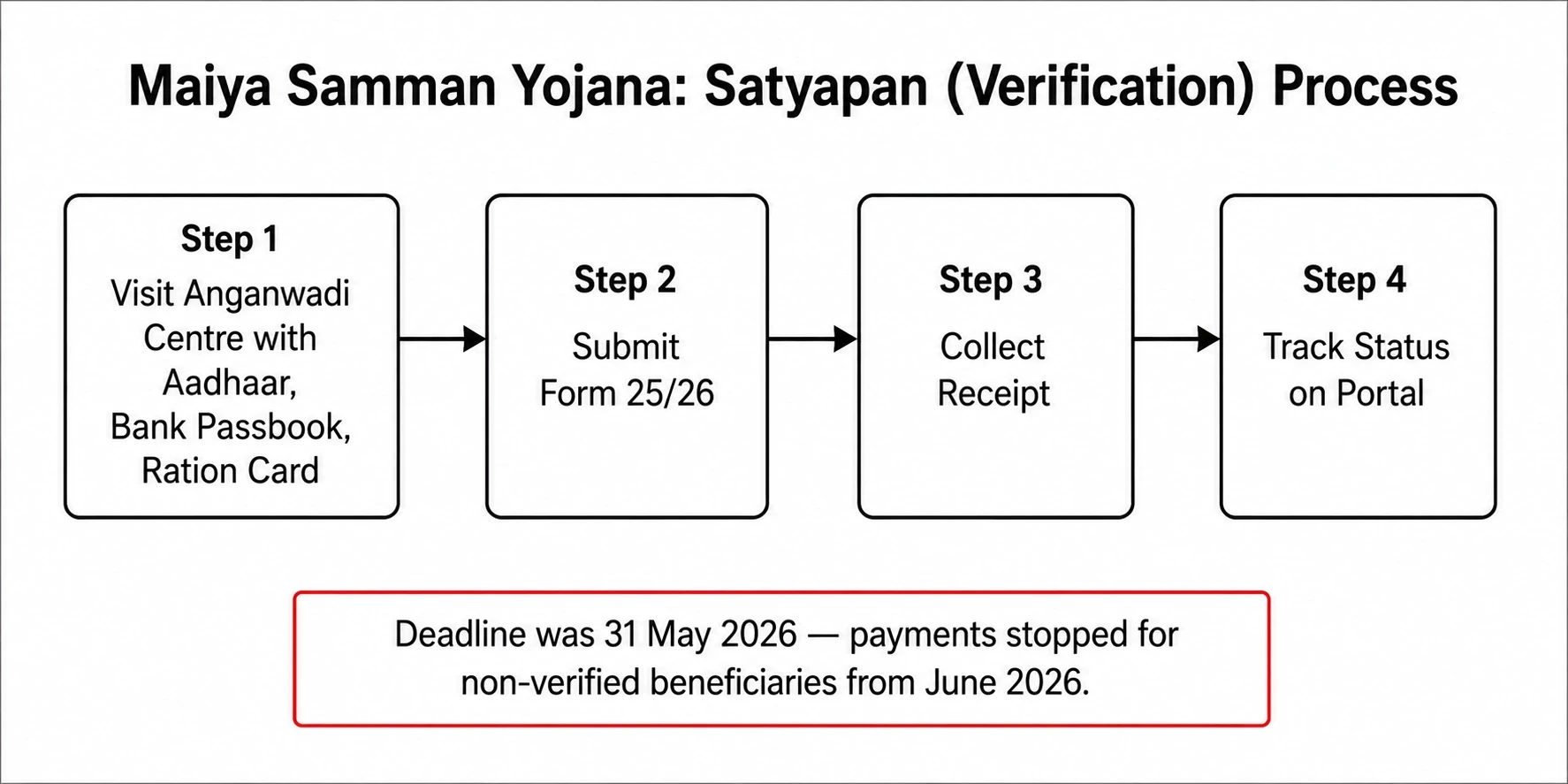
This is the most important Maiya Samman yojana new update of 2026, and a lot of women missed it.
The Jharkhand government made physical verification, called Satyapan, compulsory for existing beneficiaries.
The goal is to remove ineligible or duplicate names, so only real women get the money.
What the rule means in practice:
Beneficiaries had to submit Form 25/26 at their Anganwadi centre by 31 May 2026.
Women who did not complete verification by the deadline had their ₹2,500 stopped, in many cases without a separate warning.
From the June 2026 installment onward, only verified beneficiaries receive payment.
If your money stopped around mid-2026 even though your Aadhaar and bank account are fine, pending Satyapan is the most likely reason.
The fix is to visit the Anganwadi centre with your Aadhaar, bank passbook, and ration card, submit Form 25/26, collect a receipt, and then track the status on the portal.
Late submissions are often still processed, though that month's payment can be delayed.
How Maiya Samman Yojana Compares With Other State Schemes
Jharkhand was not the first state to try direct cash for women, but it currently pays the highest monthly amount among the large-state schemes.
This comparison is gold for a Mains answer, since it shows a clear pattern across states.
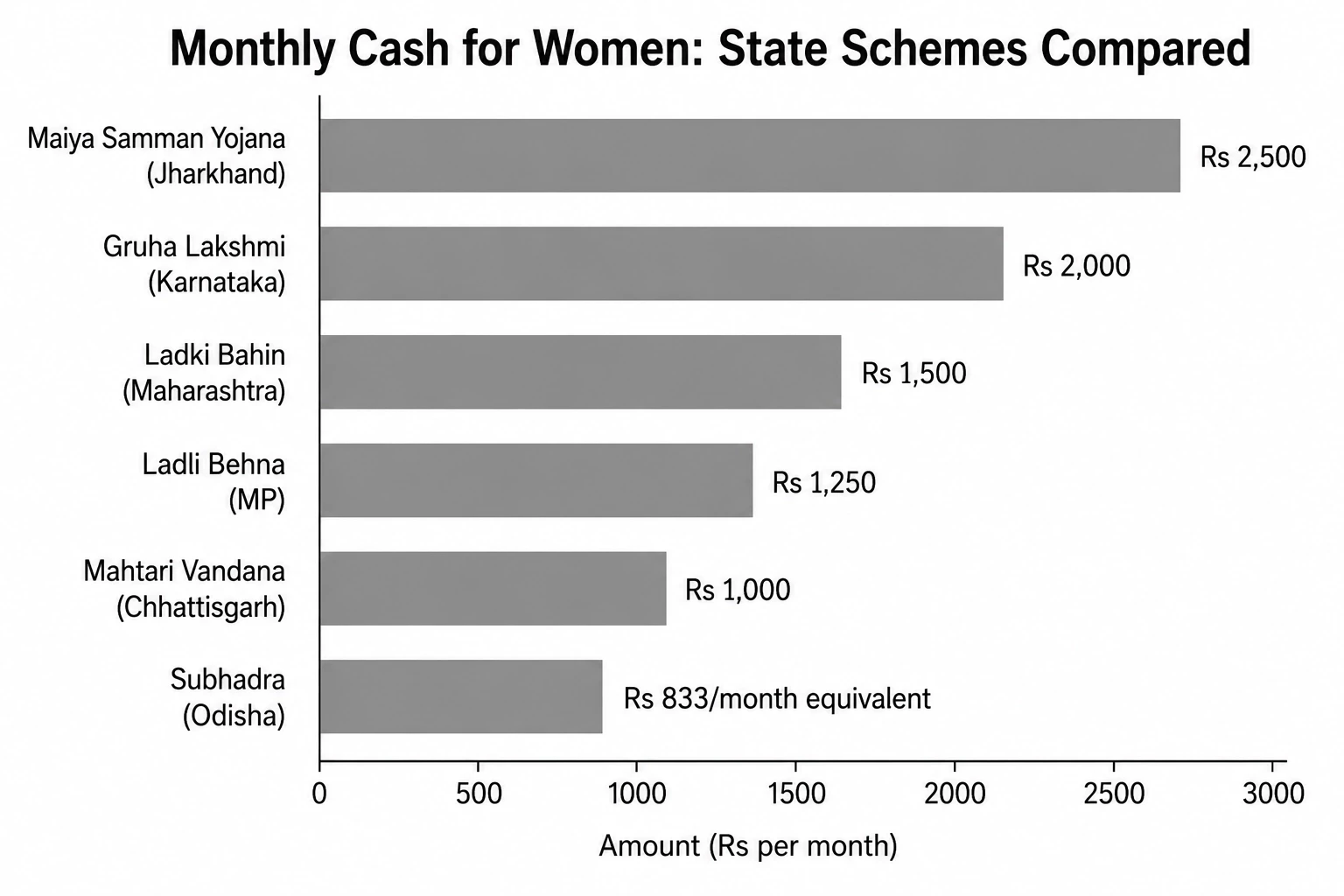
Scheme | State | Launched | Monthly amount | Age group |
Maiya Samman Yojana | Jharkhand | Aug 2024 | ₹2,500 | 18 to 50 |
Ladli Behna Yojana | Madhya Pradesh | Mar 2023 | ₹1,250 | 21 to 60 |
Ladki Bahin Yojana | Maharashtra | Jul 2024 | ₹1,500 | 21 to 65 |
Mahtari Vandana Yojana | Chhattisgarh | Mar 2024 | ₹1,000 | 21+ (married) |
Subhadra Yojana | Odisha | Sep 2024 | ₹10,000/year | 21 to 60 |
Gruha Lakshmi | Karnataka | Aug 2023 | ₹2,000 | Woman head of family |
Madhya Pradesh's Ladli Behna, launched in 2023, is widely seen as the model that the others copied.
What ties all of them together is a simple political lesson: a direct, predictable cash transfer to women tends to move votes.
That is the thread to pull on in any answer about the rise of welfare schemes before elections.
Why Maiya Samman Yojana Matters for UPSC
A scheme like this is not just current affairs trivia. It connects to the syllabus in three different papers, and the same facts can be reused across all of them.
Prelims pointers
For Prelims, you mostly need clean, factual recall. Lock these in:
Scheme: Mukhyamantri Maiya Samman Yojana, run by Jharkhand
Launched: August 2024 by CM Hemant Soren (JMM-led alliance)
Amount: ₹1,000 at launch, raised to ₹2,500 from December 2024 (₹30,000 a year)
Age band: 18 to 50 years
Family income cap: ₹8 lakh a year
Mode: DBT to an Aadhaar-linked bank account
Beneficiaries: about 56 lakh
Compare with: Ladli Behna (MP), Ladki Bahin (Maharashtra), Mahtari Vandana (Chhattisgarh), Subhadra (Odisha)
The Mains angle and the freebies debate
This is where the scheme earns its place in GS papers.
GS2 (Governance and welfare): It is a clean case study of DBT, targeting of beneficiaries, and the role of state governments in welfare.
It also touches the constitutional spirit of the Directive Principles, especially Article 39(a) on adequate means of livelihood, Article 41 on public assistance in cases of need, and Article 46 on the economic interests of weaker sections
Article 15(3), which lets the state make special provisions for women, gives such schemes their constitutional footing.
GS1 (Society): A cash transfer aimed at women raises a woman's bargaining power inside the household and allows her to smooth consumption during a tough month.
Jharkhand is one of the poorer states in India, with a multidimensional poverty headcount of about 28% in the NITI Aayog MPI 2023 and low female workforce participation.
That context makes the gender argument more compelling.
GS3 (Economy): Here lies the real debate. The scheme costs the state roughly ₹15,000 to ₹17,000 crore a year, a heavy load for a mineral-dependent economy with swinging revenues.
Supporters say cash for women improves nutrition, health and human capital and point to early evidence from MP's Ladli Behna.
Critics say it is fiscally unsustainable, warn that it can crowd out spending on schools and hospitals and point to the duplication risk with central schemes like PM-KISAN and NFSA.
The RBI and the successive Finance Commissions have time and again warned the states against incurring off-budget liabilities and unfunded subsidies. Article 282, which allows discretionary grants for public purpose, is often cited in this welfare-versus-freebies argument.
The trick in a Mains answer is to not pick a side too quickly. Show that you understand the gender and poverty case for the scheme, then weigh it against the fiscal and targeting concerns, and close with a balanced position on how such transfers can be made sustainable.
Frequently asked question (FAQs)
How much money is given under Maiya Samman Yojana?
How can I do a Maiya Samman Yojana status check?
Can I do Maiya Samman Yojana online apply from home?
Why did my Maiya Samman Yojana payment stop in 2026?
Is Maiya Samman Yojana useful for the UPSC exam?
Maiya Samman Yojana is more than a monthly ₹2,500 transfer.
For 56 lakh women in Jharkhand it is a small but steady source of independence, and for an aspirant it is a ready-made case study that ties together welfare, gender, and state finances in one place.
Keep the core facts handy for Prelims, hold both sides of the freebies debate for Mains, and if you are a beneficiary, finish your Satyapan and watch your bank passbook rather than any third-party site.


Research methodology
PadhAI's research methodology ensures every article is accurate, UPSC-ready, and beginner-friendly. We curate current affairs analysis based on UPSC exam relevance by cross-referencing The Hindu, Indian Express, and PIB. General Studies (GS) topics are drafted from NCERTs and standard books such as M. Laxmikanth, Spectrum, and GC Leong, then reviewed by subject matter experts to eliminate factual errors. Additionally, we update aspirants with verified government exam notifications alongside expert blogs suggesting the best resources, syllabus, and comprehensive Prelims and Mains strategies.


Gajendra Singh Godara is an IIT Bombay graduate and a UPSC aspirant with 4 attempts, including multiple Prelims and Mains appearances. He specializes in Polity, Modern History, International Relations, and Economy. At PadhAI, Gajendra leverages his firsthand exam experience to simplify complex concepts, creating high-efficiency study materials that help aspirants save time and stay focused.
No comments yet. Be the first to join the discussion!