Mawan Dheeyan 2026 Scheme: Eligibility, Registration, Status
The Mawan Dheeyan Scheme is a Punjab government plan that gives Rs 1,000 a month to eligible adult women, and Rs 1,500 to Scheduled Caste women, paid by DBT. Announced on 8 March 2026 and launched on 14 April 2026, its first payments are set for 1 July 2026.

Gajendra Singh Godara
9
mins read
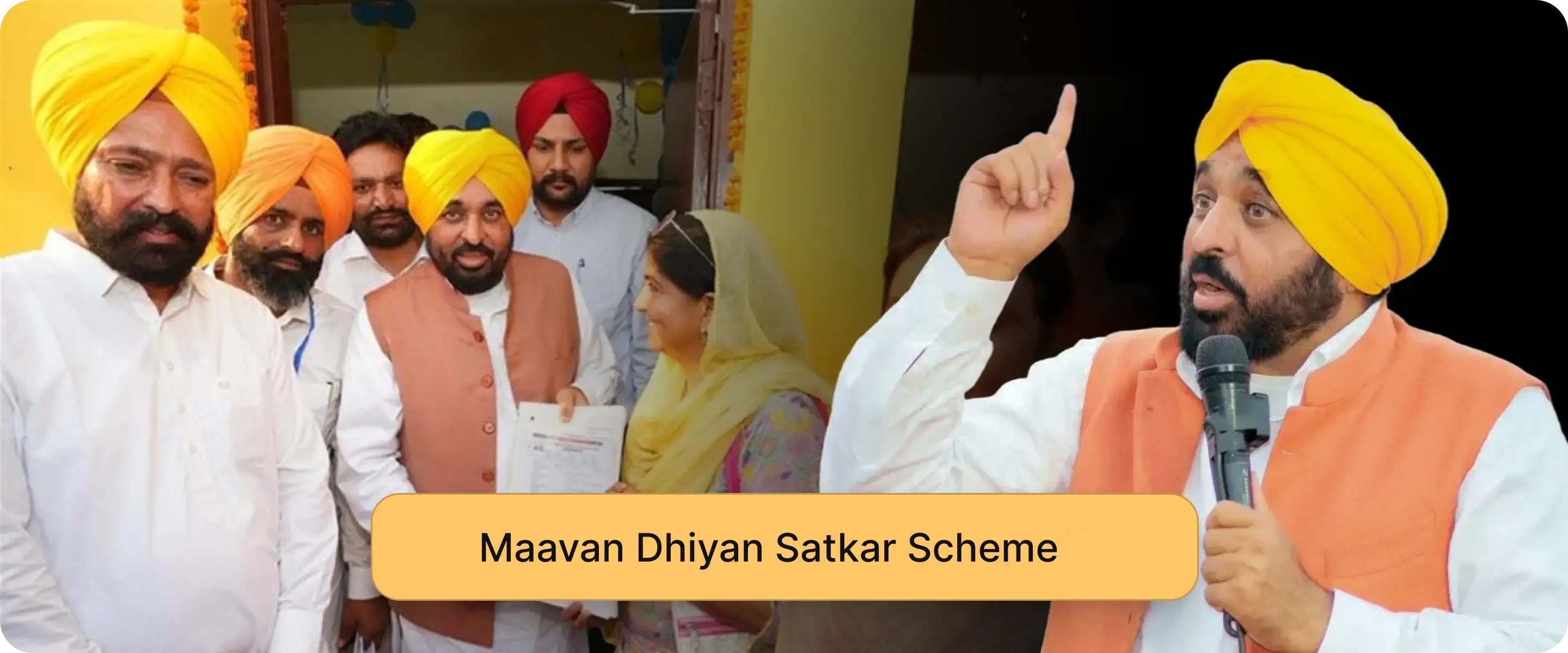
A fixed Rs 1,000 in a woman's own bank account, every single month, changes how a household runs.
That is the simple idea behind the Mawan Dheeyan scheme, Punjab's newest women-centric welfare programme.
The name itself carries the message. In Punjabi, "Mawan Dheeyan" means mothers and daughters, and "Satkar" means honour.
For a UPSC aspirant, this scheme is a textbook example of a fast-growing trend: state governments handing direct cash to women.
It pulls in welfare delivery, gender policy, Direct Benefit Transfer, the evolving landscape of the political representation of women in India, and the heated debate over welfare spending versus state finances.
This guide explains it in plain words, with the dates, numbers, and exam angles you need.
Before the detail, here is a snapshot you can lift straight into your notes.
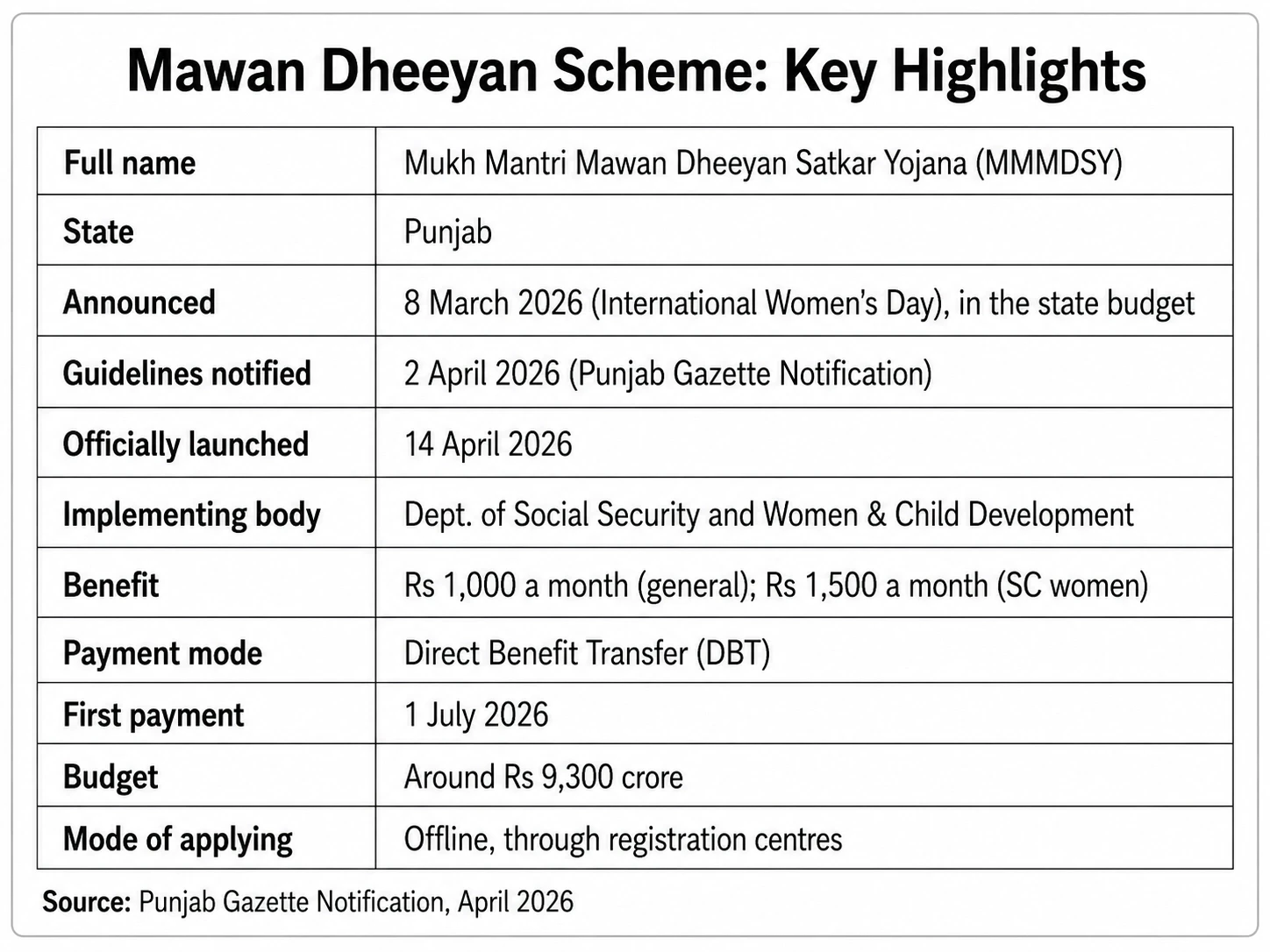
Detail | Information |
Full name | Mukh Mantri Mawan Dheeyan Satkar Yojana (MMMDSY) |
State | Punjab |
Announced | 8 March 2026 (International Women's Day), in the state budget |
Guidelines notified | 2 April 2026 (Punjab Gazette Notification) |
Officially launched | 14 April 2026 |
Implementing body | |
Benefit | Rs 1,000 a month (general); Rs 1,500 a month (SC women) |
Payment mode | Direct Benefit Transfer (DBT) |
First payment | 1 July 2026 |
Budget | Around Rs 9,300 crore |
Mode of applying | Offline, through registration centres |
The Mukh Mantri Mawan Dheeyan Satkar Yojana is also known informally as the Punjab Rs 1,000 scheme.
The government estimates that close to 97 percent of adult women in Punjab may qualify, with about 52 lakh women expected to benefit at the start.
Join our WhatsApp Community
The Mawan Dheeyan scheme is a cash transfer programme of the Punjab government that pays a fixed monthly amount to adult women across the state.
Its formal name is the Mukh Mantri Mawan Dheeyan Satkar Yojana (MMMDSY). The Department of Social Security and Women & Child Development runs it, and the money reaches women through Direct Benefit Transfer (DBT).
In one line, the Mawan Dheeyan yojana turns a political promise of monthly cash for women into a verified, bank-linked payment.
The scheme rests on a simple eligibility test. If you are an adult woman voter in Punjab and you are not in an excluded group, you get the benefit. General, OBC, and EWS women receive Rs 1,000 a month.
Scheduled Caste women receive Rs 1,500. Punjab Chief Minister Bhagwant Mann announced it during the state budget, and the government set aside around Rs 9,300 crore for it.
The amount depends on your social category, which is the one design choice worth understanding clearly.
Category | Monthly Amount |
General, OBC, and EWS women | Rs 1,000 |
Scheduled Caste (SC) women | Rs 1,500 |
The state pays the full cost from its own budget, so this is a purely state-funded scheme, not a centrally sponsored one.
Payment runs through DBT into the woman's Aadhaar-linked bank account. The higher Rs 1,500 slab for SC women is a targeted top-up that reflects the constitutional push to support weaker sections under Article 46.
Two features make the Mawan Dheeyan scheme stand out. There is no cap on how many women from one family can receive the benefit, so a mother and her adult daughters can each get a separate payment.
And women who already draw a social security pension, such as old age, widow, or disability pension, keep that pension and get this cash on top.
Add as a preferred Source on Google
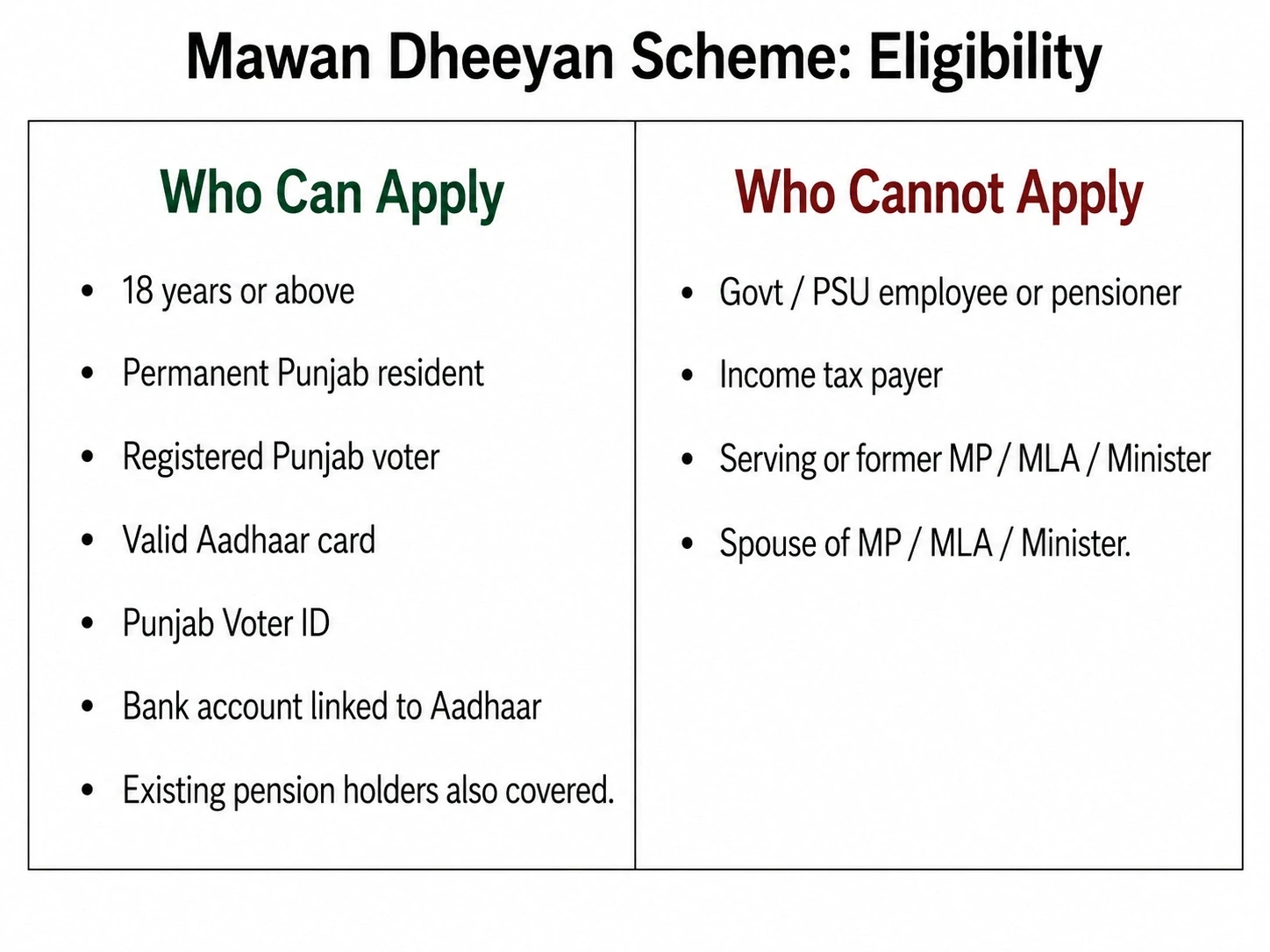
Getting the Mawan Dheeyan scheme eligibility right is what decides approval. Read the two parts below carefully.
Who Can Apply
A woman qualifies if she meets all of these conditions:
She is 18 years of age or above.
She is a permanent resident of Punjab and a registered voter in the state.
She holds a valid Aadhaar card and a Punjab Voter ID card.
Her bank account is linked with Aadhaar for DBT.
Existing pension beneficiaries are also covered, which widens the pool. So the basic Mawan Dheeyan scheme eligibility bar is low by design, since the aim is near-universal coverage of adult women.
Who Is Left Out?
The scheme screens out the better-off and those already on the public payroll. A woman is not eligible if:
She is a serving or retired employee of the central, state, or any UT government, or a pensioner from a PSU, board, or corporation.
She paid income tax of Rs 1 or more in the previous financial year.
She is a serving or former Minister, MP, or MLA.
She is the spouse of a serving or former Minister, MP, or MLA.
Keep these papers ready before you visit a centre. The documents needed are listed below:
Punjab residence proof
Age proof of the applicant
Aadhaar card
Punjab Voter ID card
Bank account passbook or details for DBT
Active mobile number
SC certificate, for Scheduled Caste applicants claiming the Rs 1,500 slab
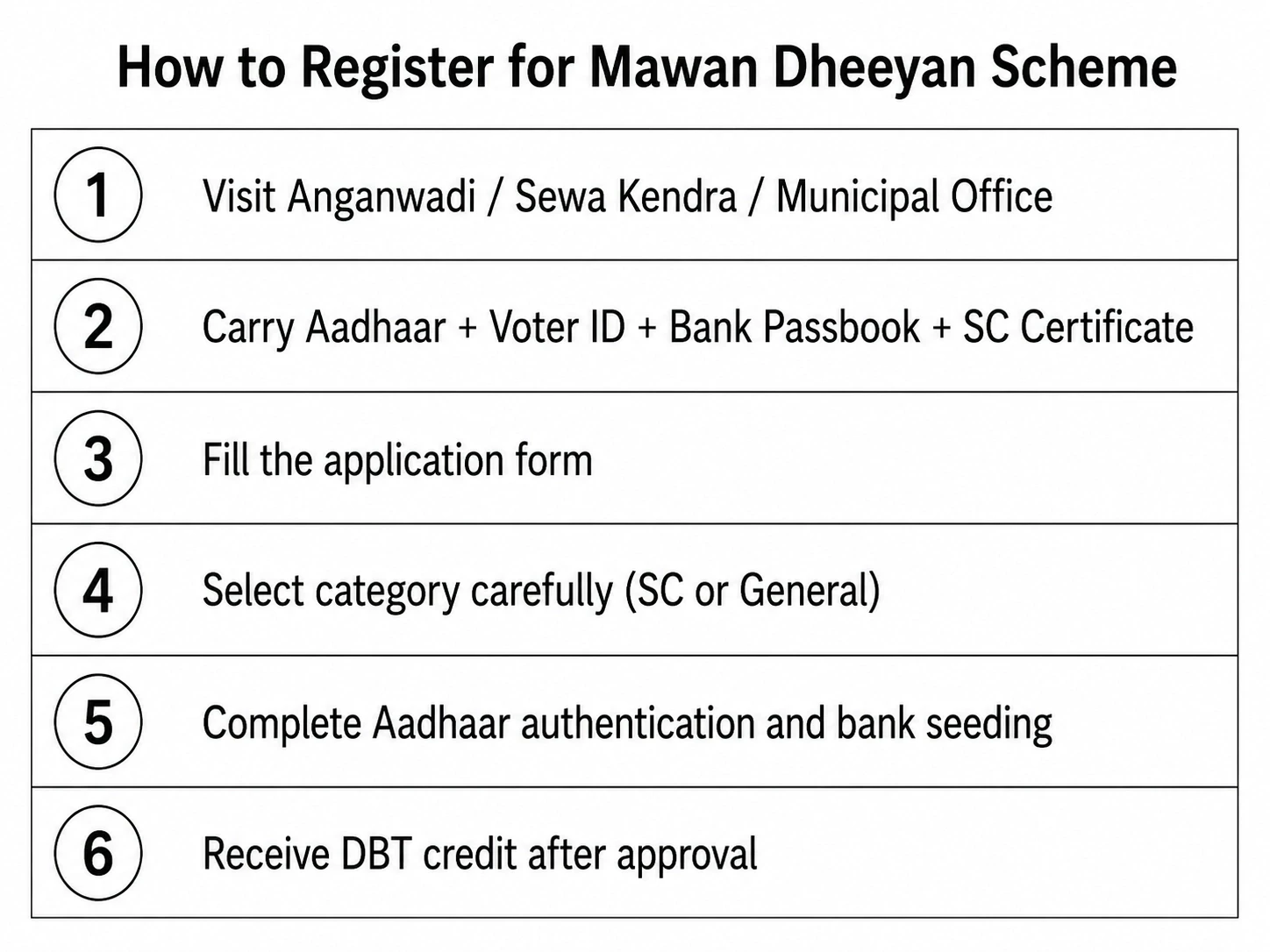
The scheme runs on offline registration. No online portal has been launched yet, so applicants must visit a designated centre.
The government set up more than 26,000 centres, including Sewa Kendras, Anganwadi Centres, and municipal offices.
The Mawan Dheeyan registration steps are given below:
Visit your nearest centre. Go to an Anganwadi Centre, Sewa Kendra, or municipal office notified for the scheme.
Carry your documents. Take your Aadhaar, Punjab Voter ID, bank passbook, and SC certificate if it applies.
Fill the form. Get the application form at the centre, or give your details for assisted registration.
Pick the right category. SC applicants must select the SC category carefully, since a wrong choice gives Rs 1,000 instead of Rs 1,500 and is hard to fix later.
Complete verification. Officials check your documents and run Aadhaar authentication and bank seeding.
Get approved. Once verified, your application is approved, and the cash reaches your Aadhaar-linked account by DBT.
Registration is free at every centre. No fee is charged at any stage of Mawan Dheeyan registration.
Phase-Wise Rollout Across Punjab
The state rolled the scheme out in phases rather than all at once. The early schedule looked like this:
Phase | Start Date | Coverage |
Phase 1 | 15 April 2026 | 9 pilot Assembly constituencies |
Phase 2 | 5 May 2026 | Around 40 more constituencies |
Later phases | Rolling | Remaining constituencies statewide |
Source: Directorate of Social Security, Women and Child Development, Punjab, 2026.
By mid-June 2026, registration had reached districts like Pathankot, with more being added in steps.
Once you register, you will want to track your case. Since the scheme is offline-first, the Mawan Dheeyan scheme status is mainly confirmed at the registration centre or with the District Social Welfare Officer.
The practical ways to check are:
Ask at the same Anganwadi Centre or Sewa Kendra where you registered, with your acknowledgement details.
Contact the District Social Welfare Officer of your district for the latest position.
Check your Aadhaar-linked bank account or passbook after 1 July 2026 to confirm the DBT credit.
The state has said it may add a digital tracking option later. Until then, the centre that handled your form is the surest place for your Mawan Dheeyan scheme status.
This is the question on every applicant's mind. Chief Minister Bhagwant Mann announced that eligible women will start receiving the monthly assistance from 1 July 2026.
Around 52 lakh women are expected to benefit in the first round.
The government also clarified a helpful point. Even if a woman finishes her registration after July 2026, she may still receive the benefit from the scheme's start date, subject to verification.
So a late registration does not automatically mean lost months, as long as eligibility checks out.
The MMMDSY in the Bigger Picture: Women Cash Schemes
For UPSC, the most useful thing is to see this scheme as part of a national pattern, not a one-off.
Many states now run direct cash schemes for women, and the MMMDSY is Punjab's entry into that group.
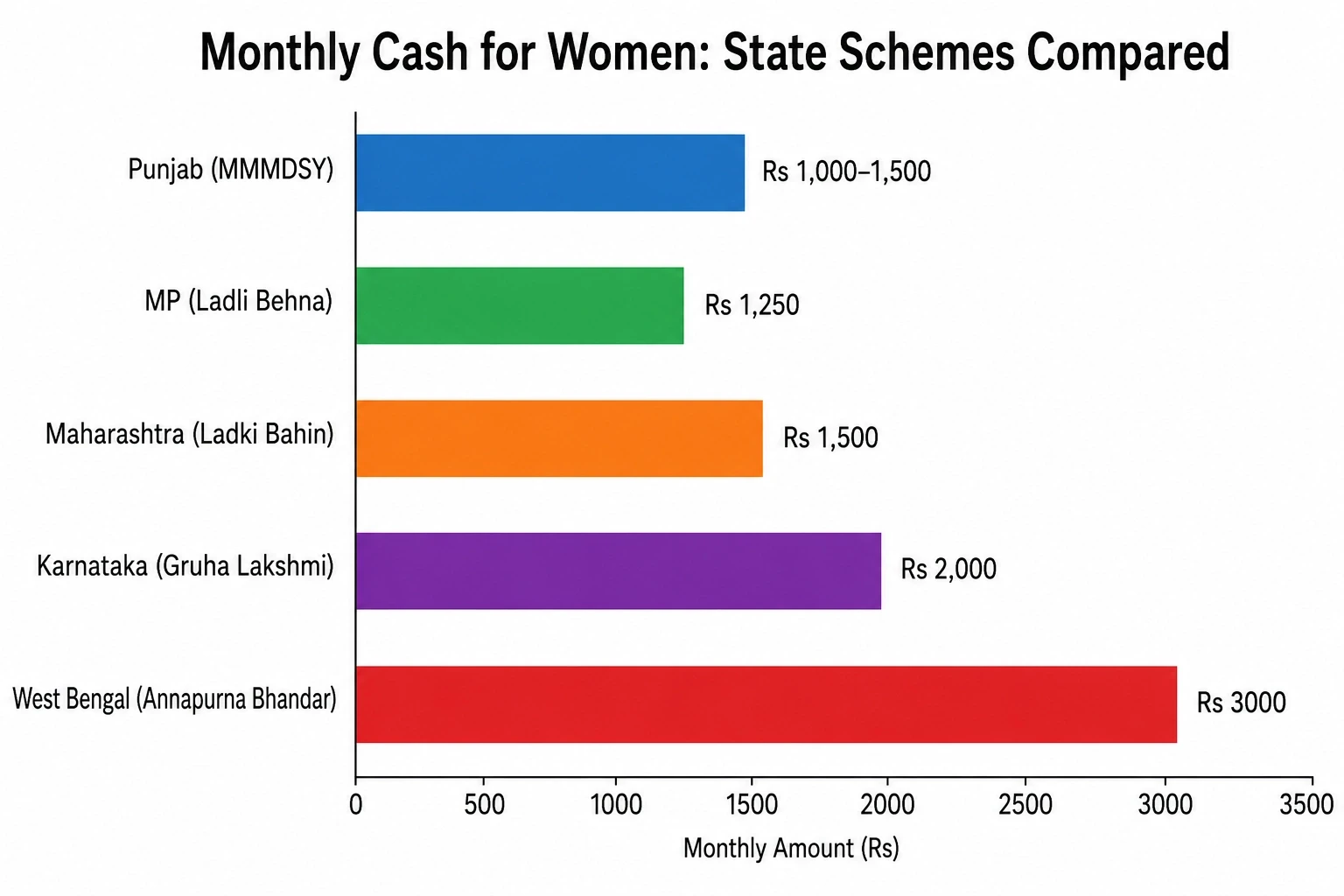
A quick comparison helps you remember them together.
State | Scheme | Monthly Amount |
Punjab | Mukh Mantri Mawan Dheeyan Satkar Yojana | Rs 1,000 to Rs 1,500 |
Madhya Pradesh | Ladli Behna Yojana | Rs 1,250 |
Maharashtra | Ladki Bahin Yojana | Rs 1,500 |
Karnataka | Gruha Lakshmi | Rs 2,000 |
West Bengal | Rs 3000 |
Figures are indicative and revised from time to time by each state.
Seen this way, the Mukh Mantri Mawan Dheeyan Satkar Yojana is one more example of what analysts call competitive welfarism, where states match one another with direct cash promises to women voters.
This single pattern can anchor a strong Mains answer on welfare politics.
Why Mawan Dheeyan Scheme Matters for UPSC
The scheme connects to several parts of the syllabus, which is why it is worth more than a passing note.
For Prelims, lock in the facts: the implementing department, the relaunch and payment dates (8 March, 14 April, and 1 July 2026), the two payment slabs, and the state-funded nature of the scheme.
The acronym MMMDSY is an easy hook for a match-the-following question.
For Mains GS Paper 2, the scheme fits questions on welfare measures for women and weaker sections.
The clear constitutional links are Article 15(3), which lets the State make special provisions for women, and Article 46, which asks the State to promote the interests of Scheduled Castes.
You can also tie it to Article 39(a) on equal means of livelihood for men and women.
For GS Paper 3, the scheme is a ready example for inclusive growth, gender budgeting, and financial inclusion.
The DBT model links neatly to the JAM trinity of Jan Dhan, Aadhaar, and Mobile, which trims leakage by sending money straight to verified accounts.
The Welfare vs Fiscal Health Debate
The richest exam angle is the tension at the centre of schemes like this. Supporters argue that cash in a woman's own hands raises her financial standing, improves household nutrition and education spending, and gives her a voice in money decisions.
Critics point to the cost. A bill of around Rs 9,300 crore a year is heavy for a state that already carries a large debt burden, and it can squeeze spending on schools, hospitals, and roads.
Cash transfers like this one feed directly into household consumption, which in turn affects national income through the multiplier effect.
This mirrors the national debate on welfare cash and so-called freebies, a topic the Reserve Bank of India and the Supreme Court have both weighed in on.
For a balanced answer, hold both sides: cash transfers as a tool for gender equity and demand in the local economy, set against the need for fiscal prudence and well-targeted spending.
The Mawan Dheeyan scheme is a fresh, real example to anchor that argument.
Frequently asked question (FAQs)
What is the Mawan Dheeyan Scheme?
What is the Mawan Dheeyan Scheme eligibility?
How do I complete Mawan Dheeyan registration?
How can I check my Mawan Dheeyan Scheme status?
When will the first payment under MMMDSY arrive?
The Mawan Dheeyan scheme, or Mukh Mantri Mawan Dheeyan Satkar Yojana, is Punjab's new women cash transfer programme.
It pays Rs 1,000 a month to eligible women and Rs 1,500 to SC women, funded fully by the state at a cost of around Rs 9,300 crore, with first payments from 1 July 2026.
For your exam, hold three threads: the constitutional roots in Articles 15(3) and 46, the DBT delivery model tied to the JAM trinity, and the welfare versus fiscal-health debate that places Punjab's scheme in the wider story of women cash schemes across India.



Research methodology
PadhAI's research methodology ensures every article is accurate, UPSC-ready, and beginner-friendly. We curate current affairs analysis based on UPSC exam relevance by cross-referencing The Hindu, Indian Express, and PIB. General Studies (GS) topics are drafted from NCERTs and standard books such as M. Laxmikanth, Spectrum, and GC Leong, then reviewed by subject matter experts to eliminate factual errors. Additionally, we update aspirants with verified government exam notifications alongside expert blogs suggesting the best resources, syllabus, and comprehensive Prelims and Mains strategies.


Gajendra Singh Godara is an IIT Bombay graduate and a UPSC aspirant with 4 attempts, including multiple Prelims and Mains appearances. He specializes in Polity, Modern History, International Relations, and Economy. At PadhAI, Gajendra leverages his firsthand exam experience to simplify complex concepts, creating high-efficiency study materials that help aspirants save time and stay focused.
No comments yet. Be the first to join the discussion!