PM UDAY Scheme: Eligibility, Registration, Status & Portal 2026
The PM UDAY scheme is a 2019 central scheme run by the Delhi Development Authority (DDA). It grants legal ownership rights to residents of 1,731 unauthorised colonies in Delhi using documents like GPA, Will and Agreement to Sell. Owners receive a Conveyance Deed or Authorisation Slip after an online application.

Gajendra Singh Godara
11
mins read
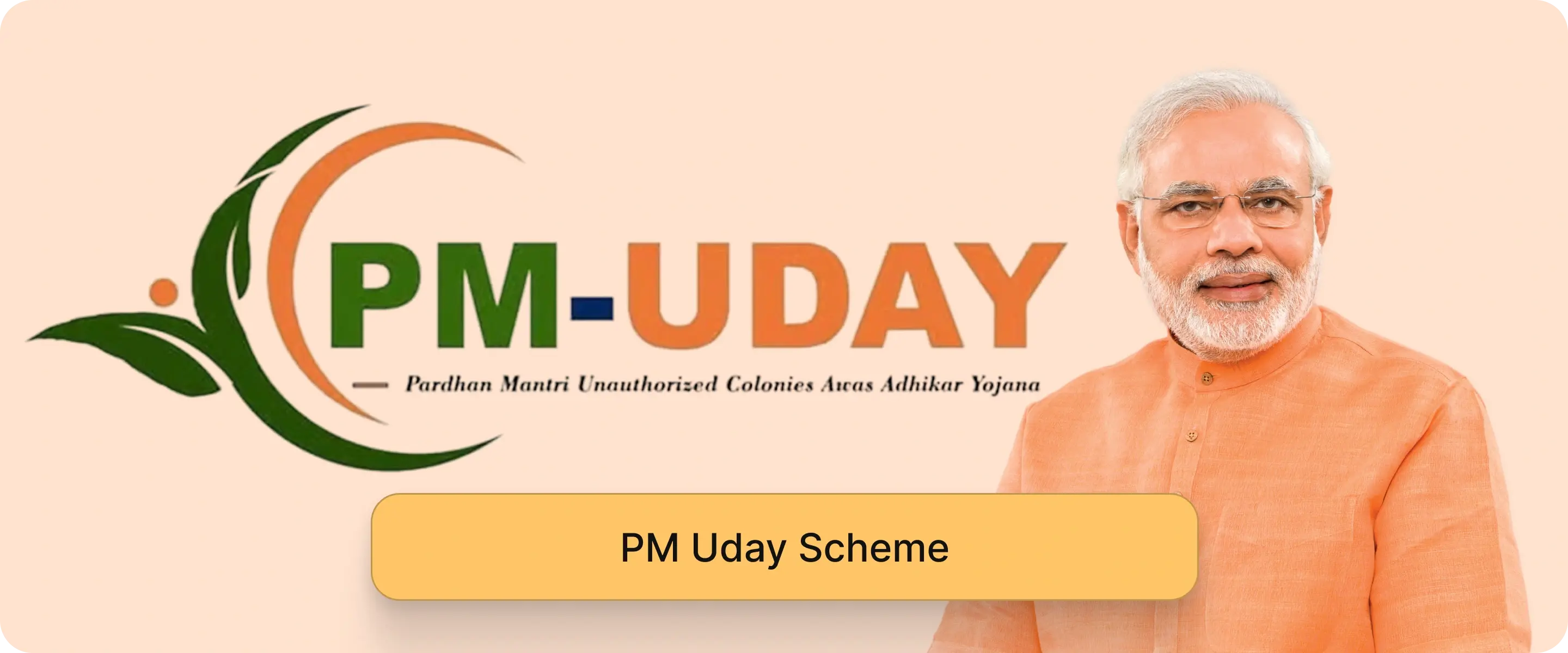
Around 40 to 45 lakh people in Delhi live in colonies that were never formally approved. For decades, they owned homes on paper that no court fully accepted.
The PM UDAY scheme changed that. It gives these residents a legal title they can sell, mortgage, or pass on to their children.
For a UPSC aspirant, this scheme sits right at the meeting point of urban governance, property law, and welfare delivery.
It shows up in GS Paper 2 under government policies, and it links to bigger themes like informal settlements and city planning.
This guide breaks down the scheme in plain language, with the facts, dates, and numbers you need for both Prelims and Mains.
The PM UDAY scheme is a central government scheme that confers legal ownership or transfer and mortgage rights to residents of 1,731 unauthorised colonies in Delhi.
The full name is Pradhan Mantri Unauthorised Colonies in Delhi Awas Adhikar Yojana. The Delhi Development Authority (DDA) runs it under the Ministry of Housing and Urban Affairs (MoHUA).
So if someone asks what is PM UDAY scheme in one line: it turns informal, paper-based ownership into a registered, bank-recognised title.
The scheme matters because of a simple gap. Most homes in these colonies were bought through a General Power of Attorney (GPA), a Will, or an Agreement to Sell.
These papers record possession, but they do not transfer clean legal ownership. Without a clear title, residents could not get home loans, could not sell easily, and lived under the fear of demolition.
Join our WhatsApp Community
Delhi grew faster than its master plans could handle. Large chunks of land meant for green or agricultural use turned into housing clusters with no approved building plans.
These clusters lacked proper roads, sewers, and safety clearances.
Earlier attempts to fix this failed. The 2008 Regulations asked the Delhi government (GNCTD) to map the boundaries of these colonies first. Even after 11 years, that mapping stayed incomplete.
The PM UDAY yojana was built to cut through this delay by using a digital, document-based process instead of waiting for slow ground surveys.
The Suraj Lamp Case and the GPA Problem
The legal trigger goes back to the Supreme Court. In the Suraj Lamp & Industries case (2011), the Court ruled that GPA, Will, and Agreement to Sell are not valid instruments for transferring property ownership.
This single judgment left lakhs of Delhi families holding papers that no longer counted as proof of title.
The government's response was to recognise such documents executed after 11 October 2011, up to a notified date, only for the limited purpose of granting rights under this scheme.
This is the legal bridge that makes the PM UDAY scheme possible.
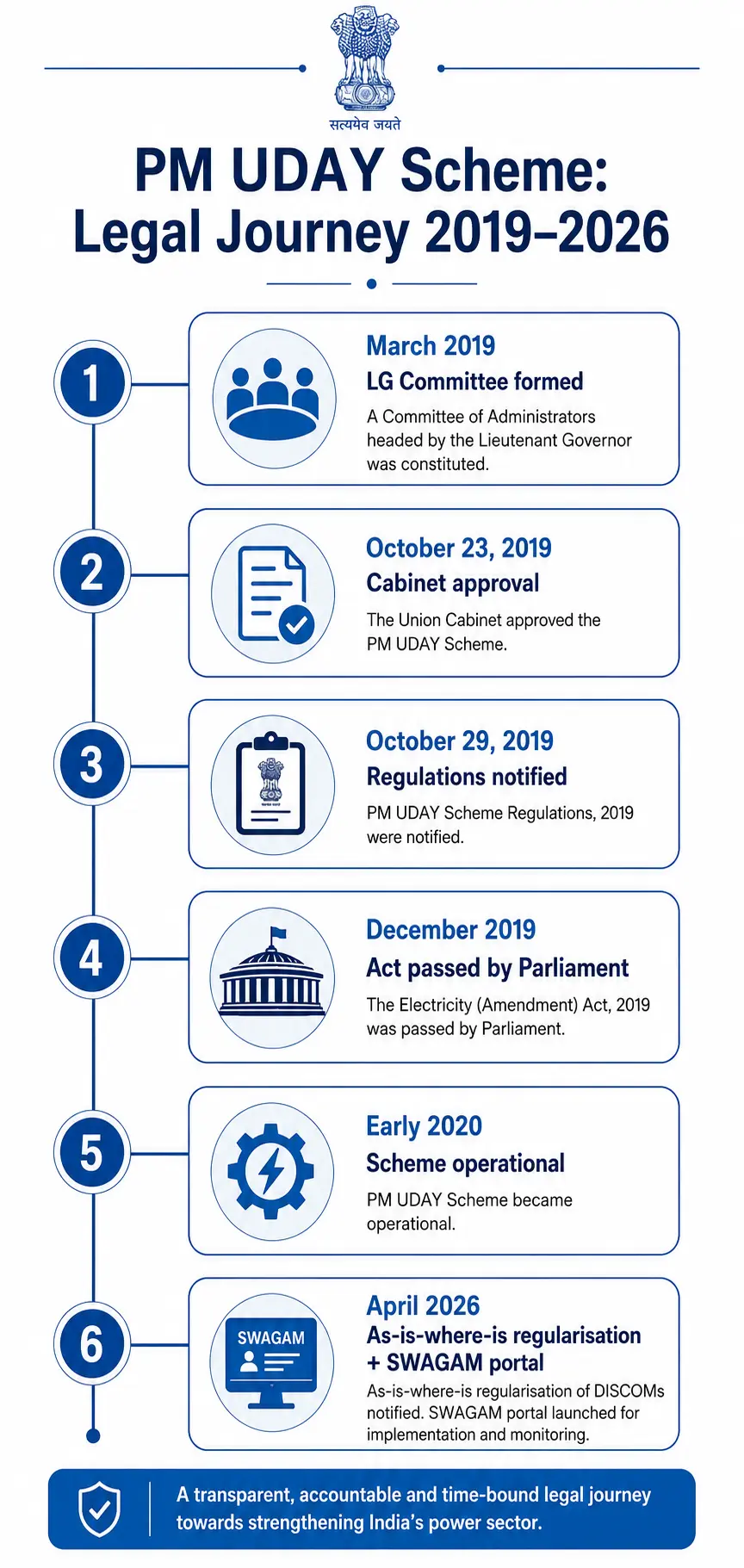
The scheme stands on a solid legal foundation, which is rare for a welfare programme. Here is the chain of events that aspirants should memorise:
Date | Event |
March 2019 | Committee set up under the Lieutenant Governor of Delhi to recommend the process |
23 October 2019 | Union Cabinet approves the proposal |
29 October 2019 | NCT of Delhi (Recognition of Property Rights of Residents in Unauthorised Colonies) Regulations, 2019 notified |
December 2019 | The NCT of Delhi (Recognition of Property Rights...) Act, 2019 passed by Parliament |
Early 2020 | Scheme made operational for residents |
Source: DDA (dda.gov.in/pm_uday) and PIB, 2025-26.
The fact that a parliamentary Act backs this scheme is its strongest point. It separates the PM UDAY scheme from ordinary executive schemes that can be withdrawn easily.
Add as a preferred Source on Google
The scheme has a few defining features that turn a messy paper trail into a clean title. The main features are listed below:
Document recognition: GPA, Will, Agreement to Sell and possession papers are accepted as a basis for granting rights.
Outcome documents: Eligible owners get a Conveyance Deed (CD) for properties on public land, or an Authorisation Slip (AS) for properties on private land.
Online process: The full PM UDAY application is filed online. A resident visits a processing centre only once, at the time of physically signing the CD or AS.
Nominal charges: Charges for private land are 50% of the public land rate. No rights are granted on vacant public land.
Easy payment: Residents can pay the charge in three equal installments.
Support system: DDA runs 10 processing centres, 17 extended offices, and 28 help desks. Common Service Centres (CSCs) also help with filing.
Here is a snapshot table you can lift straight into your notes:
Feature | Detail |
Launch year | 2019 |
Nodal agency | Delhi Development Authority (DDA) |
Ministry | Housing and Urban Affairs (MoHUA) |
Coverage | 1,731 unauthorised colonies |
Excluded | 69 affluent colonies |
Cut-off for construction | 1 January 2015 (based on 2015 satellite imagery) |
Official portal | |
Output | Conveyance Deed (CD) or Authorisation Slip (AS) |
Eligibility is the part where most applications fall apart, so read this slowly.
Properties and People Covered
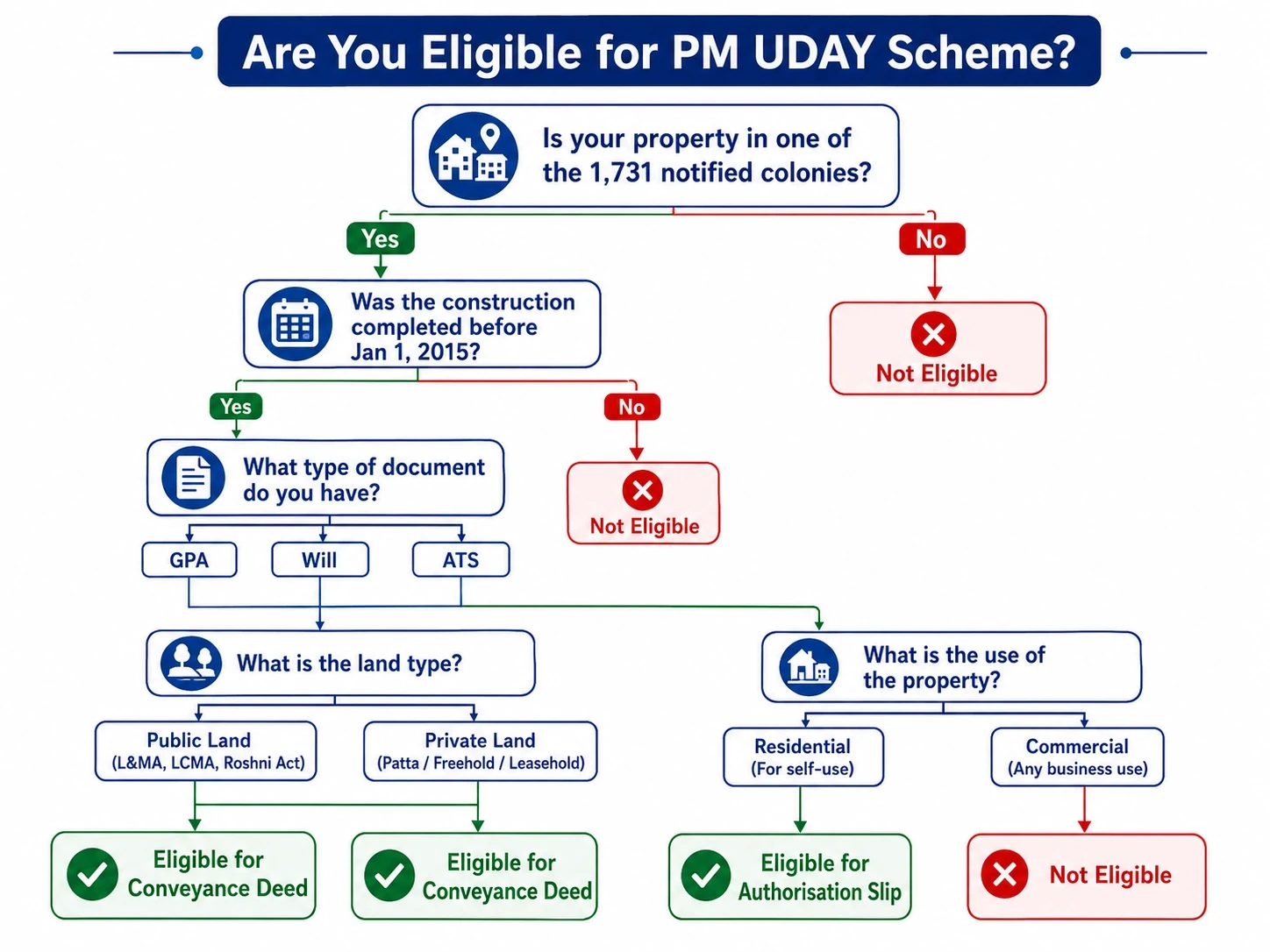
A resident qualifies if the property lies inside one of the 1,731 notified colonies and the construction existed before 1 January 2015.
The applicant must hold a recognised document, such as a registered or notarised GPA, Agreement to Sell, Will, or a possession letter with proof of payment.
Who Gets Left Out?
The scheme is not open to everyone. The Regulations exclude 69 affluent unauthorised colonies.
The scheme also keeps out vacant plots on government land, since no ownership is granted on empty public land.
Properties used for commercial activity do not qualify, because the scheme covers residential use only.
The PM UDAY registration process runs in a clear sequence. Follow it in order, and keep your documents scanned and ready. The steps are given below:
Register online. Open the PM UDAY portal at pmuday.ncog.gov.in, click Registration, and fill in owner details, property details, the colony name, and its registration number. Verify with an OTP. You will get a unique registration number.
Get the GIS survey done. Pick an empanelled GIS agency from the list shown after registration.
The agency visits your property, takes digital measurements, fixes the geo-coordinates, and uploads a GIS map. You receive a GIS ID by SMS and email.
Upload documents and file the application. Submit all personal and property papers, plus your photo and signature. The system assigns a PM-UDAY Case ID for tracking.
DDA scrutiny. Officials check the application at several stages. They may raise deficiencies, which you must fix.
Pay the charges. Pay in full or in three installments after approval.
Receive and register the CD or AS. Collect your Conveyance Deed or Authorisation Slip, then register it at the Sub-Registrar office within 3 months
If you miss this window, the document expires and needs revalidation.
Tip for applicants: Before you start the PM UDAY registration, use the UC Locator inside the PM-UDAY mobile app to confirm your property falls within an unauthorised colony boundary. This one check saves many rejections.
Documents You Need for PM UDAY Application
Keep these papers ready before you begin the PM UDAY application. The required documents are listed below:
General Power of Attorney (GPA)
Agreement to Sell (ATS)
Affidavit and possession document
Will of the last owner and the property chain in serial order
Latest ownership document and payment proof
Electricity bill showing connection date before 1 January 2015 (as construction proof)
Property tax mutation document, if any
The PM UDAY portal is the single online window for the whole scheme. The official address is pmuday.ncog.gov.in.
There is also a PM-UDAY Android app on the Google Play Store, which carries the handy UC Locator tool.
On the portal you can register a new property, file an application, reply to deficiencies, view published applications, and track progress.
Login uses your registered mobile number with OTP confirmation, so keep that number active.
Once you file, you will want to track progress. Checking your PM UDAY application status online is simple and takes two minutes.
Here is the PM UDAY status check online method:
Open the PM UDAY portal at pmuday.ncog.gov.in and click File Application.
Log in with your registered mobile number and the OTP sent to it.
On the dashboard, open the Application Status option.
View the current stage, any deficiencies raised, or the approval and rejection notes.
DDA also sends every update by SMS and email to your registered contact. So check those regularly while your PM UDAY application status moves through the system.
The application passes through several authorities, each of whom can approve it, raise a deficiency, or reject it.
Why Applications Get Rejected
Knowing the common reasons for rejection helps you avoid them. Applications are usually rejected when:
The property or its khasra falls outside the colony (UC) boundary.
Construction is not proven to exist before 1 January 2015.
The building exceeds the allowed height of 4 floors plus one.
The property has a basement or is used for commercial purposes.
The property sits near a monument, water body, or high-tension wire.
The property is sealed, disputed, or under a court case.
A built-up property paper on government land was executed after 30 October 2019.
PM UDAY vs UDAY: Clearing the Confusion
This is a classic trap in the exam. Two schemes share the name UDAY, but they have nothing in common. One deals with Delhi homes; the other deals with power companies
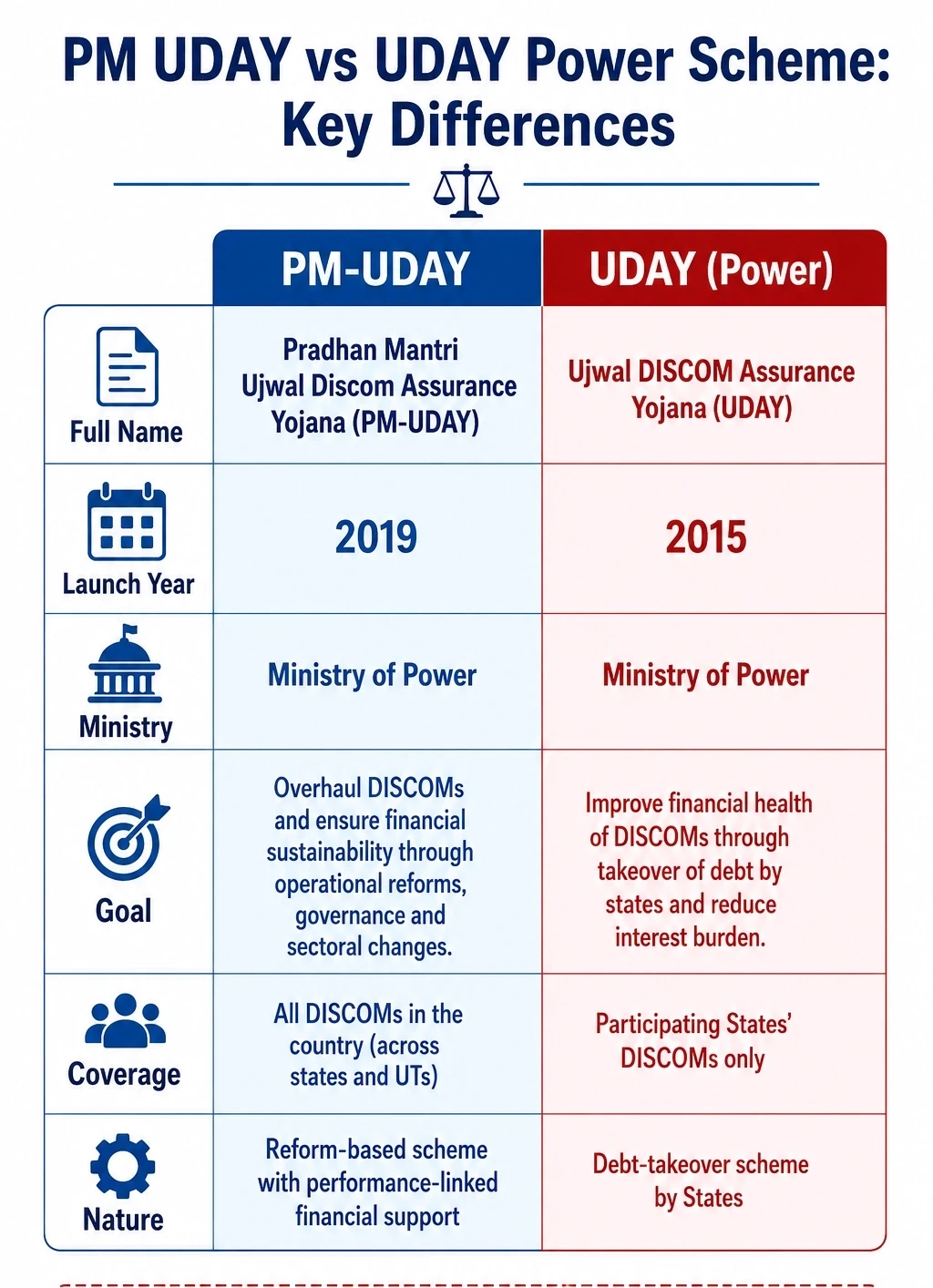
The comparison below settles it for good.
Point | PM-UDAY | UDAY (Power) |
Full name | Pradhan Mantri Unauthorised Colonies in Delhi Awas Adhikar Yojana | Ujwal DISCOM Assurance Yojana |
Launched | 2019 | 2015 |
Ministry | Housing and Urban Affairs | Power |
Goal | Ownership rights for Delhi colony residents | Financial turnaround of power distribution companies (DISCOMs) |
Coverage | 1,731 colonies in Delhi | DISCOMs of joining states |
Nature | Property and housing rights | Debt restructuring plan |
Remember the split this way: PM-UDAY is about a roof over your head, and UDAY is about the wire that powers it.
If a Prelims question links UDAY to debt and DISCOMs, it is the power scheme. If it links the name to colonies and ownership, it is the PM UDAY scheme.
PM UDAY Scheme in 2026: Latest Updates
The scheme picked up real pace in 2025 and 2026, which makes it strong current-affairs material.
By 31 March 2026, the DDA had issued roughly 40,000 Conveyance Deeds and Authorisation Slips. Uptake had stayed slow earlier.
A Lok Sabha response in July 2024 showed that only 23,811 residents were granted ownership rights out of 1,22,729 applications received, a success ratio of about 1 in 5.
In April 2026, the government took a major step. It decided to regularise colonies on an "as is where is" basis, which means residents can register without waiting for full layout-plan approvals.
The Delhi government stated that 1,511 of the 1,731 colonies were enabled for regularisation, touching about 45 lakh people.
A new SWAGAM portal began accepting applications from 24 April 2026 for cases where a CD or AS had already been issued.
The government also fixed a faster timeline: a GIS survey within 7 days, correction of application deficiencies within 15 days, and issuance of the conveyance deed within 45 days.
For Mains answers, this transition from a slow, plan-dependent model to a faster, possession-based model is a good example of governance reform in action.
Why PM UDAY Matters for UPSC
The scheme connects to several parts of the syllabus, which is why examiners like it.
For Prelims, focus on the factual hooks: the nodal agency (DDA), the parent ministry (MoHUA), the backing Act of 2019, the count of 1,731 colonies, and the 1 January 2015 cut-off. A single statement-based question can mix these up with the power UDAY scheme.
For Mains GS Paper 2, the scheme fits questions on government policies for vulnerable sections and on issues in service delivery.
You can use it to discuss tenure security, the role of property rights in financial inclusion, and the gap between policy design and ground-level uptake. For GS Paper 1, it works as a case study on urbanisation and informal settlements in Indian cities.
A useful link to draw in answers is gender. Most GPAs in these colonies are in the name of male members.
Policy discussions now push for joint or women's ownership during registration, which ties the PM UDAY scheme to women's economic rights.
Frequently asked question (FAQs)
What is the PM UDAY scheme in simple terms?
How can I check my PM UDAY application status online?
Which colonies and properties are eligible under PM UDAY?
What is the difference between PM UDAY and the UDAY power scheme?
What is the latest update on the PM UDAY scheme in 2026?
The PM UDAY scheme is the Delhi government's answer to a decades-old problem: people who owned homes but not titles.
Backed by a 2019 Act and run by the DDA, it converts GPA-based papers into a registered Conveyance Deed or Authorisation Slip.
The 2026 push toward "as is where is" regularisation has widened its reach to most of the 1,731 colonies.
For your exam, hold on to three things: the legal backing, the DDA as the nodal body, and the clean line that separates it from the UDAY power scheme


Research methodology
PadhAI's research methodology ensures every article is accurate, UPSC-ready, and beginner-friendly. We curate current affairs analysis based on UPSC exam relevance by cross-referencing The Hindu, Indian Express, and PIB. General Studies (GS) topics are drafted from NCERTs and standard books such as M. Laxmikanth, Spectrum, and GC Leong, then reviewed by subject matter experts to eliminate factual errors. Additionally, we update aspirants with verified government exam notifications alongside expert blogs suggesting the best resources, syllabus, and comprehensive Prelims and Mains strategies.


Gajendra Singh Godara is an IIT Bombay graduate and a UPSC aspirant with 4 attempts, including multiple Prelims and Mains appearances. He specializes in Polity, Modern History, International Relations, and Economy. At PadhAI, Gajendra leverages his firsthand exam experience to simplify complex concepts, creating high-efficiency study materials that help aspirants save time and stay focused.
No comments yet. Be the first to join the discussion!