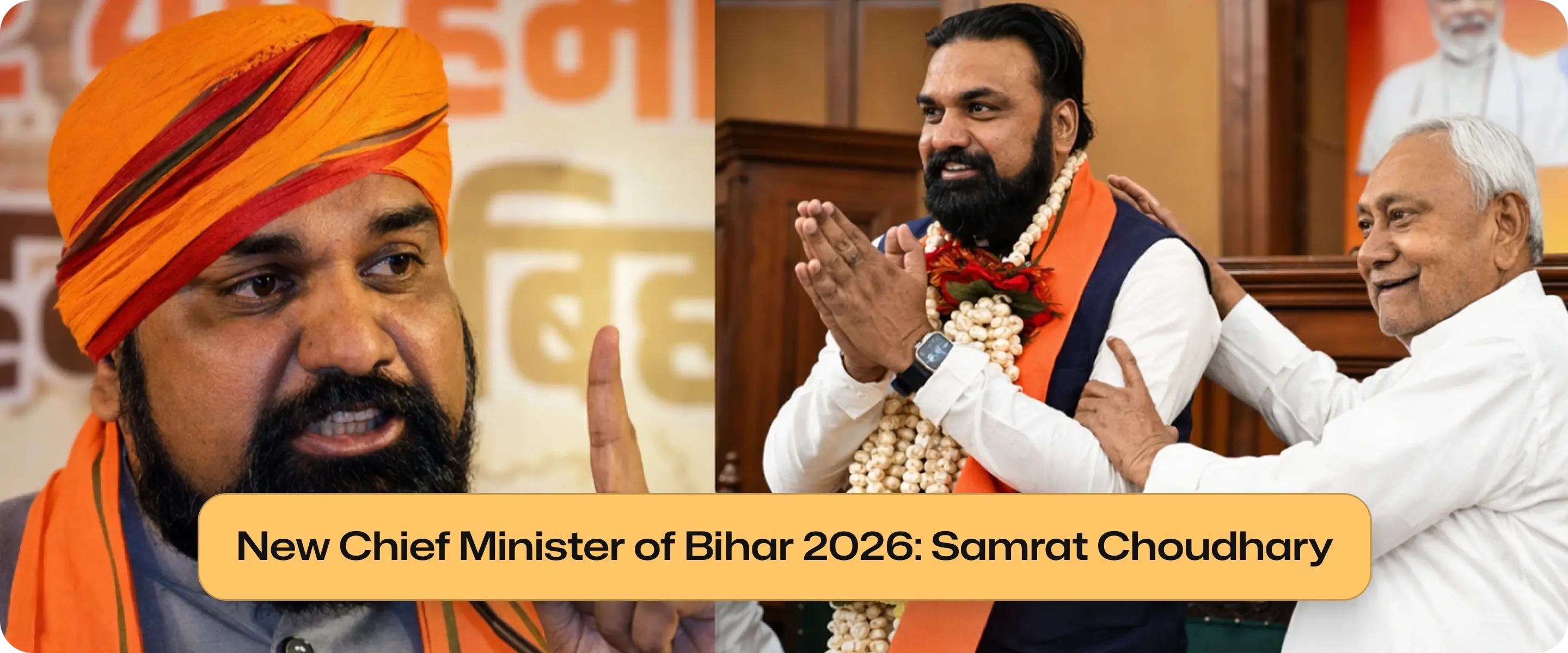
New Chief Minister of Bihar 2026: Samrat Choudhary
Samrat Choudhary was sworn in as the 24th Chief Minister of Bihar on 15 April 2026, becoming the first leader from the Bharatiya Janata Party (BJP) to hold the top post in the state’s history.

Gajendra Singh Godara
4
mins read
Key highlights:
New Chief Minister: Samrat Choudhary (BJP) is the 24th Chief Minister of Bihar
Deputy Chief Ministers: Vijay Kumar Choudhary and Bijendra Prasad Yadav (both from JD-U)
Swearing-in Date: April 15, 2026
Party in Power: NDA (BJP & JD-U Coalition)
First Milestone: First BJP CM in Bihar's history
Reason: former CM Nitish Kumar moves to Rajya Sabha
On April 15, 2026, leader of National Democratic Alliance (NDA) Samrat Choudhary was sworn in as the new chief minister of Bihar.
This marks a political transition in Bihar, as he is the first ever BJP CM succeeding long-time leader in Bihar-Nitish Kumar.
Two senior leaders of JD(U)- Bijendra Prasad Yadav and Vijay Kumar Choudhary also took oath as ministers. They are likely to be Deputy Chief Ministers in the BJP-led NDA government.
Join our WhatsApp Community
In 1912, Bihar was carved out of the Bengal Presidency. The position of chief minister of Bihar has always been important due to the large population of Bihar and its influence on national politics. Exit polls are keenly monitored to understand who will hold this office next.
Post-independence, Indian national congress had a stronghold in Bihar but the position has seen several phases of evolution since:
The Congress Era (1946–1967): Sri Krishna Sinha, called the ‘Bihari Kesari’ was the first chief minister and held the position for 17 years. Under him, Bihar became the first state to abolish the Zamindari system and focus on industrialization.
Frequent changes (1967–1990): This period saw frequent changes in leadership and many parties other than Congress gained power. An important figure is Karpoori Thakur (popularly known as Jan Nayak) who introduced the "Mungerilal Commission" report, which introduced reservations for Backward Classes in the late 1970s.
The Mandal Era (1990–2005): This era focused on upliftment of caste and religious minorities. A key figure of this period is Lalu Yadav Prasad.
Coalition Era (2005–2026): Major development of this period was the 10 terms tenure of Nitish Kumar- the longest serving CM of Bihar who focused on female education, infrastructural development, and stringent crackdown on criminal activities in the state.
Current Political Shift: Samrat Choudhary was sworn in as the Chief Minister of Bihar on 15 April 2026 after Nitish Kumar's decision to step down as Chief Minister and transition to the Rajya Sabha.
The new CM Samrat Choudhary is the first member of BJP to hold the position of Chief Minister in Bihar, signifying a historic shift in the political landscape of the state.
He is a prominent face of the Koeri (Kushwaha) community (an OBC group) in Bihar. His agenda is focusing on caste equality, infrastructure, modern agriculture, and corruption-free administration.
Table: Timeline of Political Eras in Bihar
Period | Dominant Theme | Key Figures |
1947–1967 | Congress Hegemony | Sri Krishna Sinha |
1967–1990 | Socialist Emergence | Karpoori Thakur, BP Mandal |
1990–2005 | Social Justice / Mandal | Lalu Prasad Yadav, Rabri Devi |
2005–2026 | Development / Coalitions | Nitish Kumar |
2026–Present | Shift to BJP Leadership | Samrat Choudhary |
The Chief minister of Bihar is the de-facto head of the executive organ of state government.
Appointment: The governor of Bihar appoints the chief minister as per Article 164. The chosen CM is usually a leader of the party or coalition with majority in Bihar Legislative Assembly.
Nature of Power: While the Governor is the ceremonial head, the real authority rests with the CM and the Council of Ministers.
Bicameral Influence: Unlike most Indian states, Bihar has a bicameral legislature (Assembly and Council). The CM can be a member of either house, but they are primarily accountable to the Assembly.
Add as a preferred Source on Google
Mid-term leadership succession is when a new leader takes over an existing government without the public having to vote in a new election.
This “elevation model” enables political stability that allows the ruling coalition to continue in power without fresh elections.
Samrat Choudhary’s appointment is an example of a specific constitutional path where a sitting Deputy CM or legislator is elevated to the top position mid-term.
This occurred as his predecessor Nitish Kumar resigned from his position so that he could transition to Rajya Sabha.
This has various historical precedents in Indian politics in many states.
Table: Cases of Mid-Term CM Appointments in India
Leader | State | Context of Appointment | Previous Role |
Samrat Choudhary | Bihar (2026) | Predecessor moved to Rajya Sabha | Deputy Chief Minister |
Nayab Singh Saini | Haryana (2024) | Predecessor (ML Khattar) resigned | MP / State Party Chief |
Pushkar Singh Dhami | Uttarakhand (2021) | Internal party leadership shift | MLA |
Bhupendra Patel | Gujarat (2021) | Mid-term leadership overhaul | First-time MLA |
O. Panneerselvam | Tamil Nadu (2016) | Sudden vacancy (Demise of CM) | Finance Minister |
Sushil Kumar Shinde | Maharashtra (2003) | Political stabilization mid-term | Union Minister |
Legal Features of Mid-term Leadership Change
In this specific scenario where there is a mid-term leadership succession, the following legal conditions are to be kept in mind:
The six-month rule: If a leader were not a member of either house, they would have six months to secure a seat to remain in office.
Legislature Party Election: In almost all these cases, the transition is formalized by a unanimous vote from the Legislature Party (MLAs).
Frequently asked question (FAQs)
Who was the first Chief minister of Bihar?
Who is the current Chief minister of Bihar?
Which party does Samrat Choudhary belong to?
Who is the longest-serving Chief minister of Bihar?
Why did Nitish Kumar step down?
Samrat Choudhary symbolises the end of “Nitish-era” in the politics of Bihar and entry of BJP in the leadership. Moreover, his appointment is a case study in mid-term leadership change. As the state navigates this shift, it remains to be seen how the rich social and political legacy of Bihar will be carried forward by the new chief minister.






Research methodology
PadhAI's research methodology ensures every article is accurate, UPSC-ready, and beginner-friendly. We curate current affairs analysis based on UPSC exam relevance by cross-referencing The Hindu, Indian Express, and PIB. General Studies (GS) topics are drafted from NCERTs and standard books such as M. Laxmikanth, Spectrum, and GC Leong, then reviewed by subject matter experts to eliminate factual errors. Additionally, we update aspirants with verified government exam notifications alongside expert blogs suggesting the best resources, syllabus, and comprehensive Prelims and Mains strategies.


Gajendra Singh Godara is an IIT Bombay graduate and a UPSC aspirant with 4 attempts, including multiple Prelims and Mains appearances. He specializes in Polity, Modern History, International Relations, and Economy. At PadhAI, Gajendra leverages his firsthand exam experience to simplify complex concepts, creating high-efficiency study materials that help aspirants save time and stay focused.
No comments yet. Be the first to join the discussion!