Aurangzeb ruled for 49 years, pushed the Mughal Empire to its largest size, and left it close to collapse. Both halves are true, and UPSC wants you to hold them together. This guide covers his reign, religious policy, the Deccan wars, the causes of his failure, and how historians disagree.

Gajendra Singh Godara
Last updated
9
mins read

Born 3 November 1618 at Dahod, Gujarat; died 3 March 1707 at Ahmadnagar, aged 88
Crowned 31 July 1658, taking the title Alamgir, "world seizer"
Longest reign of any Mughal emperor: 49 years
Empire at its peak in 1690, roughly 4 million sq km, Kabul to the Kaveri
Jizya reimposed in 1679, and revoked in the Deccan in 1704
Spent his last 26 years in the Deccan and never returned to Delhi
From 1658 to 1707 the sixth Mughal emperor sat on the throne, and no figure in Indian history draws more argument than Aurangzeb.
Serious study of the Aurangzeb Mughal Empire starts in one place: pulling apart what he did from what people say he did.
Abul Muzaffar Muhi-ud-Din Muhammad Aurangzeb Alamgir was his full title. Shah Jahan and Mumtaz Mahal's third surviving son, he won the crown by beating three brothers in war and locking his father away, then held power longer than any other ruler in the Aurangzeb dynasty line, the Timurid house that had ruled since 1526.
Mughal Aurangzeb usually reduces to a paradox. Under him the empire reached its widest borders ever.
That same reign produced the conditions that pulled it apart within a generation of his death.
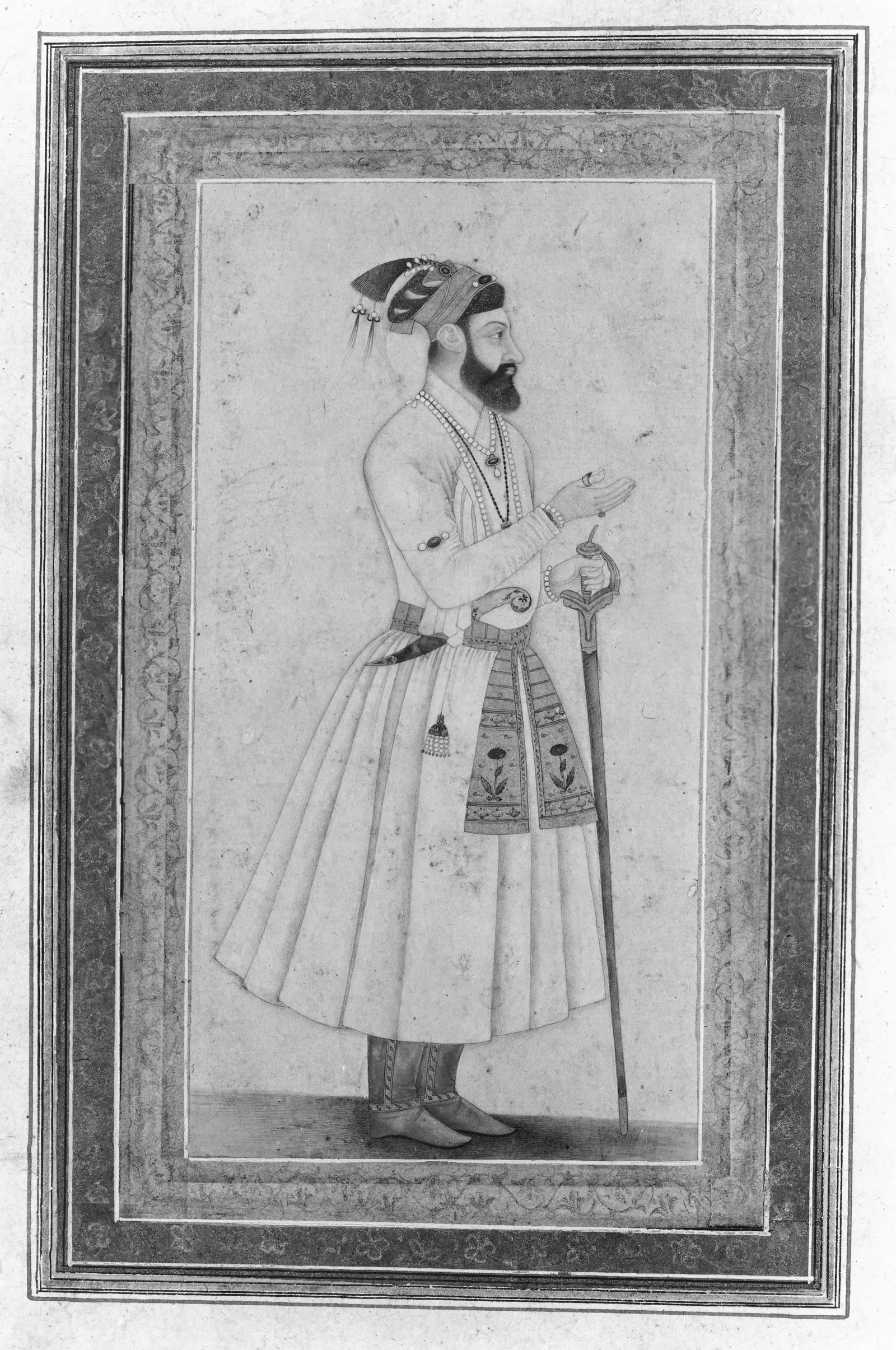
Source: Portrait of Emperor Aurangzeb, seventeenth century. The Metropolitan Museum of Art, CC0.
Point | Detail |
Full name | Abul Muzaffar Muhi-ud-Din Muhammad Aurangzeb |
Regnal title | Alamgir, "world seizer" |
Born | 3 November 1618, Dahod, Gujarat |
Parents | Shah Jahan and Mumtaz Mahal |
Coronation | 31 July 1658, with a formal second coronation in 1659 |
Reign | 1658 to 1707, 49 years |
Empire at peak | About 4 million sq km, in 1690 |
Provinces at his death | About 21 subas |
Died | 3 March 1707, Ahmadnagar |
Buried | Khuldabad, near Aurangabad, in a plain open grave |
A note on his birth date. Some sources, including one of the references for this article, give 24 October 1618.
That figure comes from Jadunath Sarkar, who used the Julian calendar. In 1618 the Julian-Gregorian gap ran to ten days, so 24 October Old Style equals 3 November New Style, the date modern references use. Neither is a mistake, but if a question asks, give 3 November 1618.
Join our WhatsApp Community
What matters for the exam in the Aurangzeb biography is the training, not the anecdotes. Everything the Mughal emperor Aurangzeb later did in the Deccan was shaped here.
Arabic and Persian were part of his education. He memorised the Quran and studied hadith and Hanafi law.
He was also a trained veena player and a skilled calligrapher, which sits awkwardly beside his later withdrawal of court patronage from music. Both things are true.
His apprenticeship was unusually long and unusually hard:
Post | Years |
Viceroy of the Deccan, first term | 1636 to 1644 |
Governor of Gujarat | 1645 |
Governor of Multan and Sindh | 1648 onwards |
Viceroy of the Deccan, second term | 1653 to 1658 |
This matters more than it looks. He knew the Deccan intimately before he was emperor, which is part of why he believed he could finish what Akbar, Jahangir and Shah Jahan had all failed to finish. His confidence was built on real experience, and it was still wrong.
Two personal traits recur in every account. He was austere, famously copying Qurans and sewing caps to earn money he considered lawfully his own rather than drawing on the treasury for personal use.
And he was relentlessly hands-on, reading petitions himself and writing orders in his own hand. That second trait became a structural weakness, as we will see.
Shah Jahan fell seriously ill in September 1657, and the Timurid absence of any succession law did the rest.
Four brothers, one throne, and the principle sometimes summed up as takht ya takhta, throne or coffin.

Battle | Date | Defeated |
Dharmat | April 1658 | Jaswant Singh, for Dara Shikoh |
Samugarh | 29 May 1658 | Dara Shikoh, the decisive battle |
Khajwa | January 1659 | Shah Shuja |
Deorai | April 1659 | Dara Shikoh, finally |
The outcome:
Aurangzeb crowned himself on 31 July 1658 at Delhi, with a grander second coronation in 1659
Shah Jahan was imprisoned in Agra Fort from June 1658 until his death on 22 January 1666
Dara Shikoh was captured, paraded through Delhi, tried for apostasy and executed in 1659
Murad Bakhsh, briefly Aurangzeb's ally, was imprisoned and executed in 1661
Shah Shuja fled to Arakan and disappeared from the record
Why Dara's defeat is treated as a turning point. Dara Shikoh was Shah Jahan's chosen heir and an intellectual who translated the Upanishads into Persian as the Sirr-i-Akbar, arguing that the Vedas and the Quran shared a source.
His defeat is often presented as the moment the empire abandoned Akbar's syncretic direction.
That framing is popular and it is too neat. Dara was a poor general with little administrative record, and the war was fought over power, with religion used by both sides as justification.
A strong Mains answer notes the symbolism and then says why it is only part of the story.
Add as a preferred Source on Google
No Aurangzeb empire map covers more ground than this one: the largest in Mughal history. His reign splits cleanly into two halves.
Northern phase, 1658 to 1681
Campaign | Year | Outcome |
Assam and Cooch Behar, under Mir Jumla | 1661-63 | Occupied, then lost; the terrain defeated them |
Palamau, the Chero kingdom | 1661 | Mughal suzerainty imposed |
Chittagong, under Shaista Khan | 1666 | Arakanese naval power broken; renamed Islamabad |
Deccan phase, 1681 to 1707
South he went in 1681, prompted partly by the rebellion of his own son Prince Akbar, and he never came back north.
He took Bijapur in 1686 and Golconda in 1687 and executed Sambhaji in 1689, and that should have ended it. Instead:
By 1690 the empire ran from Kabul to the Kaveri, about 4 million square kilometres, with roughly 21 provinces.
And 1689 is exactly where the trouble starts, which is the central irony of the reign.
No part of this topic gets examined more, or misused more, so work from the evidence in front of you.
Year | Measure |
1659 | Muhtasibs appointed to enforce public morals under sharia |
1659 | Kalima removed from coins; Nauroz celebration discontinued |
1663 | Order against sati |
1668 | Restrictions on public celebration of Hindu festivals |
1669 | Jharokha darshan discontinued; court patronage of music withdrawn |
1670 | Tuladan, the weighing of the emperor, ended |
1675 | Guru Tegh Bahadur executed at Delhi |
1679 | Jizya reimposed on non-Muslims |
Through the reign | Fatawa-i-Alamgiri compiled, a vast digest of Hanafi law |
1704 | Jizya revoked in the Deccan |
Several of these need context rather than a bare line.
Jizya. Akbar abolished it in 1564. Aurangzeb brought it back in 1679, after 115 years. A poll tax falls on non-Muslims, and people living under it read the measure as a statement about their standing in the empire.
Most accounts leave out the 1704 revocation in the Deccan, and that omission hides something: by the end, political necessity was overriding doctrine.
Temples. Early in the reign, new temple construction faced restrictions while existing temples kept protection, and land grants to Hindu temples and maths continued through the whole reign.
After the Jat, Satnami and Rajput revolts came demolitions, most notably at Mathura and Banaras. Historians split on the reading: doctrine applied consistently, or punishment aimed at centres of political resistance. Both readings have evidence.
Sectarian, not only inter-religious. Shia practice drew his hostility too, and that shaped the campaigns against Bijapur and Golconda, as did Sufi practices he considered innovations. Call his policy simply "anti-Hindu" and you miss half of it.
Guru Tegh Bahadur, 1675. Delhi was where the ninth Sikh Guru was brought, and executed. From that martyrdom came Guru Gobind Singh's founding of the Khalsa in 1699 directly, and the Sikh community turned into an organised military power, one of the empire's most durable problems.
For contrast, see how differently his great-grandfather approached the same question in our model answer on Akbar's religious syncretism.
Hardly a major community in the empire stayed quiet through the whole reign. Each revolt had its own cause, and UPSC tests that distinction.
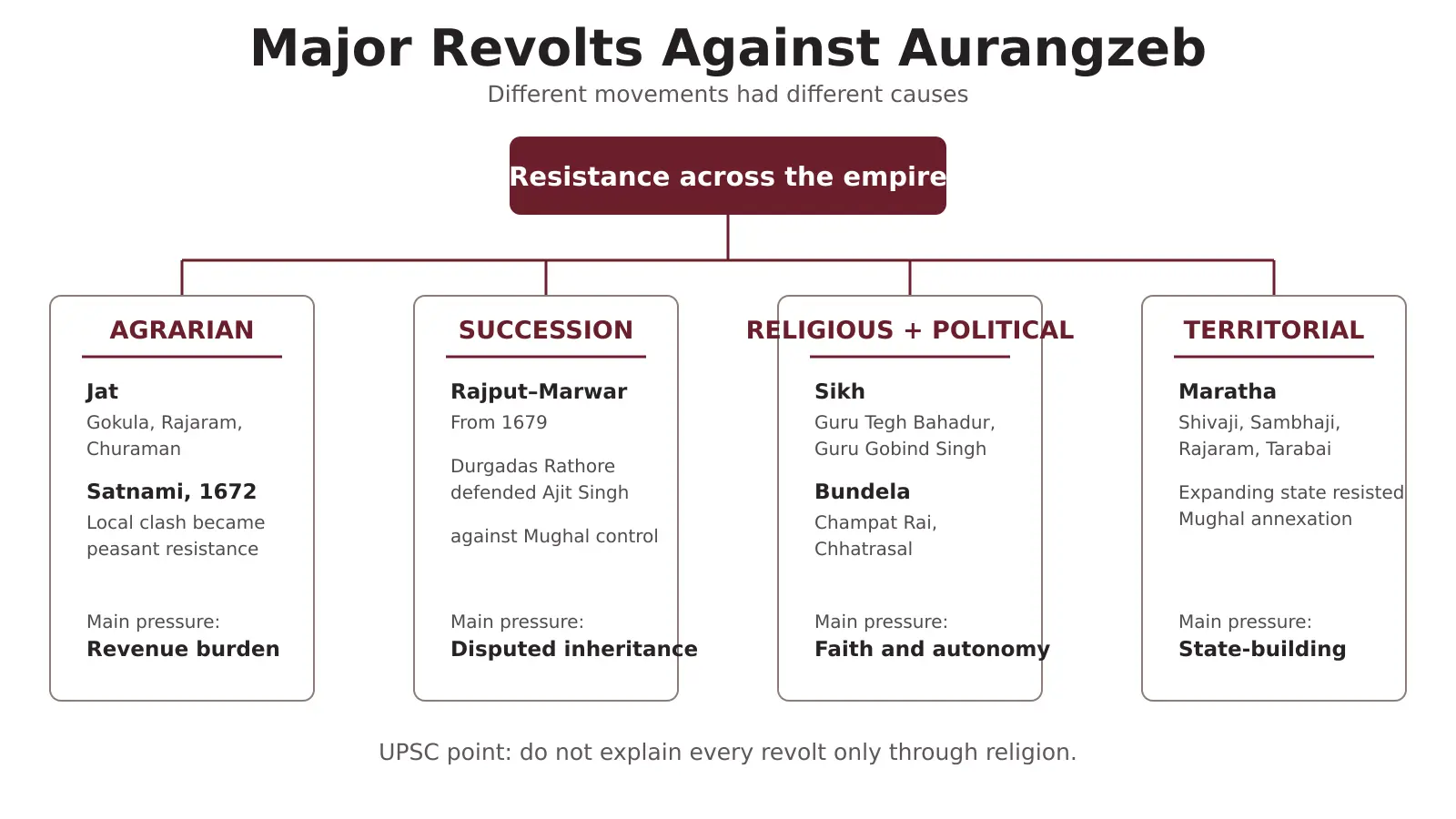
Revolt | Leaders | Principal cause |
Jat (1669, again 1685) | Gokula, Rajaram, Churaman | Agrarian distress and revenue pressure near Mathura and Agra |
Satnami (1672) | Followers of the sect | A local clash that escalated; a peasant and artisan community |
Bundela | Champat Rai, Chhatrasal | Political autonomy and religious grievance |
Sikh (from 1675) | Guru Tegh Bahadur, Guru Gobind Singh | Religious persecution; became organised military resistance |
Rajput, Marwar (from 1679) | Durgadas Rathore, for Ajit Singh | Mughal interference in the Marwar succession |
Maratha (throughout) | Shivaji, Sambhaji, Rajaram, Tarabai | Expanding Maratha statehood and resistance to annexation |
The Rajput rupture matters most structurally. Since Akbar, Rajput chiefs had been load-bearing pillars of the Mughal nobility.
When Jaswant Singh of Marwar died in 1678 without a surviving heir present, Aurangzeb tried to install his own candidate at Jodhpur.
Durgadas Rathore rescued the infant Ajit Singh, Mewar under Rana Raj Singh backed the claim, and a long war followed.
Prince Akbar, Aurangzeb's own son, joined the Rajputs and rebelled in 1681, then fled to Sambhaji and eventually Persia.
Akbar's rebellion is what pulled Aurangzeb south in 1681. The thread from a disputed succession in Marwar to the emperor's 26-year absence from Delhi is one of the most useful causal chains in the whole topic.
The reign was decided in the Deccan campaigns, and the phrase historians use for them comes from Jadunath Sarkar, who wrote plainly: "The Deccan ulcer ruined Aurangzib." He was consciously echoing Napoleon on Spain.
Why the Deccan defeated him when the conquests succeeded.
Bijapur fell in 1686, Golconda in 1687, and Sambhaji was executed in 1689. That should have closed the book. Instead:
Annexing the sultanates removed the buffer. Bijapur and Golconda had absorbed Maratha pressure. Once they were gone, the Mughals faced the Marathas directly across a long frontier.
The Marathas fought a war the Mughal army could not win. Guerrilla raids, fort warfare, no fixed capital to capture. After Sambhaji's execution, Rajaram continued the war and after his death Tarabai carried it on with real effect. Aurangzeb took forts and could not hold the countryside.
The cost was unsustainable. Army expenditure under Aurangzeb ran at roughly double Shah Jahan's. The treasury that built the Taj Mahal was being spent on sieges that produced nothing permanent.
The north was left unattended for 26 years. Provincial administration decayed, zamindars asserted themselves, and revenue collection shifted increasingly to revenue farming, where contractors extracted directly from peasants. That was worse for the cultivator and worse for the state.
His sons were kept at arm's length. Suspicious of them after Prince Akbar's rebellion, he gave none of them real administrative training. When he died, they fought, and none was equipped to govern.
Ahmadnagar, 3 March 1707: he died there at 88, having ruled longer than most people then lived. His will asked for a plain grave paid for from money he had earned copying Qurans. Khuldabad holds his grave.
A standard Mains question. Grouping beats listing here, and no single cause can carry the answer.
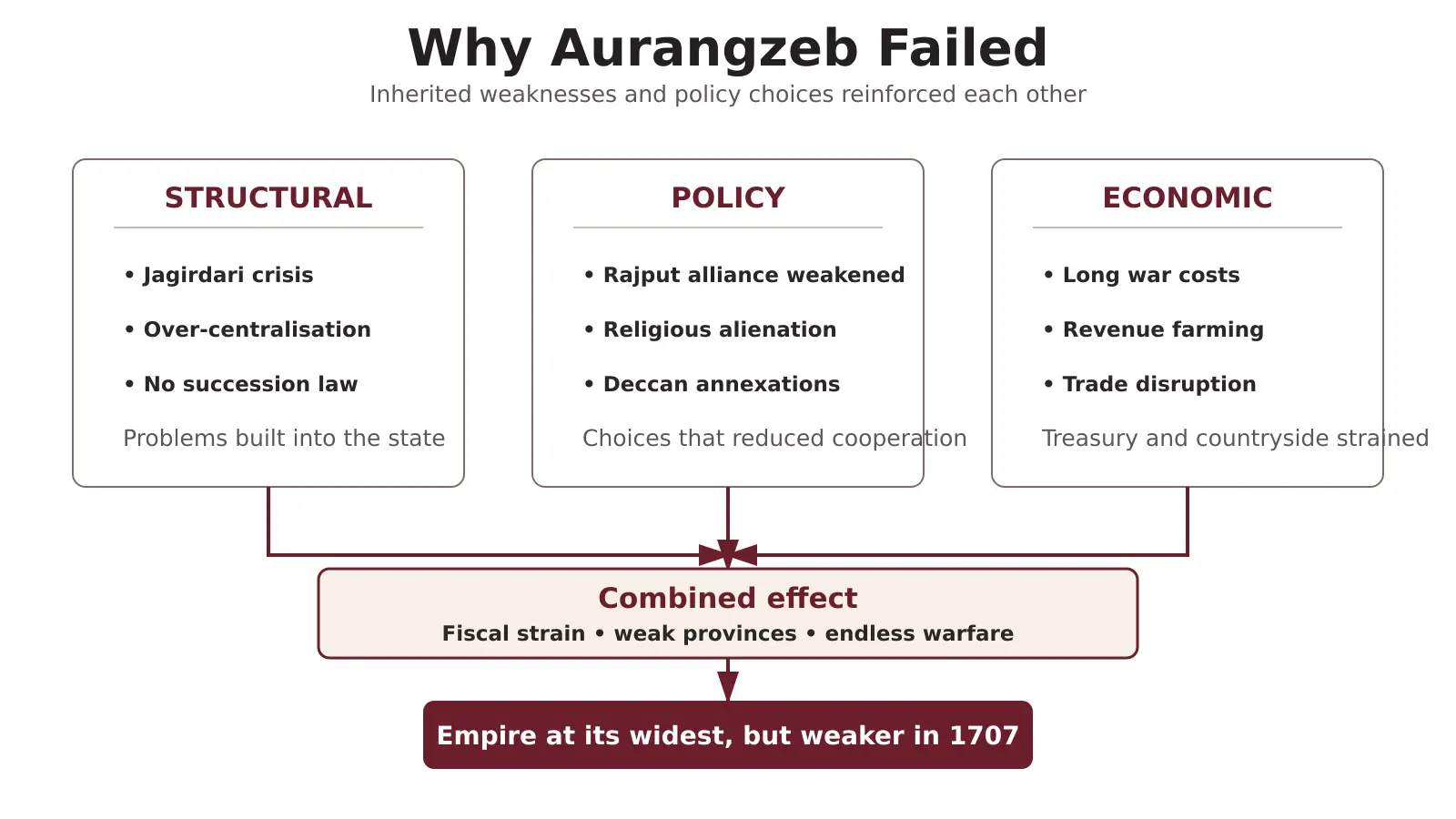
Structural causes
The jagirdari crisis. Mansabdars outnumbered the assignable revenue land available to pay them. Deccan conquests added nobles faster than they added productive jagirs, so ranks became claims on income that did not exist.
Over-centralisation. Petitions went through his own hands and every decision was his. Ministers became clerks. A system resting wholly on one man's attention breaks the moment that attention moves elsewhere, and his sat in the Deccan for 26 years.
No succession law. Civil war closed every reign, and this one guaranteed another.
Policy causes
Loss of the Rajput alliance, which had underpinned Mughal power since Akbar.
Religious measures that alienated subjects and nobles, whatever their intent. Jizya and the temple demolitions carried a political cost even where there was a legal argument.
The Deccan policy itself, which destroyed the buffer states and created a direct, unwinnable confrontation.
Economic causes
Military expenditure roughly double that of the previous reign, sustained for decades.
Revenue farming took the place of Akbar's assessed system, squeezing peasants and destabilising the agrarian base. Irfan Habib's work on the agrarian system treats this peasant distress as central.
Trade disruption in the Deccan and on the western coast, including the repeated sacking of Surat.
The honest summary: structural problems came to him inherited, his policies made several worse, and his long life let him watch all of them ripen together.
Failure here does not mean incompetence. He was a capable general and an exceptionally diligent administrator. He was applying those abilities to a problem that could not be solved by either.
School essays and good Mains answers part company at the historiography. Name the positions.
Historian | Position |
Jadunath Sarkar | The classic view. Religious bigotry alienated the majority and caused the decline. His History of Aurangzib remains the most detailed narrative account |
Satish Chandra | The crisis was in the jagirdari system. Too many nobles, too few jagirs, regardless of religious policy |
M. Athar Ali | In The Mughal Nobility under Aurangzeb, shows the proportion of Hindu nobles actually rose during his reign, which complicates a purely communal reading |
Irfan Habib | Locates the crisis in the agrarian system and peasant resistance to revenue extraction |
Audrey Truschke | In Aurangzeb: The Man and the Myth (2017), argues he acted largely as a seventeenth-century ruler pursuing power, and that both the hero and villain readings are modern projections |
These are not five ways of saying the same thing, and you should not pretend they reconcile neatly.
The useful framing for an answer is that religious policy and structural crisis were not alternatives.
Jizya and temple demolition alienated the groups whose cooperation the jagirdari system needed, and the Deccan wars deepened the fiscal crisis that made the alienation unaffordable. The causes compound.
One point of care. Aurangzeb is a live political argument in India today, and material about him circulates with a thumb on the scale in both directions. For an exam answer, cite historians rather than adjectives.
A short list of Aurangzeb facts that get tested or that correct common errors.
Shah Jahan and Mumtaz Mahal's sixth child was he, and their third surviving son. Sources use both descriptions and both are correct.
He played the veena proficiently yet withdrew court patronage from music. Music treatises continued to be written in his reign.
Bibi ka Maqbara at Aurangabad, often called the second Taj, was built by his son Azam Shah for Aurangzeb's wife Dilras Banu Begum. It is commonly misattributed to Aurangzeb himself.
The Moti Masjid inside the Red Fort at Delhi was built during his reign.
People called him Zinda Pir, the living saint, for his personal austerity.
The mansabdari system was Akbar's, not his. Some lists place it under Aurangzeb; that is wrong.
Three years before his death, in 1704, jizya was revoked in the Deccan.
North India never saw him again after 1681.
He was 88 at his death, having outlived most of his own sons' expectations of the throne.
His will asked that his funeral be paid for from money he had earned himself, and that his grave be left open to the sky.
Two further corrections worth carrying. The Fatawa-i-Alamgiri was a compilation, not a code he authored: a team of jurists digested existing Hanafi opinion under his patronage.
And his withdrawal of court patronage from music did not end Indian music, as is sometimes claimed; musicians moved to provincial courts and the writing of music treatises continued through his reign.
Medieval history in GS Paper I is where Aurangzeb history sits, and few reigns in the syllabus get examined as reliably.
Prelims tests precise attribution:
Years: 1658 coronation, 1675 Guru Tegh Bahadur, 1679 jizya, 1686 Bijapur, 1687 Golconda, 1689 Sambhaji, 1707 death
Battles of the succession war and who was defeated at each
Revolt paired with leader and with cause
Who built Bibi ka Maqbara, who introduced mansabdari
Mains asks evaluation:
Explain the causes of the failure of Aurangzeb
Whether his religious policy or structural crisis better explains Mughal decline
His Deccan policy as a political blunder
Whether he was a departure from or a continuation of earlier Mughal practice
Prepare with a two-column note: evidence down one side, the historian who reads it that way down the other. Build Mains answers using the structure in our guide to UPSC Mains answer writing practice, and pull past questions by topic from our previous year questions.
For the wider dynasty and the reigns before his, see our guide to the Mughal Empire, and for the southern power he spent his life fighting, the Vijayanagar Empire page gives the earlier Deccan context. The rest of the period sits on the medieval history hub.
One direction or the other, the Aurangzeb story usually gets told as a morality tale. The history beats both versions for interest.
The real Aurangzeb history is this. A disciplined, austere, genuinely capable ruler inherited an empire with structural flaws he did not create, spent 49 years applying enormous personal effort to it, won almost every campaign he fought, and left it weaker than he found it. That is not a story about a villain or a hero. It is a story about an institution that had outgrown the system designed to run it.
For the exam, three things carry the marks. The date spine, from 1658 to 1707. The grouped causes of failure, structural, political and economic rather than a flat list. And the historiography, named and attributed, because that is what turns a narrative into an argument.
Frequently asked question (FAQs)
Who was Aurangzeb and when did he rule?
Why did Aurangzeb reimpose the jizya?
What is meant by the Deccan Ulcer?
Explain the causes of the failure of Aurangzeb.
Was Aurangzeb intolerant of Hindus?


Gajendra Singh Godara
Ex-UPSC Aspirant | Exam Preparation Expert
Gajendra Singh Godara is an IIT Bombay graduate and a UPSC aspirant with 4 attempts, including multiple Prelims and Mains appearances. He specializes in Polity, Modern History, International Relations, and Economy. At PadhAI, Gajendra leverages his firsthand exam experience to simplify complex concepts, creating high-efficiency study materials that help aspirants save time and stay focused.
No comments yet. Be the first to join the discussion!