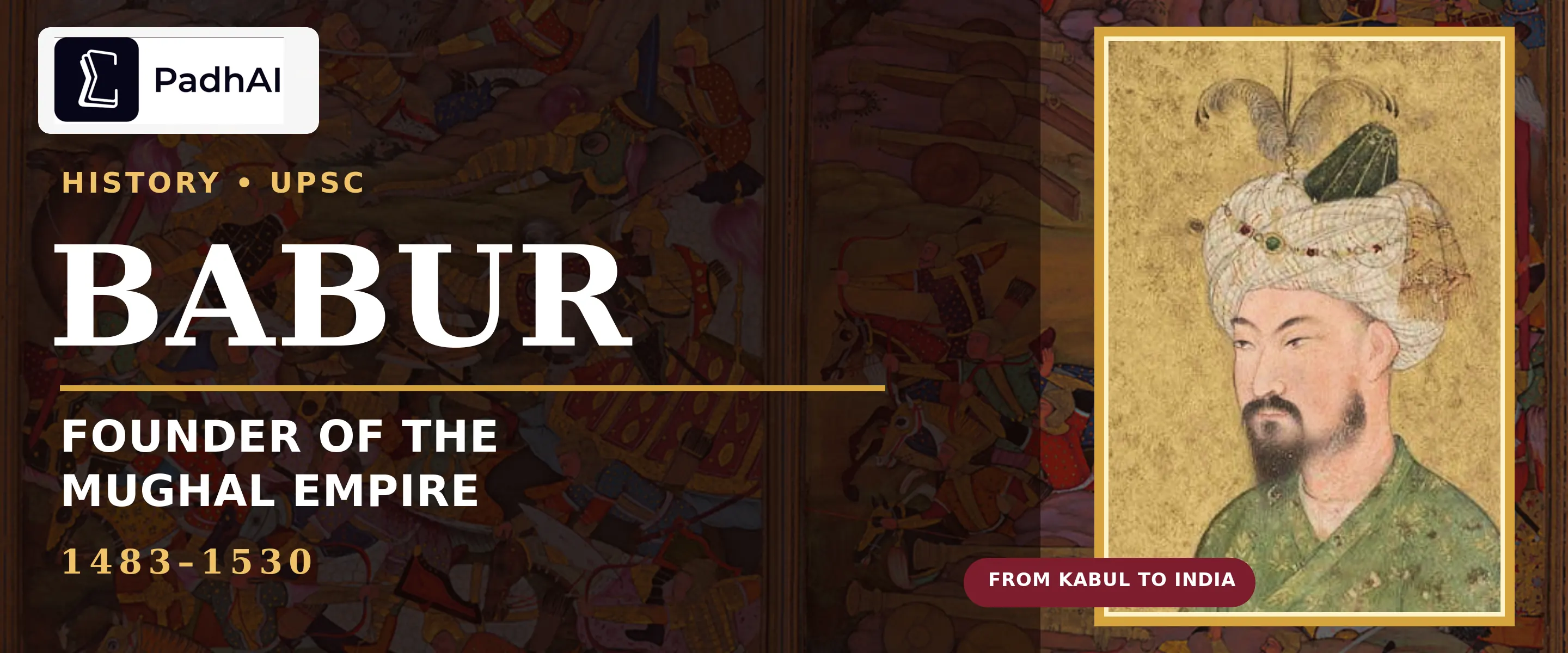
Babur inherited Fergana at the age of eleven. He later lost his kingdom, conquered Samarkand three times, and lost it just as many times. When the Uzbeks blocked his path in Central Asia, he sought a new territory in India. He died four years after his victory at Panipat. The dynasty he founded lasted more than three centuries.

Gajendra Singh Godara
Last updated
8
mins read
Fact | Information |
Full Name | Zahir-ud-din Muhammad Babur |
Birth | February 14, 1483, Andijan, Fergana Valley |
Father | Umar Shaikh Mirza II, emir of Fergana |
Mother | Qutlugh Nigar Khanum, daughter of Yunus Khan |
Ancestry | Timur on his father’s side and Genghis Khan on his mother’s side |
Accession to the throne of Fergana | 1494, at the age of eleven |
Conquest of Kabul | 1504 |
Royal title | Padshah |
Founding of the Mughal Empire | April 21, 1526, following the First Battle of Panipat |
Reign in India | From 1526 to 1530 |
Death | December 26, 1530, in Agra, at the age of 47 |
Burial | First in Agra; later in Bagh-e-Babur, Kabul |
Memoirs | Baburnama, written in Chagatai Turkish |
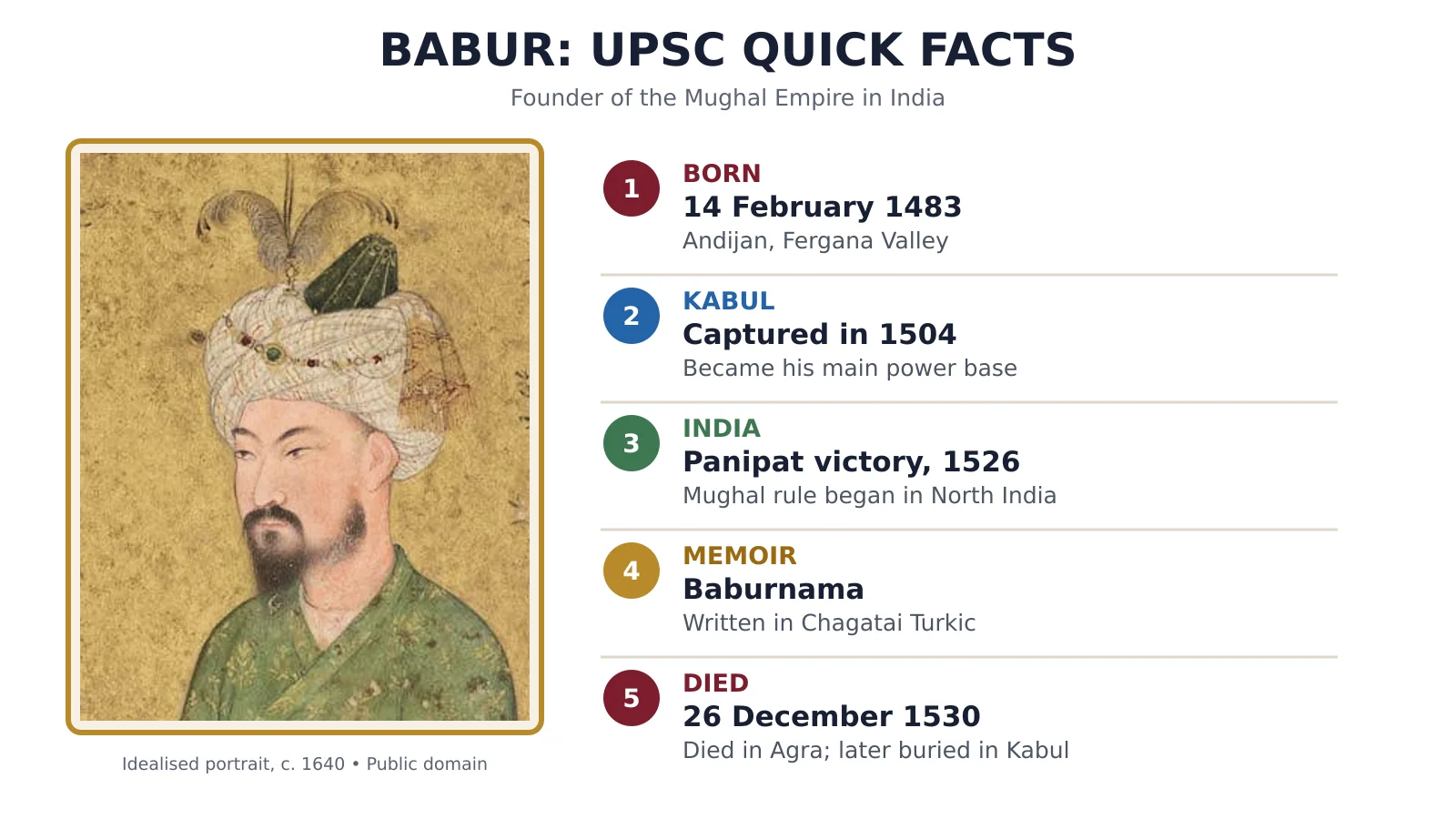
Babur was a Timurid prince and the founder of the Mughal Empire in India. His reign in India lasted barely four years and was spent largely on military campaigns.
His birth name was Zahir-ud-din Muhammad. The meaning of his nickname, Babur, remains a subject of debate.
The most widespread interpretation links it to the Persian babr, which means tiger or leopard and appears in Firdausi’s Shahnameh.
Wheeler Thackston proposed another origin: an Indo-European root related to the word “beaver,” based on the pronunciation bāh-bor. Translating it as “lion” does not correspond to either of these two explanations.
His career included more defeats than the title of “founder of an empire” might suggest. He lost Fergana and never managed to hold on to Samarkand. India became his alternative when reclaiming Central Asia was no longer feasible.
Nor did he have time to consolidate a stable imperial administration. The mansabdari system and the major fiscal reforms belong to later periods, especially the reign of Akbar.
Babur did leave a personal account of his experiences. The Baburnama recounts his victories, but also his humiliations, preferences, and flaws. Thanks to these memoirs, we can learn more than just the dates of his conquests.
Join our WhatsApp Community

Babur was born in Andijan, a city in the Fergana Valley located in present-day Uzbekistan. Fergana is the name of the region, not that of his birthplace.
The date commonly used in Indian books is February 14, 1483. Some works indicate February 23: the first date corresponds to the Julian calendar, and the second to its Gregorian equivalent.
When preparing for the UPSC, it is best to remember the commonly accepted date of February 14.
Who was Babur’s father?
His father was Umar Shaikh Mirza II, emir of Fergana and great-great-grandson of Timur. He died on June 10, 1494, when the dovecote in which he was staying collapsed into a ravine.
Babur, his eldest son, inherited the throne at the age of eleven. Sources that state he was twelve years old typically use the Islamic lunar calendar rather than the solar calendar.
His mother, Qutlugh Nigar Khanum, was the daughter of Yunus Khan and a descendant of Genghis Khan through the Chagatai branch.
Babur’s Dual Ancestry
Family Line | Ancestor | Significance |
Paternal | Timur or Tamerlane | Underpinned his political legitimacy and his Timurid identity |
Maternal | Genghis Khan, through Yunus Khan | Explains the dynasty’s association with the name “Mogul,” derived from “Mongol” |
Babur considered himself a Timurid. In his memoirs, he speaks of the Mongols with open antipathy. The term “Mughal” originated outside the dynasty; the imperial family preferred the name Gurkani, related to Timur’s title.
Before reaching India, Babur spent more than twenty years attempting to reclaim his ancestors’ territories in Central Asia.
His defeats led him to settle in Kabul and seek other opportunities for expansion.
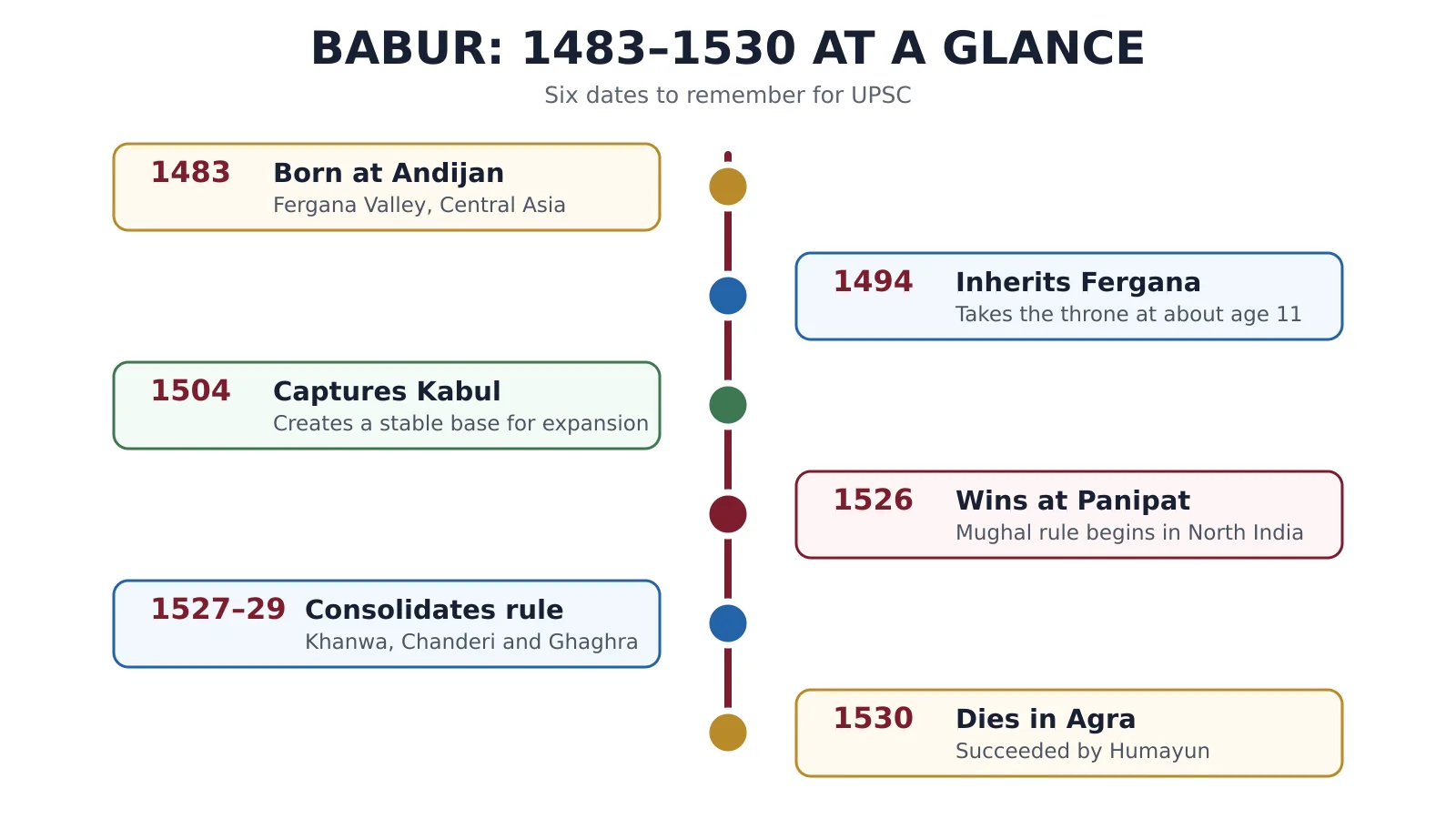
Year | Event |
1494 | Inherits Fergana at the age of eleven |
1497 | Conquers Samarkand; holds it for about one hundred days and loses Fergana |
1501 | Loses Samarkand again following his defeat by Shaybani Khan at Sar-e-Pul |
1504 | Conquers Kabul and establishes his base there |
1507 | Adopts the title of Padshah |
1510 | Shah Ismail of Persia defeats and kills Shaybani Khan at Merv |
1511 | He recaptures Samarkand with Safavid assistance |
1512 | The defeat at Ghazdewan puts an end to his final attempt to recapture Samarkand |
Why Samarkand Was Important
Samarkand had been the capital of Timur. Controlling it brought prestige and reinforced Babur’s legitimacy as a Timurid prince.
He conquered it three times, but was never able to hold it. In 1511, he recaptured the city with the support of the Safavid Shah Ismail I. In exchange, he agreed to include Shi’ite symbols on coins and in the khutbah, the Friday prayer sermon.
The decision provoked opposition from a large portion of the Sunni population and weakened his rule. The defeat at Ghazdewan in 1512 put an end to his aspirations.
The Uzbeks dominated Transoxiana, and following the Safavid defeat at Chaldiran in 1514, Babur could no longer count on a Persian intervention capable of expelling them. Kabul remained his main kingdom.
Its location was strategic, but its revenues were insufficient to support the army, the nobles, and the members of the Timurid family.
Add as a preferred Source on Google
The decision to invade India was driven by four factors:
Kabul’s revenues were insufficient. Kabul, Kandahar, and Badakhshan did not generate enough money to support his troops and reward his nobles.
Babur was aware of India’s wealth. Stories about Timur’s sacking of Delhi in 1398 were part of his family’s collective memory.
He laid claim to territories in the Punjab. He considered certain areas conquered by Timur to be part of his dynastic inheritance.
Northern India was divided. Ibrahim Lodi had provoked discontent among the Afghan nobility with his attempts to strengthen central authority. Daulat Khan Lodi and Alam Khan Lodi asked Babur for help against the sultan.
Did Rana Sanga Invite Babur?
Babur stated in the Baburnama that Rana Sanga of Mewar had also invited him to fight against Ibrahim Lodi.
There is no independent confirmation of this account. Furthermore, Babur used this claim to justify his subsequent conflict with Sanga.
Therefore, it should be treated as a statement by Babur himself, not as a proven fact.
Early Incursions into India
Year | Location or Campaign |
1519 | Bajaur and Bhira |
1520 | Sialkot |
1524 | Lahore |
1525–1526 | Decisive campaign against Ibrahim Lodi |
Element | Information |
Date | April 21, 1526 |
Location | Panipat, present-day Haryana |
Opponents | Babur and Ibrahim Lodi, Sultan of Delhi |
Babur’s army | Approximately 12,000 to 15,000 soldiers |
Lodi’s army | Much larger and equipped with war elephants |
Outcome | Death of Ibrahim Lodi and the occupation of Delhi and Agra |
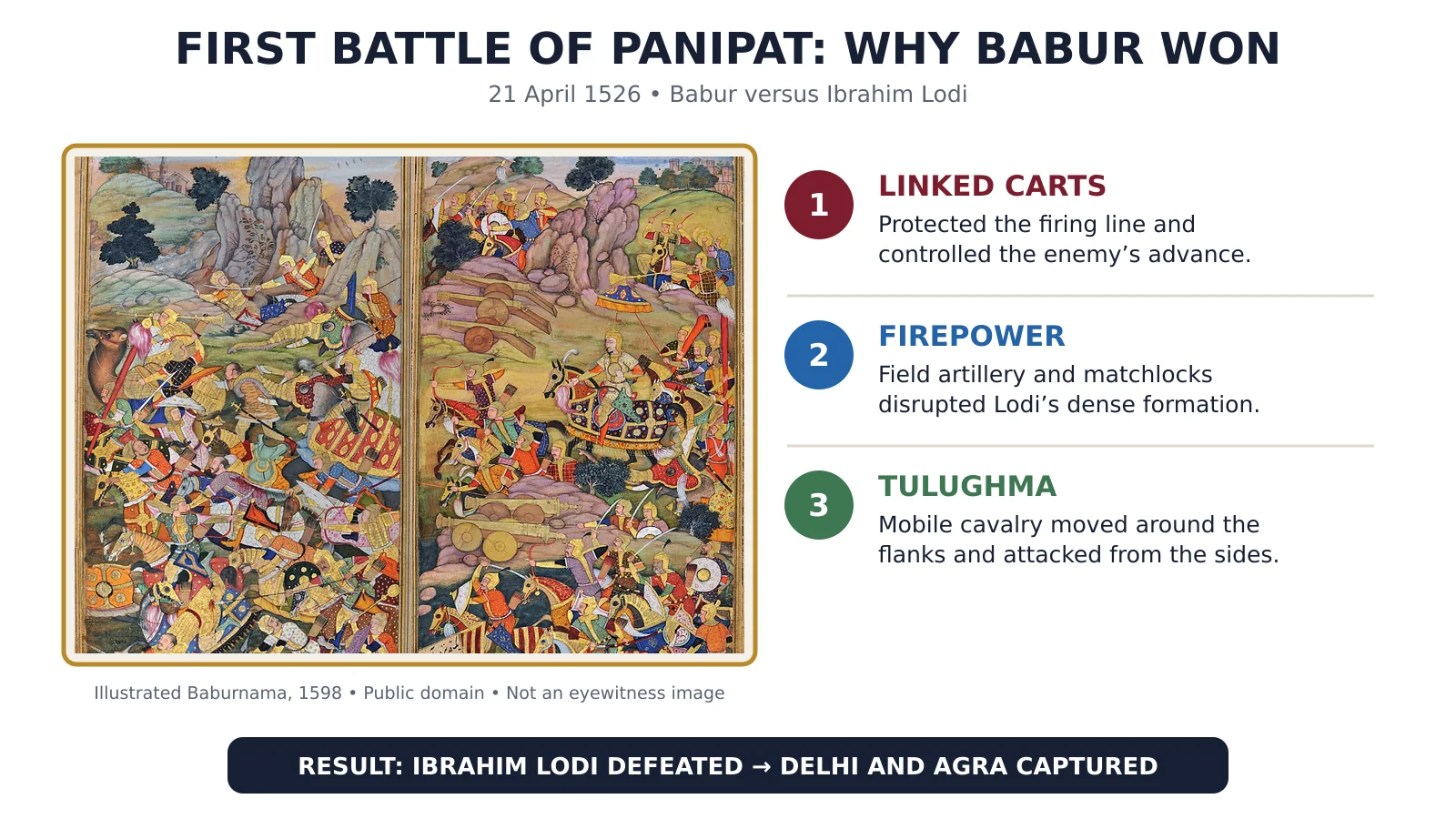
Babur defeated a much larger army using prepared defenses, artillery, and cavalry attacks from the flanks.
Tactics Used by Babur
He protected one flank with the city of Panipat and the other with a trench filled with branches and felled trees.
He positioned some seven hundred carts tied together with straps. This Rum or Ottoman device left gaps for firing matchlock weapons.
Ustad Ali Quli and Mustafa Rumi commanded the artillery. The noise and gunfire disorganized Lodi’s elephants, which further increased the chaos in his own ranks.
He employed the tulughma tactic: the cavalry surrounded the enemy and attacked its flanks and rear, while the center remained pinned down against the defenses. Ibrahim Lodi’s troops were concentrated in an area that was far too narrow. Their numerical superiority was rendered useless because they could neither deploy nor maneuver.
Outcome of the Battle
Ibrahim Lodi died on the battlefield. Babur captured Delhi and Agra, and the treasury of Agra alleviated his financial problems.
The diamond given to Humayun by the family of the Raja of Gwalior is generally identified as the Koh-i-Noor.
The battle lasted less than a week. The armies remained facing each other for several days while Babur prepared his defenses, but the fighting ended in a matter of hours, before noon.
Panipat handed Delhi and Agra over to Babur. He still had to confront the Rajput coalition and the Afghans who rejected his authority.

Battle | Date | Opponent | Outcome |
Khanwa | March 16, 1527 | Rana Sanga of Mewar and his allies | Defeat of the confederation and consolidation of Babur’s power in the Delhi and Agra region |
Chanderi | January 1528 | Medini Rai | Conquest of Chanderi and weakening of Rajput resistance |
Ghaghra | May 6, 1529 | Forces of Mahmud Lodi and Nusrat Shah of Bengal | Containment of Afghan resistance in the east and subsequent agreements |
Khanwa and the Survival of the New Kingdom
Panipat brought an end to Lodi rule. Khanwa eliminated a threat that could still have driven Babur out of India.
This distinction explains why Khanwa can be considered more decisive for the survival of the new kingdom.
Rana Sanga assembled a broad Rajput coalition and received support from Mahmud Lodi, Ibrahim Lodi’s younger brother, and from Hasan Khan Mewati.
His initial success at Bayana weakened the morale of Babur’s men. Many were weary of the campaigns and wanted to return to Kabul. Babur attempted to stem the desertions through several public gestures:
He declared the campaign a jihad.
He renounced wine and ordered the vessels in which it was stored to be broken.
He abolished a customs tax that affected Muslim merchants. He also adopted the title of Ghazi.
These measures served both a political and military purpose: to convince his troops to remain in India. Their religious dimension cannot be separated from the crisis of morale within the army.
At Khanwa, he once again combined linked chariots, trenches, firearms, and cavalry maneuvers on the flanks.
Rana Sanga fled the battlefield and died shortly afterward. The account that his own nobles poisoned him should be treated with caution.
Why Ghaghra Was Not a Complete Victory
Babur forced the Afghan and Bengali forces to retreat, but he failed to destroy them.
He ultimately agreed to settlements with the Afghan chieftains and a treaty with Nusrat Shah. Ghaghra contained the threat in the east.
It did not eliminate all resistance, so describing it as a definitive victory exaggerates its outcome.
Babur wrote the Baburnama, also known as the Tuzuk-i-Baburi, in Chagatai Turkish, his native language. Abdul Rahim Khan-i-Khanan translated it into Persian in 1589, during the reign of Akbar.
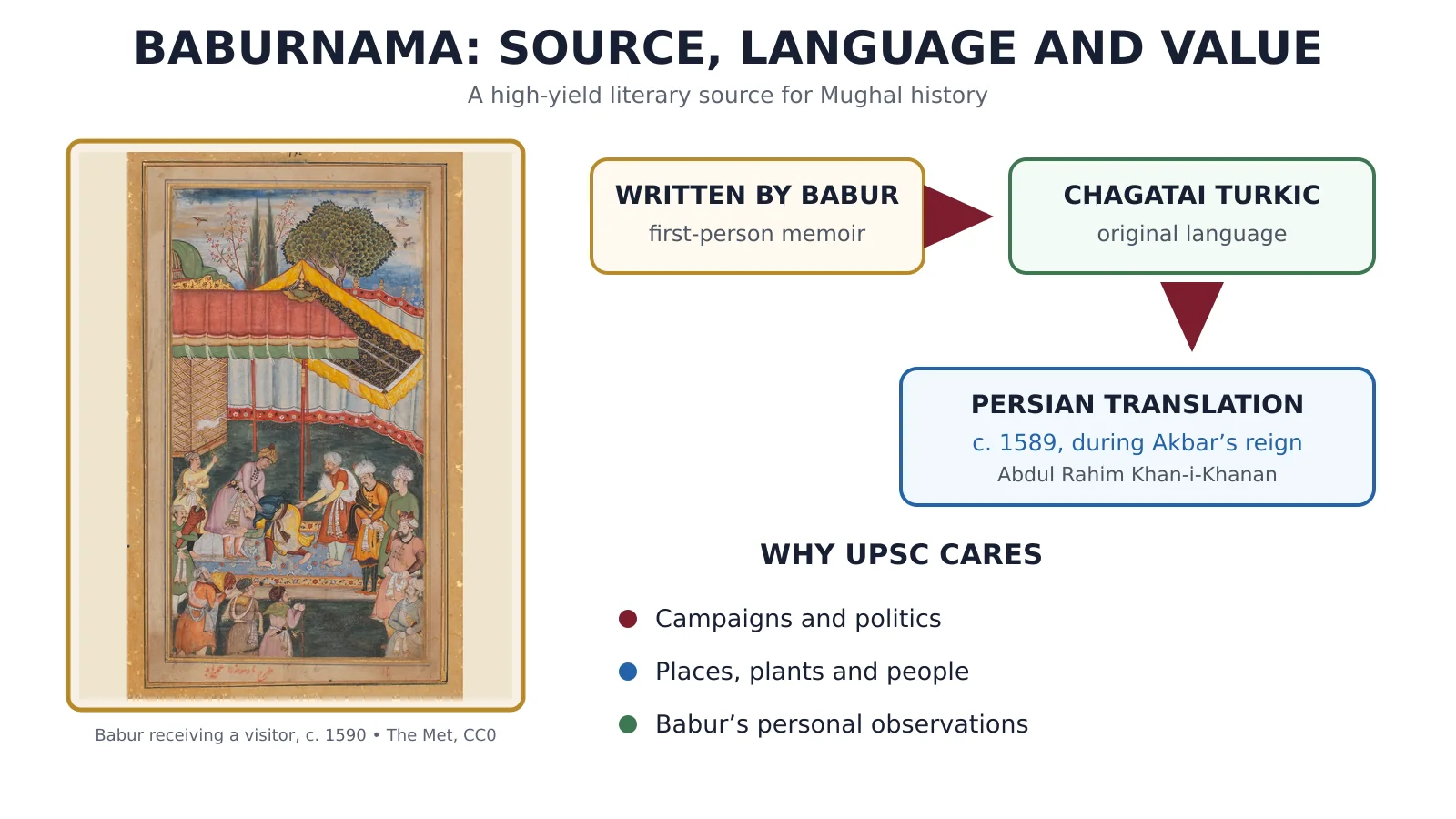
The book departs from the usual tone of a court chronicle. Babur recounts defeats and humiliations without hiding them. He describes the fruits of Fergana, the birds of India, and the rhinoceroses.
He also acknowledges his habits and weaknesses, including his fondness for drinking. His comments on India are often unfavorable.
He complains about the heat, the lack of ice, and the absence of the gardens and waterways to which he was accustomed.
Babur also designed a script called Khatt-i-Baburi and composed the Mubaiyan, a poem on Islamic law.
Aspect | Key Fact |
Work | Baburnama or Tuzuk-i-Baburi |
Original language | Chagatai Turkish |
Translator into Persian | Abdul Rahim Khan-i-Khanan |
Translation | 1589, during the reign of Akbar |
Babur built very little in India. His brief reign and continuous military campaigns left him little time.
His most recognizable contribution was the charbagh, a traditional Persian garden divided into four sections by water channels.
The Aram Bagh, also known as Ram Bagh, in Agra is generally considered the first Mughal garden in India. The design later appeared in numerous imperial complexes, including the Taj Mahal.
Structure or Design | Connection to Babur |
Aram Bagh or Ram Bagh, Agra | Garden associated with his reign and with the introduction of the charbagh design |
Kabuli Bagh Mosque, Panipat | Built to commemorate the victory of 1526 |
Jama Masjid, Sambhal | Mosque associated with his reign |
Babur appreciated poetry, natural history, and gardens with flowing water. His preferences influenced court culture. In administration, however, he retained much of the structure he found under the Lodis.
Babur fell seriously ill in late 1530. A family tradition recounts that Humayun was also ill and that Babur stood by his bedside, praying to God to transfer his son’s illness to his own body. Humayun recovered, and Babur’s condition worsened.
This is a famous episode in dynastic tradition. It cannot be presented as a verified medical explanation. Babur died in Agra on December 26, 1530, at the age of 47.
He was first buried in that city. Later, in accordance with his wishes, his remains were transferred to Bagh-e-Babur in Kabul.
What Humayun Inherited
Humayun received domains stretching from Kabul to the Ghaghra River and from the Himalayas to Gwalior. The size of the territory masked serious problems:
There was no stable imperial administration to hold the conquered territories together.
The Afghan nobility had been defeated but not reconciled with the new regime.
The Timurid tradition of dividing domains among family members fueled the ambitions of Kamran, Askari, and Hindal.
A faction at court had attempted to remove Humayun from the line of succession before Babur’s death. In 1540, Humayun lost the kingdom to Sher Shah Suri.The unfolding of this crisis and the subsequent restoration of power are part of the history of the Mughal Empire.
Babur’s campaigns altered the political balance of power in northern India. Panipat brought an end to the Lodi dynasty’s rule; Khanwa defeated Rana Sanga’s coalition.
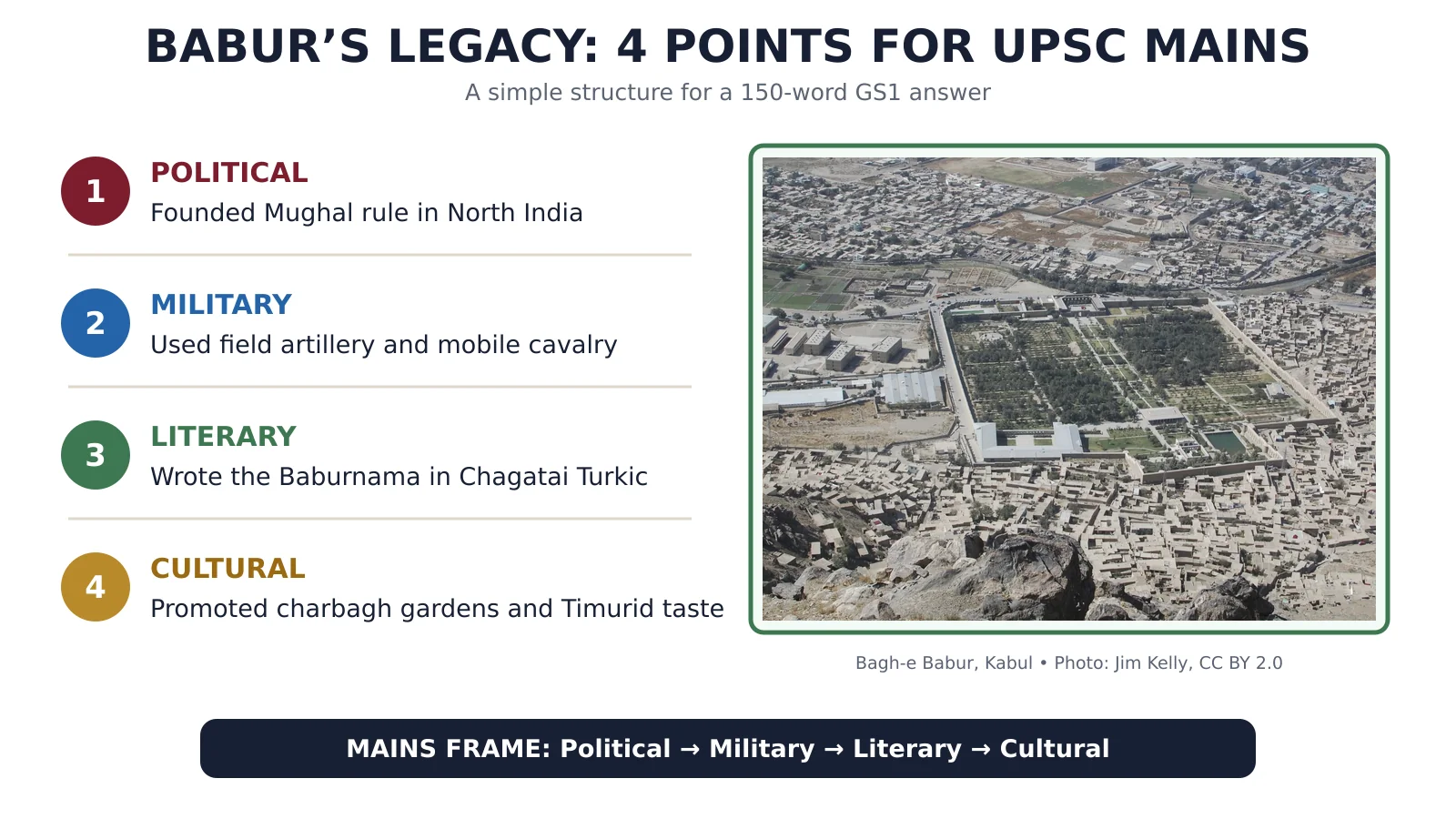
His successors were able to build a territorial empire upon these conquests.
Contribution | Historical Significance |
Defeat of the Lodis and Rana Sanga’s coalition | Reduced the main threats to Babur’s rule in northern India |
Artillery and matchlock weapons | Demonstrated the effectiveness of combining gunpowder, mobile defenses, and cavalry |
Control of Kabul | Allowed for the integration of the northwestern defenses with the territories conquered in India |
Trade routes | Strengthened ties with the caravan networks of Central Asia and Persia |
Title of Padshah | Expressed sovereign authority that did not depend on investiture by the caliph |
Gunpowder was already known in India before Panipat. Babur did not introduce it from scratch: his campaigns demonstrated how to use it effectively in open battle.
Maintaining cannons, specialists, and supplies required money, which favored rulers with greater revenues.
Kabul, and later Kandahar, connected northern India with routes leading to China, Persia, and the Mediterranean.
Their incorporation into the Mughal domains also strengthened the defense of the northwestern frontier.
Adopting the title of Padshah and dispensing with an investiture by the caliph affirmed Babur’s authority.
However, it would be incorrect to call him the first Muslim ruler of India to act independently of the Caliphate. Some Delhi sultans had already done so.
Babur is part of the medieval history section of GS Paper I. In the Prelims, it is important to distinguish between exact facts and debatable claims.
Facts to Memorize
Andijan was his birthplace; Fergana is the region.
The date of birth commonly cited in Indian textbooks is February 14, 1483.
The Battle of Panipat took place in 1526; the Battle of Khanwa in 1527; the Battle of Chanderi in 1528; and the Battle of Ghaghra in 1529.
The Baburnama was written in Chagatai Turkish, not in Persian.
Abdul Rahim Khan-i-Khanan produced the Persian translation during Akbar’s reign.
Tulughma refers to the encircling maneuver; the rumi formation refers to a defense using linked chariots.
Ustad Ali Quli and Mustafa Rumi commanded the artillery.
The invitations from Daulat Khan Lodi and Alam Khan Lodi must be distinguished from the unsubstantiated claim regarding Rana Sanga.
Topics for a Mains Answer
Topic | Approach to the Answer |
Panipat vs. Khanwa | Distinguish between the initial conquest and the survival of the new kingdom |
Babur’s Contributions | Distinguish his military and cultural achievements from Akbar’s later reforms |
Weaknesses of Humayun’s Legacy | Explain Afghan resistance, family rivalries, and the lack of administrative consolidation |
A table listing the battle, date, opponent, and outcome facilitates review. To prepare detailed answers, use the UPSC Mains essay-writing practice, along with past exam questions. The historical context of the period is covered in the medieval history section.
Frequently asked question (FAQs)
Where and when was Babur born?
Who was Babur’s father?
Why did Babur invade India?
Which battle was more important, Panipat or Khanwa?
In what language was the Baburnama written?
Babur arrived in India after failing in his attempt to reclaim Central Asia. His victories earned him a kingdom, but four years of campaigns were not enough to turn it into a stable political structure.
Humayun lost that legacy in 1540.
The family retained, however, its claim to the throne and the military experience gained under Babur.
The return of the Mughals and the reforms of his successors transformed those early conquests into a lasting empire.
The Baburnama reveals the man behind the founder: a prince who lost cities, continued to seek another kingdom, and wrote about his failures with a candor rare among the conquerors of his time.


Gajendra Singh Godara
Ex-UPSC Aspirant | Exam Preparation Expert
Gajendra Singh Godara is an IIT Bombay graduate and a UPSC aspirant with 4 attempts, including multiple Prelims and Mains appearances. He specializes in Polity, Modern History, International Relations, and Economy. At PadhAI, Gajendra leverages his firsthand exam experience to simplify complex concepts, creating high-efficiency study materials that help aspirants save time and stay focused.
No comments yet. Be the first to join the discussion!